Red Flags When Choosing an Electric Wheelchair Supplier
October 23, 2026
Introduction
Choosing a supplier is one of the most consequential decisions a distributor makes before placing an order. The chair you import carries your brand in your market, and every quality shortcut, missed certificate, or delayed container becomes your problem with your customers. That is why learning the red flags when choosing an electric wheelchair supplier matters more than negotiating the last percentage point off a quote.
This guide takes the opposite approach of a typical factory audit checklist: instead of telling you what to look for, it shows you the warning signs that should make you pause, ask harder questions, or walk away. Treat each red flag as a prompt to verify, not a reason to accuse.
What Does the Supplier’s Specification Sheet Actually Prove?
A specification sheet is the first document you see, and too often it is also the thinnest. Vague spec sheets are one of the clearest warning signs, because a manufacturer that cannot state its own product data precisely cannot be trusted with your purchase order either.
The sheet lists features but no numbers
Watch for pages that say “long range,” “powerful motor,” or “lightweight frame” without a single measured value. A real factory knows its product: net weight with battery, folded dimensions, tested range, motor rated power. If a supplier cannot tell you whether the battery is included in the stated weight, you are looking at marketing copy, not engineering data.
Key Takeaway: A serious supplier gives you numbers with units, conditions, and tolerances. A supplier that cannot answer “including the battery?” is not ready for your business.
Can the Supplier Show You a Real Certificate?
Certificates are where sourcing deals quietly die months later — at customs, or in a warranty dispute. Certificates that cannot be verified are a serious warning sign.
The certificate photo is blurry or cropped
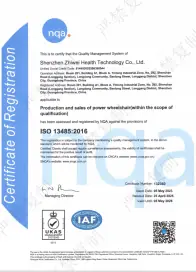
A legitimate manufacturer can produce a clear scan of its ISO 13485 certificate, CE documentation, or UN38.3 test summary on request. If what you get is a low-resolution crop that hides the certificate number or the product scope, ask for the full document — a common dodge is a certificate issued to a different company name or covering a different product category.
Key Takeaway: Verify three things on every certificate: the holder’s name matches your supplier, the scope covers your exact product, and the dates are current. Anything less is a placeholder, not compliance. Our own ISO 13485 certification is renewed on schedule and covers the models we build — hold every supplier to the same standard.
Will the Supplier Let You See the Factory?
No distributor should commit to a manufacturing partner it has never seen. A supplier that refuses a factory walkthrough — in person or by live video — is waving one of the brightest warning flags a supplier can show.
Real factories host visitors routinely. If your walkthrough request is refused outright or postponed month after month, consider what they are protecting — trading companies often pose as factories, and without a walkthrough you cannot tell whether your chairs will be built by the company you are paying.
Key Takeaway: If you cannot fly over, ask for a live video walkthrough of the production floor, warehouse, and QC area. Our factory evaluation guide walks through exactly what to check on such a visit, in person or remote.
Does the Lead Time Keep Changing?
Stable lead times are the mark of a factory that controls its own production. Shifting lead times are a classic warning sign, because they usually signal that your order will be subcontracted, queued behind larger customers, or held up by component shortages the supplier will not admit.
If the same model is “7 days” in January, “30 days” in March, and “it depends” in May, with no explanation, you are not getting production planning — you are getting sales improvisation. Ask what drives the variance: raw material stock, order backlog, or outsourced assembly. For reference, our standard is 7 days after payment for stock models, in writing before any deposit changes hands — your supplier should do the same. Our OEM timeline breakdown shows what a realistic factory schedule looks like.
Key Takeaway: Get the lead time in writing with a start date, and ask what could move it. If the answer changes every time you ask, the timeline is fiction.
Lead time signal
What it usually means
What to ask
Same model, different dates per quote
No production planning
What drives the variance?
Rush fee after deposit
Order was never scheduled
Put the timeline in the contract
Vague “it depends”
Subcontracted production
Who actually builds the chairs?
Written timeline with start date
Controlled production
Nothing — this is the good sign
Is the Price Far Below Everyone Else’s With No Explanation?
Every buyer likes a low price. A quote that undercuts the market by a wide margin with no explanation is not a bargain — it is one of the costliest mistakes a buyer can make.
Watch the pattern where the price stays low but the battery shrinks, the controller brand changes, or the charger becomes “optional.” Compare quotes line by line on identical configurations, and demand an itemized list: frame material, battery capacity and brand, motor power, controller model. If the supplier cannot name the components, the price is a guess — and you will pay the difference later. A real factory can explain exactly what sits inside its price, where component choices change both cost and reliability. See our guide to choosing the right wheelchair joystick controller.
Key Takeaway: No itemized configuration, no comparable quote — walk away from lump-sum prices.
Are the Payment Terms All Upfront With No Milestones?
How a supplier wants to be paid tells you how confident it is in its own delivery. Demanding full payment by T/T before production, with no milestone structure, is a warning sign no serious buyer should accept.
Some suppliers prefer to work “on trust” with a proforma invoice and a chat log. For a single sample that may be acceptable; for a container order it is not. You need a written agreement covering specifications, timeline, warranty terms, and what happens to defective units — signed by both sides before any money moves.
Key Takeaway: Deposit plus balance against shipment, in a signed contract, is the industry norm. Any supplier asking for more upfront should explain exactly what protection you get in return.
Payment structure
Risk to you
Verdict
100% T/T before production
Total — no leverage on delivery or quality
Red flag
Deposit + balance before shipment
Moderate — standard practice
Acceptable
Deposit + balance against B/L copy
Lower — you hold shipping leverage
Good
Signed contract with QC clause
Lowest — defined remedies
Best practice
Does the Warranty Exist Only in the Sales Chat?
Warranty promises are easy to make in a chat window and hard to enforce without a document. Vague warranty terms are a quiet warning sign — quiet because you only discover it when something breaks.
One year on what? The frame, the battery, the motor, the controller — these fail at different rates and cost different amounts to replace. A real warranty names each part and its coverage period: our standard is 36 months on the frame and 12 months each on the battery, motor, and controller, written into every contract. Then ask how a claim actually works: who you contact, what evidence they need, and who pays the freight. See our warranty questions guide for the full list of what to confirm.
Key Takeaway: Get the warranty in writing with per-part coverage periods and a defined claim process. A warranty that lives only in chat messages is a marketing slogan, not a warranty.
How Does the Supplier Handle Your Technical Questions?
The way a supplier answers technical questions reveals whether you are dealing with a manufacturer or a middleman. Evasive or copy-pasted answers are a subtle but telling warning sign.
Ask “what controller is in this model, and is it programmable?” and get back “our controllers are high quality and very reliable.” A factory engineer can name the controller, its current rating, and whether parameters are adjustable. If every question routes through a salesperson and “the engineer is busy” for weeks, you will face the same bottleneck after the sale when a customer reports a fault.
Key Takeaway: Ask two specific technical questions before you order — controller model and battery cell source are good ones. The depth of the answers is a direct measure of the factory behind the quote.
Conclusion
Spotting red flags when choosing an electric wheelchair supplier is not about catching anyone out — it is about protecting your own business before the container is sealed. Vague spec sheets, unverifiable certificates, refused factory visits, shifting lead times, unexplained low prices, all-upfront payment, chat-only warranties, and evasive technical answers each deserve one thing: verification.
Use this list alongside a proper audit process — our factory evaluation guide covers the positive side of the same checklist. And when you are ready to talk to a factory that answers these questions in writing, contact the ZVCARE team: 1-unit MOQ, 7-day lead time after payment, and warranty terms in every contract.
Frequently Asked Questions
How many red flags should make me walk away from a supplier?
There is no magic number, but treat certificate problems, refused factory access, and all-upfront payment as the three that matter most. One of those alone justifies pausing the deal; two together usually means walking away.
Can a trading company be a good electric wheelchair supplier?
It can, if it is honest about being one and adds real value — consolidation, QC inspection, logistics. The red flag is not “trading company” but a trading company posing as a factory. Ask directly who manufactures the chairs; an honest answer earns trust, a dodged one destroys it.
Should I visit the factory in person or is a video tour enough?
A live, unscripted video walkthrough of the production floor, warehouse, and QC area answers most questions for a first order. An in-person visit becomes worthwhile once volumes grow or you move into OEM customization. Either way, seeing the actual production environment — not just a showroom — is the point.
What documents should I request before placing a first order?
At minimum: a detailed spec sheet with measured values, verifiable certificates covering your exact product (ISO 13485, CE documentation, UN38.3 for the battery), a written quotation with itemized configuration, a signed contract with lead time and warranty terms, and the factory’s business license. If any of these is “not available,” treat that as a flag.
How do I verify a supplier’s certificates are genuine?
Check that the certificate holder’s name matches your supplier, that the scope covers your exact product category, and that the dates are current. For ISO certificates you can verify the certification body and certificate number through the body’s public directory. When in doubt, ask the certification body directly — legitimate suppliers expect this.
About Our Company
Since 2015, our company has focused on electric wheelchairs, building practical mobility solutions for distributors and medical stores worldwide.
Our specialized focus has led to collaborations with industry leaders and experts to develop products that truly understand and meet the needs of our discerning clients.