How to Evaluate an Electric Wheelchair Factory Before You Order
October 19, 2026
Learning how to evaluate an electric wheelchair manufacturer before you place your first order is the highest-leverage work a distributor can do. A good-looking sample tells you almost nothing about what 200 units will look like six months from now — but the factory’s certificates, floor discipline, and quality process tell you almost everything. This guide gives you a practical, step-by-step evaluation method built from how the trade actually works: what to check, how to verify it, and which red flags should make you walk away.
Start with the uncomfortable truth. Most sourcing problems distributors blame on “bad luck” — inconsistent welds, dead-on-arrival batteries, manuals with the wrong specs — trace back to a factory that was never properly evaluated. The sample was fine because samples are always fine. Your job before the first purchase order is to look past the sample and judge the system that produces it.
Why Should You Evaluate the Factory Instead of Just the Product?
Because you are not buying a chair; you are buying a production line’s output over the next year. A sample is one unit made with extra care, often by the factory’s best hands. Your real order will be built by the whole line, under schedule pressure, possibly with substitute components if the factory’s supply chain is thin. Evaluating the manufacturer is how you price that risk before it becomes your warranty cost.
Consider the math that matters. If your warranty return rate is 2% versus 6%, that gap comes straight out of your margin — and it was decided on the factory floor long before the chairs reached you. A day spent evaluating the manufacturer properly is cheaper than a single container of chairs you have to repair yourself.
What a sample can tell you — and what it cannot
A sample can tell you about design, comfort, and whether the folding mechanism feels right. It cannot tell you about batch consistency, component sourcing discipline, or whether the factory documents changes. For those answers you need the quality system behind the sample, which is exactly what this guide walks you through checking.
The cost of skipping the evaluation
Distributors who skip factory evaluation usually pay in one of three ways: quality drift across shipments, certification gaps that block customs or tenders, and a supplier who goes quiet when a warranty claim arrives. All three are predictable, and all three are what a structured evaluation prevents. For a broader view of the sourcing journey, see our guide to importing electric wheelchairs from China.
Key Takeaway: A sample shows you one chair; a factory evaluation shows you every chair you will ever receive. Judge the system, not the sample.
Evaluates
Sample testing
Factory evaluation
Design and comfort
Yes
Partially
Batch consistency
No
Yes
Certification validity
No
Yes
Warranty reliability
No
Yes
What Certificates Should an Electric Wheelchair Manufacturer Hold?
Certificates are the first filter, because they are the easiest to check and the hardest to fake well. At minimum, a serious electric wheelchair manufacturer should hold ISO 13485 for its quality management system — the medical-device-specific standard that governs how the factory designs, produces, and traces its products (see the ISO 13485 overview). Ask for the certificate itself, not a logo on a brochure: check the issuing body, the scope, the manufacturer name, and the validity dates.
For the European market, the relevant document is the CE EU Authorized Representative notification for Class I medical devices. Be precise here, because this is where weak suppliers hide: a Class I device does not carry a notified-body certificate — the compliance route is an authorized-representative filing plus the manufacturer’s own declaration. Any supplier waving a “CE certificate” for a Class I wheelchair without an AR filing behind it deserves a follow-up question. Our own notification, for reference, is filed via Humiss (H-YQ-MD-210419012) and names Shenzhen Zhiwei Health Technology Co., Ltd. as manufacturer, covering our five hero models.
Which transport and market certificates actually matter
For lithium-battery models, require the UN38.3 test report and the MSDS — without them, your freight forwarder will refuse the batteries and your shipment stops at the port. For Middle East markets, Saudi SFDA registration is the gatekeeper document. Treat every market’s paperwork as a separate checklist item rather than assuming one certificate covers everything.
How to read a certificate instead of just collecting it
Match the company name on the certificate to the company on your contract, character for character. Check that the product scope actually names electric wheelchairs, not just “medical devices” in general. And check dates — an expired ISO 13485 with “renewal in progress” is a conversation, not a disqualification, but you should know which one you are looking at. You can see how a real certificate set looks on our factory and certifications page.
Key Takeaway: Demand the actual certificate documents — ISO 13485, CE AR notification, UN38.3/MSDS — and verify the name, scope, and dates yourself. Paperwork is the cheapest due diligence you will ever do.
Certificate
What it proves
Verify
ISO 13485:2016
Medical-device quality system
Issuer, scope, validity dates
CE AR notification (Class I)
EU market compliance route
AR filing number, manufacturer name
UN38.3 + MSDS
Battery air/sea transport
Covers the exact battery model
Market registrations (e.g. SFDA)
Destination-market access
Registration status and scope
How Can You Verify a Manufacturer’s Certificates Are Genuine?
Asking for certificates is step one; verifying them is the step most buyers skip. Start with the obvious: request the full PDF, not a screenshot or a cropped photo. Then check the issuing body — ISO 13485 certificates come from accredited registrars (ours is NQA/UKAS), and the registrar’s name should be searchable. A certificate from an issuer you cannot find is worth exactly nothing.
Next, read the scope and dates the way a customs officer would. Our ISO 13485:2016, for example, was renewed on 2026-05-11 and runs to 2029-05-04 — those are the two dates a serious buyer checks first. Confirm the manufacturer name matches your supplier’s legal entity. “Shenzhen Zhiwei Health Technology Co., Ltd.” on the certificate and a different name on the proforma invoice is a discrepancy you resolve before paying, not after.
Why you should ask how the factory handles renewals
Certificates expire, and the interesting question is what the factory does about it. A manufacturer that renews ISO 13485 on schedule and files AR notifications proactively is running a compliance calendar — which tells you the quality system is alive, not decorative. Ask when their next renewal is due and who manages it. The answer reveals more than the certificate itself.
The one question that catches certificate renters
Ask which address the certificate covers, then compare it with the factory address on your video tour. Certificates rented from or shared with another facility are one of the oldest tricks in the book. The name, the address, and the faces on the video call should all belong to the same company.
Key Takeaway: Verify the full certificate PDF: accredited issuer, exact legal-entity name, product scope, and live dates. Then confirm the certificate address matches the factory you actually tour.
Check
How
Red flag
Issuer
Searchable accredited registrar
Unknown or unverifiable issuer
Entity name
Matches contract exactly
Different name on invoice
Dates
Valid through your order cycle
Expired with vague “renewing”
Address
Matches the toured facility
Certificate from another site
What Does the Production Facility Itself Tell You?
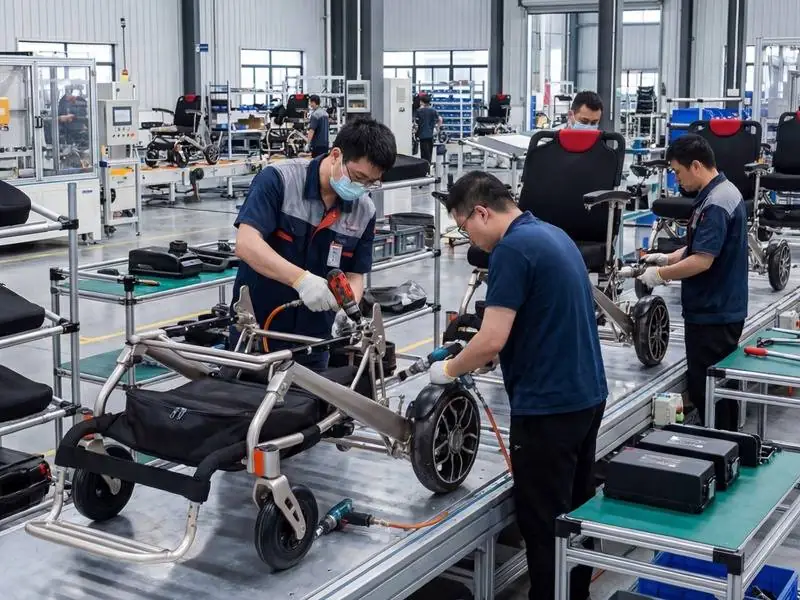
A factory tour — in person or by video — is where paper claims meet reality. You are not judging interior design; you are looking for order. Walk the flow in sequence: incoming materials, welding and frame work, assembly lines, testing stations, finished-goods warehouse, and the loading area. Each zone should look like it has a job and does it every day, not like it was tidied for your call.
Size the facility against your ambitions, honestly. Two production facilities totaling 3,000+ square meters — our own footprint — comfortably supports distributor-scale orders with room to grow; a workshop that can barely stage your first container cannot scale with you no matter how good the sample is. Ask about current capacity utilization, not just total capacity: a factory running at 95% has no room for your urgent reorder.
What to watch on the floor, specifically
Look for dedicated testing stations, not just assembly benches — wheelchairs that leave without electrical and load checks are a warranty claim waiting to happen. Look at the warehouse: finished chairs stored properly, cartons labeled by model and destination, spare parts visibly stocked. And look at the people: a stable crew that knows the product beats a revolving door of temps.
The honest limits of a video tour
Video tours are useful but staged by nature. Insist on a live walkthrough where you can ask the guide to turn the camera — “show me the QC bench,” “open that carton,” “what’s in those boxes.” A factory that redirects you back to the showroom twice is telling you something. Better still, send your own inspector for the first mass-production run; the cost is trivial next to a container.
Key Takeaway: Tour the full production flow live and unscripted, and size the facility against your growth plans. Order on the floor is the visible half of the quality system.
Zone
Healthy sign
Warning sign
Incoming materials
Labeled, organized storage
Mixed piles, no traceability
Assembly
Defined stations, tooling
Chairs built on bare floor
Testing
Dedicated QC benches
No visible testing at all
Warehouse
Labeled cartons, spare parts
Chaos, mixed models
How Do You Judge a Manufacturer’s Quality Control?
Quality control is where good factories separate from good salespeople. Ask for the QC process in writing: what gets inspected at incoming materials, what gets checked during assembly, and what the pre-shipment test covers. Vague answers — “we check everything, very strict” — are the absence of a process wearing a process’s clothes.
Get specific about the tests that matter for wheelchairs. Electrical function across every unit, brake and controller behavior, folding-mechanism cycling, and load checks on the frame — these are the failure points your customers will find if the factory doesn’t. Ask what happens to a failed unit: is it reworked and retested, or quietly packed? The rework loop is the difference between a QC system and QC theater.
Sample discipline: the pilot-run question
Ask how the factory handles the gap between approved sample and mass production. Serious manufacturers run a documented pilot or first-article inspection against the approved sample — dimensions, components, finishes, documentation. If the factory can’t describe this step, your first container is the pilot run, and you’re paying to be the test.
Documentation you should receive with every shipment
A proper manufacturer ships paperwork with product: packing lists tied to your PO, model and serial identification, and test records for the batch. This is also what makes warranty claims resolvable months later. Our incoming inspection checklist walks through what to verify when the container arrives.
Key Takeaway: Demand the QC process in writing — incoming, in-process, and pre-shipment — plus a defined pilot-run step and batch documentation. Vague quality talk is a red flag.
QC stage
Ask for
Good answer sounds like
Incoming
Component inspection records
“Motors and controllers are batch-tested on receipt”
In-process
Assembly checkpoints
“Folding mechanism cycled and signed off per unit”
Pre-shipment
Test reports per batch
“Full function test; failures reworked and retested”
What Should You Ask About Customization and Engineering Support?
Your brand ambitions live or die on the factory’s engineering flexibility. Start by mapping where you sit on the customization spectrum: private labeling (your logo, colors, packaging on a proven model) versus full OEM (structural or electronic changes). Our OEM vs ODM guide maps this spectrum in detail — know which end you’re on before you ask for quotes, because the price and lead time are completely different conversations.
Then test responsiveness with a real request: ask for something concrete — a custom frame color, your logo on the backrest, your manual in the box — and watch how the factory handles it. A capable manufacturer returns artwork proofs, a sampling timeline, and a clear price delta; a weak one returns “no problem” and nothing else. The quality of the response is the quality of the partnership.
Why component depth matters more than the catalog
A factory that controls its key components — controllers, motors, battery systems — can fix problems and customize meaningfully; a pure assembler can only forward your complaint to its own supplier. Ask who makes the controller and the motor, and what happens when a controller fails in the field. Component-level answers signal a real manufacturer.
Engineering changes and your long-term roadmap
Ask how the factory handles engineering change requests after launch: a better joystick, a reinforced armrest, a market-specific battery. You want a documented ECN-style process, not a shrug. Your product line will evolve; the factory’s change discipline decides whether it evolves cleanly.
Key Takeaway: Test the factory with a real customization request and judge the response quality. Component depth and a documented change process separate manufacturers from assemblers.
Ask
Strong signal
Weak signal
Custom color/logo/packaging
Artwork proof + sampling timeline
“No problem” with no detail
Controller/motor source
Named components, in-house fixes
“Our supplier handles it”
Post-launch changes
Documented change process
Ad-hoc, verbal only
What Do MOQ, Lead Time, and Warranty Reveal About a Manufacturer?
Commercial terms are a window into factory confidence. A 1-piece MOQ, for example, tells you the factory is set up for distributor sampling and small trial orders — it removes your risk on the first buy. Pair it with the lead-time question: 7 days after payment for standard models indicates a factory that stocks components and runs a real production rhythm, not one that starts sourcing after your deposit clears.
Warranty terms are the factory’s bet on its own quality, so read them as a signal. A manufacturer offering 36 months on the frame and 12 months each on battery, motor, and controller is pricing its own reliability into the contract. Compare that with suppliers offering 6 months across the board and ask yourself what they know that you don’t. Our full breakdown of electric wheelchair warranty terms shows which questions separate real coverage from marketing.
Spare parts: the warranty question behind the warranty
The warranty is only as good as the parts behind it. Ask whether the factory stocks spare controllers, motors, chargers, and wear parts — and how fast they ship them. A manufacturer that can’t supply a replacement joystick in reasonable time has sold you a warranty it cannot honor. Parts availability is the single most underrated evaluation criterion in this industry.
Payment terms and communication as character evidence
Reasonable payment terms for a first order, clear proforma invoices, and responsive, specific communication are all character evidence. You are choosing a multi-year partner; the sales process is the preview. Slow, vague, or evasive answers now become slow, vague, or evasive warranty support later.
Key Takeaway: Read commercial terms as confidence signals — low MOQ, real lead times, long warranties backed by stocked spare parts. The sales process previews the partnership.
Term
What good looks like
What it signals
MOQ
1 piece for sampling
Distributor-friendly setup
Lead time
~7 days after payment (standard)
Stocked components, real rhythm
Warranty
Frame 36 mo; battery/motor/controller 12 mo
Factory bets on its quality
Spare parts
Stocked, shippable fast
Warranty that can be honored
How Do You Verify a Factory’s Export Experience?
A factory that has never shipped to your region will learn on your order — and tuition is expensive. Export experience shows up in concrete details: which markets the factory already serves, whether its documentation matches those markets’ customs requirements, and how it handles the small frictions of international trade like labeling rules, voltage-region charger variants, and freight forwarder coordination. Ask for the country list, not the client list — reputable factories will name markets freely even when they protect individual buyer identities.
References are the verification layer. A factory with real export history can connect you with distributors in markets similar to yours; a factory with a thin history will stall, deflect, or offer only domestic references. When you do speak to a reference, ask about the first shipment, not the tenth — the first order is where export inexperience shows, in paperwork errors, packing mistakes, and missed vessel cutoffs.
Trade shows and the paper trail
Exhibition history is a useful proxy: factories that exhibit at real industry shows (not just local fairs) have put their products in front of international buyers repeatedly. Ask which shows, and check — photos from the event, not just a logo on the website. The paper trail should match the claims.
The first-shipment test
If references check out, structure your first order as the test it is: small quantity, standard model, normal channel. A factory with genuine export experience will handle documentation, packing, and forwarder handoff without drama. One clean first shipment is worth more than a hundred assurance emails.
Key Takeaway: Verify export experience through markets served, real distributor references, and exhibition history — then let a small first shipment confirm it. The first order is where inexperience shows.
Proof
What to ask
Good sign
Markets served
Country list
Matches your region’s requirements
References
2–3 distributors to call
Offered freely, similar markets
Exhibition history
Which shows, with photos
Real industry events, verifiable
How Should You Run the Final Check Before Placing Your First Order?
By now you have certificates verified, the floor toured, QC documented, customization tested, and terms read. The final check is about people and process risk, and it is deliberately low-tech: place a small paid sample order through the normal channel — not the VIP sample track — and watch how it is handled. Order accuracy, packing quality, documentation, and delivery timing on a 1-piece order predict the 200-piece order better than any brochure.
Then do the reference check most buyers skip. Ask for two or three distributor references in markets similar to yours, and actually call them. Ask about quality drift over time, warranty responsiveness, and how the factory behaved when something went wrong. Every factory looks good when things go right; references tell you about the bad quarter.
The red-flag list: walk away when you see these
No verifiable certificates. A factory address that doesn’t match the paperwork. Refusal to do a live, unscripted video tour. “No problem” answers to every technical question. Pressure for large deposits on a first order. Any one of these is enough to pause; two together are enough to walk away. There are plenty of real manufacturers — keep looking.
Put the evaluation on a calendar, not a feeling
A thorough first evaluation takes one to two weeks: document review, live tour, sample order, reference calls. That is not slow; that is the actual job. Rushing it to catch a selling season is how distributors end up with a container of problems arriving exactly when they can least afford them. For custom electric wheelchair MOQ planning alongside your evaluation timeline, keep the trial order small and the checklist strict.
Key Takeaway: Finish with a normal-channel sample order and real reference calls. One to two weeks of structured evaluation beats a season of firefighting.
Final check
Do this
Tells you
Trial order
1 pc via normal channel
Real order handling quality
References
Call 2–3 distributors
Behavior when things go wrong
Timeline
1–2 weeks, structured
Whether you’re rushing the job
Conclusion
Knowing how to evaluate an electric wheelchair manufacturer comes down to a repeatable checklist: verify the certificates (ISO 13485, CE AR notification, UN38.3/MSDS), tour the facility live and unscripted, get the QC process in writing, test customization responsiveness, read the commercial terms as confidence signals, and finish with a normal-channel trial order plus reference calls. Do this once, properly, and every order after it gets easier — because you chose a partner, not just a price.
If you want to see what a verifiable manufacturer looks like in practice: we are Shenzhen Zhiwei Health Technology Co., Ltd., building the ZVCARE brand since 2015 across two facilities totaling 3,000+ square meters. Start with a 1-piece trial order, standard models ship in 7 days after payment, and every chair carries our unified warranty — 36 months on the frame, 12 months each on battery, motor, and controller — backed by stocked spare parts. Contact our team and put the checklist above to work on us.
Frequently Asked Questions
How long does it take to evaluate an electric wheelchair manufacturer properly?
Plan one to two weeks: a few days for document review and verification, a live factory tour, a small paid sample order through the normal channel, and two or three reference calls. Rushing the process to catch a selling season is the most common way distributors inherit someone else’s quality problems.
Should I visit the factory in person or is a video tour enough?
A live, unscripted video tour where you direct the camera covers perhaps 80% of what a visit does, and it is how most evaluations start. For your first mass-production run, send your own inspector or a third-party QC agent — the cost is trivial next to a full container, and nothing disciplines a production line like a scheduled inspection.
What is the single most important certificate to check?
ISO 13485:2016, because it governs the entire quality management system rather than a single product test. Check the accredited issuer, the exact legal-entity name, the product scope, and the validity dates. Product-level documents like the CE AR notification and UN38.3 come next, matched to your target markets.
For the full picture, our buyer’s guide on ISO 13485 explains what the certificate actually guarantees and how to read one like an auditor.
Can one manufacturer serve multiple markets with different certification needs?
Yes, provided the factory treats each market’s paperwork as a separate workstream — CE AR notification for Europe, SFDA registration for Saudi Arabia, UN38.3/MSDS for battery transport everywhere. Ask which markets they currently ship to and which registrations they hold; a factory already serving your region has solved problems you haven’t met yet.
What should I do if a factory refuses to share certificate documents?
Treat it as a full stop, not a negotiation point. Legitimate manufacturers share certificate PDFs routinely — it is standard practice in B2B medical-device trade. Refusal usually means the documents don’t exist, don’t cover the products, or belong to someone else. Keep looking; there are plenty of verifiable factories.
About Our Company
Since 2015, our company has focused on electric wheelchairs, building practical mobility solutions for distributors and medical stores worldwide.
Our specialized focus has led to collaborations with industry leaders and experts to develop products that truly understand and meet the needs of our discerning clients.