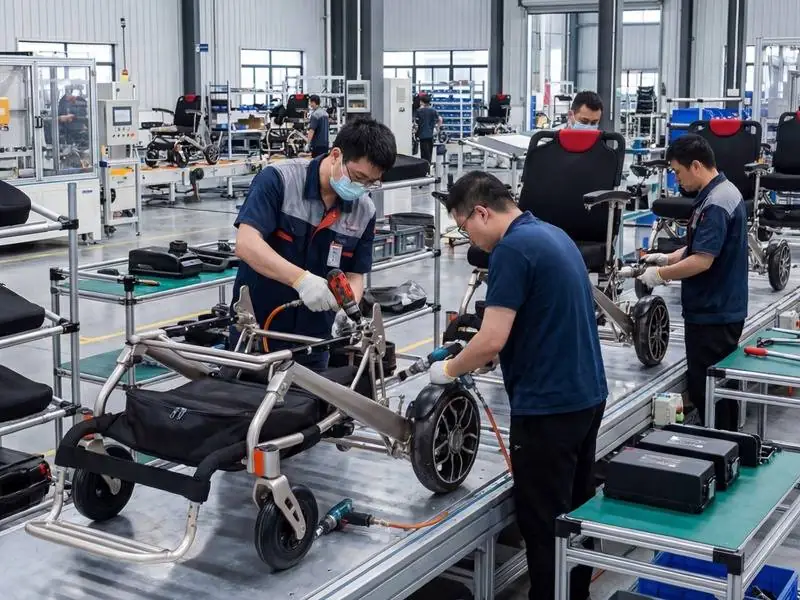
If you are asking what is the MOQ for custom electric wheelchairs, you are asking the question that decides whether your import plan is realistic. MOQ — minimum order quantity — is the smallest order a supplier will accept, and in the wheelchair trade it ranges from a single unit to fifty or more depending on who you buy from and how much customization you want. This guide explains how MOQ works in practice, what drives it up or down, and how to plan your first order without tying up cash you do not need to spend. It is written from inside a real factory — Shenzhen Zhiwei Health Technology Co., Ltd., building electric wheelchairs since 2015 — so the numbers are the ones we actually quote.
What does MOQ actually mean for electric wheelchair orders?
MOQ is the supplier’s break-even line: below it, setting up tooling, sourcing parts, and running quality checks costs more than the order is worth. For a distributor, MOQ determines your starting inventory investment, your cash tied up in stock, and how fast you can test a new model in your market before committing deeper.
A low MOQ lets you validate demand with real sales data instead of guesses. A high MOQ forces you to bet on a model before your customers have seen it. Neither is automatically better — the right MOQ depends on where you are in your buying cycle.
Why MOQ is quoted in units, sets, or pieces
Suppliers quote MOQ in whatever unit fits their packing: “units” for complete chairs, “sets” when the chair ships with a battery and charger as a bundle, “pieces” on marketplace listings that may or may not include accessories. Always confirm what one unit includes before comparing two MOQs — a 2-set MOQ that bundles batteries can be cheaper per chair than a 1-unit MOQ that does not.
The difference between MOQ and order increments
MOQ is the floor; order increments are the steps above it. Some suppliers accept 1 unit minimum but only in multiples of 5 after that. Ask both questions upfront so your reorder math stays clean.
Key Takeaway: MOQ is the supplier’s break-even point, not a sales tactic. Confirm what one unit includes and whether reorders must follow set increments.
Term
What it means
Why it matters to you
MOQ
Smallest acceptable order
Sets your minimum inventory investment
Unit / set / piece
How the supplier counts
Affects true per-chair cost comparison
Order increment
Step size above MOQ
Determines your reorder flexibility
Trial order
First small test order
Validates demand before scaling
What is a typical MOQ for custom electric wheelchairs?
Across the market, advertised MOQs for electric wheelchairs cluster in four bands: 1–2 units from factories courting new distributors, 5–10 units on marketplace listings, 10–50 units for standard wholesale, and 50+ units when the order involves custom branding or tooling changes. The spread exists because “custom” means different things to different sellers.
Our own MOQ is 1 unit — including for trial orders with OEM touches like your logo placement and packaging. We can do this because the customization we offer (colors, logo placement, packaging) uses existing tooling rather than new molds. That distinction is the whole story behind MOQ differences.
Marketplace MOQs vs factory-direct MOQs
Marketplace listings (Alibaba, Made-in-China, ecer.com) typically show MOQs of 2 sets, 2 pieces, 5 units, or 10 pieces. These sellers are often trading companies reselling factory output, so their MOQ reflects the factory’s MOQ plus their own margin buffer. Buying factory-direct removes that layer — which is why a real manufacturer can quote 1 unit while a reseller of the same chair quotes 5.
When 50+ MOQ is legitimate
A 50-unit MOQ is reasonable when your customization requires new tooling: a unique frame color outside the standard palette, a molded logo badge, or custom-printed cartons in your brand design. Tooling has a fixed cost that only makes sense spread across volume. Be suspicious of high MOQs attached to purely cosmetic changes that need no new tooling.
Key Takeaway: Typical MOQs run 1–2 units (factory-direct) to 50+ (custom tooling). If a high MOQ comes with no tooling justification, you are likely talking to a middleman.
Supplier type
Typical MOQ
Customization offered
Why the MOQ differs
ZVCARE (factory-direct)
1 unit
Colors, logo placement, packaging
Own tooling, no middleman margin
Marketplace listing
2–10 units/pieces
Limited to stock options
Reseller adds buffer to factory MOQ
Standard wholesaler
10–50 units
Standard models only
Volume pricing model
Custom tooling order
50+ units
New molds, unique branding
Fixed tooling cost spread over volume
Why do factories set MOQs in the first place?
Every production run has fixed setup costs: pulling materials, calibrating jigs, running first-article inspection, and booking QC time. On a single chair these costs are real but manageable for a factory with steady volume; on a custom run with unique specs, they can exceed the margin on a handful of units.
MOQ also protects the buyer indirectly. A factory that accepts uneconomically small custom runs will cut corners somewhere — usually in QC or after-sales support. A sensible MOQ means the factory can afford to do your order properly.
Setup costs buyers never see
Changeover on a welding jig, a paint-line color switch, and a fresh QC protocol each consume labor hours before the first sellable unit comes off the line. For standard colors these are amortized across hundreds of units; for your custom spec they land on your order alone.
How MOQ relates to production scheduling
Factories slot orders into production calendars. A 1-unit trial order fits into gaps between larger runs; a 50-unit custom order gets its own dedicated slot with a confirmed start date. Neither is “better” — they are different scheduling products, which is why lead times differ.
Key Takeaway: MOQ covers real setup costs, not greed. A factory with honest MOQs is telling you what it costs to do your order right.
Cost driver
Standard order
Custom order
Tooling/jig setup
Shared across volume
Dedicated to your spec
QC protocol
Existing checklist
New first-article inspection
Scheduling
Fits between runs
Dedicated production slot
Per-unit impact
Negligible
Significant below ~20 units
How does MOQ affect your unit price?
Unit price falls as quantity rises, but not in a straight line — the curve is steepest between 1 and 20 units and flattens after that. The first few units absorb all the setup cost; beyond roughly 50 units you are mostly paying materials and labor, so further discounts shrink.
For planning purposes, expect a single-unit trial to cost 15–30% more per chair than a 20-unit order of the same spec. That premium buys you market validation without inventory risk, which is usually the cheaper lesson.
The 1-unit premium vs the 50-unit discount
A 1-unit order carries the full setup cost on one chair. A 50-unit order spreads it fifty ways and may unlock bulk component pricing from the factory’s own suppliers. The gap between those two prices is the real cost of flexibility — budget for it rather than resenting it.
When to accept a higher per-unit price
Accept it when you are testing a new market, a new model, or a new supplier relationship. The premium on 2–5 trial units is trivial compared to the cost of 50 unsold chairs in your warehouse. Scale the order after sell-through data, not before.
Key Takeaway: Price drops fastest between 1 and 20 units. Pay the small-order premium gladly when you are still validating demand — it is cheaper than unsold inventory.
Order size
Relative unit price
Best for
1 unit (trial)
Highest (+15–30%)
Market testing, samples
5–10 units
Moderate premium
First stocking order
20–50 units
Near standard
Proven sellers
50+ units
Lowest
Custom tooling runs
Can you order just one unit as a sample or trial?
Yes — and you should insist on it before any volume commitment. A 1-unit trial order lets you check build quality, test the folding mechanism, verify battery performance, and photograph the actual product for your catalog instead of relying on supplier renders.
We accept 1-unit trial orders as standard policy, with the same 7-day lead time after payment as larger orders. The chair you receive is production quality, not a hand-built prototype — what you test is what your customers will get.
What to check when your trial unit arrives
Unfold and fold it ten times, check weld consistency at the joints, run the battery from full to empty under load, and test the controller response at low speed. Photograph everything. Any issue at unit one will repeat at unit one hundred, so this is your cheapest quality gate.
Sample cost vs sample value
Some suppliers charge a “sample fee” several times the unit price, credited against your first bulk order. That model made sense when samples were hand-built; for production-line trial units it is mostly margin. A factory confident in its product prices the trial unit near the regular unit price.
Key Takeaway: Always trial one unit first. Test it hard — folding cycles, welds, battery range, controller feel — because flaws scale with volume.
Trial check
How to test
What failure tells you
Folding mechanism
10 fold/unfold cycles
Hinge or latch design flaw
Weld quality
Visual + touch at joints
Production consistency risk
Battery range
Full discharge under load
Inflated spec claims
Controller
Low-speed maneuvering
Electronics quality
What counts as “custom” vs standard when it comes to MOQ?
“Custom” covers a spectrum, and where your request falls on it decides your MOQ. At one end: picking a standard color and adding your logo sticker — no tooling change, minimal MOQ impact. At the other: a unique frame geometry or proprietary controller firmware — new tooling, real MOQ.
Most distributor requests land in the middle: standard model, your choice of color from the factory palette, logo placement on the frame or packaging, and your branded carton. This is the OEM sweet spot, and it is why our MOQ stays at 1 unit for exactly this package.
The three tiers of customization
Tier 1 (no MOQ impact): color selection from standard palette, logo stickers or plates, branded packaging using existing carton sizes. Tier 2 (moderate MOQ): custom carton printing, unique color outside the palette, embroidered seat covers. Tier 3 (high MOQ): new molds, frame geometry changes, custom electronics.
Questions that reveal your true tier
Ask the supplier: “Does my request need new tooling?” and “Which of my changes affect the production line versus just the finishing station?” Honest answers place you in the right tier; vague answers suggest the MOQ is padded.
Key Takeaway: Most distributor OEM needs are Tier 1 — no new tooling, no MOQ penalty. Pin down your tier before accepting any MOQ quote.
Tier
Examples
Tooling needed
MOQ impact
Tier 1 — finishing
Colors, logo plate, packaging
None
None (our 1-unit MOQ applies)
Tier 2 — light custom
Custom print, unique color
Minor setup
10–20 units typical
Tier 3 — deep custom
New molds, frame changes
New tooling
50+ units typical
How do OEM customization options change the MOQ?
Each customization you add moves you along the cost curve, but not equally. Color choice from our standard palette — matte black, navy, burgundy, silver — changes nothing about MOQ because the paint line already runs those colors daily. Your logo as an engraved plate or sticker likewise adds minutes, not days.
Packaging customization is the one buyers underestimate. Switching to your branded carton is straightforward if we use our standard carton dimensions; designing a new carton size triggers structural testing and a higher MOQ. Keep your branding on standard-size cartons and the MOQ stays put.
Colors, logos, and packaging — what each costs you in MOQ terms
Colors: zero MOQ impact within the standard palette. Logo: zero impact for plates or stickers, moderate for molded badges. Packaging: zero impact for branded standard cartons, real impact for new carton structures. Knowing this lets you design your OEM package around the MOQ you want.
The OEM package that keeps MOQ at 1 unit
Our standard OEM bundle — your color choice, logo placement on frame and carton, your brand on standard packaging — is engineered to need no new tooling. That is a deliberate product decision: we want distributors testing our chairs, not waiting to afford them.
Key Takeaway: Design your OEM spec around standard tooling and your MOQ stays at 1 unit. Every request that needs new tooling should earn its MOQ with real volume behind it.
OEM option
MOQ impact
Notes
Standard palette colors
None
Paint line already runs these
Logo plate / sticker
None
Applied at finishing station
Branded standard carton
None
Your art, our carton size
Custom carton structure
Moderate–high
Needs structural testing
Molded logo badge
Moderate
New mold required
Should you negotiate MOQ with your supplier?
Yes, but negotiate the right thing. Haggling a factory from 50 units to 40 on a custom-tooling order just squeezes their margin and risks QC shortcuts. Instead, negotiate the structure: ask what customization you can drop to reach a lower tier, or whether a two-stage order (trial units now, balance on sell-through) works.
The most productive MOQ conversation starts with your sales forecast, not a demand. “We expect to sell 200 units this year, starting with a 10-unit test” gives the factory a reason to flex. “Your MOQ is too high” gives them nothing to work with.
What factories can flex vs what they cannot
Flexible: payment staging, delivery splitting (ship 10 now, 40 later), trial-unit pricing, packaging options. Not flexible: tooling cost recovery, QC time, raw material minimums from their own suppliers. Aim your negotiation at the flexible list.
The two-stage order structure
Propose it explicitly: Stage 1 is your trial/stocking quantity at the higher per-unit price; Stage 2 is the balance at volume pricing, triggered by your sell-through milestone. Serious factories prefer this to a single inflated first order — it signals a real distribution plan.
Key Takeaway: Negotiate structure, not just numbers. A two-stage order with sell-through triggers beats a haggled single MOQ every time.
Negotiation lever
Factory flexibility
Your ask
Unit count
Low (cost-driven)
Reduce via lower customization tier
Payment staging
High
Deposit + balance on shipment
Split delivery
High
Ship trial now, bulk later
Trial pricing
Medium
Near-regular price for 1–2 units
What hidden costs appear when you order below MOQ?
When a supplier agrees to go below their stated MOQ, the cost does not vanish — it relocates. Common landing spots: a per-unit surcharge, stripped-down QC (spot check instead of full inspection), slower scheduling (your small order waits for a gap), or excluded after-sales support.
None of these are scams; they are the economics of small runs made visible. The problem is when they are not disclosed. Ask directly: “If we order below MOQ, what changes — price, QC, lead time, or warranty terms?”
The surcharge vs the shortcut
A transparent surcharge (pay 20% more per unit) is honest and often worth it. A hidden shortcut (same price, half the QC) is dangerous because you cannot see it until customers complain. Always prefer the supplier who prices the small order openly over the one who matches the big-order price suspiciously easily.
How to protect a below-MOQ order
Put the QC standard in writing regardless of order size, request the inspection report with photos, and keep the warranty terms identical to volume orders. If the supplier resists any of these on a small order, that tells you everything about their priorities.
Key Takeaway: Below-MOQ costs relocate, they do not disappear. Insist on written QC and warranty terms at any quantity — resistance is a red flag.
Hidden cost
Where it lands
How to surface it
Setup cost
Per-unit surcharge
Ask for the small-order price list
QC time
Reduced inspection
Demand the inspection report in writing
Scheduling
Longer wait
Get a committed ship date
Support
Excluded warranty
Confirm warranty terms apply at any qty
How do you plan your first order around MOQ?
Start from your market, not the supplier’s catalog. Estimate 60–90 days of realistic sales for one model — not your hope, your pipeline. That number, rounded to the supplier’s increment, is your first order. If it falls below MOQ, use the trial-unit path and reorder on data.
For most new distributors, the sequence that works is: 1–2 trial units (validate quality and get catalog photos), then a 10–20 unit stocking order (cover the first sales cycle), then volume reorders driven by sell-through. Each stage answers the question the next stage needs.
The 1-10-50 progression
One unit proves the product. Ten units prove the market. Fifty units prove the business. Skipping stages feels faster but removes the checkpoints that catch bad bets early. Factories respect buyers who stage orders — it signals professionalism and predicts a long relationship.
Budgeting beyond the unit price
Your first-order budget is not units × price. Add freight (sea vs air changes everything for battery models — see our import guide), import duties for your HS code, warehousing, and a warranty reserve of 2–3% for spare parts. The MOQ conversation is really a cash-planning conversation.
Key Takeaway: Plan orders from your sales forecast outward: 1 unit to validate, 10–20 to stock, volume on sell-through. Budget freight, duties, and warranty reserve on top of unit cost.
Stage
Quantity
Purpose
What it proves
Trial
1–2 units
Quality + catalog photos
Product is real
Stocking
10–20 units
First 60–90 days of sales
Market exists
Volume
50+ units
Scale pricing
Business works
FAQ
Can I really order just 1 electric wheelchair from a factory?
From us, yes — our MOQ is 1 unit including OEM touches like your logo and packaging, with the same 7-day lead time after payment as larger orders. Across the market it varies: marketplace sellers typically want 2–10 units, and custom-tooling orders legitimately need 50+. Always confirm whether the 1-unit price includes your customization or carries a small-order surcharge.
Does a lower MOQ mean lower quality?
No — MOQ reflects production economics, not quality standards. A factory offering 1-unit MOQ on standard-tooling OEM work is simply structured for distributor testing. What matters is whether QC and warranty terms stay identical at any quantity. Ours do: frame 36 months, battery/motor/controller 12 months each, regardless of order size.
How long does a 1-unit trial order take?
Our lead time is 7 days after payment for any quantity, trial unit included — the chair comes off the same production line with the same QC checklist. Add freight time on top: express air runs about a week, sea freight several weeks depending on your port. Battery models ship under UN38.3 rules either way.
What payment terms apply to small trial orders?
T/T (bank transfer) is standard for trial orders — typically 100% upfront or a deposit with balance before shipment. L/C (letter of credit) becomes practical at larger volumes where bank fees make sense. For payment security on first orders, see the payment section of our import guide.
Should I consolidate models to meet MOQ?
Only if the models share your market. Consolidating two slow sellers to hit a volume discount creates the inventory problem MOQ discipline is meant to avoid. Better: trial each model at 1 unit, then scale the winner. Your warehouse will thank you.
Conclusion
MOQ is not a barrier — it is information. A 1-unit MOQ tells you the factory is set up for distributor testing; a 50-unit MOQ tells you tooling is involved; anything in between tells you where your customization lands on the cost curve. The distributors who do well are the ones who stage their orders (1 to validate, 10–20 to stock, volume on sell-through) and negotiate structure instead of just price.
If you are ready to test the market, start where the risk is lowest: one unit, your branding, production quality, 7 days after payment. Browse the EW1000 and EW100 to pick your trial model, or talk to us about your OEM spec — colors, logo placement, and packaging are all on the table at 1 unit.
Importing for the first time? U.S. Customs publishes a basic importing guide covering duties, documentation, and compliance — useful background before you place any international order.
Since 2015, our company has focused on electric wheelchairs, building practical mobility solutions for distributors and medical stores worldwide.
Our specialized focus has led to collaborations with industry leaders and experts to develop products that truly understand and meet the needs of our discerning clients.