A proper folding electric wheelchair travel guide starts from one fact: the best travel chair is not the lightest on paper, it is the one you can fold, lift, charge, and repair away from home without drama. This guide covers every travel scenario except the airport — car trips, trains, cruises, hotels, rain, stairs, and insurance — from the perspective of a manufacturer shipping folding chairs to distributors on three continents.
One line on flying, the question we get most: our chairs are designed for air travel (airline approval required) — battery rules, carrier approvals, and check-in steps are in our airplane guide, and the US DOT summarizes carrier obligations for passengers with disabilities.
Will a folding electric wheelchair fit in a car trunk?
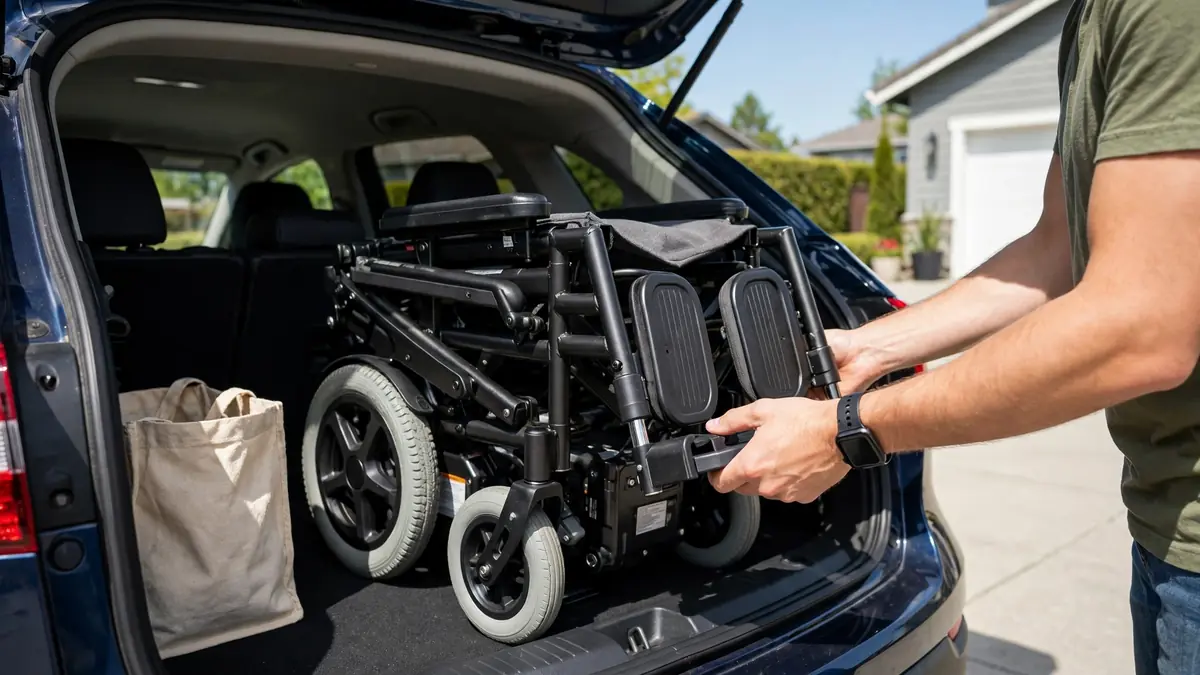
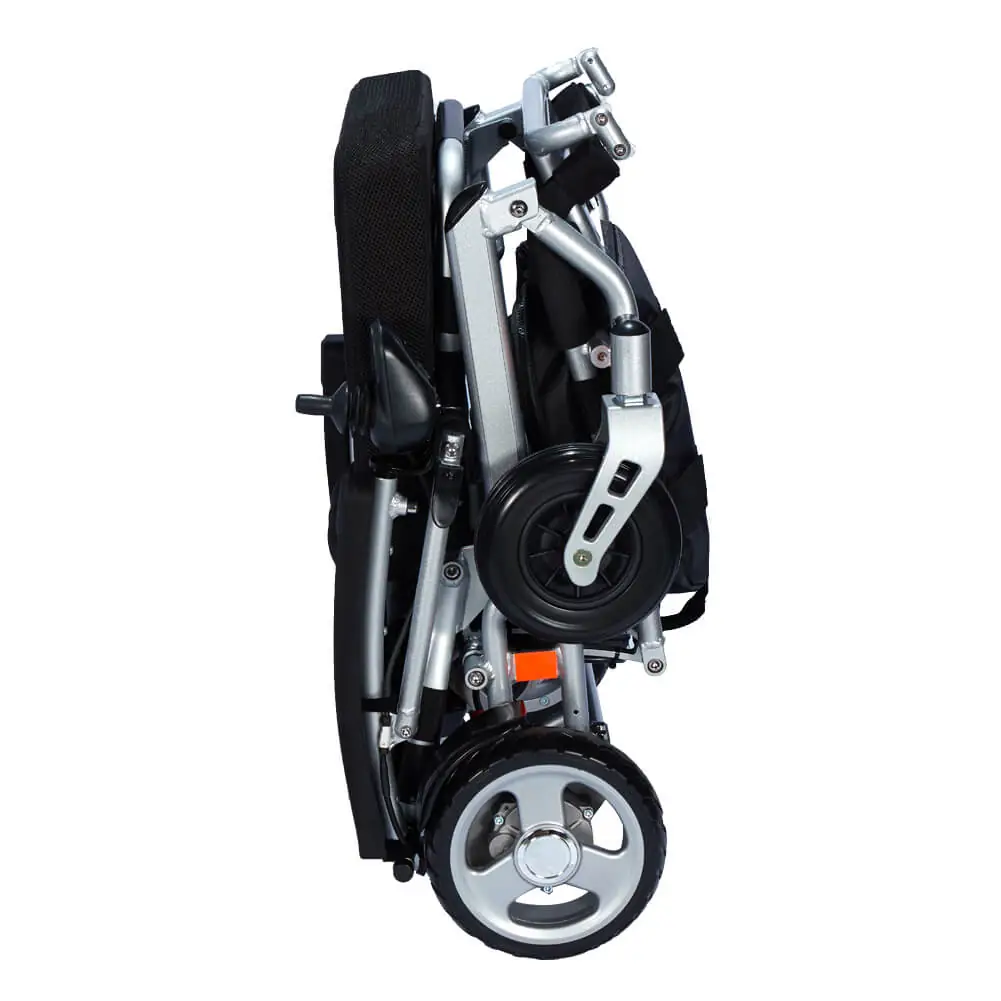
Measure the trunk, not the chair. The EW1000 folds to 73 × 39 × 71 cm at 15 kg including the battery; the EW100 folds to 70 × 58 × 33 cm at 23 kg. Both fit a standard sedan trunk on paper, but the 8 kg difference decides whether one person lifts the chair in comfortably or needs help.
Measure the trunk’s opening height and depth, not just its volume — the folded chair goes in at an angle, and a narrow trunk lip defeats a chair that “should” fit. Fold the chair fully, lock the latch, and test-load once at home rather than discovering a mismatch in a hotel parking lot. Remove the joystick first if it protrudes; it is the part most often snapped during loading.
One-person lift or two-person lift?
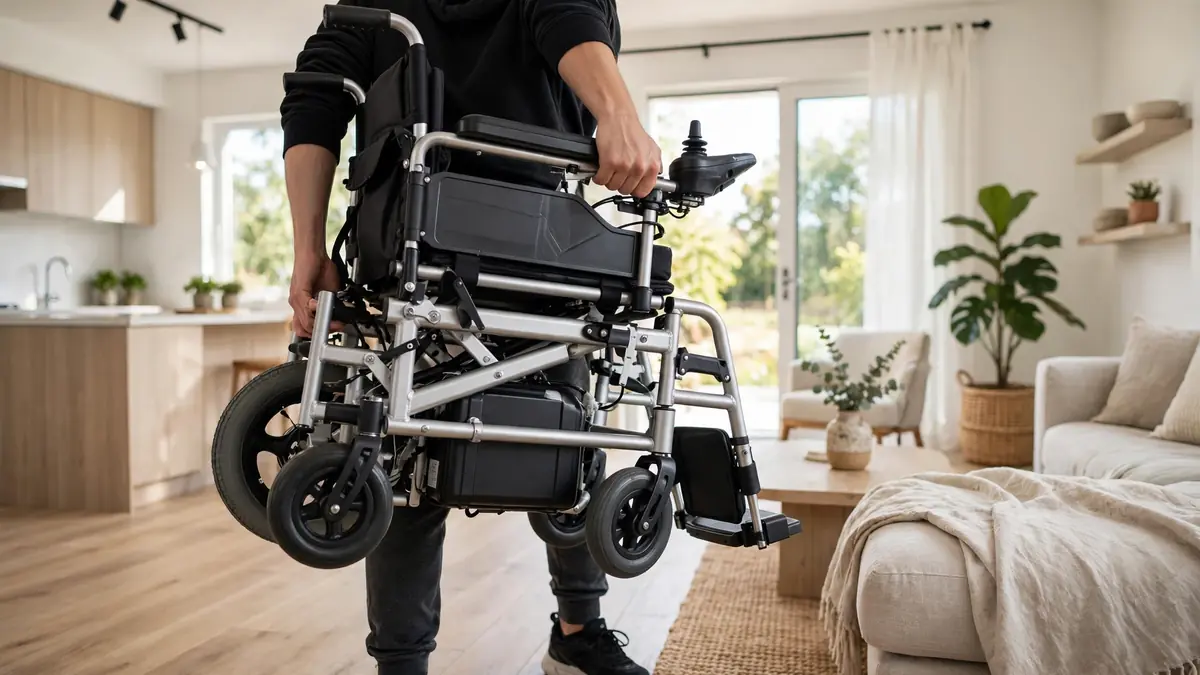
At 15 kg, most adults lift the EW1000 into a trunk alone. At 23 kg, the EW100 is a comfortable two-person lift or a careful one-person job. This is where chair weight stops being a spec-sheet number and becomes a daily-travel decision.
Key Takeaway: Folded dimensions decide whether the chair fits; total weight decides whether the trip stays pleasant. Test-load once at home.
Travel factor
EW1000
EW100
Weight (with battery)
15 kg
23 kg
Folded size (cm)
73 × 39 × 71
70 × 58 × 33
One-person trunk lift
Comfortable
Borderline — plan for help
What about trains and subways?
Folding electric wheelchairs are the easiest powered mobility device to take on rail. Folded, most operators treat the chair as luggage — no special booking, no cargo hold. Unfolded and ridden, rules vary by system and time of day, so check the operator’s policy page before you go, not at the turnstile.
High-speed rail and intercity trains
Book the accessible coach or the luggage area near the doors, and arrive 20 minutes early so staff can deploy the boarding ramp. Most high-speed operators (China’s 12306, European national railways) let you reserve station assistance in advance — use it, because platform gaps and elevator detours are hard to discover in a hurry. The folded footprint slides into overhead and end-of-car luggage racks.
Subways and city metros
Subways are where folding pays off most: a folded chair goes through the wide gate like a stroller and never blocks the aisle. Ride unfolded only where the system explicitly allows powered wheelchairs, and keep the joystick powered off while standing in a packed car — an accidental nudge in a crowd is the classic subway mishap.
Key Takeaway: Folded = luggage, unfolded = regulated. On rail, fold early, book assistance in advance, and never improvise at the gate.
Rail scenario
Folded chair
Unfolded chair
High-speed rail luggage rack
Fits, no booking needed
Needs accessible-coach booking
Station assistance
Usually unnecessary
Book in advance
Subway rush hour
Treated as luggage
Often restricted — check rules
Can you take it on a cruise ship?
Yes — cruises are among the friendliest travel modes for folding electric wheelchair users, but the cabin makes or breaks the trip. Standard cabins have narrow doors and tight bathrooms; book an accessible cabin with a wider entry and roll-in shower, and confirm the door width in writing before you pay.
Charging and storage on board
Your cabin is your charging station — bring the charger and a plug adapter for the ship’s socket type, and charge overnight. Never charge in the hallway; cruise lines prohibit it and fire regulations are strict. Fold the chair at night to free floor space; an unfolded power chair in a standard cabin leaves almost no room to move.
Shore excursions and tender boats
Some ports use tender boats (small shuttle craft) that cannot safely load a power wheelchair, folded or not. Check each port’s accessibility notes on the cruise line’s website before booking the sailing. For accessible ports, book ship-organized accessible excursions rather than independent ones — the ship’s tour desk knows exactly which buses have lifts.
Key Takeaway: Book the accessible cabin first, confirm tender-boat ports before you pay, and treat your cabin as the nightly charging base.
Cruise checkpoint
What to confirm
Cabin
Accessible cabin, door width confirmed in writing
Charging
In-cabin overnight, plug adapter for ship sockets
Ports
Tender-boat ports identified before booking
Excursions
Ship-organized accessible tours, not independent ones
How do you charge it away from home?
Charging on the road is mostly a logistics problem. Bring the charger that matches your battery chemistry — our travel chargers come in 2A/5A versions for lithium and lead-acid packs, and the wrong one shortens battery life. Charging time depends on battery capacity, so plan for an overnight charge the way you would for a phone. If your itinerary includes a flight, airlines will ask for the battery test report — the full procedure is in our airplane guide.
The hotel-room charging routine
Request a ground-floor or elevator-accessible room and charge inside the room, never in the hallway — most hotels prohibit hallway charging as a fire-safety rule. Bring a short extension cord and a plug adapter; hotel outlets hide behind furniture, and the cable must reach without tension. A full overnight charge beats a rushed top-up — lithium packs prefer complete, calm cycles, as our battery comparison guide explains.
When there is no outlet nearby
Carry the charger in the day bag, not in checked luggage — the charger is the one part you cannot improvise. On long driving days, a 12V car inverter can run the standard charger from the cigarette-lighter socket; confirm the inverter’s wattage covers the charger’s draw first. For multi-day trips, a spare battery charger in the luggage is cheap insurance against the most common travel failure: a charger left at the last hotel.
Key Takeaway: Charge overnight in the room, carry the charger in the day bag, bring plug adapters — most “charging problems” on trips are logistics, not electronics.
Charging scenario
Setup
Hotel room
Overnight charge, extension cord + plug adapter
Long driving day
12V car inverter, charger wattage confirmed
Backup plan
Spare charger in luggage, never in checked bags
What should you pack for the trip?
Pack for the chair the way you pack a first-aid kit: not because failures are likely, but because a small problem far from home becomes a big one. The list fits in a backpack: the charger plus a plug adapter, a basic multi-tool with hex keys, a cleaning cloth, and a printed copy of the battery test report (UN38.3) in case any carrier or hotel asks. Add the purchase receipt or a photo of the serial number — proof of value you will need on the spot if the chair is damaged or lost.
The 5-minute pre-trip check
Before every trip: tire pressure and tread, brake response, joystick calibration, folding latch engagement, and a full charge. Tighten any bolt that has worked loose — road vibration finds every weak fastener. Five minutes at home prevents the two most common roadside issues: a latch that will not lock and a joystick that drifts.
Spare parts worth carrying
For trips longer than a week, pack a spare charger and a spare joystick knob or controller cover — the parts most often damaged in handling, small enough to carry. Full spare-parts stock is your supplier’s job, not your suitcase’s; confirm before ordering that the factory stocks replacements for your exact model. We keep full spare-parts stock for every model shipped in the last five years, because a travel breakdown with no parts source ends the trip.
Key Takeaway: Charger, tools, cloth, battery report, receipt — five small items that solve nearly every travel-day problem.
Pack item
Why it matters
Charger + plug adapter
Cannot be improvised on the road
Multi-tool with hex keys
Vibration loosens bolts
Battery test report (printed)
Carriers and hotels may ask
Purchase receipt / serial photo
Proof of value if damaged or lost
What about rain and bad weather?
The rule is simple: rain on the move is okay, standing water is not. Wipe the joystick, charging port, and connectors dry after riding in rain, and never ride through water deep enough to reach the motor housings. When parked outdoors, throw a cheap rain cover over the joystick and seat — it prevents the most common weather damage: water seeping into the controller.
After the rain stops
Dry the chair before folding it — folding a wet chair traps moisture in the hinges and latches, where corrosion starts. Check the charging port is fully dry before plugging in; charging with a wet connector is the one rain-related mistake that can actually damage the electronics. If the chair was soaked, air-dry it unfolded overnight rather than packing it straight into the car.
Planning around the forecast
Plan indoor alternatives for heavy-rain days — museums, malls, and hotel rest days are part of a good trip anyway. A poncho keeps the rider dry, but the chair still needs its own cover when parked. In hot climates, avoid leaving the chair in a closed car in direct sun; heat is harder on batteries and electronics than rain is.
Key Takeaway: Ride in rain, avoid standing water, always dry before folding and before charging.
Weather situation
Do
Don’t
Light rain while riding
Keep moving, wipe down after
Leave joystick uncovered when parked
Heavy rain / puddles
Wait it out or take cover
Ride through deep standing water
After exposure
Dry fully, then fold
Fold wet; charge with wet connector
How do you handle stairs and escalators?
The safety rule is absolute: never ride an occupied power wheelchair on an escalator. Tip-overs on escalator steps cause serious injuries every year, and every manufacturer and transit authority prohibits it. Use elevators; where a station has none, ask staff for the accessible route or stair-climbing assistance service.
When stairs are unavoidable
Fold the chair and carry it — exactly the scenario folding chairs were invented for. At 15 kg, one adult carries the folded EW1000 up a flight of stairs; at 23 kg, the EW100 is a two-person carry. Remove the battery first if it detaches easily and carry it separately — it lightens the load and protects the most expensive component from a drop.
Ramps and curbs
Short ramps and low curbs are fine to ride: approach straight on, at low speed, with the anti-tip wheels doing their job. Never attempt a steep or wet ramp at an angle — that is how chairs tip sideways. When in doubt, fold and carry; a five-minute carry beats a damaged chair and a ruined day.
Key Takeaway: Escalators are never an option with a rider on board. Fold and carry on stairs; ride ramps straight and slow.
Obstacle
Correct approach
Escalator
Never ride occupied — use elevator or fold and carry
Staircase
Fold, remove battery if easy, carry (1–2 people by weight)
Steep or wet ramp
Do not ride at an angle — fold and carry instead
Should you buy travel insurance for the chair?
For any trip where the chair travels out of your sight — a cargo hold, a ship’s luggage room, a bus compartment — the answer is yes. A folding electric wheelchair is a multi-thousand-dollar medical device, and standard travel insurance often caps electronics or excludes mobility equipment entirely. Read the fine print for “mobility aids” or “medical equipment” before you buy, and declare the chair’s value explicitly.
What the policy should cover
Three things: damage in transit (the classic handling claim), theft from a hotel room or vehicle, and emergency rental reimbursement so a breakdown does not strand you. Keep the purchase receipt and a photo of the serial number — insurers and carriers both ask for proof of value, and “I think it cost about…” settles nothing.
When you can skip it
For pure car trips where the chair never leaves your sight, existing home or vehicle insurance may already cover it — check before buying a separate policy. Either way, the receipt-and-serial-number habit costs nothing and pays off in every scenario.
Key Takeaway: If the chair leaves your sight during the trip, insure it as declared medical equipment — and keep the receipt and serial photo handy.
Trip type
Insurance advice
Flight / cruise / rail (chair out of sight)
Dedicated policy, chair declared by value
Car trip (chair always with you)
Check home/vehicle policy first
Every trip
Receipt + serial-number photo, always
How do you research accessibility before you go?
An hour of research before booking saves a day of frustration on arrival. Start with the hotel: confirm an accessible room and ask for the actual door width in centimeters — not “accessible” as a label. Check the elevator situation too; a “ground floor” room up three entrance steps is not ground floor for a wheelchair user.
Destinations, attractions, and restaurants
Most major attractions publish accessibility pages — read them, then cross-check with recent visitor reviews mentioning wheelchairs, because official pages describe the best case. Google Maps’ wheelchair-accessible route option helps plan city days, and street-view can reveal the curb situation before you commit. For restaurants, call ahead about step-free entry; a folded chair needs roughly a stroller’s footprint, which most venues handle if warned.
The local fallback plan
Identify one local wheelchair rental or repair contact at your destination before you travel — a quick search for “wheelchair rental” plus the city name usually surfaces options. If the worst happens, a rental keeps the trip alive while the insurance claim processes. Save the contact in your phone, not just a bookmark; you may need it without data access.
Key Takeaway: Confirm door widths in writing, cross-check official accessibility claims with recent reviews, and save one local rental contact before you go.
Research target
What to verify
Hotel
Actual door width (cm), step-free entrance, elevator
Attractions
Official accessibility page + recent wheelchair reviews
City movement
Wheelchair-accessible routes, curb situation
Fallback
One local rental/repair contact saved in phone
How do you choose a travel-ready model?
Judge travel candidates on four things: weight you can lift, folded size that fits your car, fold time you will tolerate daily, and frame material for the weight-to-strength tradeoff. The carbon-fiber EW1000 at 15 kg folds in about 30 seconds; the aluminum EW100 at 23 kg folds in about 5 seconds. Neither is wrong — they optimize for different travelers, as our carbon fiber vs aluminum comparison explains.
The questions that decide it
Ask how the battery comes out — a battery that removes in seconds without tools matters for hotel-room charging and airline check-in. Ask about the folded footprint against your actual trunk measurements, not the brochure photo. And ask what spare parts the supplier stocks for that exact model; a travel chair with no parts support is a disposable chair. Both our models are designed for air travel (airline approval required), so the decision comes down to how you travel, not whether you can.
For distributors: what to stock before travel season
Stock the lighter folders before holiday peaks and bundle a spare charger as an add-on — the highest-margin, most-appreciated accessory in this category. Keep one demo unit unfolded in the showroom and one folded in a car trunk outside; nothing sells a travel chair like watching it disappear into a trunk in under a minute. This guide is written to be forwarded — send it to customers who ask “can I travel with it?” and let the specifics do the selling.
Key Takeaway: Match the chair to your lifting ability and your trunk, confirm battery removal and parts support, then choose the frame material for your budget.
Travel criterion
EW1000 (carbon fiber)
EW100 (aluminum)
Weight with battery
15 kg
23 kg
Folded size (cm)
73 × 39 × 71
70 × 58 × 33
Fold time
~30 seconds
~5 seconds
Best for
Solo travelers, frequent flyers
Budget-conscious, quick daily folding
Conclusion
Traveling with a folding electric wheelchair is a solved problem — the chairs fold small, lift light, charge overnight, and handle every transport mode from sedans to cruise ships. The trips that go wrong fail on logistics, not technology: a trunk never measured, a charger left at the last hotel, a tender-boat port never checked, a policy that excluded mobility equipment.
As the factory behind this guide — Shenzhen Zhiwei Health Technology Co., Ltd., building electric wheelchairs in Longgang, Shenzhen since 2015 — we build our travel models around these realities: 15 kg you can lift alone, folded footprints measured against real trunks, and full spare-parts support for every model shipped in the last five years. Our terms are straightforward: 1-unit MOQ, 7-day lead time after payment, frame 36-month and battery/motor/controller 12-month warranty.
Distributors: forward this guide to any customer asking about travel — and stock the folders before the holiday peak. Travelers: measure your trunk, pack the charger in the day bag, and go.
FAQ
Can I take a folding electric wheelchair on a train?
In most cases, yes — folded, it travels as ordinary luggage with no special booking. Riding it unfolded is regulated: check the operator’s policy on powered wheelchairs, book station assistance in advance for high-speed rail, and avoid rush-hour restrictions on metros.
Will a folding electric wheelchair fit in a normal car trunk?
Usually. Our EW1000 folds to 73 × 39 × 71 cm and our EW100 to 70 × 58 × 33 cm — both fit a standard sedan trunk. Measure your trunk’s opening and depth first, and test-load once at home; the 15 kg EW1000 is a comfortable one-person lift, while the 23 kg EW100 is easier with two people.
How do I charge my electric wheelchair at a hotel?
Charge it inside your room overnight — never in the hallway. Request a ground-floor or elevator-accessible room, bring a plug adapter for the local socket type and a short extension cord, and carry the charger in your day bag rather than checked luggage.
Can a folding electric wheelchair get wet in the rain?
Light rain while riding is fine; standing water is not. Wipe the joystick, charging port, and connectors dry afterward, cover the joystick when parked, and always dry the chair fully before folding it or plugging in the charger.
Should I remove the battery when traveling?
Remove it when it makes the chair lighter to lift — for stairs, trunk loading, or airline check-in. For hotel charging, charging overnight with the battery in the chair is the simplest routine; just make sure the charging port is dry before you plug in.
About Our Company
Since 2015, our company has focused on electric wheelchairs, building practical mobility solutions for distributors and medical stores worldwide.
Our specialized focus has led to collaborations with industry leaders and experts to develop products that truly understand and meet the needs of our discerning clients.