How to Import Electric Wheelchairs from China: A Buyer's Guide
October 15, 2026
Introduction
If you are learning how to import electric wheelchairs from China, the fastest way to lose money is to treat every Alibaba listing as equal. Some sellers are real factories with production lines you can visit; others are trading companies reselling someone else’s chairs at a markup, with no control over quality or delivery. This guide is written from inside a real factory — Shenzhen Zhiwei Health Technology Co., Ltd., manufacturing electric wheelchairs in Longgang, Shenzhen since 2015 — so you get the process as it actually works: certifications, MOQ, OEM customization, payment terms, lead times, battery shipping rules, and the inspection steps that protect your order.
How do you tell a real factory from a trading company?
This is the first question to settle, because everything else — price, lead time, warranty — depends on who actually builds the chair. A trading company adds a margin (often 15–30%) and cannot change a design, expedite production, or honor a warranty claim without going through the factory anyway.
Ask for three things: a business license showing manufacturing in its scope, photos or video of the production floor (not just a showroom), and the factory address for a video call walkthrough. A real manufacturer will do a live video tour without hesitation. We do them weekly for distributors in Southeast Asia, the Middle East, and Europe — it takes 20 minutes and answers more than a month of emails.
A business license (营业执照) with “manufacturing” in its registered scope, an ISO 13485 certificate naming the company as the manufacturer, and export customs registration. If the ISO certificate names a different company than the one quoting you, you are talking to a middleman. Our ISO 13485:2016 certificate, renewed through NQA/UKAS on 2026-05-11 and valid to 2029-05-04, names Shenzhen Zhiwei Health Technology Co., Ltd. directly — that is the company you would sign the contract with.
Why video factory tours beat showroom photos
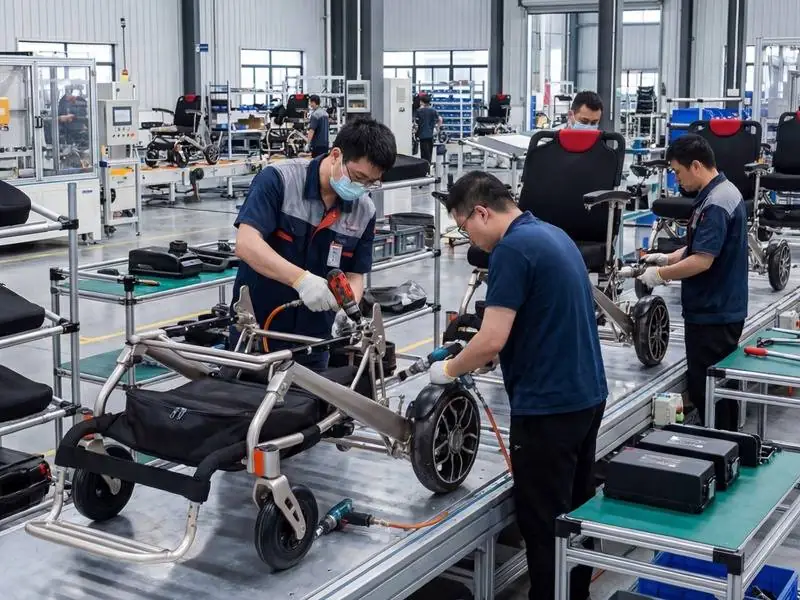
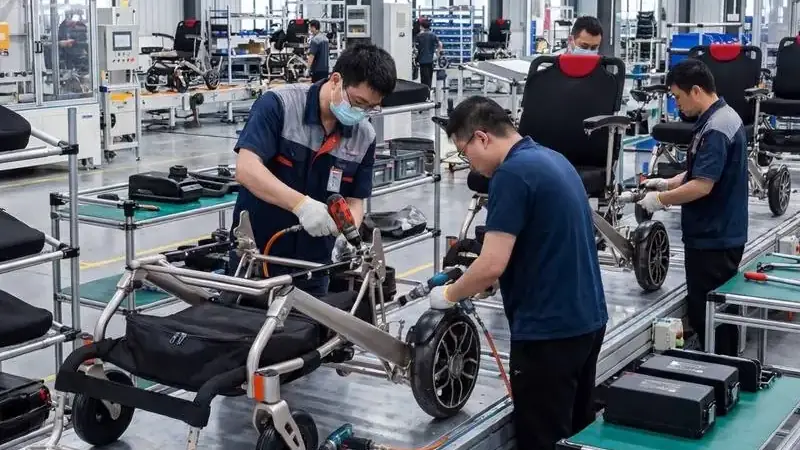
Showroom photos can be rented. A live video call cannot be faked easily: ask to see the welding station, the motor testing bench, and the warehouse with your model in stock. Watch how workers handle the frames — a tidy line with jigs and test equipment signals process control. Our two production facilities total over 3,000 sqm, and buyers who tour them virtually almost always move forward, because the operation matches the brochure.
Key Takeaway: Verify the factory before you discuss price. License scope, ISO certificate naming, and a live video tour filter out 90% of trading companies.
Check
Real factory
Trading company
Business license scope
Includes manufacturing
Trading only
ISO 13451/13485 certificate holder
Same company as quoter
Different company
Live video tour
Offered readily
Delayed or refused
Price flexibility on specs
Can adjust (owns tooling)
Fixed (resells stock)
What certifications must the supplier actually have?
Certifications are not decoration — they determine whether your shipment clears customs and whether you can legally sell the chairs in your market. For electric wheelchairs, which are medical devices in most jurisdictions, three documents matter.
ISO 13485 — the one that matters most
ISO 13485 is the quality management standard for medical devices. It is the certificate distributors and hospital buyers ask for first, and it is audited annually — unlike a one-time test report. Confirm the certificate is current, issued by an accredited body (ours is NQA with UKAS accreditation), and names your supplier as the manufacturer, not just a distributor.
CE marking, UN38.3 and shipping documents
For Europe, electric wheelchairs are typically Class I medical devices: there is no notified-body certificate, only an EU Authorized Representative notification plus the manufacturer’s declaration of conformity. Be wary of suppliers who show you a “CE certificate” from an unrecognized body for a Class I device — ask what the notification number covers instead. For the lithium battery, you need a UN38.3 test report and an MSDS; without them, forwarders will refuse the cargo and airlines will reject it. Our UN38.3 documentation covers the lithium battery configurations we ship, and we provide the MSDS with every battery order.
Key Takeaway: Demand ISO 13485 naming the supplier, a proper Class I CE notification (not a fake certificate), and UN38.3 + MSDS for any lithium battery shipment.
Document
What it proves
Ask for it when
ISO 13485 certificate
Medical-device quality system
Always — first filter
EU AR notification (Class I)
Legal sale in the EU
Selling into Europe
UN38.3 test report
Battery transport safety
Any lithium battery order
MSDS
Handling and shipping info
Every battery shipment
What MOQ should you expect?
Minimum order quantity is where many first-time importers over-commit. Industry sourcing platforms often quote 10–50 units for trial orders, which forces you to gamble on an untested supplier. Our policy is different: our MOQ is 1 unit.
Why we accept 1-unit trial orders
A single-unit order lets you test the actual product — folding mechanism, controller feel, battery range — before you commit to a container. It also lets your local compliance consultant check the device against your market’s requirements. We would rather earn a 200-unit order after you have tested one chair than win a 50-unit order from someone who has never touched the product.
How MOQ affects your unit price
Smaller orders cost more per unit — that is honest math, not a penalty. A 1-unit order ships by express courier with individual packing; a 100-unit order ships by sea in consolidated cartons at a fraction of the freight cost per chair. Ask your supplier for a tiered price list (1 / 10 / 50 / 100+ units) so you can plan your margin at each stage of growth.
Key Takeaway: Start with a 1-unit trial, validate the product and the supplier, then scale. Never let a high MOQ force your first decision.
Order size
Typical use
What to check
1 unit
Product evaluation
Build quality, docs included
10–20 units
Market test
Consistency across units
50–100 units
First commercial order
Sea freight quote, lead time
100+ units
Distributor stocking
OEM terms, spare parts pack
How does OEM/ODM customization work?
OEM is where buying from a factory pays off most. A trading company can put your sticker on a box; a factory can change the chair. Our standard OEM scope covers frame colors, logo placement, and packaging — the three changes distributors ask for most.
What you can customize (and what you cannot)
Color changes are straightforward — powder-coating runs in batches, so expect a small surcharge below 50 units and no surcharge above it. Logo placement (frame decal, controller sticker, carton print) is done in-house. Packaging can be customized with your brand, multilingual manuals, and your local compliance labels. What you cannot change cheaply is the frame geometry or the electronics architecture — those are ODM projects with tooling costs and longer timelines, sensible only at 500+ units.
The OEM process step by step
It runs in four steps: artwork confirmation (you send vector logos, we return a placement mockup), pre-production sample (one unit built to your spec for approval), mass production, and final QC with photos before shipment. The sample step is non-negotiable — never approve an OEM run from a mockup alone. See our OEM and customization options for the full process.
Key Takeaway: OEM (colors, logo, packaging) is low-risk and fast; ODM (new designs) needs volume. Always approve a physical sample first.
Customization
Typical lead time
Minimum order
Frame color
+2–3 days
10 units
Logo placement
+1–2 days
1 unit
Custom packaging/manual
+3–5 days
50 units
New model design (ODM)
60–90 days
500+ units
What payment terms are standard?
Payment structure is your main leverage for risk control. The standard pattern in this industry is a deposit before production and the balance before shipment — but the exact split and the payment channel matter.
T/T, L/C and Trade Assurance compared
Telegraphic transfer (T/T) with 30% deposit and 70% balance before shipment is the most common arrangement for orders under $50,000. It is fast and has low fees. Letters of credit (L/C) suit larger orders — the bank guarantees payment against shipping documents — but L/C fees and paperwork make it uneconomical below roughly $30,000. Alibaba Trade Assurance adds a platform layer of protection for buyers who want order tracking and dispute handling, at the cost of slightly higher transaction fees.
How to structure payments to reduce risk
Never pay 100% upfront to a supplier you have not vetted. The 30/70 split works because the deposit commits the factory to buy materials while the balance — paid after you see QC photos or an inspection report — keeps leverage on your side until the goods are verified. For your first order, tie the balance payment explicitly to passing your inspection checklist (see the inspection section below).
Key Takeaway: 30% deposit / 70% before shipment via T/T is the industry standard for small-to-mid orders; use L/C above ~$30,000 and never pay 100% upfront to an untested supplier.
Method
Best for
Cost
Protection level
T/T 30/70
Orders under $50,000
Low wire fees
Medium (split risk)
L/C at sight
Orders over $30,000
Bank fees 1–2%
High (bank guaranteed)
Trade Assurance
First-time buyers
Platform fees
Medium-high (dispute channel)
How long does production really take?
Lead time is where vague promises cause the most damage. “15–30 days” on a sourcing platform often means 15 days if everything goes right and 30+ when it does not. Our standard lead time is 7 days after payment — because we build from stocked frames, motors, and controllers rather than ordering parts per order.
Our 7-day lead time — how it works
Day 1–2: materials pulled and frames prepared. Day 3–5: assembly, wiring, and controller programming. Day 6: full QC — folding cycle test, brake test, battery charge/discharge check. Day 7: packing with export cartons. OEM color or packaging changes add 2–5 days (see the table above). This timeline applies to our standard models like the EW1000 carbon fiber chair and the EW100 aluminum model.
What can delay your order
Three things cause most delays: custom parts with no stock (non-standard colors, special controllers), incomplete artwork for OEM branding, and shipping space during peak season (September–November). Ask your supplier which components are stocked versus made-to-order before you promise delivery dates to your own customers.
Key Takeaway: Get lead time in writing with the clock starting at a defined event (payment received, artwork approved). 7 days is realistic for stocked standard models; custom work adds days, not weeks.
Stage
Standard models
With OEM changes
Materials & prep
2 days
2–4 days
Assembly & wiring
3 days
3–5 days
QC & testing
1 day
1–2 days
Packing
1 day
1–2 days
How are lithium batteries shipped?
This section surprises more first-time importers than any other. An electric wheelchair is easy freight; its lithium battery is regulated dangerous goods. Get this wrong and your shipment gets held, returned, or refused at the port.
UN38.3, MSDS and air-freight limits
Every lithium battery shipped internationally needs a UN38.3 test report proving it survived altitude, vibration, shock, and thermal tests, plus a Material Safety Data Sheet describing handling. Airlines additionally cap lithium battery size — most passenger-aircraft rules limit spare batteries to 160Wh, and many carriers require pre-approval for any battery-powered mobility device. Our battery guide explains the differences between lithium and lead-acid wheelchair batteries in detail, including why lithium dominates new designs despite the stricter shipping rules.
Sea vs air for battery-powered wheelchairs
For commercial quantities, sea freight is the default: batteries travel as Class 9 dangerous goods with proper labeling and documentation, at a fraction of air cost. Air freight works for samples and urgent small orders but costs 4–6x more and faces stricter carrier-by-carrier approval. Lead-acid batteries ship under simpler rules but weigh far more — a tradeoff worth calculating per order. Per the WHO’s medical device guidance, importers should confirm device classification in their own market before arranging transport, since rules follow the device, not just the battery.
Key Takeaway: Budget for UN38.3 + MSDS paperwork on every lithium order, default to sea freight for volume, and confirm airline rules before promising air delivery dates.
Option
Cost vs sea
Battery paperwork
Best for
Sea freight (FCL/LCL)
Baseline
UN38.3 + MSDS + DG label
20+ units
Air freight
4–6x
UN38.3 + MSDS + carrier approval
Samples, urgent <10 units
Express courier
8–10x
Carrier-specific battery form
1-unit trial
FOB vs EXW vs DDP — which should you choose?
Incoterms decide where the supplier’s responsibility ends and yours begins. For electric wheelchairs from China, three terms cover nearly all orders.
What each term means for your costs
EXW (Ex Works): you collect from the factory gate and handle everything — cheapest quote, most work. FOB (Free on Board): the supplier delivers to the port and loads the vessel; you handle ocean freight, insurance, and destination customs. DDP (Delivered Duty Paid): the supplier’s forwarder handles everything to your door, duties included — simplest, but you pay a premium and lose visibility into the freight breakdown.
Our recommendation for first-time importers
Start with FOB if you have a forwarder, because you control the shipping cost and timeline. Use DDP only when you have no logistics partner and the order is small enough that the premium does not destroy your margin. Avoid EXW unless you have an agent in China — factory-gate pickup for dangerous-goods cargo involves export declarations most buyers cannot file themselves.
Key Takeaway: FOB is the sweet spot for most buyers — the factory handles export, you control freight. DDP for simplicity on small orders, EXW only with a China-side agent.
Term
Supplier handles
You handle
Best for
EXW
Nothing beyond the gate
Everything
Buyers with a China agent
FOB
Export + port loading
Freight, insurance, customs
Most first orders
DDP
Door-to-door incl. duties
Nothing
Small orders, no forwarder
How do you inspect quality before shipment?
Inspection is the cheapest insurance in the import process. A $200–$300 third-party inspection on a $10,000 order is a 2–3% premium that catches the problems you cannot see in photos.
Third-party inspection — worth it?
For first orders, yes — always. Agencies like SGS, TÜV, or Bureau Veritas send an inspector to the factory on your behalf with your checklist. For repeat orders with a proven supplier, you can scale back to the supplier’s QC photos and video, plus random spot checks. We welcome third-party inspectors and provide them with a testing area; suppliers who resist inspections are telling you something.
What to check on the production line
Your checklist should cover: folding/unfolding cycle (smooth, no play in hinges), brake engagement on a slope, controller response in all directions, battery charge from empty to full with no overheating, and carton drop-test on one packed unit. Ask for the QC report with photos of each tested unit’s serial number — not a generic “all passed” statement.
Key Takeaway: Inspect the first order with a third party, keep the checklist, and reuse it for every reorder. Photos beat promises.
Check
How to verify
Reject if
Folding mechanism
10 open/close cycles on video
Sticking, loose hinges
Brakes
Slope hold test
Any rolling
Battery
Full charge cycle, temp check
Overheating, short runtime
Carton/packing
Drop test one unit
Cracked frame, loose parts
And once the container lands, run an incoming inspection checklist before the cartons disappear into your warehouse.
What warranty and after-sales terms should you ask for?
Warranty terms reveal how much a supplier trusts its own product. Vague “one year warranty” language with no component breakdown usually means the supplier has never handled a claim.
Our warranty terms, in writing
We warrant the frame for 36 months and the battery, motor, and controller for 12 months each. These are the four components that actually fail in the field, so the breakdown matters more than a headline number. Ask every supplier for the same four-line breakdown — if they cannot produce it, their warranty is marketing copy.
Spare parts — the question buyers forget
A warranty without spare parts is a return label, not a solution. Before you order, confirm the supplier stocks controllers, motors, chargers, and batteries separately — and at what price. Your end customers will need a replacement charger or a new joystick long before they need a new chair, and being able to sell spare parts (including battery chargers) turns after-sales from a cost center into a revenue stream. We keep full spare-parts stock for every model we have shipped in the last five years.
Key Takeaway: Get the four-line warranty breakdown (frame / battery / motor / controller) and confirm spare-parts availability and pricing before your first order.
Component
Our warranty
What to ask others
Frame
36 months
Same — structural, longest
Battery
12 months
Cycle count covered?
Motor
12 months
Brush/brushless specified?
Controller
12 months
Programming support included?
Conclusion
Learning how to import electric wheelchairs from China comes down to five decisions: verify the factory is real, confirm the three key documents (ISO 13485, Class I CE notification, UN38.3 + MSDS), start with a 1-unit trial, lock payment to inspection, and nail down warranty plus spare parts in writing. Do those five and the rest — freight terms, OEM colors, packaging — becomes routine paperwork.
We are the factory described in this guide: Shenzhen Zhiwei Health Technology Co., Ltd., building electric wheelchairs in Longgang, Shenzhen since 2015, across two facilities totaling 3,000+ sqm. Our terms are the ones quoted above — 1-unit MOQ, 7-day lead time after payment, frame 36-month / battery-motor-controller 12-month warranty, and full spare-parts support. If you are evaluating suppliers, start with a single unit and put our process to the test. Read more about who we are and how we build — then send us your requirements.
FAQ
Can I import just one electric wheelchair from China as a sample?
Yes. Our MOQ is 1 unit, and we recommend every new buyer start there. A single-unit order ships by express courier in 7 days plus transit time, and lets you evaluate build quality, documentation, and the supplier’s communication before committing to volume.
Do I need an import license for electric wheelchairs?
It depends on your market. Electric wheelchairs are regulated as medical devices in the US, EU, UK, and Australia, among others — you may need to register as an importer with your national authority (e.g., FDA establishment registration in the US). Your supplier’s ISO 13485 certificate and CE documentation support your application but do not replace it.
How much does it cost to ship electric wheelchairs from China?
For a 1-unit sample, express courier typically runs $150–$300 depending on destination. For 20–100 units, sea freight drops the per-unit shipping cost dramatically — often under $50 per chair to major ports. Lithium batteries add dangerous-goods handling fees on every mode; get the freight quote with the battery declared, not without.
How do I pay a Chinese wheelchair factory safely?
Use 30% deposit / 70% balance before shipment via T/T for orders under $50,000, with the balance tied to passing inspection. For larger orders, a letter of credit through your bank adds protection. Never wire 100% upfront to a supplier you have not visited or verified.
What is the difference between buying from a factory and a trading company?
A factory controls design, production scheduling, quality, and warranty — and typically quotes 15–30% lower by cutting out the middleman margin. A trading company resells and cannot change specs or expedite production. Verify with the business license scope, the ISO 13485 certificate holder name, and a live video factory tour.
—
DRAFT NOTES (remove before WP push):
– Internal links used (6, per 2026-10-14 principle): About (/about/), Solutions (/solutions/), EW1000, EW100, post #5 (lithium vs lead acid), spare parts + charger pages (counted as the parts-program link; charger linked within H2#10 paragraph)
– External link (1): WHO medical devices page, target=_blank rel=noopener — URL verified HTTP 200 on 2026-10-14
– Tables: 10 (one per H2) — must convert to Gutenberg wp:table blocks before push (spec §3.3.6)
– Headings: convert ##/### to wp:heading blocks; NO # H1 in body (spec §3.3.8)
– Links: all already HTML — verify grep for ]( returns 0 before push
– Tomorrow still needed: app password → generate/upload featured + body images → replace IMAGE placeholders → Gutenberg HTML → XML-RPC draft → user preview → AIOSEO → publish → curl verify → GSC reminder
About Our Company
Since 2015, our company has focused on electric wheelchairs, building practical mobility solutions for distributors and medical stores worldwide.
Our specialized focus has led to collaborations with industry leaders and experts to develop products that truly understand and meet the needs of our discerning clients.