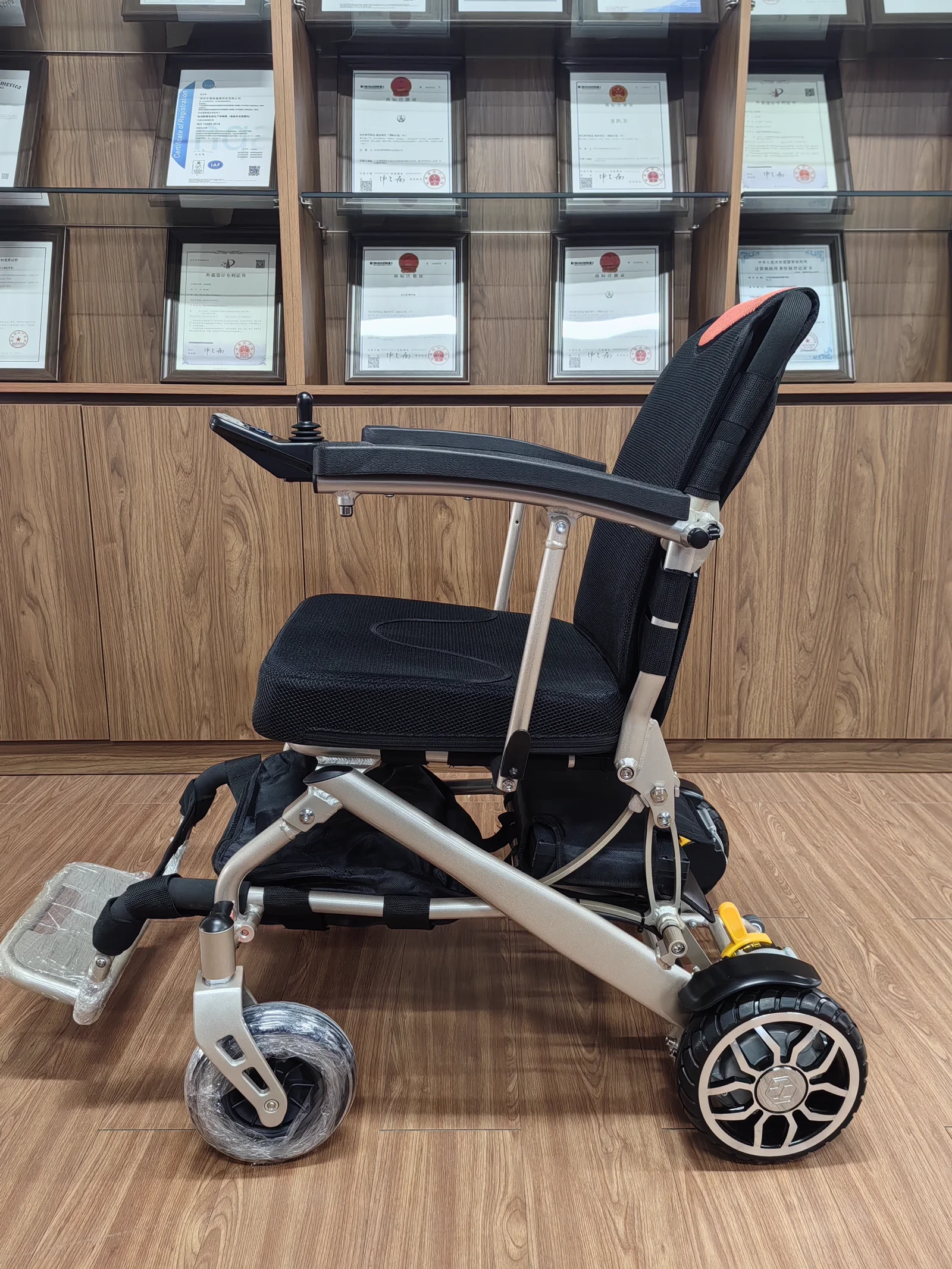
What Safety Features Should Every Electric Wheelchair Have?
Consider this electric wheelchair safety features explained from the factory floor — not as marketing badges, but as design decisions that keep a rider safe when something goes wrong. Every serious electric wheelchair combines four layers of protection: braking that works even without power, stability hardware that resists tipping, rider restraints for slopes and curbs, and controls that prevent sudden or unintended movement.
On our own chairs, the non-negotiable layer is the electromagnetic brake: release the joystick and the chair stops, and it stays stopped even if the battery dies mid-slope. That single design choice eliminates the most dangerous failure mode in powered mobility — a chair rolling away from its rider. Everything below builds on that foundation, and we will show you exactly which of our five models carries which feature, verified against our live product pages.
The four layers of wheelchair safety
Think of safety as layers, not items. The braking layer (electromagnetic brakes) handles stopping. The stability layer (anti-tip wheels, low center of gravity, wheelbase geometry) handles tipping. The restraint layer (seat belts) handles rider displacement on slopes and bumps. The control layer (speed settings, joystick design, fault protection) handles human error.
Why the order matters for buyers
A chair with ten listed features but no electromagnetic brake is less safe than a chair with three features built around one. When you compare suppliers, check the braking layer first — it is the one you cannot compensate for with careful driving. The electromagnetic braking system on our EW1000 is a good reference for what this looks like in a product specification.
Key Takeaway: Judge an electric wheelchair’s safety by its four layers — braking, stability, restraint, and control — in that order. Braking that holds without power is the foundation everything else builds on.
Safety layer
What it does
Example on ZVCARE chairs
Braking
Stops and holds the chair
Electromagnetic brake, all 5 models
Stability
Resists tipping
Anti-tipper wheels (EW8722)
Restraint
Keeps rider seated
Safety belt (EW1000)
Control
Prevents unintended movement
Adjustable speed, iV2 with ABS
How Do Electromagnetic Brakes Work on an Electric Wheelchair?
An electromagnetic brake is engaged by default and released by electricity — the exact opposite of what most people expect. When you push the joystick, the controller sends power to release the brake and drive the motors; the moment you release the joystick, or the moment power is cut for any reason, springs snap the brake shut and the wheels lock. There is no coasting, no rolling, no “oops” moment.
This fail-safe logic is why electromagnetic brakes are the standard on serious power chairs. A conventional friction brake depends on the rider applying it; an electromagnetic brake depends on nothing — it is the resting state of the machine. On a slope, this means a dead battery leaves you parked, not rolling. Our electric wheelchair controller page documents how the brake integrates with the iV1 and iV2 control systems.
Release-to-stop in daily use
In practice, riders never think about the brake — they think about the joystick. Push to go, release to stop, and the stop is immediate and complete, with no hand lever to remember. For distributors, this matters in training: end users cannot forget to brake, because braking is what the chair does when left alone.
Power-off hold on slopes
The scenario that sells this feature is simple: the battery dies halfway up a ramp. With electromagnetic brakes, the chair simply stops where it is. The rider waits for assistance instead of sliding backward. This is the behavior to verify during incoming inspection — power the chair off on a gentle slope and confirm it holds (more on that in the distributor checklist below).
Key Takeaway: Electromagnetic brakes are fail-safe by design — they engage when power is removed, so a dead battery means a parked chair, not a runaway one. All five of our models use them.
Brake type
How it engages
Fails safe without power?
Electromagnetic
Springs engage when power cuts
Yes — this is the standard
Electronic (regenerative)
Motor resistance while powered
Partially — needs power
Manual hand brake
Rider squeezes a lever
No — depends on the rider
Why Are Anti-Tip Wheels Important?
Anti-tip wheels are small wheels mounted behind the main drive wheels, and their job is exactly what the name says: they catch the chair if it starts tipping backward. On flat ground you never notice them; on a steep ramp, a sharp curb cut, or a sudden acceleration from a stop, they are the difference between a scare and a fall.
Rearward tipping is the most common tip direction because drive wheels sit under the rider’s center of mass and acceleration pushes weight backward. Our EW8722 lists anti-tipper wheels in its specification — worth checking on any model you evaluate, because not every chair in this class includes them. When comparing suppliers, ask specifically: “are anti-tip devices standard, optional, or absent?” The answer tells you how the factory thinks about slope safety.
Uphill and acceleration scenarios
Going uphill shifts the rider’s weight toward the rear of the chair. Combine a steep ramp with a strong acceleration from the joystick and the front casters can lift. Anti-tip wheels limit how far the chair can rotate before the small wheels contact the ground and stop the motion. They do not prevent the initial lift — they cap it at a safe angle.
Curbs, thresholds, and downhill control
Downhill, the risk flips: the chair’s weight shifts forward and the electromagnetic brake does most of the work, but anti-tip wheels still protect against sudden stops that pitch the rider forward. At curbs and door thresholds, they prevent the chair from rocking backward when the front casters drop off an edge. They are a passive, zero-maintenance device — no adjustment, no battery, no failure mode.
Key Takeaway: Anti-tip wheels are cheap, passive insurance against rearward tipping on ramps and curbs. Our EW8722 includes them as standard — confirm their presence on any chair you source.
Scenario
Tip risk
What anti-tip wheels do
Steep ramp ascent
Rearward lift under acceleration
Cap rotation at a safe angle
Curb drop-off
Backward rock as casters drop
Catch the frame before it goes over
Sudden stop downhill
Forward pitch
Stabilize the chassis
Do Electric Wheelchairs Need Seat Belts?
A seat belt on an electric wheelchair is not about crashes — it is about keeping the rider positioned correctly on slopes, over bumps, and during the small jolts of daily outdoor use. Riders with good trunk control on flat indoor floors may never need one; riders tackling ramps, uneven pavements, or transport in vehicles benefit from one every day.
Our EW1000 lists a safety belt in its specification, and we treat it as recommended rather than mandatory — honest positioning matters here. A supplier that claims every rider needs a belt is selling fear; a supplier that never mentions one is ignoring real outdoor use. The right question for a distributor is not “does it have a belt” but “which riders and which routes make the belt the right choice, and is it standard or an accessory?”
Who benefits most from a seat belt
Riders with limited trunk stability, anyone regularly using ramps steeper than a gentle driveway, and chairs that will be transported in vehicles while occupied all benefit. For indoor-only use on flat floors by riders with full trunk control, the belt adds little — and an unused belt is just clutter.
Proper use and positioning
A wheelchair seat belt should sit low across the pelvis, not across the stomach, and it should be snug enough that the rider cannot slide forward under it. It is a positioning aid, not a car seatbelt — it is not designed for vehicle-crash loads. Train end users on this distinction; misuse creates a false sense of security.
Key Takeaway: Seat belts are positioning aids for slopes, bumps, and transport — recommended for outdoor and limited-mobility riders, optional for flat indoor use. Our EW1000 includes one; ask your supplier whether it is standard or an add-on.
Rider profile
Belt recommendation
Reason
Outdoor routes with ramps
Recommended
Slope and bump displacement risk
Limited trunk stability
Recommended
Positioning support
Flat indoor use, full trunk control
Optional
Low displacement risk
How Do Speed Controls Keep Riders Safe?
Speed control on a power chair is not a single setting — it is the combination of the joystick’s proportional response, a maximum-speed limiter, and (on better controllers) programmable speed profiles. Push the joystick a little and the chair crawls; push it fully and it reaches the capped maximum, never beyond. That cap is the safety feature.
Our controllers document adjustable speed settings, and the iV2 adds ABS anti-lock logic to the braking side. For distributors, the practical point is trainability: a new rider starts on the lowest speed profile indoors and graduates to full speed only when their control is proven. A chair with one fixed speed denies you that ramp — every rider, from first-timer to veteran, gets the same response.
Indoor versus outdoor speed profiles
Indoors, the safe maximum is walking pace or below — doorways, furniture, and other people leave no margin. Outdoors, a higher cap makes the chair practical for real distances. Programmable profiles let one chair serve both without compromise, and they let caregivers lock the maximum down for riders who need the guardrail.
The joystick as a safety device
A 360-degree proportional joystick gives fine control at low deflection — the difference between nudging through a doorway and lurching through it. Combined with the electromagnetic brake’s instant release-to-stop, the joystick-brake pair means the rider is never more than a relaxed hand away from a full stop. See our controller specifications for how the iV1 and iV2 implement this.
Key Takeaway: Adjustable speed caps and proportional joysticks let one chair be safe indoors and practical outdoors. Start every new rider on the lowest profile.
Slopes combine every risk at once — gravity pulling backward or forward, reduced traction, and no flat place to recover — so they are the right test for the whole safety system. Three features do the heavy lifting: the electromagnetic brake holding the chair at a standstill, anti-tip hardware limiting rotation, and a low center of gravity keeping the mass between the wheels.
When we evaluate our own designs, the slope test is simple and binary: power off on the slope — does it hold? Joystick released mid-slope — does it stop promptly without sliding? These are checks any distributor can run during incoming inspection with no instruments. If a supplier’s chair drifts or slides in either test, the brake system is not doing its job, regardless of what the brochure claims.
Brake hold at standstill
This is the electromagnetic brake’s signature test. Park the chair across a gentle slope, power it off completely, and watch. A proper system does not move a millimeter — the springs hold the wheels mechanically, independent of electronics. Do this test before you accept a shipment, not after a customer complains.
Controlled descent and anti-tip backup
Going down, release the joystick and the chair should stop promptly rather than gathering speed. The brake handles the stop; anti-tip wheels stand by for the unexpected — a wet patch, a sudden obstacle, a rider error. No single feature covers every slope scenario, which is exactly why the layered approach from the first section matters.
Key Takeaway: Test any chair on a real slope before you buy in bulk: power-off hold and release-to-stop are binary pass/fail checks that no brochure can fake.
Slope check
How to test
Pass criteria
Power-off hold
Park across slope, switch off
Zero movement
Release-to-stop
Release joystick mid-descent
Prompt stop, no sliding
Anti-tip presence
Visual inspection of rear
Small wheels fitted behind drive wheels
How Can Distributors Check Safety Features Before Buying in Bulk?
Safety claims are easy to print and hard to verify — which is precisely why incoming inspection exists. A distributor buying in bulk should treat the first units of every shipment as test articles: run the brake tests, confirm the hardware listed on the spec sheet is actually fitted, and document the results before the chairs go to customers.
Start with the spec sheet cross-check. Our product pages list the electromagnetic brake on all five models, anti-tipper wheels on the EW8722, a safety belt on the EW1000, and ABS on the iV2 controller and EW8720 — your inspection should confirm each fitted item on the physical chair. Then run the functional tests: power-off hold on a slope, release-to-stop from low speed, and a joystick-center check at power-on (the chair must not move until the joystick returns to neutral and is operated again).
The five questions to ask your supplier
Ask: which brake type, and is it fail-safe without power? Are anti-tip devices standard or optional? Is the seat belt standard, and for which models? What does the controller do if powered on with the joystick off-center? What is the documented procedure when a brake fault is suspected? A supplier that answers all five concretely — with spec-sheet references — is a supplier that has thought about safety. Vague answers are a finding, not a pass.
Documenting the inspection
Photograph the brake units, the anti-tip hardware, and the belt fittings on the first article, and keep those photos with the shipment record. If a warranty claim later involves a safety component, that record is what separates a manufacturing issue from damage in transit or misuse. Our warranty terms spell out exactly what is covered and for how long — frame 36 months, battery, motor, and controller 12 months each — so inspection findings map directly to claim eligibility.
Key Takeaway: Verify, don’t trust: cross-check the spec sheet against the physical chair and run the two slope tests on the first article of every shipment. Five concrete questions separate serious suppliers from brochure writers.
Inspection item
Method
Reference
Brake type and presence
Visual + spec sheet cross-check
Product page spec
Power-off hold
Slope test, power off
Zero movement = pass
Release-to-stop
Release joystick at low speed
Prompt stop = pass
Anti-tip / belt fitted
Visual inspection
EW8722 / EW1000 spec
Fault behavior
Power on with joystick deflected
Must not move until re-centered
What Should You Tell End Users About Safe Daily Operation?
The safest chair in the world still depends on the person driving it, and most safety incidents come from habit, not hardware. Distributors who train their dealers — and dealers who brief end users — see fewer claims and happier customers. The briefing takes ten minutes and covers three habits: the pre-ride check, slope discipline, and speed discipline.
The pre-ride check is thirty seconds: joystick centers freely, battery shows adequate charge, brakes hold on a gentle incline, and the seat belt is available for outdoor routes. Slope discipline means straight up and straight down, never across, at a controlled speed with the belt fastened. Speed discipline means the lowest profile indoors and full speed only in open outdoor space. None of this requires technical knowledge — which is why it works.
The daily thirty-second check
Teach every rider: before the first drive of the day, confirm the joystick springs back to center, check the battery gauge, and rock the chair gently to feel the brake hold. These three checks catch the majority of developing problems — a sticky joystick, a depleted battery, a brake that needs attention — before they become incidents. Our travel guide covers the same discipline for riders taking their chairs on the road.
Slope and curb habits
Straight lines on slopes, walking pace or below, belt fastened, and no diagonal traverses — diagonal is how chairs tip sideways, the one direction anti-tip wheels cannot help with. At curbs, approach squarely at low speed and let the casters climb before the drive wheels push. These habits are free, and they prevent the incidents that no hardware can.
Key Takeaway: Ten minutes of rider briefing — a thirty-second pre-ride check, straight-line slope discipline, and indoor speed discipline — prevents more incidents than any single hardware feature.
Habit
What to do
Why it matters
Pre-ride check
Joystick center, battery, brake hold
Catches problems before driving
Slope discipline
Straight up/down, belt on
Prevents sideways tips
Speed discipline
Lowest profile indoors
Doorways leave no margin
Which Certifications Back Up Electric Wheelchair Safety Claims?
A safety feature is a claim; a certification is evidence that an independent body checked the claim. For electric wheelchairs sold into Europe, the relevant evidence is the EU Class I medical device notification (filed through an Authorized Representative, backed by the manufacturer’s declaration), ISO 13485 for the quality management system behind the design, and test standards like the ISO 7176 series that define how brakes, stability, and controls are measured.
We publish our actual certificates on our About page — ISO 13485, the EU Authorized Representative notification (Class I), China NMPA registration, Saudi SFDA registration, plus UN38.3 and MSDS for the lithium batteries and the sea-transport certificate. We show them because a B2B buyer should be able to verify, not just believe. The brake-effectiveness methods in ISO 7176-3:2012 are a good example of what “tested” should mean: defined slopes, measured stopping distances, disclosed results.
What to ask for, and what to ignore
Ask a supplier for the certificate itself, not a logo on a brochure — and check what it actually covers (product scope, issuing body, validity). Be wary of certificates that have expired, that cover a different product, or that no one can produce on request. And note what we do not claim: we do not hold FDA clearance, so we do not write about FDA as if we did.
Why the factory behind the paper matters
A certificate says the design passed; the factory’s quality system says every unit matches the design. That is what ISO 13485 covers — the process discipline across our two facilities and 3,000+ sqm of production space that keeps unit #1,000 identical to the certified sample. Paper without process is decoration.
Key Takeaway: Ask for the actual certificate, check its scope and validity, and confirm the factory’s quality system behind it. We publish ours on our About page — hold every supplier to the same standard.
Evidence
What it proves
Where we publish it
EU AR notification (Class I)
EU medical device filing
About page
ISO 13485
Quality management system
About page
ISO 7176 test methods
How brakes/stability are measured
Referenced standard
UN38.3 / MSDS
Battery transport safety
About page
Conclusion
Electric wheelchair safety features work as a system: electromagnetic brakes that hold without power, anti-tip hardware that caps a tip before it becomes a fall, seat belts that keep the rider positioned, and speed controls that match the chair to the environment — all of it verifiable against certificates and test standards rather than taken on trust. When you evaluate a supplier, check the layers in order, run the slope tests yourself, and ask for the actual paperwork.
We build our chairs this way because we are the factory — two facilities, 3,000+ sqm, building since 2015 — and we publish the specs, the certificates, and the warranty terms (frame 36 months; battery, motor, and controller 12 months each) to prove it. If you are sourcing electric wheelchairs, start with a single unit: 1pc MOQ, 7-day lead time after payment, spare parts including controllers and motors available for your after-sales stock.
Frequently Asked Questions
Will an electric wheelchair roll away if the battery dies on a slope?
No — not if it uses electromagnetic brakes, which all five of our models do. The brake is spring-engaged and only released by electrical power, so a dead battery leaves the chair parked exactly where it stopped. This is the single most important safety behavior to verify during incoming inspection.
Can anti-tip wheels be removed for a tighter turning radius?
They can, but you should not. Anti-tip wheels add almost nothing to the turning circle and removing them deletes the only protection against rearward tipping on ramps. If a rider requests removal, document that the chair is being used outside its designed safety configuration.
Is the seat belt standard on all your models?
No. Our EW1000 lists a safety belt in its specification; across the range, treat the belt as model-specific equipment and confirm per model on the product page. For outdoor routes and riders with limited trunk stability, we recommend specifying it.
What is the maximum safe slope for an electric wheelchair?
There is no single number — safe slope depends on the chair’s brake hold, center of gravity, anti-tip geometry, and the rider’s weight and positioning. Rather than trusting a brochure figure, run the two tests in this guide (power-off hold, release-to-stop) on the actual chair. Any supplier quoting a slope angle should be able to show the test behind it.
How should a distributor verify brakes on incoming shipments?
Test the first article of every shipment: confirm the brake type against the spec sheet, run the power-off hold test on a gentle slope, and run the release-to-stop test at low speed. Photograph the brake units and keep the results with the shipment record — it is your baseline if a warranty question ever arises.
—
About Our Company
Since 2015, our company has focused on electric wheelchairs, building practical mobility solutions for distributors and medical stores worldwide.
Our specialized focus has led to collaborations with industry leaders and experts to develop products that truly understand and meet the needs of our discerning clients.