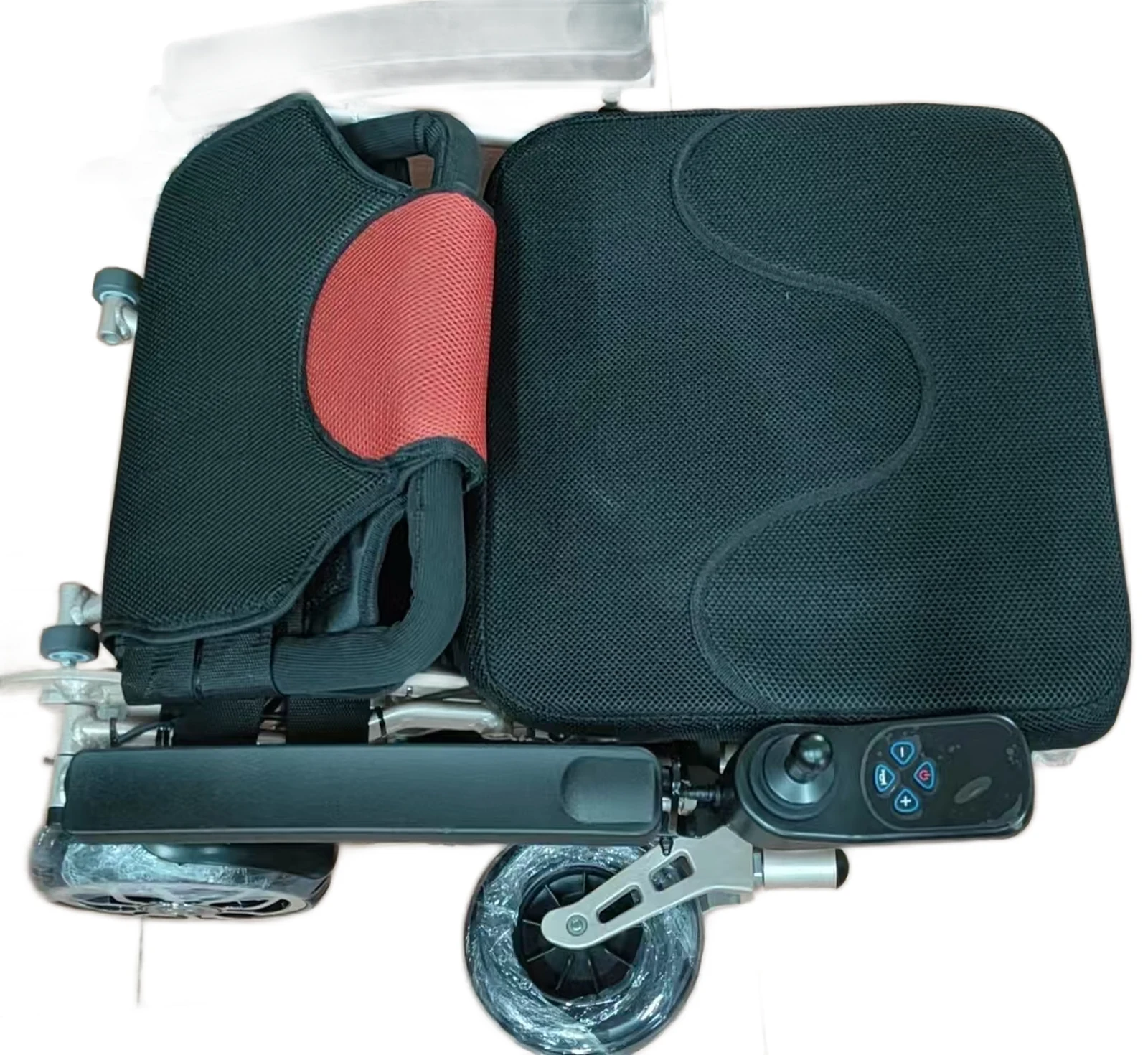
Folding Electric Wheelchair Dimensions: Folded vs Unfolded
October 18, 2026
Folding electric wheelchair dimensions are the first specification a serious buyer checks — and the most misunderstood. Every folding model has two sets of dimensions: unfolded (the chair you ride) and folded (the package you transport and store). Distributors who only quote the unfolded size are answering the wrong question, because nobody’s warehouse, car trunk, or shipping container ever holds an unfolded chair. This guide explains what folded vs. unfolded dimensions mean, publishes our five models’ real numbers — verified from our live product pages today — and shows you how to use dimensions to make buying, trunk-fit, and freight decisions.
A note on honesty before the numbers: dimensions only mean something when everyone measures the same way. Our figures below are length × width × height in centimeters, measured at the chair’s widest and tallest points with standard configuration. When you compare suppliers, ask whether their numbers include the joystick, footrests, and anti-tip wheels — a “compact” folded size that quietly excludes the joystick is not compact, it is incomplete.
What Do “Folded” and “Unfolded” Dimensions Actually Mean?
Unfolded dimensions describe the chair in riding position: how much floor space it occupies and whether it fits through your customer’s doorways and into their daily life. Folded dimensions describe the chair collapsed for transport and storage: the actual package you lift into a car, stack in a warehouse, or load into a container. Both are written as length × width × height (L×W×H), and mixing up the order is one of the most common errors in buyer-supplier communication — always confirm which number is which.
The folded figure is the one that decides real-world usability. A chair can ride beautifully and still fail commercially if it does not fit the car trunks in its target market. That is why this article spends most of its time on folded numbers: unfolded dimensions vary less between models and matter less to the buying decision.
The L×W×H convention — and why to confirm it
Most manufacturers write dimensions as length × width × height, but not all, and some spec sheets omit the order entirely. Before comparing two suppliers’ “73×55×31” figures, confirm the axis order and whether protrusions are included. Five minutes of clarification here prevents a container of chairs that do not fit the plan.
Folded photos beat folded numbers
Numbers tell you the bounding box; photos tell you the shape. A chair that folds flat like a suitcase and a chair that folds into an L-shape can share similar bounding boxes and behave completely differently in a trunk. Always ask the supplier for a photo of the actual folded chair — we publish folded-view photos on every product page for exactly this reason.
Key Takeaway: Unfolded = riding footprint; folded = transport package. Always confirm L×W×H order and whether joystick and footrests are included — and ask for a folded photo, not just numbers.
Dimension set
What it describes
Decides
Unfolded (L×W×H)
Chair in riding position
Doorways, daily use
Folded (L×W×H)
Chair collapsed
Trunk fit, storage, freight
Packing size
Carton for shipping
Freight cost, container loading
Why Do Folded Dimensions Matter More Than Unfolded Ones?
Because the chair spends most of its commercial life folded. Between factory and end user, the chair is folded in its carton, folded in the container, folded in your warehouse, folded in the delivery van, and folded in the customer’s car trunk far more often than it is unfolded and ridden. Every one of those steps has a size constraint, and the folded dimensions are what must clear all of them.
For distributors, folded size drives three costs directly: freight (through carton size and volume weight), warehousing (how many units per square meter of rack), and delivery (whether one van trip carries two chairs or four). A model that is 10 cm narrower when folded can be the difference between stacking two-high and three-high in your warehouse — multiplied across hundreds of units, that is real rent money.
The distributor’s dimension checklist
Run every candidate model through four gates: does it fit the most common car trunk in your market, does the carton stack efficiently on a standard pallet, how many cartons fit your usual container, and can one person handle the folded package safely. A model that passes all four earns its place in your lineup; a model that fails the trunk test will generate returns no matter how good it rides.
Unfolded still matters — for the rider
None of this demotes the unfolded dimensions to trivia. Seat width, overall width for doorways, and turning space still decide whether the chair works in the rider’s home. But those are rider-fit questions with well-understood answers; the commercial questions — trunk, warehouse, container — are where folded dimensions do their quiet, decisive work. For measuring seat fit properly, see how to measure electric wheelchair seat sizes.
Key Takeaway: The chair lives folded through most of its commercial journey — carton, container, warehouse, trunk. Folded dimensions drive freight, storage, and delivery costs; check trunk fit, pallet stacking, and container loading before you commit.
Stage
Constraint
Dimension that matters
Car trunk
Trunk opening and depth
Folded L×W×H
Warehouse
Rack and pallet efficiency
Folded + carton size
Container
CBM and volume weight
Packing size
Rider’s home
Doorways, turning
Unfolded W, turning radius
Will a Folding Electric Wheelchair Fit in a Car Trunk?
Usually yes — if you check before you buy, not after. The folded heights of our five models run from 31 cm to 76 cm, and that spread is the whole story: our EW100 folds flat to just 31 cm high, sliding into a sedan trunk like luggage, while our larger EW8703G folds to 76 cm high and wants an SUV or van. Same category, completely different trunk requirements.
The practical method is boring and foolproof: measure the trunk opening (not just the interior — the opening is the gate), measure the folded chair, and leave margin for lifting angles. Trunk lips, wheel arches, and sloping tailgates all steal space the tape measure does not show. Our travel guide covers the full loading routine; the dimension check is step one of it.
The 31 cm benchmark
Fold flat enough and the trunk question disappears. At 73×55.5×31 cm folded, the EW100’s 31 cm height is the number to beat in the lightweight class — it fits trunks that reject taller-folding chairs, slides under some beds for home storage, and needs no disassembly. When a customer asks “will it fit my car,” a flat-folding chair lets you answer with unusual confidence.
What to do when it does not fit
If the folded chair clears the trunk on paper but not in practice, check the removable parts before blaming the chair: quick-release footrests and a detachable joystick shave centimeters that matter. And if the chair genuinely needs a bigger vehicle, say so plainly — a customer who buys the wrong chair for their car becomes a return, and returns cost more than honest advice. Our airplane guide applies the same measure-first discipline to air travel.
Key Takeaway: Measure the trunk opening — not just the interior — against the folded dimensions, with margin for lifting. Flat-folding chairs (our EW100 at 31 cm high) clear trunks that taller folders cannot.
Check
How
Why it matters
Trunk opening
Tape the narrowest point
The opening is the gate
Folded height
Tallest point of folded chair
Usually the limiting dimension
Lifting margin
Add 5–10 cm
Angles and lips steal space
How Do Dimensions Affect Shipping and Freight Costs?
Through the carton, not the chair. Freight forwarders price on whichever is greater — actual or volume weight — and volume weight comes straight from the packing size. Our EW8722’s carton (81×42×78 cm) bills at 53 kg volumetric against 48 kg actual; our EW8703G’s larger carton (90×45×80 cm) prices at 65 kg. The folded chair inside did not change; the centimeters of carton did.
This is why packing size deserves the same scrutiny as the chair’s own dimensions. A supplier quoting a low unit price with a wasteful carton can cost you more landed than a pricier chair in a tight carton. Ask for packing size and gross weight on every quotation, and run the volume-weight math yourself — it takes one minute and it is always worth it.
Container loading: the B2B math
For sea freight, convert packing size to cubic meters and divide into the container: a standard 20-foot container holds about 33 CBM inside (see this container dimensions reference). Our EW100’s carton at 62×35×78 cm is about 0.17 CBM — roughly 190 cartons per 20GP on volume, before stacking and weight limits. Do this arithmetic for every model you consider; it turns vague “good for shipping” claims into a concrete units-per-container figure you can price against.
Stacking and the warehouse after arrival
Cartons that share a footprint stack cleanly; mixed footprints waste vertical space. If you carry several models, compare their packing sizes side by side — two models with near-identical cartons (our EW8722 and EW8720 both pack at 81×42×78 cm) share pallets and racking without re-planning. Small standardization wins like this compound across a warehouse.
Key Takeaway: Freight prices off the carton via volume weight — our EW8722 bills at 53 kg volumetric vs. 48 kg actual. Always get packing size and gross weight on the quotation, and convert to units-per-container before comparing suppliers.
Model
Packing size (cm)
Gross / volume weight
EW1000
80×41×76.5
21 kg
EW100
62×35×78
—
EW8722
81×42×78
48 kg / 53 kg vol
EW8703G
90×45×80
49 kg / 65 kg vol
EW8720
81×42×78
48 kg / 54 kg vol
How Do Our Five Models Compare on Size?
Here are the real numbers, verified from our live product pages today. Two patterns stand out. First, the lightweight pair (EW1000 carbon, EW100 aluminum) folds dramatically smaller than the full-size trio — that is the portability you are paying for. Second, among the full-size models, folded footprints cluster tightly while weights and heights differ, so the choice between them turns on comfort and features rather than transport size.
Read the table by use case, not by “smallest wins.” The EW1000 is the travel specialist: smallest folded volume in the lineup at 15 kg. The EW100 is the flat-fold champion: 31 cm high, the trunk-and-under-bed pick. The EW8722, EW8703G, and EW8720 are daily drivers where folded size is similar and the decision turns on wheels, seating, and finish — see our weight guide for how weight and size trade off.
Where each model wins on size
No single model wins every dimension, so read the table by job: the EW1000 wins smallest folded package for travelers, the EW100 wins flattest fold for car trunks, and the full-size trio wins on seating and ride comfort where folded size is nearly tied. Distributors usually carry one lightweight and one full-size model precisely because no chair covers both jobs.
What the numbers do not show
No table captures folding effort, folded stability (does it stay folded in the trunk?), or whether the chair stands upright when folded for showroom display. These are the questions to ask on a video call with the factory — or better, to answer yourself from the sample unit. Dimensions get the chair through the door; the mechanism decides whether it stays sold.
Key Takeaway: EW1000 is the smallest folded package, EW100 folds flattest (31 cm), and the full-size trio clusters together. Choose by use case — travel, trunk-fit, or daily driving — not by “smallest number wins.”
What Should You Check Beyond the Dimension Numbers?
Four things the spec sheet will not tell you: folding effort (one person folding in seconds outsells a two-person job regardless of the numbers), folded stability in a moving trunk, pinch-point safety for elderly users folding the chair themselves, and whether the folded chair stands upright on its own for showroom display and hallway storage.
Our maintenance guide covers keeping the folding mechanism smooth — hinges, latches, and locks need the same regular attention as the electronics. A chair whose mechanism is clean folds to its published dimensions; a chair with a gritty hinge does not fold fully, and then the numbers on the spec sheet are fiction.
The mechanism matters more than the centimeters
Two chairs with identical folded dimensions can feel completely different to operate — one glides shut with one hand, the other needs a knee and a prayer. The folding linkage, latch quality, and hinge tolerances decide this, and none of it appears in a dimension table. When you cannot visit the factory, the sample unit is your only honest judge.
Ask for the folded video
A 30-second video of a real person folding the real chair answers all four questions at once: effort, stability, safety, and final form. We publish folding videos for our lightweight models because the mechanism is a selling point, not a secret. Any supplier who cannot produce one is telling you something.
Key Takeaway: Beyond the numbers, check folding effort, folded stability, pinch-point safety, and whether it stands upright folded. Ask for a 30-second folding video — it answers everything the spec sheet cannot.
Beyond-numbers check
What to look for
How to verify
Folding effort
One person, seconds
Folding video
Folded stability
Stays folded in transit
Sample unit
Pinch safety
Guards, smooth action
Sample unit
Upright standing
Stands folded alone
Photo/video
How Do You Measure a Wheelchair Correctly?
Measure at the widest and tallest points with the chair in standard configuration — joystick mounted, footrests attached, anti-tip wheels on — because that is the chair your customer receives. Measure length front-to-back, width side-to-side, height floor-to-top, and write them in that order every time. Photograph the tape measure against the chair; a photo ends more disputes than a paragraph.
For folded measurement, fold the chair exactly as the manual instructs, engage the folding lock, and then measure — an unlocked chair springs open a few centimeters and your “folded” number is wrong. Measure twice, and if you are a distributor receiving a shipment, spot-check one carton in five against the supplier’s published figures. Catching a dimension drift early is infinitely cheaper than discovering it across a full container.
Photograph the tape measure
A photo of the tape against the folded chair settles more disputes than any email thread. Keep one photo per model in your records — folded front view with the tape visible — and share it with customers who ask “will it fit.” It takes ten seconds and it ends the most common pre-sales question in this category.
The distributor’s receiving check
Build a one-page receiving checklist: carton count, one-in-five dimension spot check, folding function test, and a photo of each model’s folded state for your records. Ten minutes per shipment, and it converts dimension disputes from arguments into evidence.
Key Takeaway: Measure at widest/tallest points, standard configuration, L×W×H in that order — folded, with the lock engaged. Photograph the tape; spot-check one carton in five on arrival.
Step
Do this
Avoid this
Configuration
Standard: joystick, footrests on
Measuring a stripped chair
Folded lock
Engage before measuring
Unlocked “folded” numbers
Order
Length × width × height
Unlabeled number triples
Evidence
Photo of tape on chair
Memory and good intentions
Do Smaller Folded Dimensions Mean a Better Wheelchair?
No — they mean a more portable one, and portability is one virtue among several. The smallest-folding chair in our lineup, the EW1000, achieves it with a carbon frame and a 15 kg build aimed at travelers; our EW8703G folds larger because it carries big wheels, a wider seat range, and the stability of a daily driver. Neither is “better” — they answer different customers.
The honest way to read dimensions is as a fit question, not a quality ranking. Match the folded size to the transport reality of your market, match the unfolded size and seating to the rider, and let the mechanism quality — smooth, safe, durable folding — be the quality signal. A chair that folds small but fights you every time is worse than a chair that folds bigger and glides.
When smaller is genuinely better
Smaller is genuinely better in exactly one case: when the transport constraint is hard and non-negotiable — a specific car trunk, a specific airline cargo limit, a specific warehouse rack. In those cases, buy to the constraint and accept the trade-off knowingly. Everywhere else, treat folded size as one input among several, weighted by how the chair will actually be used.
The trade-off table
Every centimeter saved in folded size is paid for somewhere: in frame material cost, in seat width, in wheel size, or in folding complexity. Understanding the trade keeps you from demanding the impossible from a supplier — the smallest, the cheapest, the most comfortable — and lets you choose the right compromise deliberately. Our solutions page lays out how we help distributors match models to markets.
Key Takeaway: Folded size measures portability, not quality. Match dimensions to your market’s transport reality and the rider’s needs; judge quality by the folding mechanism, not the centimeter count.
Priority
Favors
Costs
Smallest folded
Carbon/compact designs
Price, sometimes seat width
Flattest fold
Trunk and under-bed storage
Mechanism complexity
Largest unfolded
Rider comfort, stability
Transport size
Will It Fit Through Doorways and Elevators?
The unfolded width is the number that answers this, and it is the one buyers check last when they should check it early. Standard interior doorways run 70–80 cm wide in most markets; our models’ unfolded widths run 58–71 cm, so all five clear a standard doorway — but older buildings, bathroom doors, and narrow hallways are where the margin disappears. Measure the narrowest doorway in the rider’s actual home, not the front door.
Elevators are the tighter constraint in apartment markets. A standard residential elevator fits any of our unfolded chairs, but the combination of chair plus caregiver needs more room than the chair alone. Turning radius matters here too: a chair that fits through the door but cannot turn in the hallway is only half usable. Our unfolded widths and compact turning are designed for exactly these real-world spaces — but “designed for” is not “measured in your building,” so the tape measure still wins.
The three measurements that prevent returns
Doorway width at the narrowest point, hallway turning space, and elevator interior — those three, taken in the rider’s home, prevent the most common fit complaint in this category. Distributors who include a simple “measure your home” card in the box see fewer returns, because the customer checks before the delivery van leaves.
When the fit is tight
If a doorway is borderline, removable armrests or a narrower cushion can buy the missing centimeters — ask the supplier which parts detach without tools. And when no configuration fits, say so before the sale: recommending a smaller model, or declining the sale, costs less than a return and protects the brand. Fit honesty is part of what “dimensions you can verify with a tape measure” means in practice.
Key Takeaway: Check the narrowest doorway, hallway turning space, and elevator interior in the rider’s actual home — not just the front door. When the fit is borderline, ask which parts detach without tools; when nothing fits, say so before the sale.
Home check
Measure
Our range
Narrowest doorway
Narrowest point, cm
Models 58–71 cm wide
Hallway turning
Space to turn around
Compact turning radius
Elevator interior
Chair + caregiver
Fits standard residential
Conclusion
Folding electric wheelchair dimensions come in three layers — unfolded for the rider, folded for transport, packing size for freight — and the buying mistakes almost all happen in layers two and three. Measure the trunk opening before you promise trunk fit, run the volume-weight math before you compare freight quotes, and convert packing size to units-per-container before you call a price “cheap.”
Our five models span the real range of the category, from the 15 kg EW1000 traveler to the big-wheel EW8703G daily driver, and every number in this article is on our live product pages today — not in a brochure from last year. If you are matching models to your market, start with the table above, then contact us for a quotation: 1pc MOQ, 7-day lead time, and dimensions you can verify with a tape measure.
Frequently Asked Questions
What are the typical folded dimensions of a folding electric wheelchair?
Lightweight models fold to roughly 73×40–55×31–71 cm; full-size models to roughly 80–89×34–43×74–76 cm. Our five models’ exact figures are in the comparison table above, verified from our product pages.
Should I compare folded or unfolded dimensions when buying?
Both, for different decisions: unfolded for rider fit and doorways, folded for trunk fit, storage, and freight. Most buying mistakes come from checking only the unfolded numbers.
Do folded dimensions include the joystick and footrests?
Ours do — measured in standard configuration. Always ask other suppliers the same question, because a folded size that quietly excludes protrusions is misleading.
What is the difference between folded dimensions and packing size?
Folded dimensions are the chair itself collapsed; packing size is the shipping carton, which is larger and is what freight forwarders price on via volume weight.
Which of your models folds the smallest?
The EW1000 has the smallest folded package overall (73×39×71 cm, 15 kg); the EW100 folds the flattest at just 31 cm high — the best pick for low car trunks and under-bed storage.
—
About Our Company
Since 2015, our company has focused on electric wheelchairs, building practical mobility solutions for distributors and medical stores worldwide.
Our specialized focus has led to collaborations with industry leaders and experts to develop products that truly understand and meet the needs of our discerning clients.