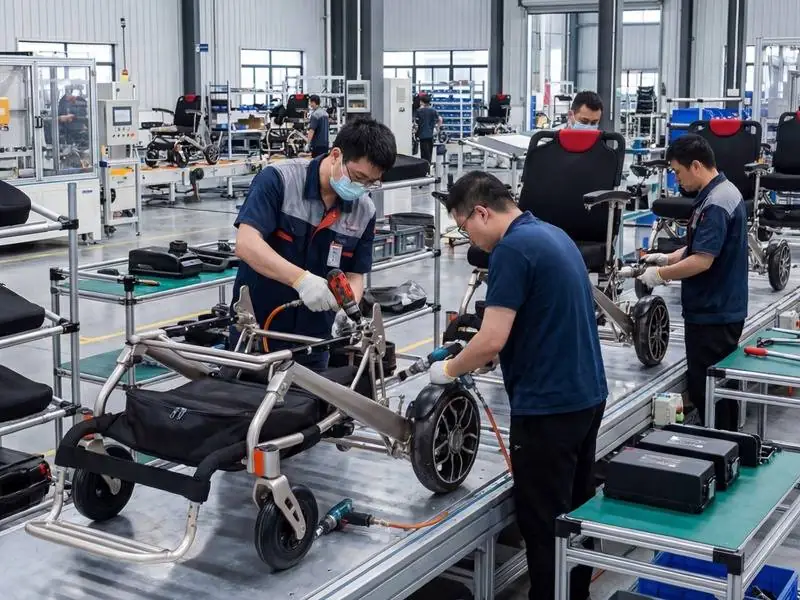
Private labeling an electric wheelchair means selling a proven, factory-built model under your own brand name — your logo on the chair, your colors, your packaging — without designing a wheelchair from scratch. (The general retail concept is well documented — see this private label overview.) For distributors, it is the fastest route from “we resell wheelchairs” to “we have our own wheelchair brand,” and it is how most regional wheelchair brands actually start. This guide walks through how to private label electric wheelchairs the way factories really run it: what you can customize, what you need to prepare, how the process works step by step, and the traps that cost first-timers money.
The first thing to get straight is the vocabulary. Private label, white label, OEM, and ODM get thrown around as synonyms, and they are not. Our OEM vs ODM guide unpacks the manufacturing models in detail; the short version is that private labeling sits at the light end of the spectrum — cosmetic branding on an existing, proven model — while full OEM can mean redesigning the chair itself. Most distributors asking about private label actually want the light end, and that is good news: it is faster, cheaper, and far less risky than most people assume.
What Does It Mean to Private Label an Electric Wheelchair?
To private label an electric wheelchair is to take a manufacturer’s existing model and make it yours on the surface: your brand name and logo on the frame, backrest, and packaging, your chosen frame color, your manual and warranty card inside the box. Underneath the branding, the engineering is unchanged — the same motors, controller, battery system, and folding mechanism the factory has already proven in the field.
That distinction matters because it defines what you are buying: not a development project, but a finished product with a track record. When something goes wrong in the field, the fix already exists; when a customer asks about range or load capacity, the data already exists. You are buying proven engineering and adding your brand equity on top.
Private label vs. white label vs. OEM — the practical difference
White label usually means the factory’s generic version with minimal branding changes, sold to many buyers who each add a sticker. Private label goes further: your colors, your logo placement, your packaging, your documentation — a product that looks and feels like your brand, even though you did not engineer it. Full OEM starts where private label stops: changing the chair’s structure, electronics, or performance. Know which one you actually need before you ask for quotes, because the price and lead time are completely different conversations. Our RFQ template for electric wheelchairs turns that decision into a document factories can quote against.
Why the “proven model” part is the whole point
The economics of private label only work because the engineering cost is already sunk. A new wheelchair design takes months of prototyping and testing; a private label version of an existing model takes weeks of artwork and sampling. Your risk is branding and marketing, not engineering — and that is a risk most distributors are far better equipped to manage.
Key Takeaway: Private labeling means your brand on a factory’s proven model — your logo, colors, and packaging over unchanged engineering. It is the light, fast end of the OEM spectrum, not a development project.
Model
What changes
What stays the same
Typical lead time
Private label
Logo, colors, packaging, manuals
Engineering, specs, certifications base
Weeks
White label
Sticker/logo only
Everything else
Days to weeks
Full OEM
Structure, electronics, performance
Manufacturing capability
Months
Why Do Distributors Private Label Electric Wheelchairs?
The honest answer is margin and control. Selling someone else’s branded chair makes you a reseller competing on price against every other reseller of the same chair. Selling your own branded chair makes you the brand — you set the price, you own the customer relationship, and no competitor can undercut you on the identical product because the identical product does not exist under their name.
There are quieter reasons too. A private label line lets you build a coherent product family — three models, one visual identity, one manual style — instead of a patchwork of supplier brands. It makes spare parts simpler, because every chair in your lineup comes from one factory relationship. And it changes how end customers see you: a distributor with its own brand reads as a serious, committed player, not a trader who will switch suppliers next quarter.
The margin math that drives the decision
A reseller margin on a third-party brand is whatever the market leaves you. A private label margin is yours to design: factory cost plus your branding cost, priced at whatever your market bears for your brand. The branding itself — logo decals, color powder-coating, printed cartons — is a small fraction of the unit cost, which is why the math works even at modest volumes.
When private label is the wrong move
Private label is not magic. If you sell ten chairs a year, the artwork and sampling effort may not pay back. If your market buys purely on the lowest price and ignores brands, the premium you hope to charge may not materialize. And if you cannot support warranty claims under your own name, do not put your name on the chair — the brand promise is yours to keep, not the factory’s.
Key Takeaway: Distributors private label for margin and control: your brand, your pricing, your customer relationship. It pays when you have real volume and can stand behind the warranty yourself.
Reason
What you gain
What it demands from you
Margin
Price-setting power
Marketing investment
Brand control
No identical-product price war
Consistent quality bar
Product family
Coherent lineup, simpler spares
Volume across models
What Can You Actually Customize on a Private Label Wheelchair?
This is where first-time buyers either over-expect or under-ask. On a private label program, you can change everything the customer sees and touches, and nothing about how the chair works. The standard customization menu at a real factory covers frame color, logo placement, cushion and backrest cover branding, packaging, and documentation — and that is usually plenty to make the chair unmistakably yours.
Frame color is the biggest visual lever. A distinctive color — rose gold, deep blue, matte graphite — does more for shelf presence than any logo. Logo placement typically includes the backrest cover, the battery box or shroud, and sometimes the armrest or footrest. Packaging is underrated: a printed carton with your brand, your model name, and your contact details turns every delivery into a brand impression, and it costs far less than most buyers expect.
The customization list we actually offer
To keep this concrete, here is our real private-label menu: frame colors from our powder-coating range, logo placement on the backrest cover, battery box, and armrests, branded retail packaging with your artwork, and manuals and warranty cards printed with your brand and local-language text. What we do not change on a private label order is the engineering — motors, controller, battery system, and folding mechanism stay exactly as tested and certified.
What to ask for in your artwork package
Prepare vector logo files, your brand color codes, the exact text for cartons and manuals, and any market-specific labeling your country requires. The single most common delay in private label orders is not production — it is artwork going back and forth because the logo arrived as a low-resolution screenshot. Send print-ready files on day one and you cut a week off the timeline.
Key Takeaway: Private label changes what the customer sees — colors, logos, packaging, manuals — not how the chair works. Send print-ready vector artwork on day one; bad files are the most common delay.
Customizable
Examples
Notes
Frame color
Powder-coating range
Biggest visual impact
Logo placement
Backrest, battery box, armrests
Vector files required
Packaging
Printed carton, your model name
Cheap brand impression
Documentation
Manual, warranty card, languages
Your contact details
What Do You Need Before Your First Private Label Order?
Four things, none complicated: your brand assets (vector logo, color codes, the exact legal name for the carton); your market’s labeling requirements — tell the factory before artwork is finalized, not after the cartons are printed; a clear model choice with battery option and accessories; and a realistic first-order quantity.
On quantity, here is where our factory differs from most: our MOQ guide explains that we accept private label orders from a single unit. That means you can order one branded sample — your colors, your logo, your carton — before committing to volume. Most factories quote 50 or 100 units minimum for custom branding; being able to hold the actual product in your hands first changes the risk profile completely.
The sample-first rule
Never place a volume private label order without approving a physical sample. Photos lie about color: powder-coating looks different under your showroom lights than in the factory’s photos, logo proportions change at real size, and carton print quality is impossible to judge on screen. One sample unit costs little and answers every question that email threads cannot.
Paperwork buyers forget
Confirm who holds the test reports and certificates behind the model you are branding — you will need them when your market’s customs or regulators ask. Agree in writing how warranty claims flow: customer to you, you to factory, with what response time. And settle spare parts supply for your branded line before you need it, because a brand with no spare parts is a brand with an expiry date. Our warranty questions guide lists the exact questions to ask any supplier.
Key Takeaway: You need brand assets, market labeling rules, a chosen model, and a sensible first quantity. Always approve a physical branded sample first — and lock down certificates, warranty flow, and spare parts in writing.
Preparation item
What to prepare
Common mistake
Brand assets
Vector logo, color codes
Low-res screenshots
Market labeling
Required markings, languages
Told after cartons printed
Model choice
Model, battery, accessories
Changing mid-production
First quantity
Start with 1 sample
Skipping the sample
How Does the Private Label Process Work, Step by Step?
The process has six steps and no mystery: inquiry (model, branding, quantity), artwork (you send assets, the factory returns mockups), sample (built as a real 1-unit order and shipped to you), approval (you check against the mockups), mass production (approved branding applied across the order), and QC/shipment in your cartons.
The step buyers underestimate is artwork approval. Every round of “can the logo be a little bigger” restarts the clock on sampling, because the factory cannot build what you have not approved. Consolidate your feedback into one round, approve once, and the timeline holds.
Where the timeline actually goes
With artwork approved promptly, our standard lead time is 7 days after payment — the same as our standard models, because private labeling adds branding steps, not engineering steps. The realistic total from first email to delivery is two to four weeks: a few days of artwork back-and-forth, sample production and shipping, your approval, then the production run. Buyers who send print-ready files on day one consistently land at the short end of that range.
What “approved” should mean in writing
Approval should be a clear, dated confirmation — an email stating “artwork v3 approved for production” — not a chat message saying “looks good.” If a color or logo placement is wrong on arrival, the written approval record is what determines who pays to fix it. Factories that insist on written approval are protecting you as much as themselves.
Key Takeaway: Six steps — inquiry, artwork, sample, approval, production, QC/shipment. Artwork approval is the usual bottleneck; consolidate feedback into one round and confirm approval in writing.
Step
Your job
Factory’s job
1. Inquiry
Model, branding, quantity
Quotation
2. Artwork
Send assets, approve mockups
Digital mockups
3. Sample
—
Build branded sample
4. Approval
Check and confirm in writing
Adjust if needed
5. Production
—
Apply approved branding
6. QC & shipment
Receive and verify
Inspect, pack, ship
What Should You Watch Out for With Private Label Wheelchairs?
Three traps catch first-timers. The first is certification responsibility: putting your brand on the chair can make you the responsible party in your market’s eyes, even though you did not manufacture it. Make sure the factory’s test reports and certificates genuinely cover the model you are selling, and understand what your market requires of the brand owner — when in doubt, ask a local compliance consultant before you order, not after customs holds your shipment.
The second trap is the spare parts gap: agree upfront which wear parts and electronics you will stock and at what lead time the factory replenishes them — customers do not forgive a branded chair that cannot be repaired. The third trap is artwork drift across reorders: keep your own approved artwork files and send the exact version every time; never assume the factory kept yours.
The question to ask before you sign anything
Ask the factory: “If my customer has a warranty claim in month eight, exactly what happens?” The answer should name a process — who you contact, what evidence they need, how the replacement part ships, who pays freight. A vague “we support warranty” is not an answer. Our standard is concrete: frame 36 months, battery, motor, and controller 12 months each, and our solutions page describes how we work with distributors on after-sales.
Keep the engineering honest
One more: never let branding enthusiasm push you into spec changes you do not understand. Private label means the engineering stays as certified and tested. If a tweak to the chair itself is ever on the table, that is no longer private label — it is custom development, with its own testing and timeline. Keep the two conversations separate.
Key Takeaway: The three traps are certification responsibility, the spare parts gap, and artwork drift. Get the warranty process in writing, stock the parts, and keep your own approved artwork files.
Trap
The risk
The fix
Certification responsibility
You are liable as brand owner
Verify reports cover your model
Spare parts gap
Unrepairable branded chairs
Agree parts supply upfront
Artwork drift
Inconsistent branding
Keep and resend your files
How Do Spare Parts and Warranty Work Under Your Private Label Brand?
This is the question that separates serious private label programs from logo-sticker exercises. When the chair carries your brand, the customer calls you — not the factory — when something breaks. That is exactly as it should be, provided you set up the back end before the first sale: a small stock of the parts that actually fail, and a clear, written warranty flow with the factory behind you.
The parts worth stocking are the wear and damage items: batteries, chargers, controllers and joysticks, tires and casters, armrest pads. These are the same parts any wheelchair distributor stocks; the only difference is that they arrive in your branded packaging and your customers associate the fast repair with your brand. A two-week wait for a controller because you ordered it only after the failure is how brands lose dealers.
Put the warranty flow in writing
Agree the process before you need it: the customer contacts you, you diagnose with the factory’s support, the factory ships the replacement part within an agreed time, and everyone knows who pays freight in which direction. Our standard warranty — frame 36 months, battery, motor, and controller 12 months each — travels with the chair regardless of whose logo is on it, and the warranty questions guide gives you the full checklist to run with any supplier.
Your brand is your after-sales
End customers do not distinguish between “the factory’s fault” and “your fault” — there is only your brand on the chair. The distributors whose private label lines thrive are the ones who treat after-sales as marketing: fast parts, clear communication, problems solved in days. Budget for it the same way you budget for the branding.
Key Takeaway: Your brand means your warranty desk. Stock wear parts up front, put the factory warranty flow in writing, and treat fast after-sales as part of the brand — not as a cost center.
Stock item
Why
Reorder trigger
Batteries & chargers
Most common replacements
Keep 5–10% of units sold
Controllers/joysticks
Damage-prone electronics
Keep 2–3% of units sold
Tires, casters, pads
Wear items
Keep with every bulk order
How Much Does Private Labeling Cost?
Less than most buyers fear. Cosmetic private labeling — colors, logos, packaging, manuals — adds a modest per-unit cost on top of the base model price, and for standard cosmetic branding there is typically no separate tooling or setup fee — your quotation will confirm the exact figure. The cost drivers are the ones you would expect: a custom frame color outside the standard range, complex multi-position logo work, fully printed cartons versus labeled ones, and translated manuals.
The expensive version of private label is the one where the buyer keeps changing the artwork. Every revision round costs sample time and attention; approve once and the cost stays where the quotation put it. And remember the sample: one branded unit up front is the cheapest insurance in the whole process.
Pricing it into your retail
Work backwards from your target retail price. Subtract your margin, subtract freight and duties, subtract the branding adder — what remains must cover the base unit cost with room to spare. If the math only works at volumes you cannot sell, the model or the market is wrong, not the factory’s price. Our about page shows the factory behind the numbers, and contact us for a real quotation on your specific branding — it takes one email to replace guessing with numbers.
The one-line pricing sanity check
Before you approve any private label quotation, run this line: (base unit + branding adder + freight + duty) × your required margin = required retail; then ask whether your market actually pays that retail for your brand. If yes, proceed. If no, change the model, the market, or the plan — not the factory’s price.
Key Takeaway: Standard private label branding adds a modest per-unit cost with no tooling fee. Price backwards from your target retail; the sample unit is the cheapest insurance you will ever buy.
Cost item
Typical shape
How to control it
Logo decals/placement
Small per-unit adder
Approve artwork once
Custom frame color
Per-unit adder
Stay in standard range
Printed cartons
Per-unit adder
Label vs. full print
Branded sample
One unit
Always order it
How Do Reorders and Scaling Work?
The first order proves the concept; reorders prove the business. Reordering a private label line should be the easiest purchase you make: same model, same artwork files, same carton — just a purchase order and the standard 7-day lead time after payment. The distributors who scale smoothly treat the first order as a template-setting exercise: every decision documented, every artwork file versioned, so reorder number ten is as clean as reorder number one.
What changes as you scale is leverage, not process. Larger quantities can improve your unit economics on freight (fuller containers) and sometimes on the branding adder itself — but the artwork, the QC criteria, and the warranty flow stay identical. Resist the temptation to “improve” the branding on every reorder; consistency is what builds brand recognition, and your customers’ shelves should look the same in year two as in month two.
Keep one artwork master file
Maintain a single master folder: the approved vector logo, the exact color codes, the carton print files, the manual version in each language. Send this folder — not last year’s email attachments — with every reorder. Artwork drift is the silent killer of private label consistency, and the fix is boring on purpose: same files, every time, no exceptions.
When to extend the line
Add a second model when the first one sells itself — not before. A private label line of two or three complementary models (say, a lightweight traveler plus a full-size daily driver) under one visual identity reads as a real brand; five models launched at once reads as a gamble. Each addition repeats the same discipline: sample first, approve in writing, stock the parts.
Key Takeaway: Reorders should be the easiest purchase you make — same artwork files, same QC, standard lead time. Scale changes your leverage, not your process; keep one artwork master folder and extend the line only when the first model earns it.
Scaling step
What to do
What to avoid
Reorder
Resend master artwork files
Digging up old email attachments
Volume growth
Consolidate freight, fuller containers
Changing branding mid-stream
Line extension
Add models that complement
Launching five at once
Conclusion
Private labeling an electric wheelchair is one of the highest-leverage moves a distributor can make: your brand on proven engineering, your pricing power, your customer relationship — for little more than the cost of good artwork and one sample unit. The process is straightforward when you respect its discipline: print-ready files on day one, a physical sample before volume, written artwork approval, and spare parts and warranty agreed upfront.
If you are ready to see what your brand looks like on a real chair, start where the risk is lowest: one branded sample, your colors and logo, built on a model with years of field history like our EW1000. Talk to us through the contact page — 1pc MOQ, 7-day lead time, and a factory that has run private label programs long enough to know where the traps are.
Frequently Asked Questions
What is the difference between private label and white label?
White label is minimal branding — usually just a logo sticker — on a generic product sold to many buyers. Private label goes further with your colors, logo placement, packaging, and documentation, making the product genuinely feel like your brand.
Can I private label just one electric wheelchair?
At our factory, yes — our MOQ is 1 unit, including branded orders. One branded sample is in fact the recommended first step before any volume commitment.
Who is responsible for certification on a private label wheelchair?
It depends on your market’s rules, but as the brand owner you are often the responsible party in regulators’ eyes. Make sure the factory’s test reports cover the exact model you sell, and check local requirements before ordering.
How long does a private label order take?
With artwork approved promptly, our production lead time is 7 days after payment. Realistically, allow two to four weeks from first inquiry to delivery including artwork, sampling, and shipping.
Can I change the chair’s design, not just the branding?
That moves beyond private label into custom OEM development, with its own engineering, testing, and timeline. Keep branding changes and engineering changes as two separate conversations.
—
About Our Company
Since 2015, our company has focused on electric wheelchairs, building practical mobility solutions for distributors and medical stores worldwide.
Our specialized focus has led to collaborations with industry leaders and experts to develop products that truly understand and meet the needs of our discerning clients.