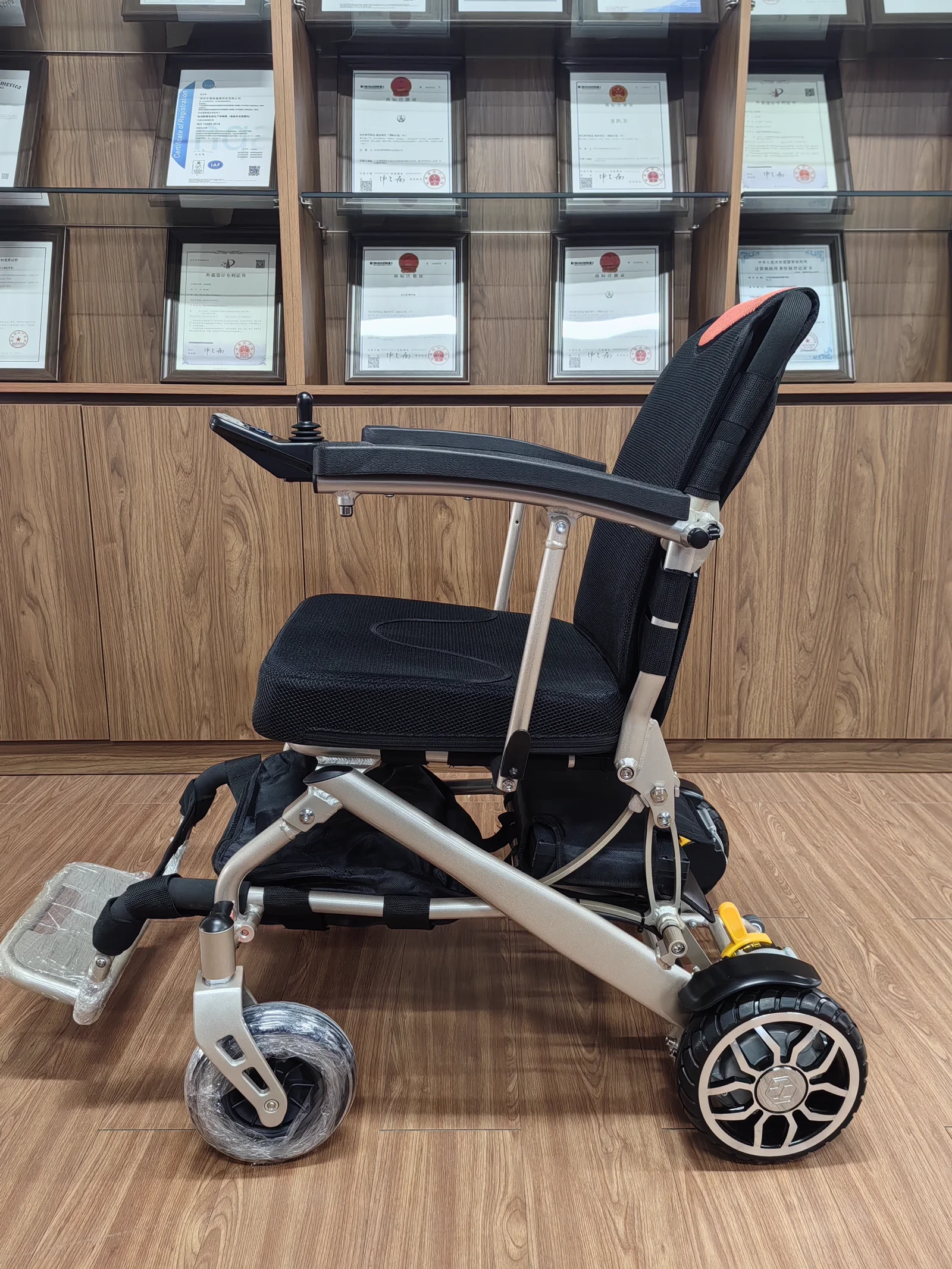
How Far Does a Folding Electric Wheelchair Go on One Charge?
October 17, 2026
One of the first questions every buyer asks about a folding electric wheelchair is also one of the most misunderstood: how far does a folding electric wheelchair go on one charge? The honest answer is that it depends — on the model, the battery, and how the chair is actually used. This guide gives you our real range figures, explains what moves them up or down, and shows you how to compare range claims between suppliers without getting misled.
We publish range for all five of our models, measured the same way, and every one of our product pages carries the same qualifier: range depends on user weight, terrain, and more. That qualifier is not fine print to hide behind — it is the most important sentence in this entire article. Our battery guides cover the chemistry; here is what those batteries deliver in kilometers.
How Far Does a Folding Electric Wheelchair Go on One Charge?
Across our lineup, published range runs from 12 to 22 km per charge — and the spread itself is instructive, because it shows how battery size drives range more than any other single factor. Our lightweight lithium models (EW1000 at 15±3 km, EW100 at 12±5 km) trade some range for portability; our lead-acid models (EW8722, EW8703G, EW8720) carry dual 12V 22.3Ah batteries and reach 18–22 km. Same factory, same testing discipline, different design priorities.
The ± in our figures is deliberate honesty, not vagueness. A 15±3 km rating tells you the chair does about 15 km under reference conditions and that real users see roughly 12–18 km depending on how they ride. Any supplier quoting a single exact kilometer figure with no range and no conditions is giving you a marketing number, not an engineering one. When you compare our EW1000 against our EW8722, you are comparing a 15 kg carbon travel chair against a long-range daily driver — different answers to different needs.
Read the range table before the marketing copy
Before believing any range claim — ours or anyone’s — find the battery specification behind it. Range without battery context is meaningless: a 22 km claim on a small lithium pack and a 22 km claim on dual lead-acid batteries describe very different chairs. The table below pairs every figure with its battery, so you can see exactly what buys the kilometers.
Why we publish ranges, not single numbers
A single number implies laboratory certainty that does not exist in real wheelchair use. Publishing 15±3 km or 18–22 km tells a distributor what to promise customers without overpromising, and it gives our own support team a defensible reference when a user asks why their chair does 13 km instead of 15. Precision about uncertainty is more useful than false precision.
Key Takeaway: Our folding wheelchair range runs 12–22 km depending on model and battery. Always pair a range figure with its battery spec and its conditions — a kilometer number alone tells you nothing.
Model
Battery
Published range
EW1000 (carbon, 15 kg)
24V 10Ah lithium (240Wh)
15±3 km
EW100 (aluminum, 23 kg)
Lithium
12±5 km
EW8722 / EW8703G / EW8720
Dual 12V 22.3Ah lead-acid (≈535Wh)
18–22 km
What Does “Range” Actually Mean on a Spec Sheet?
“Range” on a spec sheet means distance traveled on a full charge under the manufacturer’s reference conditions — typically a standard-weight rider, flat smooth surface, moderate speed, moderate temperature. Change any of those and the number moves, which is why the honest version of this article keeps repeating the conditions. There is no universal test cycle for wheelchair range the way cars have, so cross-brand comparisons are only as fair as the conditions are similar.
The physics is simple: range equals energy stored divided by energy consumed per kilometer, and energy stored is measured in watt-hours (volts × amp-hours) — the only fair way to compare batteries across voltages and chemistries. Our EW1000’s 24V 10Ah pack stores 240Wh; the dual 12V 22.3Ah setup stores about 535Wh, more than double, delivering roughly the range advantage you would expect. This battery capacity explainer walks through the Wh math with worked examples.
The three numbers that define any range claim
Every range figure rests on three inputs: battery energy (Wh), consumption per kilometer (set by weight, terrain, speed, and drivetrain efficiency), and the test conditions. If a supplier gives you the range but not the battery Wh or the conditions, you have one of three numbers — ask for the other two before comparing. This is also why our product pages state the qualifier explicitly rather than burying it.
Consumption matters as much as capacity
Two chairs with identical batteries can show different range because consumption differs — motor efficiency, controller behavior, tire rolling resistance, and total weight all take their cut. Motor type is the biggest lever here — see brushed vs brushless motors for electric wheelchairs. This is why a lighter chair does not automatically go farther: it depends on whether the weight saving came with a smaller battery. Compare Wh first, then ask about the conditions; never compare headline kilometers alone.
Key Takeaway: Range = battery energy (Wh) ÷ consumption per km, under stated conditions. Wh is the fair comparison unit across voltages and chemistries; demand it alongside every range claim.
Input
What it is
Where to find it
Battery energy
Watt-hours (V × Ah)
Spec sheet / product page
Consumption
Wh per km (weight, terrain, speed)
Rarely published — ask
Test conditions
Rider weight, surface, temperature
The honest qualifier
What Affects Real-World Range the Most?
In order of impact, the big five are: rider weight, terrain, temperature, speed, and tire condition. Rider weight is straightforward physics — moving more mass costs more energy, and the effect is roughly proportional, which is why our pages say range depends on user weight first. Terrain is the silent killer of range expectations: a route with gentle but constant inclines can halve the flat-ground figure, because climbing converts battery energy into gravitational potential with no recovery on the way up.
Temperature surprises people. Lithium batteries deliver noticeably less usable energy in cold weather — a chair that does 15 km at 25°C may do 11–12 km near freezing — while extreme heat accelerates long-term degradation even as short-term range looks normal. Speed matters because air resistance and motor losses rise faster than speed itself; the difference between a gentle cruise and full speed all day is measurable in kilometers. And under-inflated or worn tires add rolling resistance that quietly taxes every trip, which is one more reason our maintenance guide treats tire checks as range maintenance.
The realistic range rule
Take the published figure, then adjust: subtract 10–20% for a heavier rider or hilly routes, another 10–15% in cold weather, and treat the remainder as your planning number. If that planning number covers the user’s real daily distance with margin, the chair fits. Distributors who walk customers through this arithmetic get fewer “the range is wrong” complaints than those who quote the headline figure and hope.
What does not affect range (but people think it does)
Folding the chair does not change its range — folded dimensions affect transport, not energy. The joystick speed setting only matters insofar as it changes actual speed; the setting itself consumes nothing meaningful. And a newer chair of the same model does not inherently go farther than an older one unless the battery has degraded — which brings us to the battery’s own aging, covered in our guide to how long wheelchair batteries last.
Key Takeaway: Weight, terrain, temperature, speed, and tires — in roughly that order — decide real range. Plan with the published figure minus realistic deductions, and the chair will meet expectations instead of missing them.
Factor
Effect on range
What to do
Rider weight
Roughly proportional
Compare at realistic loads, not minimum
Hills and rough terrain
Can halve flat-ground range
Ask about the user’s actual routes
Cold weather
−10–25% usable energy
Plan winter range separately
High speed
Disproportionate consumption
Cruise moderate for max distance
Worn/under-inflated tires
Steady rolling-resistance tax
Monthly tire checks
How Do Battery Specs Translate Into Kilometers?
Start with watt-hours, because Wh is the energy in the tank. Our EW1000’s 24V 10Ah lithium pack holds 240Wh; the dual-battery lead-acid chairs hold about 535Wh. Divide by consumption — typically 15–25Wh per kilometer for a folding power chair depending on the factors above — and you get the published ranges: 240Wh ÷ ~16Wh/km ≈ 15 km; 535Wh ÷ ~25Wh/km ≈ 21 km. The math is approximate because consumption varies, but it shows the relationship honestly: double the energy, roughly double the range, all else equal.
This is also why battery chemistry alone does not determine range — energy does. A lithium battery is lighter per Wh and lasts more cycles, which is why our travel chairs use lithium, but a lead-acid pack with more total Wh will still go farther on a charge. Buyers who fixate on “lithium = longer range” are confusing the chemistry’s advantages (weight, lifespan, discussed in our lithium vs lead-acid guide) with the energy’s job. For range comparisons, compare Wh; for weight and lifespan comparisons, compare chemistry.
Reading a battery label like a buyer
A proper battery label gives you voltage, amp-hours, chemistry, and ideally watt-hours. Multiply V × Ah yourself to verify the Wh — it takes five seconds and catches the most common spec-sheet games, like quoting the Ah of a single cell instead of the pack. If a supplier’s label gives you Ah without voltage, or a range without either, treat both as incomplete information and ask.
Why dual batteries exist
Our long-range models use two 12V batteries rather than one larger unit for practical reasons: redundancy, easier handling (each battery is lighter to lift), and the ability to size the chair’s electrical system around standard, proven components. The trade-off is weight — lead-acid is heavy per Wh — which is exactly why these are our 18–22 km daily drivers rather than our travel chairs. Design is always a trade; honest spec sheets show you which trade was made.
Key Takeaway: Wh (V × Ah) is the energy in the tank; divide by ~15–25Wh/km consumption for a reality check on any range claim. Compare Wh for range, chemistry for weight and lifespan — they answer different questions.
Battery
Energy (Wh)
Typical range
Best for
24V 10Ah lithium
240
15±3 km
Travel, portability
Lithium (EW100)
See product page
12±5 km
Lightweight daily use
Dual 12V 22.3Ah lead-acid
≈535
18–22 km
Maximum range per charge
Why Doesn’t Your Chair Reach the Brochure Number?
Because the brochure number was measured under reference conditions and you live in the real world — and this is true of every honest manufacturer, not a defect in your chair. The reference rider is typically lighter than average, the surface is flat and smooth, the speed is moderate, the temperature is room temperature, and the battery is new. Change two of those and a 15 km chair doing 12 km is behaving exactly as physics predicts.
Before concluding anything is wrong, run the checklist: full charge after a complete cycle, tires in good shape, route no hillier than estimated, and reasonable temperature. An aged battery also explains a lot — a two-year-old pack with hundreds of cycles holds less than a new one, as our battery lifespan guide explains. In the large majority of “range disappointment” cases we hear about, the answer is conditions or battery age, not a faulty chair.
When short range IS a problem
There are genuine faults that cut range: a battery with a dead cell (charges “fully” in suspiciously short time, then drops fast), a dragging brake or seized caster forcing the motors to work overtime, or a charger that never actually completes the cycle. The diagnostic order is battery first, mechanical drag second, charger third — and our maintenance guide’s inspection routines catch the mechanical causes. If a new chair under reference-like conditions misses its published range by a wide margin, that is a warranty conversation, and you should have it with data: your weight, your route, the temperature, the battery’s age.
How to talk about this with customers
Distributors: never promise the headline number as a guarantee. Promise the planning number — headline minus realistic deductions for the customer’s weight and terrain — and you will under-promise and over-deliver, which is the entire game in after-sales satisfaction. Put the conditions in writing on the quotation; it takes one sentence and prevents the most common post-sale dispute in this industry.
Key Takeaway: A chair missing its brochure range under real conditions is usually physics, not a fault — check charge, tires, terrain, temperature, and battery age first. Genuine faults show as sudden, large drops, and those deserve a data-backed warranty discussion.
Symptom
Likely cause
Action
10–20% below published
Conditions (weight, hills, cold)
Normal — adjust planning number
Sudden large drop
Dead cell, dragging brake, bad charger
Diagnose in order: battery, mechanical, charger
Gradual decline over years
Normal battery aging
Plan replacement; see lifespan guide
How Can Riders Extend Their Range?
The free gains come from habits, not hardware. Charge fully before long days — partial charging is fine for short trips but never the basis for range planning. Keep tires properly maintained and cruise at moderate speed; both savings are disproportionate to the effort. And plan routes: a flat 3 km route beats a hilly 2 km route on energy, even though it is longer on the map.
Battery care is range care over time. Everything in our charging and storage guidance — correct charger, no deep discharges, no extreme heat, no long-term flat storage — preserves the battery’s capacity, which is what “range” means a year from now. A well-kept battery still delivers near its rated Wh after hundreds of cycles; a neglected one can lose a quarter of its capacity in a single abusive summer. The habits are in our guides to how long wheelchair batteries last and maintenance; the payoff is measured in kilometers.
The spare-battery strategy
For users whose days genuinely exceed one charge, a second battery is more practical than a bigger chair. Swapping takes a minute, doubles the day’s range, and the spare charges while the chair works. Distributors: this is also a natural attach sale at purchase time, when the customer’s range anxiety is highest and the value proposition is clearest. Make sure the spare is the correct matched battery for the model — batteries are not interchangeable across chairs.
What does not help (despite the forums)
Aftermarket “range extender” gadgets, over-inflating tires beyond spec, and running the battery to absolute zero “to calibrate it” — none of these help, and the last two actively harm. The lithium battery’s management system already handles calibration; deep discharges just age the cells faster. If a forum tip sounds like free energy, it is misunderstanding energy.
Key Takeaway: Full charges, maintained tires, moderate speed, smart routes, and good battery habits — the free range gains. For genuinely long days, a matched spare battery beats every trick.
Habit
Range effect
Cost
Full charge before long days
Starts at 100%, not 80%
Free
Moderate cruising speed
Disproportionate saving
Free
Tire maintenance
Removes rolling-resistance tax
Minutes monthly
Correct charging and storage
Preserves capacity over years
Free
Matched spare battery
Doubles the day
Purchase
What Range Fits Typical Daily Use?
Match the chair to the day, not the dream. Indoor and around-the-block use — under 5 km — is comfortably served by any of our models; range is simply not the deciding factor here, so choose on weight, folded size, and comfort instead. Mixed daily use — errands, appointments, park visits, roughly 5–12 km — is the heartland where our lithium travel chairs live, provided the planning number (not the headline) clears the day with margin.
Full-day outdoor use — 12 km and beyond, all-day outings, rural routes — points to the long-range lead-acid models, whose 18–22 km gives genuine all-day confidence. And for users whose needs vary, the spare-battery strategy from the previous section effectively moves any chair one category up. The most expensive mistake in this decision is buying range you will never use at the cost of portability you need every day — a 22 km chair that never leaves the neighborhood but will not fit in the car boot is the wrong chair bought for the right reason.
The distributor’s sizing conversation
Ask the customer for their real week, not their aspirations: how far on the longest normal day, what terrain, what temperature range, and whether a car boot matters. Then recommend from the planning number. This five-minute conversation prevents the two classic mismatches — the travel chair bought for farm tracks, and the heavy long-range chair bought for apartment living — and it positions you as the dealer who asks questions, which is worth more than any spec sheet.
Range is one spec among many
A fixation on range alone produces bad purchases. Weight determines whether the chair travels; folded dimensions determine whether it fits the car; seat comfort determines whether the user tolerates long days at all; after-sales determines what happens in year two. Range gets the headline because it is a number, but the best chair for a customer is the best balance — which is exactly what a good distributor helps them find.
Key Takeaway: Under 5 km daily: any model, choose on other specs. 5–12 km: lithium travel chairs with margin. 12 km+: long-range models or a spare battery. Never buy range you won’t use at the cost of portability you need daily.
Daily distance
Fit
Note
Under 5 km
Any model
Decide on weight, size, comfort
5–12 km
EW1000 / EW100 (lithium)
Use planning number with margin
12 km and beyond
EW8722 / EW8703G / EW8720
18–22 km all-day confidence
Variable days
Any + spare battery
One category up, on demand
Should Distributors Verify Range Themselves?
Yes — and it is easier than it sounds, plus it pays for itself in credibility. When your sample chair arrives, run your own range loop: a measured course, a rider weight close to your market’s average, the speed your customers actually use, and honest notes on temperature and terrain. One afternoon gives you a planning number you can stand behind with customers, replacing the brochure figure with “we tested it here, this is what it does.”
Document the test the same way every time — same course, same rider weight, same protocol — and you build a comparison database across models and even across suppliers that no brochure can argue with. Photograph the battery label, record the starting and ending gauge readings, and keep the results with the sample record. When a customer later questions range, you answer from your own data, which ends the discussion. Our travel guide covers the related discipline of verifying travel-relevant specs before you promise them.
What to do when your test disagrees with the brochure
First, check your conditions against the reference conditions — most disagreements dissolve here. If your honest test still shows a large gap on a new chair, raise it with the factory with your data attached: course, weight, temperature, battery age, gauge readings. A professional factory will engage with data — it may reveal a genuinely underperforming battery, which is a warranty matter, or it may refine everyone’s understanding of the conditions. Either outcome beats arguing about a headline number.
Turn testing into marketing
“We test every model’s real range before we sell it” is a powerful sentence on a distributor’s website, and it costs one afternoon per model. Publish the methodology, not just the numbers — customers trust a dealer who shows the work. In markets where competitors quote brochure figures, tested figures are a quiet but decisive differentiator.
Key Takeaway: Run your own measured range loop on every sample; document it identically each time. Your own data ends customer disputes and becomes marketing no competitor can copy-paste.
Test element
Standardize
Why
Course
Same measured loop
Comparability across models
Rider weight
Near market average
Relevance to your customers
Speed
Typical customer speed
Real-world validity
Records
Label photo, gauge readings
Dispute-proof documentation
What Should You Ask Your Supplier About Range?
Five questions separate professional suppliers from brochure suppliers: the exact battery spec (voltage, amp-hours, chemistry, watt-hours) and the reference conditions behind the figure (rider weight, surface, speed, temperature). Ask whether the figure is a single test, an average, or an honest spread — and how range, cost, and weight change across battery options. Finally, ask what they tell distributors to promise customers: the headline, or a planning number with deductions? Listen for specifics volunteered before you ask.
Listen to how the answers come. A supplier that answers all five with specifics, volunteers the qualifier before you ask, and points you to the product page data is operating the way we try to operate. A supplier that gets vague on conditions, cannot state the Wh, or treats the question as an accusation is telling you how the after-sales relationship will go. Range is a small window into factory culture — use it.
The question behind the questions
What you are really asking is: does this factory think in engineering or in marketing? Every answer above has a version that is honest and a version that is evasive, and experienced buyers learn to hear the difference in seconds. Our standing offer, extended in every article we write: bring us your hardest technical questions first, on range or anything else — including through our contact page — because how a factory handles scrutiny is the most reliable quality signal there is.
How we answer these five questions ourselves
Battery: every model page lists voltage, amp-hours, chemistry, and the resulting watt-hours. Conditions: our published ranges carry the plain qualifier about user weight, terrain, and temperature — no fine print. Spread: we publish 15±3 km and 18–22 km, not single laboratory numbers. Options and trade-offs are on the spec tables, and our planning-number method is this article itself. Hold us to all of it.
Key Takeaway: Battery Wh, reference conditions, honest spread, option trade-offs, and the planning number — five questions that reveal whether your supplier thinks in engineering or marketing.
#
Ask
Honest answer sounds like
1
Exact battery spec?
“24V 10Ah lithium, 240Wh”
2
Reference conditions?
“75 kg rider, flat, 20°C, moderate speed”
3
Single number or spread?
“15±3 km depending on use”
4
Battery options’ trade-offs?
“Bigger pack: +6 km, +4 kg, +$X”
5
What should we promise?
“The planning number, not the headline”
Conclusion
How far a folding electric wheelchair goes on one charge comes down to three things: the energy in the battery (watt-hours), how fast the chair spends it (weight, terrain, temperature, speed), and the honesty of the conditions behind the quoted figure. Our range runs 12–22 km across the lineup — 15±3 km for the carbon travel chair, 12±5 km for the aluminum lightweight, 18–22 km for the long-range lead-acid models — each paired with its battery spec and the same plain qualifier about real-world conditions.
For buyers, the method in this guide beats any single number: compare Wh, deduct for your real conditions, plan from the planning number, and verify with your own test loop if you are buying at volume. And if you are evaluating us as a supplier, start with the five questions in the last section — asked through alice@zvcare.com, answered with data. A factory confident in its engineering welcomes the arithmetic.
Frequently Asked Questions
How far can a folding electric wheelchair go on a single charge?
It depends on the model and battery: our lineup publishes 12–22 km — the EW1000 carbon travel chair does 15±3 km on its 240Wh lithium pack, while our lead-acid models reach 18–22 km on about 535Wh. Real-world range varies with rider weight, terrain, temperature, and speed; plan from a realistic planning number rather than the headline figure.
What does 240Wh mean on a wheelchair battery?
Watt-hours measure the battery’s total stored energy: volts × amp-hours. A 24V 10Ah pack stores 240Wh. Wh is the only fair way to compare batteries across voltages and chemistries — divide Wh by roughly 15–25Wh/km consumption for a reality check on any range claim.
Why is my wheelchair’s range lower in winter?
Lithium batteries deliver less usable energy in cold weather — expect roughly 10–25% less range near freezing compared to room temperature. This is normal chemistry behavior, not a fault. Plan winter range separately if the chair is used outdoors in cold climates.
Does a heavier rider reduce the range?
Yes, roughly proportionally — moving more mass costs more energy. Our published figures assume reference conditions, so heavier riders, hilly routes, or both will see lower real-world range. Use the planning-number method in this guide: headline minus realistic deductions.
Can I extend my wheelchair’s range with a second battery?
Yes — a matched spare battery is the most practical range extender, effectively doubling the day’s distance with a one-minute swap. Make sure it is the correct battery for your exact model; wheelchair batteries are not interchangeable across chairs. Ask your distributor about a spare at purchase time, when the value is clearest.
—
About Our Company
Since 2015, our company has focused on electric wheelchairs, building practical mobility solutions for distributors and medical stores worldwide.
Our specialized focus has led to collaborations with industry leaders and experts to develop products that truly understand and meet the needs of our discerning clients.