OEM vs ODM Electric Wheelchair: What's the Difference?
October 17, 2026
If you are sourcing electric wheelchairs from China, you will run into two terms in the first conversation with any factory: OEM and ODM. Understanding the oem vs odm electric wheelchair decision is not academic — it determines who owns the design, what you can customize, how many units you must order, and how fast you can get to market. This guide explains both models the way a factory sees them, so you can choose with open eyes.
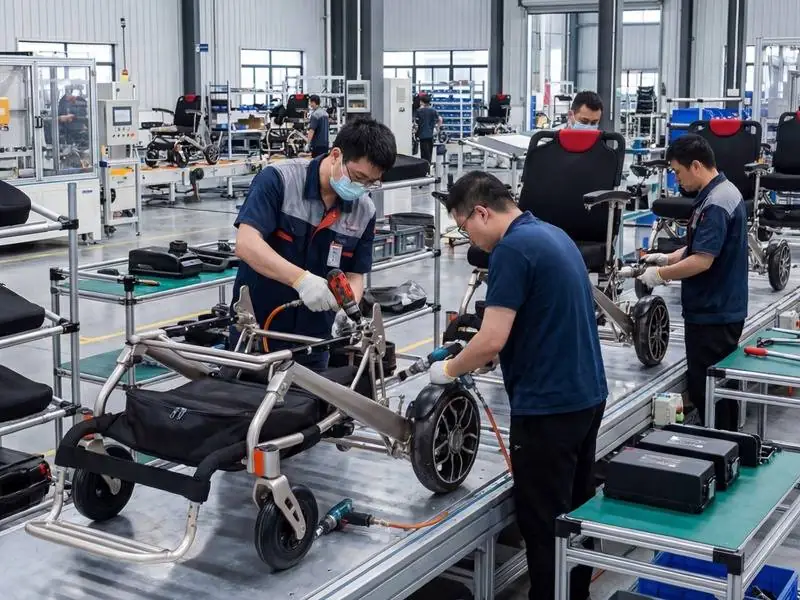
We are ZVCARE, a Shenzhen electric wheelchair manufacturer, and we work both ways: some partners bring us their own designs to build (OEM), others take our proven platforms — the EW1000, EW100, EW8722 and the rest — and sell them under their own brand (ODM). Both are legitimate; they simply fit different businesses. Our OEM solutions page outlines what we offer, and this article explains how to decide.
What Do OEM and ODM Actually Mean in Electric Wheelchair Manufacturing?
OEM — Original Equipment Manufacturing — means you provide the design and the factory builds to your specification. Your drawings, your dimensions, your choice of materials, your brand on every unit. The factory contributes production capacity, process engineering, and quality control, but the product identity is yours. If you have ever wondered why two wheelchairs can look identical yet carry different brands, ODM is usually the answer.
ODM — Original Design Manufacturing — reverses the roles: the factory provides a finished, tested design, and you customize and brand it. You choose from existing platforms, specify your colors, logo placement, packaging, and documentation language, and the factory produces your branded version. It is faster and cheaper to start because the design, tooling, and testing already exist — you are not paying to invent a wheelchair, only to make it yours.
The one-sentence test
If you can answer “who designed this chair?” then you understand the difference: with OEM, the answer is you; with ODM, the answer is the factory. Everything else — cost, timeline, customization depth, IP ownership — flows from that single distinction. For a realistic stage-by-stage picture of the production schedule, see how long electric wheelchair OEM takes: a factory timeline. When a factory quotes you, the first clarifying question should always be which model the quote assumes, because an OEM quote and an ODM quote for “the same” wheelchair are built from completely different cost structures.
Why the distinction matters more in wheelchairs than in simpler products
An electric wheelchair is a regulated medical-adjacent device with motors, controllers, batteries, and safety systems that must work together — not a commodity you can re-spec on a whim. Under OEM, you carry the responsibility for getting that system design right; the factory will build exactly what your drawings say, including any mistakes. Under ODM, the factory has already debugged the system across thousands of units, which is why ODM chairs from an established manufacturer tend to have fewer first-year surprises. For more on how manufacturing models affect product development generally, see this neutral OEM vs ODM explainer.
Key Takeaway: OEM means you own the design and the factory builds it; ODM means the factory owns the design and you brand it. The right choice depends on your design capability, budget, timeline, and how much differentiation your market needs.
OEM
ODM
Who designs the chair
You (the buyer)
The factory
Design/IP ownership
Yours
Factory’s (your brand assets are yours)
Customization depth
Full — geometry, materials, systems
Bounded — colors, branding, config, packaging
Upfront investment
Higher (design, tooling, validation)
Lower (existing platform)
Time to market
Longer
Shorter
How Does the OEM Process Work, Step by Step?
A real OEM project follows a disciplined sequence, and understanding it helps you judge whether a factory is serious. It starts with requirement discussion: you describe your target market, positioning, required certifications, and expected volumes, and the factory assesses feasibility and responds with an initial cost structure. Vague requirements at this stage produce vague quotes — the factories worth working with will push back and ask hard questions. To get comparable quotes from multiple factories, start from our RFQ template for electric wheelchairs.
Next comes sample development: the factory builds to your specification and you test each sample against your own criteria, not the factory’s brochure. Expect iterations — the first sample validates direction, rarely perfection. Only after formal approval does mass production begin, with inspection criteria agreed in advance. Our guide to importing electric wheelchairs from China covers the commercial mechanics around this process.
What the factory needs from you
OEM only works if you arrive with something concrete: technical drawings or at minimum fully dimensioned specifications, target performance figures (range, load, speed), your branding assets, and clarity on certifications for your market. “Build me something like your EW1000 but better” is not an OEM brief — it is a request for the factory to do your design work. The more complete your input, the more accurate the quote and the fewer sample rounds you will burn through.
Where OEM projects usually stall
In our experience, OEM timelines slip for three predictable reasons: incomplete specifications that force the factory to guess, certification requirements discovered late (a market needs a document nobody mentioned in month one), and approval bottlenecks on the buyer side where samples wait weeks for feedback. All three are preventable. A factory that gives you a structured specification template and a certification checklist upfront — before quoting — is showing you it has run this process before.
Key Takeaway: OEM runs requirement → sample → approval → production. Your specification quality determines everything downstream: complete inputs get accurate quotes and fast samples; vague inputs get all three failure modes.
Step
Your deliverable
Factory deliverable
Requirement discussion
Specs, market, certifications, volumes
Feasibility review, initial cost structure
Sample development
Feedback on each iteration
Built-to-spec samples, test data
Approval
Formal sign-off
Frozen BOM and inspection criteria
Mass production
Purchase orders
Production, QC, shipment
How Does the ODM Process Work?
ODM starts from the opposite end: instead of a blank page, you start with a proven chair. The process opens with platform selection — you evaluate the factory’s existing models against your market’s needs: weight, folded size, range, load capacity, price positioning. This is hands-on work: request samples of two or three candidate platforms and test them the way your customers will use them, because the platform you pick is the product you will live with.
Then comes customization within the platform’s bounds. This is where many buyers underestimate what is possible: frame colors, logo placement and method, seat and backrest materials, packaging design, user manual language, charger plug type, and configuration choices like battery options. What you cannot change without crossing into OEM territory is the core geometry and the validated system design — the frame structure, motor-controller-battery integration, and safety architecture that the factory has already tested. Respect that boundary and ODM delivers remarkable speed; fight it and you pay OEM prices for ODM speed.
Why ODM dominates first-time wheelchair brands
Most new mobility brands choose ODM for their first product, and the logic is sound: no R&D payroll, no tooling investment, no debugging a novel drivetrain in public. You get a chair that has already survived thousands of real users, your brand on it, and a path to market measured in weeks rather than quarters. The trade-off is differentiation — your competitors can buy the same platform — which is why branding, service, and channel execution matter more under ODM than under OEM.
The honest limits of ODM customization
A straight-talking factory will tell you what it cannot do on an ODM platform: it cannot change the folding geometry, cannot swap in an unvalidated motor-controller combination, and cannot promise certifications the platform was never tested for. Be wary of any supplier that says yes to everything — in wheelchair manufacturing, “yes to everything” usually means “we will figure it out during your production run,” which is exactly where quality problems are born.
Key Takeaway: ODM means selecting a proven platform and branding it within real engineering bounds. It is the fastest credible path to market — provided you respect what the platform was validated for.
What changes
What stays
Branding
Logo, colors, packaging, manuals
Factory’s platform identity underneath
Configuration
Battery options, accessories, plugs
Core frame geometry
Market adaptation
Documentation language, charger type
Validated safety architecture
OEM vs ODM: Which Model Fits Your Business?
Choose by your situation, not by which sounds more prestigious. OEM fits buyers who own a design or have the engineering resources to develop one, need genuine differentiation, and can fund tooling and validation. ODM fits everyone else — distributors building a brand quickly, e-commerce sellers testing a category, established retailers adding a mobility line without an R&D department. Neither is “better”; they answer different business questions.
A useful rule of thumb: if your competitive advantage will come from the product itself — a novel folding mechanism, a patented frame, a unique clinical feature — you need OEM, because ODM cannot give you what the factory never designed. If your advantage will come from brand, service, price, or distribution — the far more common case — ODM gets you selling while competitors are still in CAD. Many successful brands do both sequentially: ODM to enter and learn the market, OEM for the differentiated second generation funded by the first.
The startup question
First-time wheelchair brands almost always belong in ODM. The capital efficiency is decisive: instead of funding a full development program before your first sale, you invest in branding, inventory, and go-to-market — the things that actually determine whether a new mobility brand survives year one. Once you have sales data, customer feedback, and cash flow, you will know exactly what your OEM design should improve, which is a far stronger brief than any first-timer writes.
The established-brand question
If you already sell mobility equipment and want a wheelchair line that nobody else has, OEM earns its keep. Your volume justifies the tooling, your engineers can hold up their end of the technical conversation, and the differentiation protects your margins from the price erosion that hits shared ODM platforms. Just budget honestly: design, tooling, testing, and certification for your markets, plus the management time to run sample iterations properly.
Key Takeaway: ODM for speed and capital efficiency; OEM for differentiation you can defend. Match the model to where your competitive advantage actually comes from — product novelty points to OEM, brand and execution point to ODM.
Your situation
Recommended
Why
New brand, first wheelchair product
ODM
Fastest credible market entry, no R&D spend
Testing a new market or channel
ODM
Low commitment, quick read on demand
Patented or novel design to protect
OEM
Only OEM gives you design ownership
Existing volume justifying tooling
OEM
Differentiation defends margins long-term
What Can You Actually Customize Under Each Model?
This is where factory honesty matters most, so here is our real list. Under ODM on our platforms, you can specify frame colors, logo placement and application method, seat and backrest upholstery materials, packaging design and branding, user manual and labeling languages, charger plug type for your region, and battery configuration choices where the platform supports options. That is a substantial branding palette — enough that two distributors selling the same platform can look like completely different brands to end users.
Under OEM, the palette opens fully: frame geometry, material selection, component specification down to the motor and controller models, entirely custom branding and packaging, and documentation built around your design. The boundary between the models is engineering validation: anything that changes how the chair behaves structurally or electrically needs the full OEM treatment — design review, prototyping, testing — because it invalidates the testing the ODM platform already passed.
How to read a factory’s customization list
When evaluating suppliers, ask for the customization list in writing and watch for two red flags. First, a factory that claims unlimited ODM customization is either inexperienced or planning to learn on your order. Second, a factory that cannot show you physical examples of past custom work — actual branded chairs, actual custom packaging — is selling a capability it may not have exercised. Our About page shows our facility, and we keep sample archives of custom projects for exactly this conversation.
Packaging: the underestimated customization
Distributors routinely under-specify packaging and regret it. Your carton is your brand’s first physical impression, it determines freight damage rates, and in e-commerce it is literally the product photo’s backdrop. Specify double-wall cartons, custom print, foam layout, and included documentation as deliberately as you specify the chair — and confirm the packaged dimensions, because a carton 5 cm too large can erase your margin on air freight.
Key Takeaway: ODM customization covers branding, colors, materials, packaging, and documentation — more than most buyers expect. OEM adds full engineering freedom. Judge any factory by written lists and physical samples, not promises.
Minimum order quantity is where the two models diverge most visibly — and where you should read every factory’s policy carefully. ODM, being built on existing platforms with existing tooling, can usually start at low volumes; some factories quote 10–50 units as typical for custom ODM runs, reflecting setup costs for your branding and packaging. OEM, with its tooling and development investment to amortize, traditionally demands more.
Our policy is deliberately different: 1 unit MOQ, including for customized orders. We can do this because our platforms are mature, our customization processes are production-line routines rather than special projects, and we would rather earn a distributor’s growth than gatekeep it behind volume. If you are comparing factories, MOQ is one of the fastest filters — a factory that needs 50 units to change a logo is telling you something about how its production is organized. Our MOQ guide explains exactly what “1 unit” covers.
Why MOQ exists at all
MOQ is not a tax on small buyers; it reflects real setup economics — line changeovers, custom material procurement, packaging print runs, documentation preparation. When a factory quotes a high MOQ, it is usually saying these setup tasks are manual and disruptive in its operation. Low MOQ, honestly offered, signals that customization is systematized. Ask any factory not just what its MOQ is, but what drives it — the answer reveals operational maturity.
Sampling vs. MOQ: don’t confuse them
Samples are not small MOQs; they serve a different purpose. A sample validates the product before you commit — fit, finish, performance, documentation — and sample pricing reasonably reflects the one-off handling involved. Be suspicious of “free samples” on fully custom work (someone is cutting a corner) and equally suspicious of sample prices that look like retail plus a penalty. A professional factory prices samples transparently and credits them against your first production order.
Key Takeaway: ODM MOQs are structurally lower than OEM; ours is 1 unit for both. When comparing factories, ask what drives their MOQ — the answer tells you how systematized their customization really is.
Typical market
ZVCARE
ODM custom MOQ
Often 10–50 units
1 unit
OEM MOQ
Higher (tooling amortization)
1 unit
Sample availability
Usually yes, priced
Yes, credited to first order
How Do Lead Times Differ Between the Two Models?
Standard production lead time is the easy part: our lead time is 7 days after payment for our standard and customized ODM chairs, because the platform is proven and customization runs on routine processes. That is the number to hold us to, and it is the number your planning should use. Where lead times genuinely diverge is everything before production starts.
OEM adds development time that no factory can compress away: design finalization, tooling, prototyping, sample iterations, testing, and certification documentation for your markets. Anyone quoting OEM mass-production timelines without accounting for these phases is quoting a fantasy. ODM’s advantage is precisely that all of this already happened — your timeline is sample approval plus the standard production lead time. When a factory gives you a lead time, always ask what it includes and, more importantly, what it assumes you have already completed.
The sample trap
The most common lead-time disappointment in wheelchair sourcing is not production — it is samples. Buyers approve a sample mentally, then discover the approval itself took six weeks of internal debate, or the “final” sample needs one more revision. Protect your timeline by agreeing the sample evaluation criteria before the sample ships, naming the single person on your side who approves, and treating each sample round as a scheduled event, not an open-ended activity.
Planning around real timelines
For ODM, a realistic plan is: 1–2 weeks for platform samples and selection, your evaluation time, customization confirmation, then production lead time plus freight. For OEM, add the full development program before that sequence starts, and add contingency — first-of-kind designs always find something in testing. Build your launch calendar backward from when you need sellable inventory, not forward from when you place the order.
Key Takeaway: Our production lead time is 7 days after payment for proven platforms. OEM’s extra time lives in development, not production — budget for design, tooling, and testing honestly, and your launch date will survive contact with reality.
Phase
ODM
OEM
Design and tooling
Done (existing)
Your program, your timeline
Samples
Platform samples, fast
Built to your spec, iterative
Production
7 days after payment (our standard)
After design freeze and approval
What Should Your Manufacturing Agreement Cover?
Whether OEM or ODM, put the important things in writing before production — not because you distrust your factory, but because written agreements prevent the misunderstandings that destroy partnerships. The specification comes first: exact model, configuration, branding details, packaging, and documentation, each version-controlled. If it is not in the spec, you cannot fairly reject it at inspection.
Quality terms follow: inspection criteria, acceptable quality limits, who inspects (you, the factory, or a third party), and what happens to rejected units — rework, replacement, or credit, with timelines. Then the commercial backbone: pricing and validity period, payment terms, lead times with start-point definitions, and the warranty in full — ours is frame 36 months with battery, motor, and controller at 12 months each, and our warranty guide details what that means in practice. Finally, the forward-looking clauses: spare parts availability and pricing, documentation updates, and who owns what IP under your chosen model.
The IP clause, plainly stated
Under OEM, your agreement should state explicitly that the product design, tooling you paid for, and all related IP are yours, and that the factory will not produce your design for others. Under ODM, it should state that the base platform remains the factory’s while your branding assets, custom packaging designs, and any modifications you funded are yours. Vague IP language is the most expensive sentence to litigate later; precise language is the cheapest insurance you will ever buy.
Spare parts: the clause buyers forget
Wheelchairs need consumables — tires, joystick boots, batteries, chargers — and your customers will come back to you, not the factory, when they wear out. Your agreement should lock in spare parts availability for a defined period, pricing mechanics, and lead times for parts orders. A factory that hesitates on spare parts commitments is signaling where its after-sales priorities lie. We maintain parts for every model we build and publish a dedicated spare parts page for exactly this reason.
Key Takeaway: Spec, quality terms, commercial terms, warranty, IP ownership, and spare parts — in writing, before production. The agreement is not about distrust; it is how professionals prevent the misunderstandings that kill partnerships.
Clause
Why it matters
Get specific on
Specification
Defines what “correct” means
Version-controlled BOM and drawings
Quality and inspection
Defines acceptable vs. reject
Criteria, AQL, who inspects
Warranty
Defines post-sale responsibility
Duration per component, claim process
IP ownership
Defines who owns the design
OEM: yours; ODM: platform factory’s, brand yours
Spare parts
Defines long-term support
Availability period, pricing, lead time
How Do You Start an OEM or ODM Project With Us?
Start with a conversation, not a purchase order. Tell us your market, your positioning, which model you are leaning toward — or that you are unsure, which is completely fine — and we will tell you honestly which fits, including telling you when ODM is the smarter first step. Send your specifications if you have them; if you don’t, we will work from our platforms and your branding requirements.
What happens next is structured: platform selection or requirement review, samples, your evaluation, customization confirmation, production on our 7-day lead time after payment, and shipment with full documentation. One unit MOQ means you can validate with a single branded sample before committing to inventory — the lowest-risk way we know to start a manufacturing relationship. Reach us at alice@zvcare.com, or through our contact page — and if you are comparing factories, bring us your hardest questions first. How a factory handles those tells you everything.
What to send in your first message
Your market and positioning, which model you are leaning toward (or that you are unsure), your target volumes, and any must-have certifications. If you have specifications or drawings, send them; if not, tell us which of our platforms caught your eye and what you would change. A short, honest brief gets you a useful answer within a day; a vague “send catalog and best price” gets you a catalog.
What happens after you reach out
We reply with a straight recommendation — OEM, ODM, or “start ODM, consider OEM later” — plus the honest implications for MOQ, timeline, and cost structure. Then samples: a branded unit you can test, measure, and show your customers before any inventory commitment. No pressure to scale until the sample has earned it.
Key Takeaway: Start with an honest brief — market, volumes, certifications, and what you want to change. We reply with a straight OEM/ODM recommendation, then a branded sample; you commit to inventory only after the sample earns it.
Step
What happens
Your commitment
First contact
Honest OEM/ODM recommendation
A clear brief, nothing more
Sampling
Branded sample to test
Sample cost, credited to first order
Production
7-day lead time after payment
1 unit MOQ
Conclusion
OEM and ODM are not rivals — they are two doors into the same factory, and the right door depends on where your advantage comes from. Bring a design worth protecting and the resources to develop it, and OEM gives you ownership and differentiation. Bring a brand, a channel, and the need for speed, and ODM puts a proven, tested wheelchair under your name in weeks. Many of our longest partnerships started at the ODM door and walked through the OEM one later, once the market had taught them exactly what to build.
Whichever door you choose, the fundamentals do not change: a written specification, agreed inspection criteria, honest lead times, a real warranty, and spare parts you can count on in year three. We hold ourselves to 1 unit MOQ and 7 days production lead time after payment because those numbers remove the two biggest reasons distributors hesitate to start. If you are ready to talk, alice@zvcare.com reaches the people who actually build the chairs — start with your hardest question and judge us by the answer.
Frequently Asked Questions
What is the difference between OEM and ODM in one sentence?
In OEM you provide the product design and the factory builds it; in ODM the factory provides a proven design that you customize and brand. Who designs the chair is the entire difference — cost, timeline, and IP all follow from it.
Can I really start with just 1 unit?
With us, yes — our MOQ is 1 unit including customized orders, because our platforms are mature and customization runs as production-line routine. Across the market, custom ODM runs typically start at 10–50 units, so always confirm the specific factory’s policy rather than assuming.
Who owns the design under each model?
Under OEM, you own the product design and any tooling you paid for — your agreement should say so explicitly. Under ODM, the factory owns the base platform design while your branding assets, custom packaging, and funded modifications are yours. Get it in writing either way.
How long does it take to get my branded wheelchairs?
For ODM on our proven platforms: sample evaluation on your schedule, then 7 days production lead time after payment, plus freight. For OEM, add the full development program — design, tooling, prototyping, testing — before production can start. Always ask what a quoted lead time includes.
Can I switch from ODM to OEM later?
Yes, and many successful brands do exactly that: ODM to enter the market quickly and learn what customers want, then OEM for a differentiated second generation funded by the first round’s revenue. Your ODM experience gives you the market knowledge to write a far stronger OEM brief.
—
About Our Company
Since 2015, our company has focused on electric wheelchairs, building practical mobility solutions for distributors and medical stores worldwide.
Our specialized focus has led to collaborations with industry leaders and experts to develop products that truly understand and meet the needs of our discerning clients.