Can a Folding Electric Wheelchair Handle Grass, Gravel, and Slopes?
October 23, 2026
Can a folding electric wheelchair handle grass, gravel, and slopes? If you stock folding models, your customers will ask you exactly that — and the honest answer is more nuanced than a simple yes or no. This guide breaks down what folding electric wheelchairs genuinely handle, where they struggle, and how to advise your customers without overpromising.
Can a Folding Electric Wheelchair Handle Grass?
Short, firm grass — a maintained lawn, a dry garden path — is fine. Long grass, wet ground, or soft soil after rain is not: the small front casters sink and the drive wheels spin instead of gripping.
How does firm grass differ from soft ground?
Firm, mowed grass behaves almost like pavement, with predictable steering and near-normal battery drain. Soft or waterlogged ground raises rolling resistance sharply — the casters dig in and the chair works harder for every meter, which is also why off-pavement use shortens working range (see our folding wheelchair range guide).
What should you tell a customer who crosses lawns daily?
Ask how often and how far. An occasional shortcut across a dry lawn is fine for any folding model. A daily route across uneven park ground needs wider pneumatic tires and more motor power — and the customer must understand a folding chair is still a compromise, not an all-terrain machine.
Key Takeaway: Firm, dry grass is fine; wet or long grass is not. Match tire and motor to the customer’s actual route.
Grass condition
How a folding chair behaves
What tells you it is too soft
Dry, mowed lawn
Rolls nearly like pavement
—
Damp, short grass
Slower, more steering correction
Ruts forming — turn back
Long or waterlogged grass
Wheels spin, chair can get stuck
Drive wheels dig instead of rolling
What Happens on Gravel and Loose Surfaces?
Gravel is harder on a folding wheelchair than grass. Loose stones shift under the small front casters, making steering twitchy and sending vibration through the light folding frame. Fine, compacted gravel at low speed is manageable; coarse, loose gravel is not — casters plow, the ride turns harsh, and punctures threaten pneumatic tires.
Why do small casters suffer on gravel?
Folding chairs are built for compactness, which means small front casters. A small caster meets a stone at a steeper angle than a large wheel does, so it climbs over the stone instead of rolling past it — every impact slows the chair. Larger casters would cope better, but they add folded size, exactly what folding buyers want to avoid.
Can tire choice fix the gravel problem?
Tires help but cannot change caster geometry. Wider pneumatic tires spread the load and grip loose surfaces better than narrow solid ones, and absorb some vibration a light frame transmits. Our solid vs pneumatic tire guide covers the trade-offs — puncture risk versus comfort and grip.
Key Takeaway: Compacted fine gravel at low speed is manageable; loose coarse gravel exposes the limits of small casters.
Loose surface
Main problem for a folding chair
Practical takeaway
Fine, compacted gravel path
Vibration, slower pace
Acceptable at low speed
Coarse, loose gravel
Casters plow and wander
Avoid for regular use
Sand or deep loose fill
Wheels sink and spin
Not suitable — do not promise it
Can a Folding Electric Wheelchair Climb Slopes?
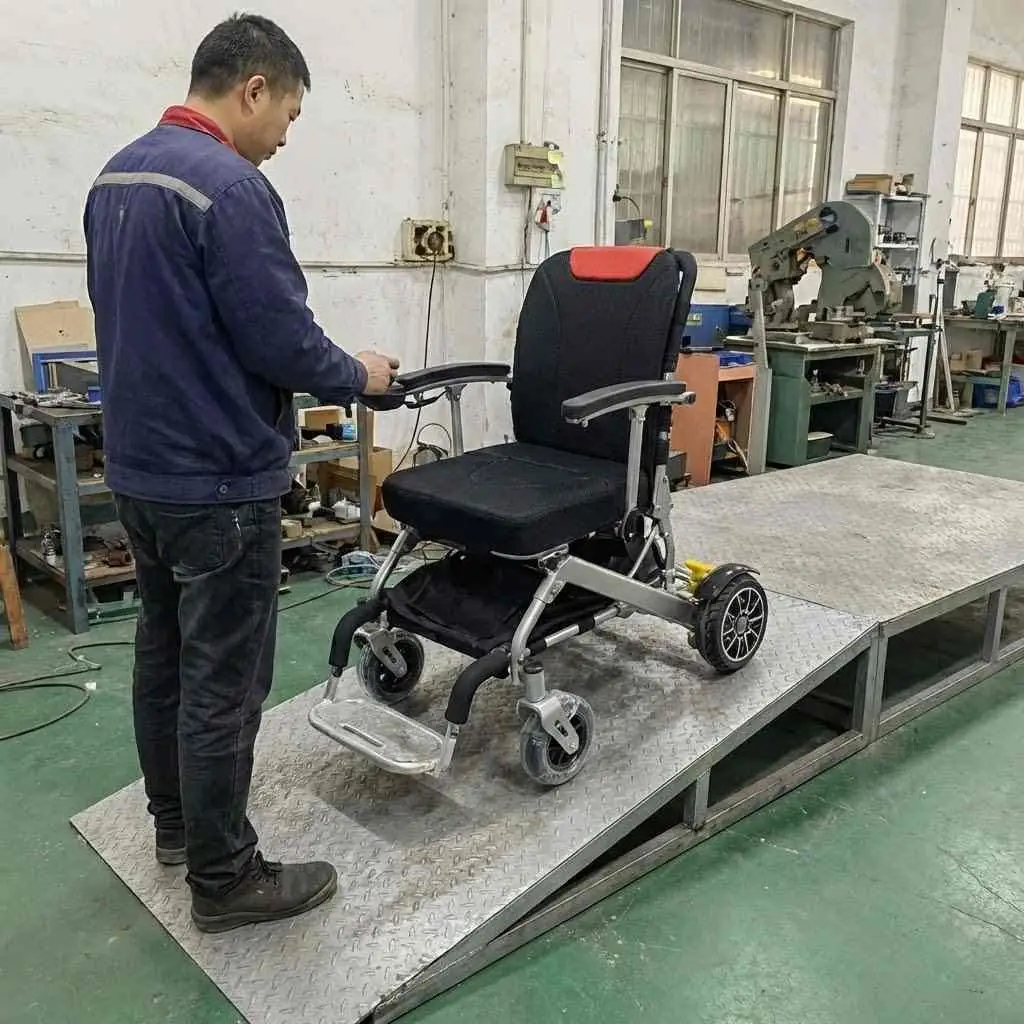
Yes — within the gentle slopes of the built environment: driveway aprons, dropped curbs, standard access ramps. The electromagnetic brake on every ZVCARE chair holds the chair when the joystick is released and prevents rollback on inclines — the safety feature that matters most on slopes.
How do you judge a “normal” slope?
Use public building code as a reference: accessible ramps are typically built to standards such as the ADA design standards maximum of 1:12 — one unit of rise for twelve of run. That is what architects consider a wheelchair-safe ramp, and a fair benchmark for what a folding chair handles daily. Steeper than that asks more from motors and brakes than the chair was designed for.
What makes slope climbing fail?
Three things: low battery, excess load, and a wet or loose surface. A near-empty battery cannot deliver full current when the motors demand it most; an overloaded chair strains the drive system; a slippery ramp defeats traction before power matters. Tell customers to treat slopes like a pilot treats takeoff — battery charged, load within rating, surface dry.
Key Takeaway: Standard access ramps and driveway slopes are fine. Judge anything steeper against the 1:12 benchmark; check battery, load, and surface.
Slope factor
Effect on a folding chair
What to check before climbing
Standard access ramp
Designed-for use
Nothing special — proceed
Steeper than 1:12-style ramps
Motors strain, brakes work harder
Reduce load, go straight up
Wet, mossy, or loose surface
Traction fails before power does
Wait for dry conditions
What Actually Determines Terrain Capability?
Four components decide off-pavement behavior: motor power, tire type, weight distribution, and caster size. The first two you can choose when speccing a model for your market; the last two are baked into the folding geometry.
Why is weight distribution fixed on a folding chair?
A folding chair must fold — that constraint sets where battery, motors, and seat sit. Drive wheels carry most of the weight, good for traction on firm surfaces but leaving the small front casters with little load and therefore little grip. On loose ground the casters skate instead of steering. That is physics, not a defect, and it applies to every folding model on the market.
Which two factors can you actually choose?
Motor power and tires. Higher wattage holds speed better when resistance rises; wider pneumatic tires grip loose surfaces better than narrow solid ones. When a customer describes their daily terrain, these are the two levers you pull — the rest of the chair is what it is.
Key Takeaway: Motor power and tire type are your two levers; caster size and weight distribution are fixed by the folding design.
Component
What it controls on rough ground
Can you choose it?
Motor power
Whether the chair keeps moving when resistance rises
Yes — 200W / 250W / 320W options
Tire type
Grip on loose surfaces, ride comfort
Yes — solid vs pneumatic
Caster size
Steering over stones and ruts
No — fixed by folding geometry
Weight distribution
Front-caster grip vs drive-wheel traction
No — fixed by folding design
How Much Does Motor Power Matter on Rough Ground?
A great deal. Our brushed gear motors come in three ratings — DR1 at 200W, DR2 at 250W, DR3 at 320W — and each step buys noticeably more headroom when the surface fights back. On pavement even 200W feels ample; on grass and loose gravel, the gap between 200W and 320W is the difference between maintaining speed and bogging down.
Which motor suits which terrain?
For pavement with occasional firm grass, 200W is enough and keeps the price sharp. For regular parks, gravel paths, or gentle slopes, step up to 250W or 320W — the extra power buys torque reserve when the ground resists, not top speed. Our 200W vs 250W vs 320W motor guide breaks down the wattage decision; our brushed vs brushless comparison covers the drive-type choice.
Does a brushless motor help off pavement?
The DR8 brushless 250W delivers power more smoothly and wastes less energy as heat, which helps on longer mixed-terrain routes. Its 17:1 gear reduction gives steady low-speed pull — useful when the chair must ease over an obstacle rather than charge at it. For premium folding models with real terrain needs, brushless is the better drive story.
Key Takeaway: More watts mean more torque reserve on soft and loose ground. Match the motor to the customer’s worst daily surface.
Tires are the cheapest terrain upgrade you can offer. On loose surfaces, a wider pneumatic tire beats a narrow solid tire on everything that matters: grip, comfort, and rolling over small stones instead of being stopped by them. The price is puncture risk and slightly more maintenance — a trade most outdoor-heavy customers accept happily.
What do solid tires give up outdoors?
Solid tires are puncture-proof and maintenance-free — the right call for indoor and urban customers. Off pavement they are harder and narrower, transmitting every stone into the frame. On gravel that means a harsher ride and less grip; on wet grass, more slipping.
When should you recommend pneumatic?
Whenever the daily route includes parks, garden paths, or any unpaved stretch. The grip difference on loose ground is immediately noticeable, and the comfort difference on gravel is what stops customers complaining about the ride. Stock pneumatic variants wherever outdoor use is the norm.
Key Takeaway: Pneumatic tires are the single best terrain upgrade for a folding chair. Stock them wherever customers leave the pavement.
Tire type
Grip on loose ground
Trade-off
Wide pneumatic
Best — spreads load, grips, absorbs vibration
Puncture risk, needs air checks
Narrow pneumatic
Better than solid, less than wide
Compromise for mixed use
Solid
Least grip off pavement, harshest ride
Puncture-proof, zero maintenance
Where Should Distributors Draw the Line?
Draw it at honesty: a folding electric wheelchair is built for firm surfaces, and everything beyond that is a graded compromise. Short firm grass, compacted paths, standard ramps — yes, with the right motor and tires. Sand, mud, rocky trails, steep unpaved slopes — no. Saying otherwise is how warranty disputes and bad reviews start.
What should never be promised?
Never promise all-terrain capability — folding chairs are not all-terrain chairs, and no tire or motor changes that. Never invent numbers: no slope angles, obstacle heights, or off-pavement range figures the factory has not measured. Speak in relative terms — bigger motors climb better, pneumatic tires grip better — and leave absolute claims out of your catalog and sales scripts.
How does honesty protect the business?
Every overpromise becomes a support ticket. A customer sold “all-terrain” who gets stuck in sand blames the chair, the dealer, and the brand — in that order. A customer told exactly what the chair handles, who bought the right motor and tires for their route, becomes a repeat buyer. The line you draw in the catalog keeps your reviews clean.
Key Takeaway: Promise firm surfaces; describe the rest as a graded compromise in relative terms. No invented numbers, ever.
Customer expectation
Honest position
Why it protects you
“It handles all terrain”
Correct it — folding chairs are not all-terrain
Prevents warranty disputes
“How steep a hill can it climb?”
Standard ramps yes; beyond that, check surface and load
No invented slope numbers
“Will it go through sand?”
No — recommend against it
Sets realistic boundaries
How Should You Advise Customers About Terrain?
Make terrain part of your standard intake questions, alongside weight, transport, and budget. Ask where the chair will actually go every day: pavement only, parks and gardens, gravel driveways, rural paths. The answer tells you which motor and tire combination to recommend — and whether a folding chair is the right product at all.
What does a good terrain question sound like?
“Tell me about the worst surface you cross in a normal week.” That one question surfaces the grass shortcut, the gravel driveway, and the steep garage ramp that brochure answers would have missed. Then match: the worst surface decides the motor, the route mix decides the tires, and anything beyond firm-surface-plus becomes a conversation about expectations.
How do you close the sale honestly?
Frame the folding chair as what it is: the most convenient chair for people who live mostly on firm surfaces and occasionally go beyond them. If the customer’s terrain genuinely exceeds that, say so — and point them at the right spec rather than the wrong product. An honest no today is a five-star review tomorrow.
Key Takeaway: Ask about the worst weekly surface, spec motor and tires to it, and say no when a folding chair is the wrong product.
What customers ask
What to tell them
How to say it
“Will it handle my garden?”
Ask about the surface first
“Tell me about the worst patch you cross each week.”
“Which model for our park paths?”
Higher-wattage motor, pneumatic tires
“For that route, I would step up to 250W with pneumatic tires.”
“Is it all-terrain?”
No — and that is fine
“Built for firm surfaces with some off-pavement ability, not trails.”
Conclusion
Can a folding electric wheelchair handle grass, gravel, and slopes? It handles short firm grass, compacted paths, and standard access ramps well — especially with a higher-wattage motor and pneumatic tires. It does not handle sand, mud, loose coarse gravel, or steep unpaved slopes, and no folding chair should be sold as if it does. The distributors who win this category ask about the customer’s worst weekly surface, spec the motor and tires to it, and keep every claim in relative, honest terms.
If you are planning your next order, contact our factory team — 1 pc MOQ, 7-day production lead time after payment, three brushed motor ratings (200W / 250W / 320W) plus the brushless DR8, and solid or pneumatic tire options on every folding model. Tell us your customers’ terrain and we will help you spec the right combination.
FAQ
Can a folding electric wheelchair be used on grass every day?
It depends on the grass. A short, dry, mowed lawn crossed daily is manageable, especially with pneumatic tires. Long grass, wet ground, or soft soil after rain will bog down any folding chair — the small front casters sink and the drive wheels lose traction.
Are folding electric wheelchairs good on gravel driveways?
Fine, compacted gravel at low speed is acceptable. Coarse, loose gravel is not a good daily surface — the small front casters plow and wander, and the ride turns harsh through the light folding frame. Wider pneumatic tires help noticeably, but they do not change the caster geometry behind the problem.
What is the steepest slope a folding electric wheelchair can climb?
No single number fits every chair, rider, and surface — beware any seller who quotes one. Standard access ramps and driveway slopes are what folding chairs are built for; public ramps are typically designed to the ADA 1:12 maximum slope, a reasonable benchmark for “a normal ramp.” Beyond that, battery charge, total load, and surface condition decide the outcome.
Do bigger motors really help on rough terrain?
Yes — as torque reserve, not top speed. A 320W motor does not make a folding chair faster on grass; it keeps the chair moving when resistance rises, where 200W would bog down. Match wattage to the worst daily surface: 200W for pavement with occasional firm grass, 250W or 320W for regular parks, gravel paths, and slopes.
Should I stock folding wheelchairs with solid or pneumatic tires?
Stock both and let the customer’s terrain decide. Solid tires suit indoor and urban customers who value zero maintenance and puncture-proof reliability. Pneumatic tires suit anyone who regularly leaves the pavement — the grip and comfort difference on grass and gravel is immediately noticeable. Where outdoor use is the norm, pneumatic should be your default recommendation.
About Our Company
Since 2015, our company has focused on electric wheelchairs, building practical mobility solutions for distributors and medical stores worldwide.
Our specialized focus has led to collaborations with industry leaders and experts to develop products that truly understand and meet the needs of our discerning clients.