Electric Wheelchair Motors: 200W vs 250W vs 320W — What the Numbers Mean for Buyers
October 23, 2026
Introduction
When a supplier quotes you “200W”, “250W”, or “320W” motors, those numbers decide how your chairs climb, how they behave under load, and how happy your customers will be a year from now. This guide explains what electric wheelchair motors 200W vs 250W vs 320W actually mean in practice — and how to match wattage to your market instead of just picking the biggest number.
What Does Motor Wattage Actually Measure in an Electric Wheelchair?
Wattage is the motor’s rated electrical power — roughly, how much work it can do continuously without overheating. In a 24V wheelchair drive system, a 200W motor and a 320W motor both run on the same voltage; the difference shows up as torque: the higher-rated motor can push harder against resistance, such as a slope, a heavy rider, or rough ground.
However, wattage alone does not tell you the whole story. Gear reduction, controller current limits, and total chair weight all shape what the rider actually feels. A well-matched 200W drive can outperform a poorly matched 320W one in real conditions.
Why do suppliers quote watts per motor instead of per chair?
Because each drive wheel has its own motor. A “200W” chair normally means two 200W motors — one per side — working together. When comparing quotes, always confirm whether the number is per motor or total; mixing the two up is one of the most common spec-sheet misunderstandings.
Does rated wattage equal peak power?
No. Rated wattage is the continuous safe output. Motors briefly deliver more during startup or a steep climb — that is normal and expected. What matters for your buyers is the rated figure, because it reflects what the motor can sustain day after day.
Key Takeaway: Wattage measures sustained working capacity, not a single burst. Always confirm per-motor vs total when comparing supplier quotes.
How Do 200W, 250W, and 320W Motors Differ in Real Use?
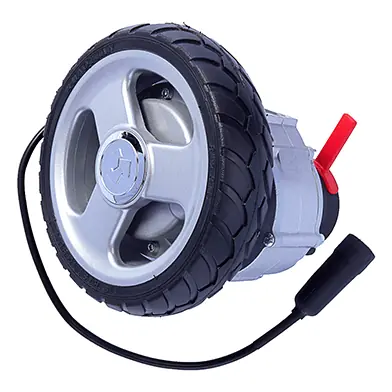
The practical differences are torque, heat margin, and cost. Our own brushed range shows the ladder clearly: the DR1 at 200W (3500 RPM), the DR2 at 250W, and the DR3 at 320W (4500 RPM) — all 24V, all with electromagnetic brakes, all 13.5 kg per pair.
DR1
DR2
DR3
Rated power
200W
250W
320W
Rated voltage
24V
24V
24V
Rated speed
3500 RPM
4500 RPM
4500 RPM
Brake
Electromagnetic
Electromagnetic
Electromagnetic
Weight
13.5 kg / pair
13.5 kg / pair
13.5 kg / pair
Controller
iV1 brushed
iV1 brushed
iV1 brushed
Best for
Light travel chairs, flat terrain
All-rounders, mixed use
Heavier chairs, hilly markets
A 200W drive is enough for a light folding chair on mostly flat ground. Step up to 250W for a general-purpose chair that meets curbs and short ramps daily. The 320W DR3 earns its place on heavier chairs and in markets where hills are part of everyday routes.
Is the jump from 250W to 320W worth the cost?
It depends on the chair it goes into. On a 23 kg folding chair the difference is modest; on a 45 kg full-size chair carrying a heavier rider, the extra torque is the difference between climbing steadily and straining. Match the motor to the chair, not to a round number.
Do higher-wattage motors wear out faster?
Not inherently. A 320W motor running well within its rating often runs cooler and lasts longer than a 200W motor constantly pushed to its limit. Oversizing slightly for the application is a durability strategy, not waste.
Key Takeaway: 200W for light/flat, 250W for general use, 320W for heavy chairs and hills. The chair’s weight and terrain decide — not the brochure.
How Much Does Wattage Matter for Slope Climbing and Load?
A great deal — climbing is where torque demand peaks. On flat ground, even a small motor sips power; on a ramp, current draw climbs sharply and the motor’s rated capacity becomes the ceiling. This is why two chairs with identical batteries can behave very differently on the same hill.
For distributors, the honest test is simple: know the steepest ramp your customers actually face, and make sure the motor’s rated power handles it with margin to spare. A motor that merely survives the climb will run hot and age faster than one that climbs comfortably. Our electromagnetic brake guide explains the other half of slope safety — how electromagnetic brakes hold a chair on an incline once the motors stop driving.
What about rider weight?
Heavier riders raise torque demand on every slope and every start from standstill. If your market skews toward larger riders, that alone can justify stepping up one wattage class — the same logic as choosing a stronger engine for a heavier vehicle.
Can gearing compensate for lower wattage?
Partly. Our brushless DR8, for example, uses a 17:1 gear reduction to turn 250W into strong, steady climbing torque. Gearing trades speed for force — which is why rated RPM matters alongside watts when you compare motors.
Key Takeaway: Slopes and load are where wattage earns its keep. Size the motor for the worst real ramp, not the average flat pavement.
Does a Higher-Wattage Motor Drain the Battery Faster?
Not necessarily — and this surprises many buyers. Battery drain depends on the work actually done, not the motor’s rating plate. A 320W motor cruising on flat ground draws only what it needs, often no more than a 200W motor doing the same job.
Where the bigger motor does use more energy is exactly where it is needed: climbing, accelerating, and carrying load. Over a mixed day, the difference in range is usually smaller than buyers fear — and a motor straining at its limit can actually waste more energy as heat than a larger motor working comfortably. For the full picture on what shapes real-world distance, see how far a folding electric wheelchair goes on one charge.
So why do spec sheets link bigger motors to shorter range?
Because test conditions differ, not because physics punishes you. A heavier chair needs a bigger motor and carries more weight — the weight shortens range, not the wattage itself. Compare chairs of similar weight before blaming the motor.
Does motor choice affect which battery to specify?
Indirectly. Higher sustained loads reward a battery that handles current well — which is one reason lithium packs pair naturally with stronger drives. Our lithium vs lead-acid comparison walks through that trade-off.
Key Takeaway: Wattage rating does not set energy use — the work does. Don’t reject a stronger motor over range fears alone.
Why Isn’t a Bigger Motor Always the Better Choice?
Three reasons: controller pairing, efficiency at low load, and regulation. Every motor needs its matched controller — our DR1/DR2/DR3 brushed motors pair with the iV1 controller, and mixing types is not possible. A bigger motor with an undersized controller is money wasted; the controller, not the motor, becomes the limit.
Second, an oversized motor running at a fraction of its rating can be less efficient in stop-start indoor use than a right-sized one. Third, some markets regulate drive power for certain product categories — always check local rules before specifying the top of the range.
What happens if the controller and motor are mismatched?
You get the worst of both: the performance of the weaker part and the price of the stronger one. Worse, sustained mismatch can overheat the controller. This is why we ship motors factory-matched with their controllers and test the pair before it leaves.
Is there a downside to standardizing on one wattage?
Only if your lineup spans very different chairs. In our experience, many distributors standardize on 250W for the core range and reserve 320W for heavy-duty models — fewer SKUs, simpler spares, and every chair adequately powered.
Key Takeaway: Match the motor to its controller and its chair. Bigger is only better when the whole drive system — and the regulation — supports it.
How Do You Match Motor Wattage to Your Market’s Terrain?
Start from the ground your customers actually roll on. We suggest three bands:
Market profile
Typical terrain
Sensible choice
Travel / indoor
Airports, malls, flat homes
200W (DR1)
Urban all-rounder
Curbs, short ramps, mixed pavement
250W (DR2 / DR8)
Hilly / heavy-duty
Long slopes, rough ground, larger riders
320W (DR3)
This is a starting framework, not a rulebook. A travel chair sold in a hilly city still needs the stronger drive — the rider’s real routes beat the product category every time.
Should the whole lineup share one motor?
For spares simplicity, many dealers prefer it. If 80% of your volume is urban all-rounders, a single 250W platform with the 320W reserved for flagship heavy models keeps inventory lean without underpowering anyone.
Where does brushless fit in this picture?
Wattage and motor type are separate decisions. Our DR8 is a 250W brushless wheel motor — same power class as the DR2, but quieter and maintenance-free. If you want the full type comparison, read brushed vs brushless motors for electric wheelchairs alongside this guide.
Key Takeaway: Map wattage to terrain bands, then simplify SKUs around the band that carries your volume.
What Should Distributors Check Beyond the Wattage Number?
Wattage opens the conversation; these four items close it. First, the brake: every ZVCARE motor carries an electromagnetic brake — release-to-stop, power-off holding, locked on slopes. A wattage figure without a brake specification is an incomplete quote.
Second, rated RPM and gearing, which decide whether those watts become speed or torque. Third, weight per pair — 13.5 kg for our brushed range, 8.5 kg for the DR8 — because motor weight counts against the chair’s total. Fourth, controller pairing and whether the supplier tests the pair before shipping.
What questions reveal a weak motor quote?
Ask for the brake type, the controller model it pairs with, and the rated RPM — not just watts. A supplier who can answer all three precisely is selling an engineered drive system; one who only repeats the wattage is selling a number.
Does ZVCARE offer OEM motor options?
Yes — power rating and packaging can be customized, with 1-pair MOQ and 7-day lead time. Contact our factory team with your chair’s weight class and target terrain and we will recommend the wattage.
Key Takeaway: Brake type, RPM/gearing, weight, and controller pairing matter as much as watts. Quote the system, not the number.
Which Motors Do ZVCARE Wheelchairs Actually Use?
Our chairs use the motors described in this guide — no mystery parts. The EW100 runs the 250W brushless DR8 wheel motor for quiet, maintenance-free drive; the brushed DR1/DR2/DR3 cover the rest of the range — confirm the exact motor fit for your model when you request a quote. Every motor ships factory-matched with its controller (iV1 for brushed, iV2 for brushless) and every one carries an electromagnetic brake as standard.
The photo above is our own assembly line, where motors are fitted and each drive pair is tested before the chair moves to packing. When your customers ask what is inside the chair, you can answer with specifics instead of adjectives.
Can I get a different wattage than the standard fit?
Within the range, yes — that is normal OEM work. Tell us the chair model, the rider profile, and the terrain, and we will confirm the right DR1/DR2/DR3/DR8 choice before quoting.
What warranty covers the motors?
Twelve months, like the battery and controller (the frame carries 36 months). Warranty claims need the serial number plus photos or video, and cover normal use.
Key Takeaway: We publish the exact motors we fit. Ask any supplier for the same transparency before you commit.
Conclusion
Electric wheelchair motors 200W vs 250W vs 320W is not a ranking from bad to best — it is a matching exercise. Map the wattage to your customers’ terrain and rider profile, verify the brake, gearing, and controller pairing behind the number, and standardize where volume allows. Do that, and the motor becomes a selling point instead of a warranty risk.
If you are building your lineup now, start from the terrain bands in this guide and talk to our factory team — 1pc MOQ, 7-day lead time, frame 36-month and battery/motor/controller 12-month warranty, and full spare-parts support for every drive we sell.
FAQ
Is 200W enough for an electric wheelchair?
For a light folding chair used on flat ground — airports, malls, smooth homes — yes, 200W per motor is a proven, efficient choice. It struggles only where torque demand spikes: steep ramps, heavy riders, and rough ground. If your customers face those daily, step up to 250W or 320W.
What is the most popular motor wattage for distributors?
In our experience, 250W is the workhorse: enough torque for curbs and short ramps, efficient for daily mixed use, and available in both brushed (DR2) and brushless (DR8) forms. Many dealers standardize their core range on 250W and reserve 320W for heavy-duty flagships.
Can I replace a 200W motor with a 320W one later?
Physically it may fit, but the controller must match the motor type and current — a brushed 320W needs its proper brushed controller (iV1 class), and you cannot mix brushed and brushless parts. In practice, upgrading the whole factory-matched drive pair is safer than swapping the motor alone.
Do higher-wattage motors need bigger batteries?
Not automatically. What matters is the current the drive actually draws in your use case. A well-matched lithium pack handles a 320W drive comfortably; problems come from sustained overload, not from the rating plate. Size the battery to the work, as our battery guides explain.
How long do ZVCARE wheelchair motors last?
With normal use and the factory-matched controller, the brushless DR8 has no brushes to wear at all, and brushed units need only periodic brush inspection. All carry a 12-month warranty, and we stock spare motors and brushes for dealers.
About Our Company
Since 2015, our company has focused on electric wheelchairs, building practical mobility solutions for distributors and medical stores worldwide.
Our specialized focus has led to collaborations with industry leaders and experts to develop products that truly understand and meet the needs of our discerning clients.