How to Read an Electric Wheelchair Specification Sheet
October 23, 2026
Introduction
Learning how to read an electric wheelchair specification sheet is the fastest way to separate serious suppliers from spec-sheet marketers. Two chairs can look identical on paper and behave completely differently in a warehouse, a car trunk, or on a ramp — the difference is almost always hidden in how the numbers were measured, not in the numbers themselves. This guide decodes the six numbers distributors most often misread, and gives you the exact questions that expose a weak spec sheet before you place an order.
What Does “Net Weight” Actually Include?
Net weight is the first number buyers compare and the easiest one to game. A chair listed at “15 kg” and a chair listed at “19 kg” may weigh exactly the same on your scale — the difference is what the supplier chose to include.
With or Without the Battery?
Always ask whether the stated weight includes the battery. A 24V 10Ah lithium pack adds roughly 2–3 kg; on a lightweight chair that is 15–20% of the total. Our own EW1000 is listed at 15 kg including the battery, and we say so on the sheet — because a buyer comparing it against a “14 kg” chair that quietly excludes the battery is being misled by 3 kg.
The honest convention is simple: state the number and the condition in the same line, e.g. “15 kg (including battery)”. If a spec sheet gives you a weight with no condition attached, treat it as incomplete, not impressive. Our guide to how much a folding electric wheelchair weighs breaks down where every kilogram sits on a typical chair.
Why “Heaviest Piece” Matters More Than Total Weight
For folding chairs, net weight answers the product question; gross carton weight answers the freight question. Heaviest single piece answers the caregiver question: a chair that lifts as one unit is harder for one person to load than a chair of similar weight that splits into two lighter lifts (frame + removable battery). Ask for both the total and the heaviest single piece.
Weight line
What to ask
Why it matters
Net weight
With or without battery?
2–3 kg swing on light chairs
Heaviest piece
Battery removable?
Decides one-person loading
Gross / carton weight
Per unit or per master carton?
Freight quotes depend on it
User weight capacity
Tested to which standard?
Comfort ≠ rated load
Key Takeaway: Never compare two weight figures until you know both were measured the same way — battery in or out.
How Should You Read Folded Dimensions?
Folded dimensions decide whether the chair fits a car trunk, a warehouse shelf, or a shipping carton. They are also one of the most creatively reported numbers in the industry.
Which Orientation Do the Numbers Describe?
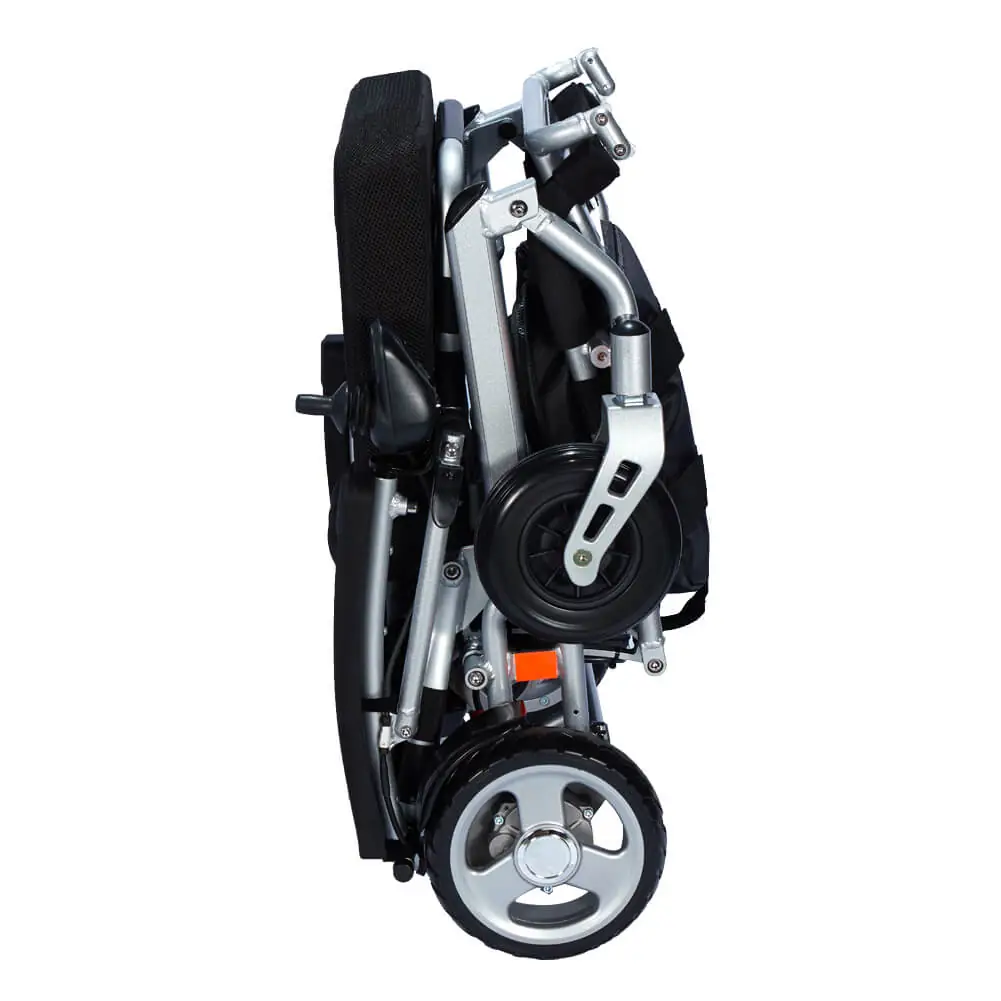
A folded chair is a three-dimensional object, and “73 × 39 × 71 cm” means nothing until you know which number is length, width, and height in the folded position. Some suppliers list unfolded-orientation labels on folded numbers; others measure with the joystick removed and footrests detached without saying so. Ask for the measurement condition: folded, joystick on or off, footrests attached or removed. Our EW1000 folds to 73 × 39 × 71 cm and our EW100 to 73 × 55.5 × 31 cm — both measured folded, joystick attached, ready to lift.
Folded Size vs. Shipping Carton Size
Folded dimensions and carton dimensions are different numbers serving different buyers. The trunk question needs folded size; the freight question needs carton size plus gross weight. A serious spec sheet lists both. If only one appears, ask which one it is before you quote freight — see our folding electric wheelchair dimensions guide for how the two relate.
Dimension
Answers which question
Common trick
Folded L×W×H
Fits the trunk / shelf?
Joystick removed silently
Carton L×W×H
Freight volume?
Quoted per 2-unit carton
Unfolded L×W×H
Fits through doors?
Footrest position unstated
Seat W×D
Fits the rider?
Measured inside vs outside armrests
Key Takeaway: Three numbers without orientation labels are decoration. Ask for the measurement condition every time.
What Do Range Figures Actually Promise?
Range is the number buyers remember and the number most divorced from reality. A responsible figure always travels with its conditions.
The ± Tolerance Is Part of the Number
We list the EW1000’s range as 15 ± 3 km — the tolerance is not a weakness, it is the honest part. Rider weight, terrain, speed setting, tire pressure, and ambient temperature all move the real figure, and any supplier quoting a single clean number without a range is quoting a laboratory best case. Treat “±” as a sign of an honest sheet, not a weak product. The ISO 7176-4 standard defines how theoretical range should be determined from energy consumption — ask whether the figure follows it.
Test Conditions Change Everything
Two chairs with the same battery can show different range because consumption differs — and two test rides of the same chair can differ substantially if one was flat mall floors and the other was winter ramps. Ask for the test rider weight, terrain, and speed. Our guide to how far a folding electric wheelchair goes on one charge and our lithium vs lead-acid comparison explain which variables move the number most.
Range claim
What to ask
Red flag
Single number, no ±
Under what conditions?
“Up to” with no baseline
± tolerance given
Rider weight? Terrain?
Tolerance wider than ±30%
Battery in Wh
Usable or nominal Wh?
Only Ah given, no voltage
“Tested” range
Which standard?
No standard named
Key Takeaway: A range figure without test conditions is a wish. The ± and the conditions are the real specification.
Is Load Capacity the Same as Riding Comfort?
No — and confusing the two is how distributors end up with returns from buyers who “fit the weight limit” but hate the chair.
Rated Load vs. Seat Geometry
Load capacity is a structural number: the frame and motors are tested to carry it. Comfort is a geometry question: seat width, seat depth, armrest spacing, and footrest position. A chair rated for 125 kg can still feel cramped for a tall rider if the seat depth is short. Always read load capacity together with the seat dimensions, and when in doubt, ask for the seat measurement method — inside or outside the armrests changes the number by centimeters that matter.
The Questions That Reveal Real Fit
Ask which test dummy weight the rating used, whether the rating covers the whole chair or just the frame, and what the recommended (not maximum) user weight is. Our guide to measuring electric wheelchair seat sizes gives you the exact method to verify fit claims yourself.
Spec line
Structural meaning
Comfort question to ask
Max load 125 kg
Frame won’t fail
Seat width for that rider?
Seat 46 cm wide
Fits average hips
Inside or outside armrests?
Seat depth 42 cm
Thigh support
Rider’s thigh length?
Backrest height
Trunk support
Adjustable or fixed?
Key Takeaway: Load capacity keeps the chair safe; seat geometry keeps the rider happy. A complete sheet addresses both.
Does a Bigger Motor Wattage Mean a Stronger Chair?
Wattage is the most misunderstood number on a drive-system spec. It describes electrical input, not what the wheels actually do.
Wattage, Torque, and Controller Amps
A 250W motor with the right gear ratio and a well-matched controller can out-climb a 320W motor paired with a weak controller. What moves the chair is torque at the wheel, and torque comes from the motor plus the gearbox plus the controller’s current limit. Our iV1 brushed controller runs 70A (1680W) or 50A (1200W) and our iV2 brushless runs 50A (1200W) — the controller amperage is the number that actually decides hill performance alongside the motor. Ask for all three: motor watts, gear ratio or torque, and controller amps.
What “320W” Doesn’t Tell You
Wattage alone says nothing about duty cycle (how long it sustains that output on a slope), efficiency (how much battery it drinks doing it), or braking (what holds the chair when the power cuts). A sheet that lists motor watts but hides the controller spec is showing you the engine and hiding the transmission. For a full guide to matching wattage to your market, see our 200W vs 250W vs 320W motor guide.
Drive spec
What it tells you
What to ask next
Motor 2×250W
Input power per side
Torque? Gear ratio?
Controller 50A
Current available
Brushed or brushless tuning?
Max slope (e.g. 8°)
Tested climbing
With what load?
Brake type
Holding safety
Electromagnetic? Tested how?
Key Takeaway: Read motor, controller, and brake as one system. Any one number alone is marketing.
What Should the Warranty Section Really Tell You?
A warranty line like “1-year warranty” is nearly content-free. Serious suppliers split the warranty by component because components fail on different timelines.
Split Warranties Are Normal — Vagueness Is Not
Our standard is explicit: frame 36 months, battery 12 months, motor 12 months, controller 12 months. That split exists because a frame and a battery age differently, and any supplier lumping them into one number is either overpromising on the battery or underdelivering on the frame. Ask for the split in writing, and ask what voids it — unauthorized modifications and water submersion are standard exclusions; “commercial use” exclusions deserve a closer look if you run a rental fleet.
The Exclusions That Matter
The exclusions section is where warranty disputes are born. Read it before the coverage, not after: who pays return freight on a warranty claim, whether the supplier advances replacement parts, and what proof they require (serial number, photos, video). Our warranty questions guide lists everything to confirm before you sign.
Warranty line
Good sign
Warning sign
Split by component
Frame 36 mo / parts 12 mo
Single “1 year” for everything
Claim process
Parts advanced, freight split
Buyer pays all freight
Exclusions listed
Specific and reasonable
“Damage” undefined
Start date
Delivery date
Factory ship date
Key Takeaway: A warranty is only as good as its exclusions and its claim process. Get both in writing.
Which Certifications Belong on a Serious Spec Sheet?
Certifications are the easiest lines to fake and the most expensive to verify — which is exactly why buyers should check them.
Product Certifications vs. Factory Certificates
These are different things and a good sheet keeps them apart. ISO 13485:2016 certifies the factory’s quality management system — it says nothing about whether a specific chair model is safe. CE marking (for Class I devices, an EU Authorized Representative notification plus the manufacturer’s declaration) and UN38.3 battery transport testing apply to the product itself. When a sheet lists “ISO / CE” without saying which applies to what, ask.
How to Verify a Claim in Two Minutes
Ask for the certificate number and the product models it covers, then check the issuing body’s database. A supplier who hesitates to share a certificate number is telling you everything you need to know. Note what is not claimed, too: we do not publish turning-radius figures because our product pages were never validated for them, and we say so rather than inventing numbers.
Certificate
Covers
Quick check
ISO 13485
Factory quality system
IAF database, scope line
CE (Class I)
EU market access
AR notification + declaration
UN38.3
Battery air/sea transport
Test report number
Test reports
Specific claims
Lab name, date, model
Key Takeaway: Certificate numbers you can verify beat logos you can’t. Absence of a claim is more honest than a vague one.
What Five Questions Expose a Weak Spec Sheet?
If you only have ten minutes with a new supplier’s sheet, these five questions do most of the work.
The Questions Themselves
Ask them in this order: (1) Is the net weight with or without the battery? (2) Which orientation do the folded dimensions use, and was the joystick attached? (3) What were the test conditions behind the range figure? (4) Can you split the warranty by component and state the exclusions? (5) Which certificate numbers cover this exact model? A supplier who answers all five crisply is usually worth a sample order; one who deflects twice is telling you about their factory, not their spec sheet.
What Good Answers Sound Like
Good answers are specific and boring: “15 kg including battery”, “73 × 39 × 71 cm folded, joystick attached”, “15 ± 3 km with a 75 kg rider on flat ground”. Bad answers are smooth and vague: “about 15 kg”, “compact folding”, “long range”. Boring wins — every time.
Question
Good answer
Walk away
Weight condition
“Including battery”
“Net weight 15 kg” (no condition)
Folded orientation
Labeled L×W×H folded
Three numbers, no labels
Range basis
± with conditions
“Up to 20 km”
Warranty split
Per component + exclusions
One vague year
Certificates
Numbers for this model
Logos, no numbers
Key Takeaway: Specific, boring answers signal a real factory. Smooth, vague answers signal a trading company with a designer. That instinct is the whole point of learning how to read an electric wheelchair specification sheet.
Conclusion
A specification sheet is a supplier’s honesty test disguised as a technical document. Once you know how to read an electric wheelchair specification sheet, the numbers matter less than the conditions attached to them — battery in or out, folded which way, tested how, warranted for what, certified by whom. Learn to read the conditions and you will never again be surprised by a chair that arrives different from the chair you ordered.
If you want a spec sheet written the honest way, contact our factory team: 1pc MOQ, 7-day lead time after payment, frame 36-month and battery/motor/controller 12-month warranty, and full certification documentation with verifiable numbers.
FAQ
Should I trust the range figure on an electric wheelchair spec sheet?
Trust it only as far as its conditions go. A figure like “15 ± 3 km” with stated rider weight and terrain is a working number you can plan around; a lone “up to 20 km” with no conditions is a best-case laboratory result. Always ask for the test basis, and derate generously for hills, heavy riders, and cold weather.
Why do two suppliers list different weights for similar chairs?
Usually because they measured different things — one includes the battery and the other doesn’t, or one weighed the chair with armrests and footrests removed. Ask both suppliers for the exact measurement condition, then compare. A 2–3 kg “advantage” often evaporates once the battery is added back.
What folded dimensions do I actually need for a car trunk?
You need the folded length, width, and height with the joystick attached, measured in the folded orientation — plus your trunk’s smallest opening, not its volume. Compare the chair’s largest folded dimension against the trunk opening first; that single check eliminates most bad fits.
Is a higher top speed always better?
Not for most buyers. Higher speed demands stronger brakes, more stable geometry, and often faces local regulations — many markets cap mobility devices well below what motors can deliver. A moderate top speed with confident braking is more commercially reliable than an aggressive number on paper.
What should I do if a spec sheet lists no certifications at all?
Ask for them directly, starting with the certificate numbers covering the exact model you want. A serious factory will provide ISO 13485 scope, CE documentation, and battery test reports without hesitation. If the supplier deflects or offers only logos, treat every other number on the sheet with the same skepticism.
About Our Company
Since 2015, our company has focused on electric wheelchairs, building practical mobility solutions for distributors and medical stores worldwide.
Our specialized focus has led to collaborations with industry leaders and experts to develop products that truly understand and meet the needs of our discerning clients.