How Electric Wheelchairs Are Shipped from China: Sea, Air, and Express Compared
October 23, 2026
If you are buying electric wheelchairs from China, the factory price is only half the story. How electric wheelchairs are shipped from China — by sea, by air, or by express courier — decides your landed cost, your delivery date, and how much risk you carry along the way. This guide compares the three options the way a factory sees them, so you can match the shipping mode to your order size and your timeline.
How Long Does Sea Freight Take for Electric Wheelchairs from China?
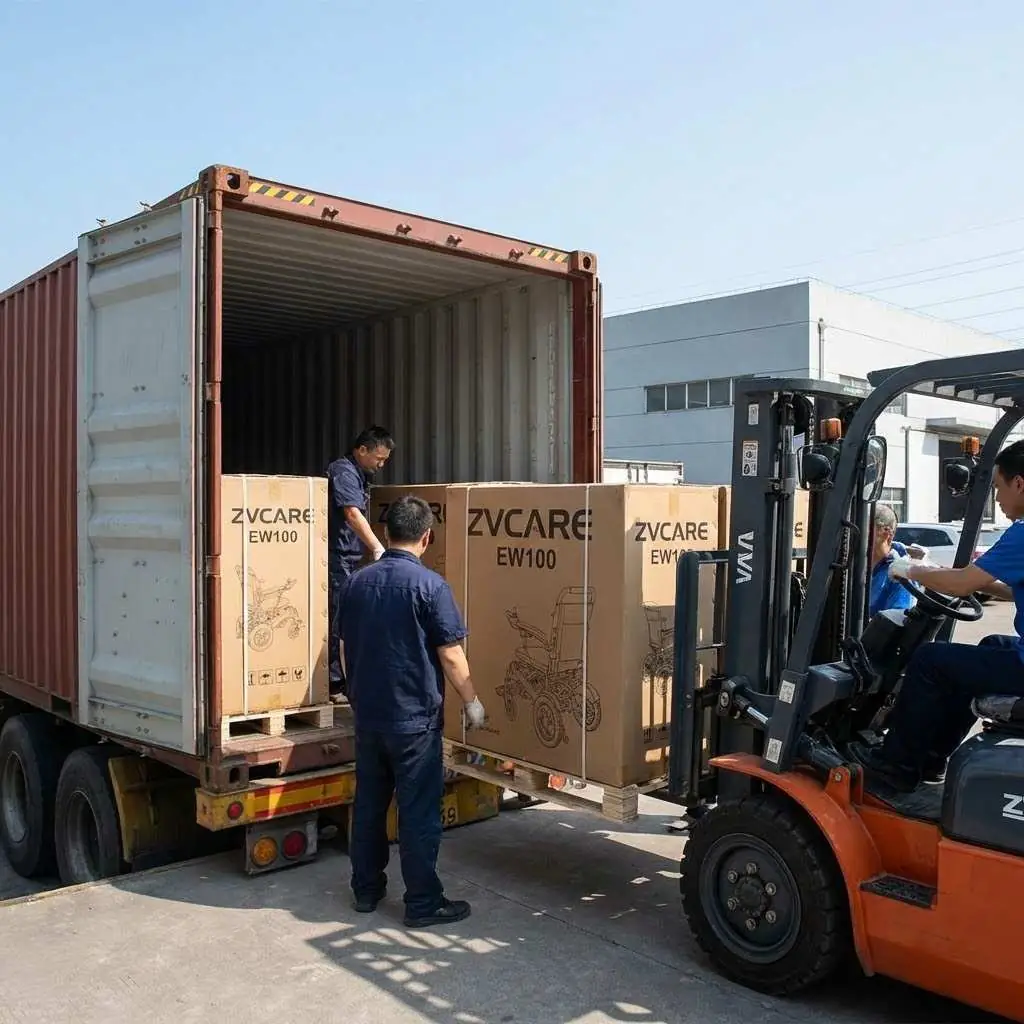
Sea freight is the default for wheelchair shipments, and for good reason: a folded electric wheelchair is bulky, and ocean containers are the cheapest way to move volume.
What transit times should you plan for?
From major Chinese ports (Shenzhen, Guangzhou, Ningbo, Shanghai) to common destinations, port-to-port transit typically runs in multi-week ranges: roughly 3–5 weeks to Europe, 2–4 weeks to the Middle East and Southeast Asia, and 4–6 weeks to the US East Coast. These are ranges, not promises — congestion, transshipment, and peak season all move the needle.
Why is sea freight the most economical choice?
Ocean freight is priced by container or by cubic meter, and wheelchairs are a classic “light but bulky” cargo: the cost driver is volume, not weight. A single 20-foot container holds dozens of folded wheelchairs, which spreads the fixed cost thin. For anything above a few units, sea freight almost always wins on cost per chair.
Key Takeaway: Sea freight is the economical default for wheelchair orders; plan in weeks, not days, and build port-to-door time into your launch calendar.
When Does Air Freight Make Sense for Electric Wheelchairs?
Air freight costs several times more than sea freight per kilogram — but for wheelchairs, there is a catch that matters more than price: the battery.
What is the battery problem with air freight?
Electric wheelchairs run on lithium batteries, and lithium batteries are regulated as dangerous goods in air transport. They can only fly as cargo under strict IATA Dangerous Goods Regulations: correct classification, UN38.3 test reports, proper packaging, labeling, and documentation. Passenger-aircraft restrictions are even tighter, so wheelchair batteries generally travel on cargo aircraft with the right paperwork. This is not a corner you can cut — airlines and forwarders will simply refuse the shipment.
When is air freight still worth it?
Air freight makes sense for urgent sample orders, replacement parts that unblock a stalled customer, or small high-margin batches where speed protects a sale. Transit is measured in days (typically 3–7 days airport to airport), but remember that dangerous-goods handling adds booking lead time on top of the flight itself.
Key Takeaway: Air freight buys speed, not simplicity — the lithium battery paperwork (UN38.3 and IATA DGR compliance) is mandatory, so start the documentation early. See the IATA lithium battery guidance for the current rules. Our UN38.3 guide for wheelchair batteries explains what the test report covers.
Can You Ship Electric Wheelchairs by Express Courier?
Yes — for single units and small parcels, express couriers (DHL, FedEx, UPS and their equivalents) are often the simplest option.
What are the limits of express shipping?
Express works best for one or two chairs: samples, warranty replacements, or a first trial order. The courier handles pickup, export clearance, and last-mile delivery in one booking, which is why many distributors start here. The trade-off is cost per unit — express is the most expensive mode per chair — and size limits: a packed wheelchair carton (for example, our EW1000 ships at 80×41×76 cm, 21 kg gross) is near the upper end of what express networks accept without surcharges.
How do batteries work with express couriers?
The same lithium rules apply. Couriers accept UN38.3-compliant batteries with proper labeling, but each carrier has its own acceptance checklist — confirm battery acceptance with the courier before you book, not after the carton is sealed.
Key Takeaway: Express is ideal for samples and single-unit orders (our 1 pc MOQ ships this way routinely); it is not economical for volume.
How Should Electric Wheelchairs Be Packed for Export?
Packaging is where cheap quotes hide expensive surprises. A wheelchair that arrives with a cracked armrest costs more than the carton you saved.
What does proper export packaging look like?
Each wheelchair should ship in its own export carton with internal cushioning that locks the frame, protects the joystick, and keeps the battery terminals covered. Cartons should be strong enough to survive stacking — ask your supplier about carton ply and whether pallets are used for container loads. Our EW1000 packs at 80×41×76 cm (21 kg gross), the EW100 at 62×35×78 cm, and the larger EW8722 at 81×42×78 cm (48 kg gross) — folded dimensions drive both freight cost and container planning, so confirm them before you book space.
Why do folded dimensions matter so much?
Because freight is sold by volume. A chair that folds a few centimeters flatter can mean one more row per container layer — across a full container, that is real money. When comparing suppliers, compare packed dimensions, not just product weight.
Key Takeaway: Confirm packed dimensions and carton strength in writing before shipment; volume, not weight, sets your freight bill.
Packaging check
What to confirm
Why it matters
Individual export carton
One chair per carton, cushioned
Prevents transit damage claims
Carton strength
Ply rating, stacking tolerance
Containers are stacked high
Joystick protection
Separate wrapping/padding
The most damage-prone part
Battery terminal covers
Terminals insulated
Required for dangerous-goods compliance
What Do EXW, FOB, and CIF Mean for Wheelchair Buyers?
Incoterms decide where the factory’s responsibility ends and yours begins. Three cover almost every wheelchair deal.
How do the three common terms differ?
Under EXW (Ex Works), you collect the goods at the factory gate — cheapest headline price, but you arrange everything downstream. Under FOB (Free on Board), the factory delivers the goods onto the vessel at the origin port; you handle ocean freight and beyond. Under CIF (Cost, Insurance and Freight), the factory quotes you a price that includes ocean freight and insurance to your destination port — simplest for buyers who want one number, though you should still understand what is inside it.
Which term should a new distributor choose?
If you have your own forwarder, FOB gives you control over the freight leg. If you are placing your first order, CIF (or asking the factory to arrange door-to-door via their forwarder) keeps things simple — just make sure the quote breaks out product, freight, and insurance separately so you can compare offers fairly. One wheelchair-specific note: if the quote is DDP, confirm in writing who files the lithium battery customs declarations at your end, because that responsibility is where DDP quotes most often go vague.
Key Takeaway: Match the Incoterm to your logistics capability — FOB for control, CIF for simplicity — and always compare quotes on a like-for-like basis.
How Do You Choose Between Sea, Air, and Express?
The decision comes down to three variables: order size, urgency, and unit economics.
What is the practical decision rule?
Use express for samples and single units. Use air freight when speed protects revenue — urgent parts, a deadline-bound tender, a stock-out that costs more than the freight premium. Use sea freight for everything else, especially replenishment orders you can plan ahead. Many distributors run a mixed rhythm: sea freight for planned stock, express for the occasional emergency.
How does order size change the math?
One chair ships by express. A handful of chairs can go by air if the margin supports it. From roughly a pallet upward, sea freight (LCL shared container, then FCL full container) takes over on cost. The exact crossover moves with fuel surcharges and season, so treat it as a range and get fresh quotes per shipment.
Key Takeaway: Match the mode to the mission — express for samples, air for urgency, sea for volume — and re-check the crossover point each time you order.
Sea freight (FCL/LCL)
Air freight
Express courier
Typical transit
Weeks (port to port)
Days (airport to airport)
Days (door to door)
Relative cost
Lowest per unit at volume
Several times sea freight
Highest per unit
Best for
Planned stock, 1 pallet+
Urgent parts, deadline orders
Samples, 1–2 units
Battery handling
Standard DG process
Strict IATA DGR + UN38.3
Carrier checklist + UN38.3
Planning needed
Most (book ahead)
Medium (DG booking lead time)
Least (one booking)
How Do Shipping Choices Affect Landed Cost and Lead Time?
Freight is only one line in the landed-cost math, but it interacts with everything else.
What goes into landed cost beyond freight?
Product price, international freight, insurance, destination port charges, customs duties, and local delivery all stack up. A cheaper factory quote with weak packaging can lose its advantage in damage claims; a faster mode can win back margin by avoiding stock-outs. Our landed cost guide walks through the full calculation step by step.
How should you plan lead time end to end?
Count the full chain: production time (we produce in 7 days after payment), export packing and booking, the transit itself, customs clearance, and local delivery. Distributors who only ask about the ocean leg routinely underestimate by two weeks or more. Our lead time guide breaks down each stage. For the whole process from RFQ to delivery, see our import guide.
Key Takeaway: Quote landed cost, not factory price — and plan lead time door to door, not port to port.
Conclusion
How electric wheelchairs are shipped from China is a business decision, not just a logistics detail. Sea freight carries your planned volume at the lowest cost per chair, air freight rescues urgent situations (with proper battery paperwork), and express couriers handle samples and single units with the least friction. Get quotes per shipment, confirm packaging and packed dimensions in writing, and plan the full door-to-door timeline.
If you are planning your next order, contact ZVCARE — 1 pc MOQ, 7-day production lead time after payment, export packing included, and full UN38.3 documentation support for your forwarder.
Frequently Asked Questions
Can lithium wheelchair batteries be shipped by air?
Yes, but only as regulated dangerous goods: they need UN38.3 test reports, correct classification, and IATA-compliant packaging, labeling, and documentation. They generally travel on cargo aircraft, not passenger flights. Start the paperwork before you book the flight.
How many electric wheelchairs fit in a 20-foot container?
It depends on folded dimensions — volume is the constraint, not weight. Ask your supplier for the packed carton dimensions (for example, our EW1000 packs at 80×41×76 cm) and have your forwarder calculate the load plan. Flatter-folding models load significantly more units per container.
Should I choose FOB or CIF for my first wheelchair order?
CIF is simpler for a first order because the factory arranges ocean freight and insurance to your port — but ask for the cost breakdown so you can compare offers fairly. Once you have a forwarder you trust, FOB usually gives you better control over the freight leg.
Do I need a freight forwarder, or can the factory arrange everything?
Factories that export regularly can arrange door-to-door shipping through partner forwarders, which many first-time buyers prefer. As your volume grows, having your own forwarder typically gives you better rates and visibility. Either way, confirm who handles export customs clearance before the goods leave the factory.
What documents do I need to import electric wheelchairs?
Typically: commercial invoice, packing list, bill of lading (or air waybill), and battery test reports (UN38.3/MSDS) for customs. Your market may also require product certifications — check import requirements before the goods ship, not after they arrive.
About Our Company
Since 2015, our company has focused on electric wheelchairs, building practical mobility solutions for distributors and medical stores worldwide.
Our specialized focus has led to collaborations with industry leaders and experts to develop products that truly understand and meet the needs of our discerning clients.