When comparing an electric wheelchair vs mobility scooter for your product line, the choice comes down to your customers’ daily reality. An electric wheelchair suits buyers who need precise indoor maneuverability and full postural support, while a mobility scooter fits those who prioritize longer outdoor range and simpler operation.
Picture this: a distributor in Riyadh orders 50 units for elderly customers, only to face returns — too bulky for apartment elevators, wrong fit for the market. As this electric wheelchair vs mobility scooter guide shows, the decision looks simple, but a wrong pick costs you return shipping, restocking fees, and buyer trust.
Once you grasp the real differences, matching product to customer becomes straightforward. This guide covers every factor that matters — from turning radius to spare parts — so your next order lands right. If you’re sourcing from a factory-direct electric wheelchair manufacturer, you’ll see exactly where each line fits your catalog.
Which fits your customer better: electric wheelchair or scooter?
An electric wheelchair fits customers who need tight indoor maneuverability and customized seating, while a scooter suits those who want simple outdoor cruising.
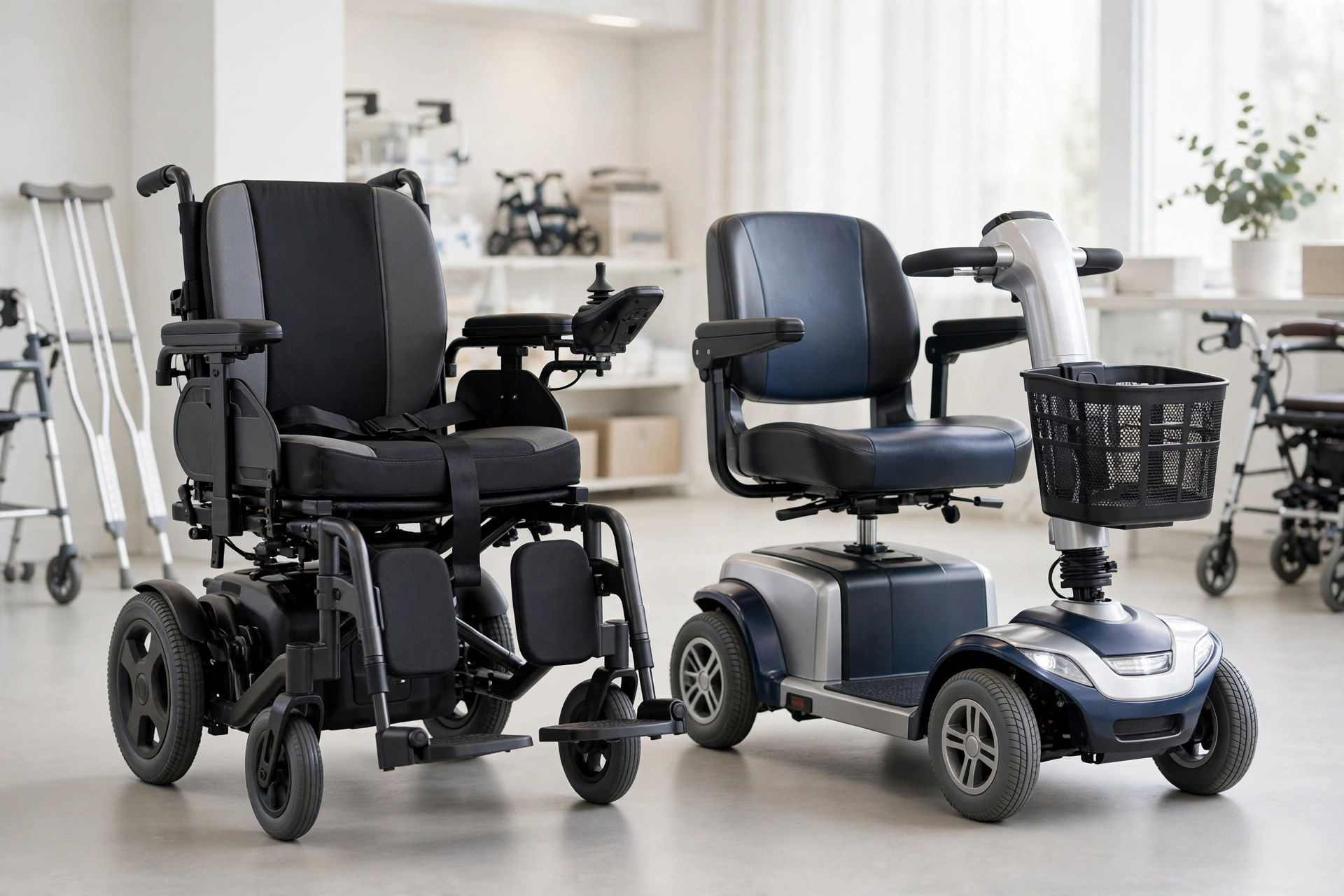
The core difference comes down to design philosophy. An electric wheelchair is built around the user sitting in the device — joystick control, compact footprint, powered positioning options. A mobility scooter puts the user on a platform with a steering tiller, like a small electric bike with a seat. Your customers feel this difference in the first 30 seconds of a test ride.
What is the fundamental design difference?
Think of it this way: wheelchairs prioritize medical function, scooters prioritize convenience transport. According to the WHO’s guidelines on assistive technology, proper device matching significantly improves user outcomes. Therefore, this distinction shapes everything from pricing to after-sales.
- Electric wheelchair: joystick-controlled, mid-wheel or rear-wheel drive, tight turning radius (often under 90 cm), supports power seating options like tilt and recline
- Mobility scooter: tiller-steered (like bicycle handlebars), front-wheel drive common, wider turning radius, fixed or basic swivel seat
- Frame philosophy: wheelchairs are rehab equipment; scooters are personal mobility vehicles
For example, you wouldn’t recommend a scooter to a hospital rehab ward. Similarly, you wouldn’t pitch a complex rehab wheelchair to a retiree who simply wants to ride to the market.
Key Takeaway
Match the device to where your customer spends 80% of their time, not the occasional outing. Indoor-heavy use points to wheelchairs; outdoor cruising points to scooters.
| Factor | Electric Wheelchair | Mobility Scooter |
|---|---|---|
| Primary environment | Indoor + mixed | Outdoor |
| Control type | Joystick | Tiller (handlebar) |
| Turning radius | Tight (under 90 cm typical) | Wide (120 cm+) |
| Seating | Customizable, postural support | Basic padded seat |
Electric Wheelchair vs Mobility Scooter: How Do They Handle Tight Indoor Spaces?
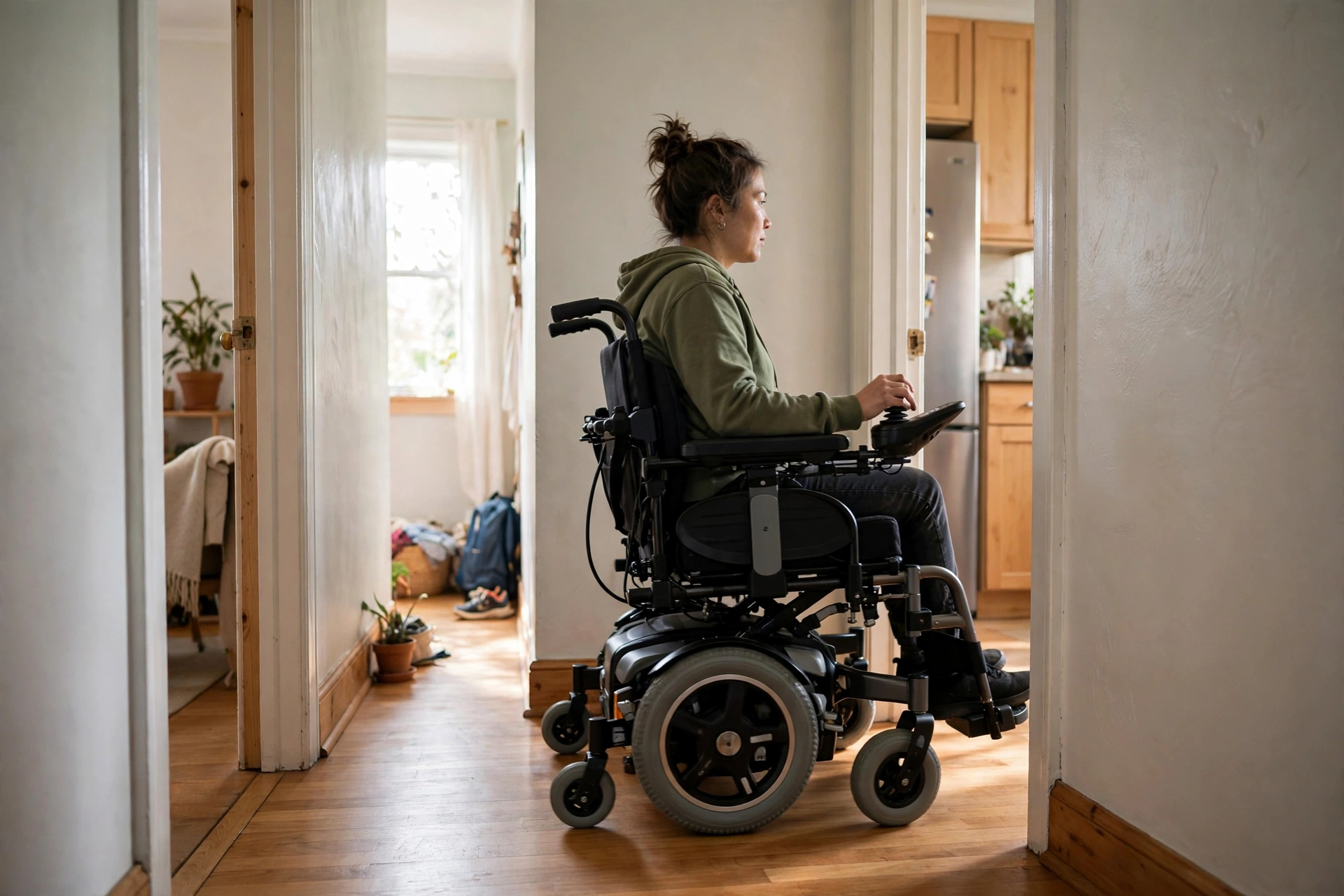
An electric wheelchair turns in spaces where a scooter simply cannot, thanks to its compact wheelbase and joystick steering.
First, measure your customer’s narrowest doorway. Standard interior doors run 70–80 cm wide. A mid-wheel-drive wheelchair pivots within its own length — many models turn in under 90 cm. A typical 4-wheel scooter needs 120–150 cm to complete a turn, which rules out most bathrooms and small elevators.
Why does turning radius decide indoor usability?
Here’s the practical test: can the device do a U-turn in a standard hallway? If not, your customer will get stuck daily.
- Mid-wheel drive: smallest turning circle, best for apartments and clinics
- Rear-wheel drive: stable at speed, wider turns, better for mixed indoor-outdoor
- Front-wheel drive: climbs small obstacles well, moderate turning
You should ask buyers about their customers’ living situations before recommending. A scooter in a 60-square-meter apartment is a returns headache waiting to happen.
Key Takeaway
For indoor-heavy markets — dense cities, apartment living, hospital supply — the wheelchair’s turning advantage isn’t a nice-to-have, it’s the whole sale.
| Scenario | Electric Wheelchair | Mobility Scooter |
|---|---|---|
| Standard doorway (75 cm) | Fits | Often too wide |
| Small elevator | Fits | Usually excluded |
| U-turn in hallway | Yes | Rarely |
Electric Wheelchair vs Mobility Scooter: Which Is Easier to Transport?
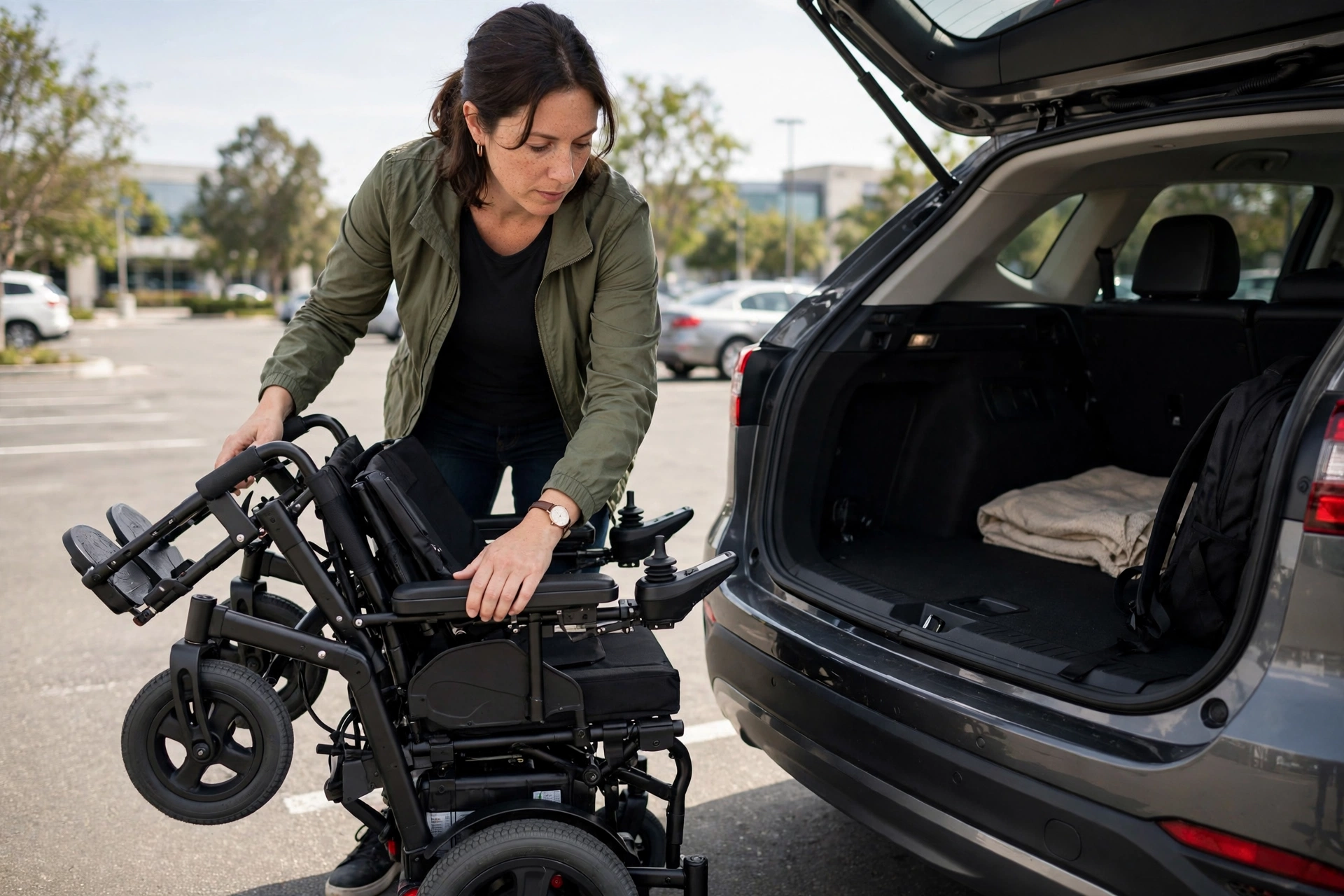
An electric wheelchair is generally easier to transport because folding models collapse in seconds to car-trunk size, while scooters often need disassembly.
In addition, your distributors care about this twice: first when shipping containers to their warehouse, then when their retail customers ask “will it fit in my car?” When evaluating electric wheelchair vs mobility scooter options for transport, remember: a product that’s painful to transport generates support calls and bad reviews.
How fast can each type fold or disassemble?
However, let’s be honest — nobody enjoys wrestling with a 50 kg device in a parking lot.
Modern folding electric wheelchairs collapse in under 30 seconds with no tools, folding to roughly 70×60×35 cm. That’s standard sedan trunk territory. Scooters typically break into 4–5 pieces (seat, battery, front and rear sections), which takes several minutes and still leaves you with bulky parts.
- Folding wheelchair: one motion, 5–30 seconds, no tools needed
- Disassembling scooter: 4–5 separate pieces, several minutes, heaviest piece often 15–20 kg
- Non-folding wheelchair: heavier, needs a van or lift — flag this for your buyers
Key Takeaway
Transport ease affects your margin at every step — freight, warehousing, and end-user satisfaction. Folding wheelchairs win on all three.
| Factor | Folding Electric Wheelchair | Typical Scooter |
|---|---|---|
| Fold/disassembly time | 5–30 seconds | Several minutes |
| Trunk fit | Standard sedan | Often needs SUV/van |
| Container density | High | Lower |
Electric Wheelchair vs Mobility Scooter: Battery Range Comparison
An electric wheelchair with 15–25 km of real-world range covers a full day of typical use for most customers.
How far can each type travel per charge?
However, here’s the thing — brochure range and real range are different animals.
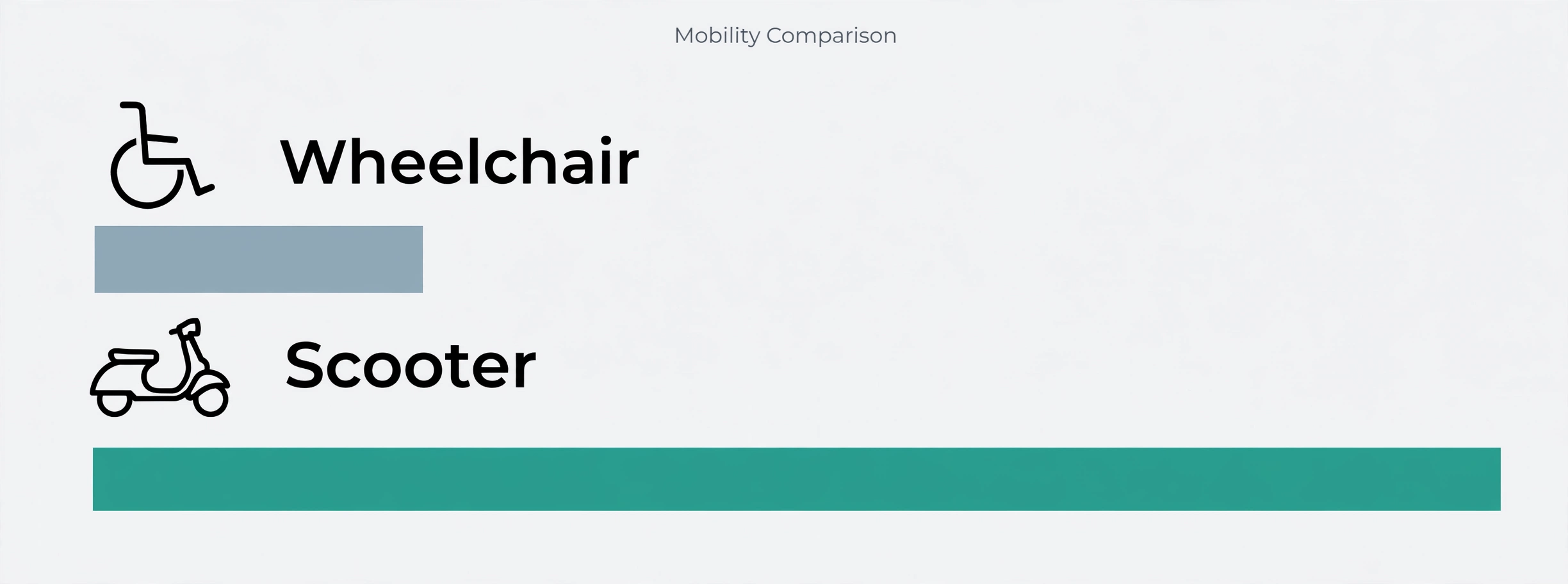
Most electric wheelchairs deliver 15–25 km per charge under normal conditions (75 kg user, flat terrain, moderate speed). Mobility scooters often advertise 25–40 km thanks to larger battery packs. But real-world factors — hills, user weight, stop-and-go use — cut both figures by 20–30%.
- Wheelchair typical range: 15–25 km (lithium models at the higher end)
- Scooter typical range: 25–40 km (bigger batteries, but heavier to charge)
- What actually matters: does it cover a full day without midday charging?
Key Takeaway
Don’t sell on maximum range — sell on “a full day without charging.” For most users, 15+ km of honest range beats 30 km of brochure fiction.
| Battery Factor | Electric Wheelchair | Mobility Scooter |
|---|---|---|
| Typical real range | 15–25 km | 20–30 km |
| Battery weight impact | Lighter packs, easier handling | Heavier packs |
| Full-day coverage | Yes for most users | Yes, with margin |
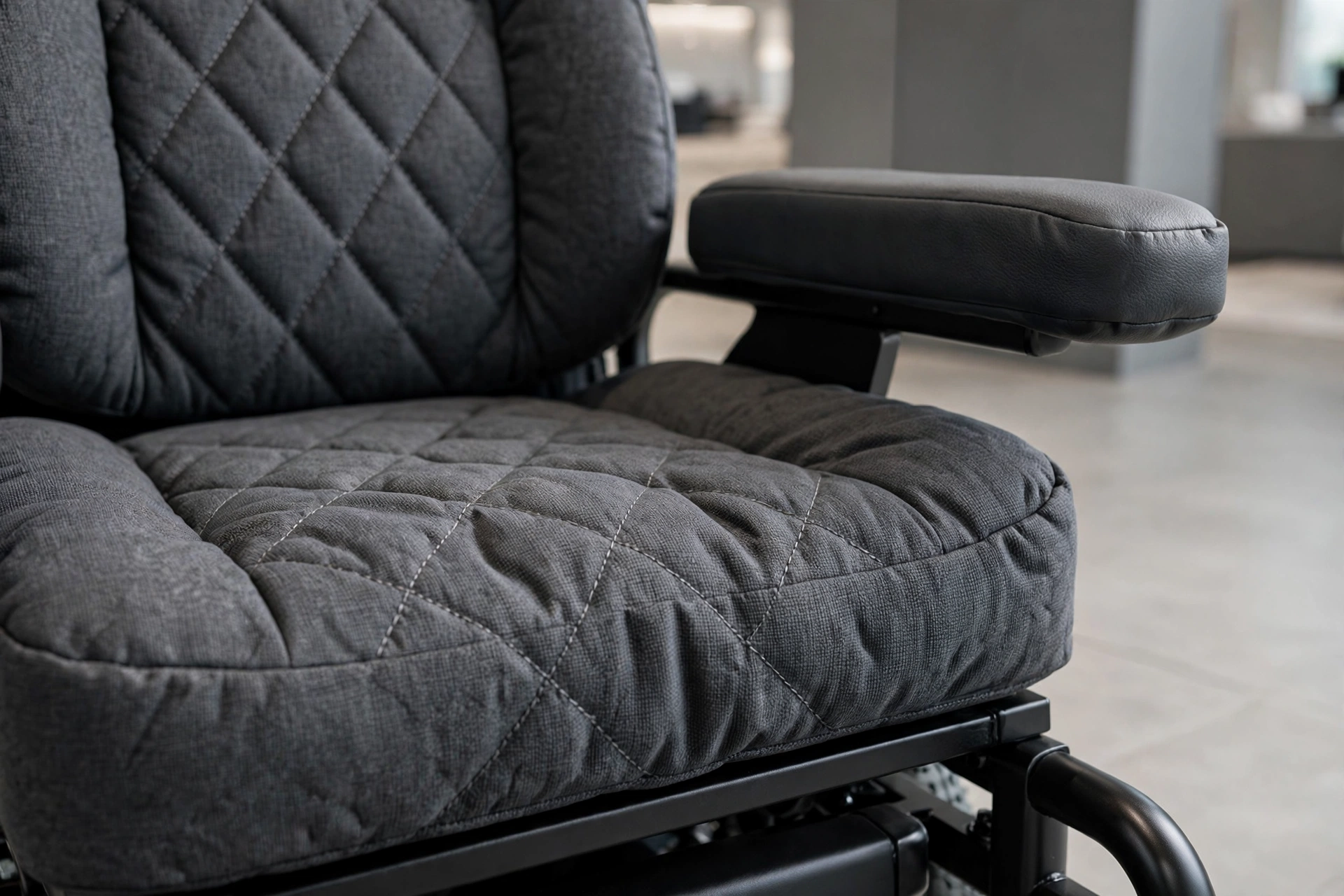
What seating comfort does an electric wheelchair offer?
An electric wheelchair offers significantly more seating customization than a scooter, including adjustable backrests, pressure-relief cushions, and power positioning.
How do seat designs actually compare?
Nevertheless, let’s cut through the marketing. A scooter seat is essentially a padded office chair — fine for an hour, punishing after four.
Electric wheelchair seating starts where scooters stop. You get width and depth options, adjustable backrest angles, removable armrests for side transfers, and compatibility with medical-grade pressure-relief cushions. For users sitting 8+ hours daily, these aren’t luxuries — they’re clinical necessities.
- Wheelchair seating: multiple widths, adjustable angles, pressure-relief compatible
- Scooter seating: fixed or basic swivel, limited padding options
- Transfer access: flip-back armrests and swing-away footrests make wheelchair transfers safer
Key Takeaway
Seating is the wheelchair’s strongest clinical selling point and your highest-margin upsell path — cushions and positioning accessories drive repeat orders.
| Seating Feature | Electric Wheelchair | Mobility Scooter |
|---|---|---|
| Pressure-relief options | Full range available | Limited |
| Backrest adjustment | Multi-angle, some powered | Fixed or basic |
| All-day sitting (8h+) | Designed for it | Not recommended |
How do electric wheelchair controls compare to scooters?
An electric wheelchair joystick gives precise proportional control with minimal hand strength, while a scooter tiller needs grip strength and arm movement.
Is a joystick easier than a tiller for weak hands?
Specifically, for users with limited hand function — arthritis, post-stroke weakness, muscular conditions — the answer is clearly yes.
A joystick needs only light fingertip pressure and small movements to drive, turn, and stop. Modern controllers are programmable: speed, acceleration, and turning sensitivity can all be tuned to the user. A scooter tiller requires gripping, pushing, and pulling through a wider range of motion, which excludes many potential users.
- Joystick: fingertip operation, programmable sensitivity, one-hand use
- Tiller: requires grip strength and bilateral arm movement
- Customization: wheelchair controllers adapt to progressive conditions; tillers don’t
You should ask about the end user’s hand function early in the conversation. It’s the fastest way to narrow the choice.
Key Takeaway
Controls aren’t just about driving — they’re about who gets independence and for how long. The joystick’s adaptability is a clinical and commercial advantage.
| Control Aspect | Electric Wheelchair | Mobility Scooter |
|---|---|---|
| Input method | Joystick (fingertip) | Tiller (grip + arm) |
| Hand strength needed | Minimal | Moderate |
| Adaptable to decline | Yes | No |

Which costs less to stock: electric wheelchair or scooter?
An electric wheelchair typically costs more per unit than a basic scooter, but the total cost of ownership — including parts, service, and returns — often favors wheelchairs for medical-channel buyers.
How do unit prices and margins compare?
To illustrate, let’s talk real numbers. Entry-level scooters can undercut basic wheelchairs on sticker price, sometimes significantly.
However, medical-channel buyers don’t buy on sticker price alone. They buy on reliability, parts availability, and after-sales support. A wheelchair with a 36-month frame warranty and readily available spare parts protects their margin far better than a cheap scooter with no service network. Your factory-direct pricing on wheelchairs narrows the gap further.
- Entry price: basic scooters often cheaper upfront
- Medical-grade wheelchairs: higher ticket, higher perceived value, better margins
- Volume pricing: factory-direct wheelchair pricing improves significantly at 50+ units
You make more per sale on wheelchairs, and your buyers face fewer warranty headaches. That’s a healthier business for everyone.
Key Takeaway
Judge on total economics, not unit price. For medical channels, wheelchairs deliver better lifetime value for you and your buyers.
| Cost Factor | Electric Wheelchair | Mobility Scooter |
|---|---|---|
| Unit price | Mid to high | Low to mid |
| Parts margin opportunity | High | Low |
| Return rate risk | Lower | Higher (sizing errors) |

What safety features matter in an electric wheelchair?
An electric wheelchair with electromagnetic brakes, anti-tip wheels, and programmable speed limits provides safety that scooters can’t match in clinical settings.
How do braking systems differ in practice?
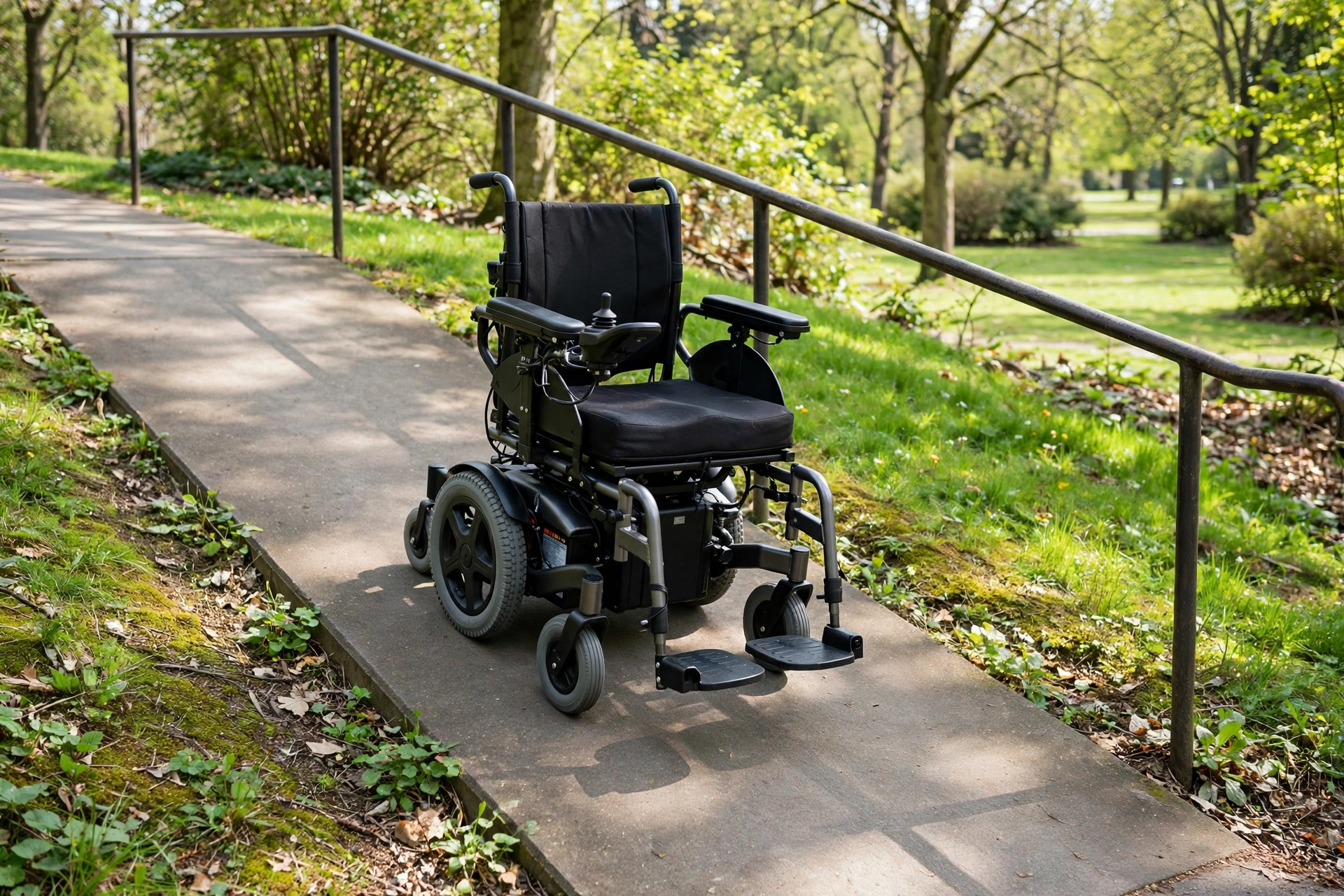
For instance, here’s what actually happens on a slope: release the joystick on a wheelchair and electromagnetic brakes engage instantly — the chair stops and holds, even on an incline.
Scooters rely on manual or drum brakes that need hand strength and don’t auto-engage. On a ramp, a moment’s inattention on a scooter means rolling. For elderly users or busy care staff managing multiple patients, that difference is everything.
- Electromagnetic brakes: auto-engage on joystick release, hold on slopes
- Manual/drum brakes: need active hand operation, no auto-hold
- Emergency stop: wheelchair controllers include instant-stop programming
Key Takeaway
In any electric wheelchair vs mobility scooter evaluation, safety features are procurement checkboxes for institutional buyers. The wheelchair’s auto-braking and stability profile clears bars that scooters can’t.
| Safety Feature | Electric Wheelchair | Mobility Scooter |
|---|---|---|
| Auto-engage brakes | Yes (electromagnetic) | No |
| Slope holding | Automatic | Manual effort |
| Tip-over resistance | High (low center) | Moderate |
Who should you recommend an electric wheelchair to?
You should recommend an electric wheelchair to users who need all-day mobility, precise indoor control, or postural support — and a scooter to independent users wanting simple outdoor transport.
Which medical conditions point to each device?
To help with this, here’s a practical sorting framework you can share with your dealers.
Wheelchairs suit: spinal cord injuries, advanced MS, muscular dystrophy, post-stroke with one-side weakness, severe arthritis, and anyone needing tilt/recline for pressure management. Scooters suit: mild mobility limitations, post-surgery recovery, early-stage arthritis, and users who walk short distances but tire easily.
- Wheelchair indicators: needs postural support, limited hand function, all-day use, indoor primary
- Scooter indicators: good trunk control, outdoor primary, short-term or mild needs
- Red flags: don’t sell scooters to users who can’t safely operate a tiller
You protect your buyers when you help them say no to the wrong sale.
Key Takeaway
Teach your dealers this sorting logic and they’ll make fewer wrong recommendations — which means fewer returns for everyone.
| User Profile | Recommend Electric Wheelchair | Recommend Scooter |
|---|---|---|
| All-day sitting need | Yes | No |
| Good hand function only | Either | Yes |
| Postural support required | Yes | No |
| Simple outdoor trips | Either | Yes |

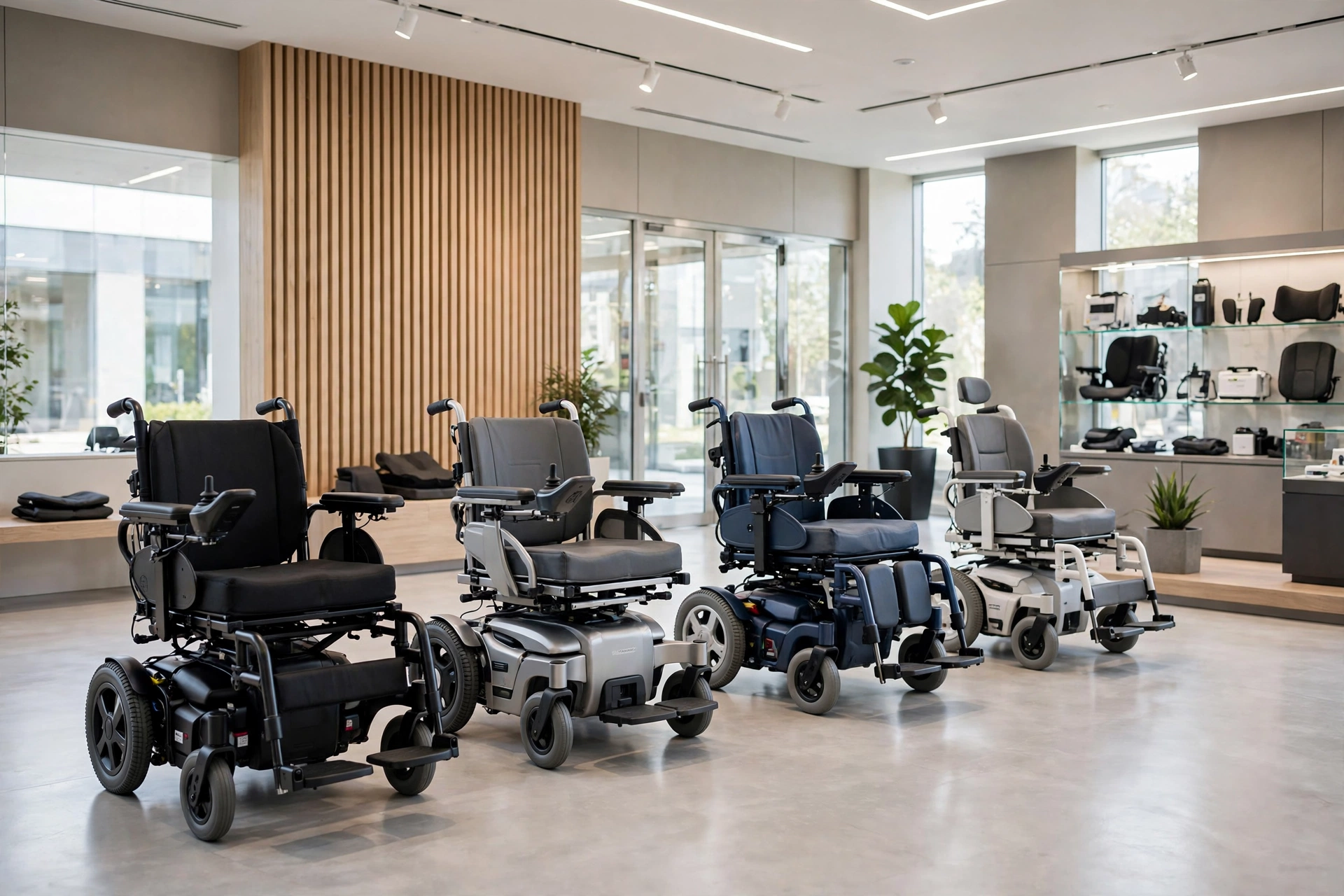
How to choose the right electric wheelchair for your market?
Choose the right electric wheelchair for your market by matching device capabilities to local demand, regulations, and service capacity — then validate with a small trial order.
This is where everything comes together into a buying decision. You’ve done the comparison; now let’s turn it into an order plan.
What does your local demand actually look like?
In other words, your market isn’t “everyone who needs mobility.” It’s specific.
Survey your existing customers: what percentage need indoor vs outdoor primary use? What’s the average user weight in your market? Do local regulations require specific certifications? Are your buyers hospitals (clinical specs matter) or retail stores (price and looks matter)? Answer these before choosing models, and check what’s already selling well for competitors in your region.
- Demand mapping: indoor vs outdoor split, clinical vs retail channel mix
- Regulatory check: CE, FDA, or local certifications required for import
- Competitive gap: which price-performance tier is underserved locally
- Service readiness: can your team handle joystick programming and diagnostics?
As a result, you can get most of these answers from three phone calls to your best customers. Do that before you finalize any model selection.
Key Takeaway
The best product choice is the one your market actually buys twice — first the device, then the spare parts and the next model up.
| Decision Step | Action | Why It Matters |
|---|---|---|
| Demand mapping | Survey top customers | Avoids stocking wrong models |
| Sample testing | 1–2 units, real users | Catches issues before volume |
| Support validation | Time factory responses | Predicts long-term partnership quality |
Conclusion
This electric wheelchair vs mobility scooter comparison solved the core stocking dilemma: when an electric wheelchair beats a scooter (indoor precision, clinical seating, adaptable controls, safety) and when a scooter makes sense (simple outdoor cruising for independent users). You now have the comparison tables, the user profiles, and the decision framework to match products to customers without costly trial and error.
Here’s what we can do for you: factory-direct pricing with 1 pc MOQ, 7-day lead time after payment, full spare parts supply, and engineering support that answers fast. Whether you need lightweight folding models, heavy-duty options, or premium configurations, we build to your market’s requirements — not to a generic catalog.
We believe every distributor deserves a manufacturing partner whose quality they never have to apologize for. If you’re ready to stock products your customers will thank you for, contact us today and let’s talk about your market.
FAQ
Still weighing the electric wheelchair vs mobility scooter decision? These answers address the questions distributors ask most.
Can I ship both wheelchairs and scooters by air?
Yes, but wheelchairs are easier. Folding models with lithium batteries under 300Wh generally meet airline rules (approval is per airline — always check first). Scooters with larger packs often must go by sea. Confirm UN38.3 certification with your factory before booking.
What’s the best option for elderly care homes?
An electric wheelchair is usually the best fit for care homes. Residents need indoor maneuverability for narrow corridors, all-day seating comfort with pressure relief, and controls that work with limited hand strength. Electromagnetic auto-brakes also reduce staff supervision burden. Scooters make sense only if the facility has wide outdoor grounds and independent residents.
How do I know if my customer needs a wheelchair or a scooter?
Start with three questions: Where will they use it 80% of the time (indoors points to wheelchair)? Can they grip and steer a tiller safely (if not, wheelchair)? Do they need postural support or pressure relief (if yes, wheelchair)? If the answers are mixed, arrange a trial with both types — a 30-minute real-world test beats any checklist.
Can I get spare parts for both product types?
Yes — and this is where supplier choice matters most. A factory-direct manufacturer stocks controllers, motors, batteries, joysticks, and chargers with fast dispatch. Trading companies often can’t supply parts at all, leaving your customers stranded after the warranty. Always confirm parts availability and lead times before placing your first order.
What’s the MOQ if I want to mix models in one order?
It depends on the factory. We offer 1 pc MOQ, so you can mix lightweight, heavy-duty, and premium models in a single order to test your market. Many factories require 20–50 pcs per model, which forces you to gamble on untested products. Low MOQs let you validate demand before committing to volume.