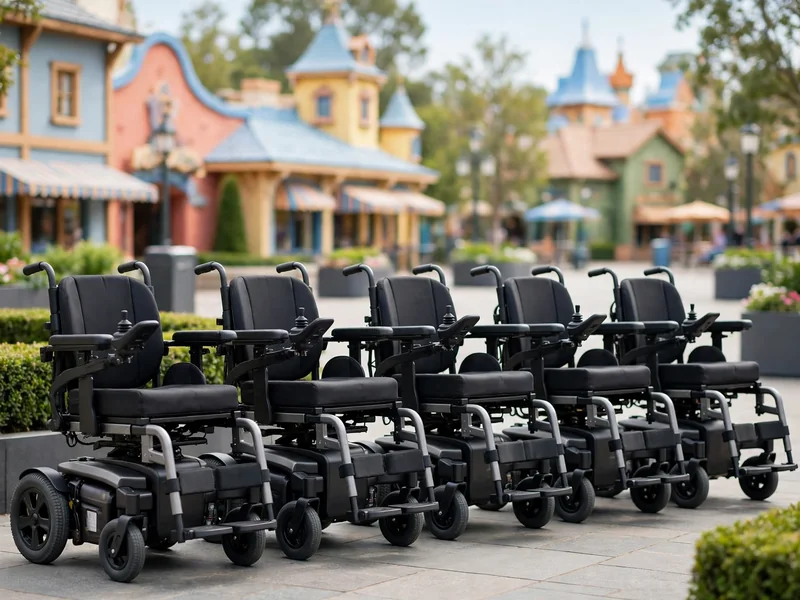
A theme park guest who cannot walk the whole park still wants the whole day: the rides, the shows, the food, and the walk back to the gate at closing time. That is why electric wheelchairs for theme parks are bought as a working fleet, not as single chairs for single visitors. The buyer is the park operator, and the job is to keep a row of chairs charged, clean, and ready to hand over from the moment the gates open until the last guest leaves. This electric wheelchairs for theme parks buyers guide covers that job in order: sizing the fleet, choosing chairs, organizing charging and handover, and keeping spares on hand.
What Does a Theme Park Loaner Fleet Actually Look Like?
A theme park loaner fleet is a set of electric wheelchairs the park owns and lends to guests for the day, usually from a rental desk near the entrance. Guests leave identification or a deposit, take a chair for the day, and return it to the same desk before they leave. The chairs are the park’s own equipment, so the park is responsible for charging them, cleaning them between guests, and fixing them when something breaks.
The fleet lives in two places: a visible rental point where guests collect and return chairs, and a back-of-house area where chairs are charged, cleaned, and checked. The rental point must be easy to find, because a guest who is already tired does not want to hunt for it. The back-of-house area needs power points, room to park a row of chairs, and space for a technician to work. Many parks also run a mix of chair types, because guests differ: some need a light chair for easy transfers, while others need a sturdier chair for a full day outdoors.
How Are Electric Wheelchairs for Theme Parks Different From a Stadium Fleet?
The closest comparison is the stadium fleet, and the difference is the rhythm of use. A stadium runs a loan fleet for match days and event days: chairs go out in a rush before the event, sit during the game, and come back in a rush at the end. A theme park runs a resident fleet that works every day the park is open, from opening to closing, with guests arriving all day long rather than in one wave. Our guide to electric wheelchairs for stadiums explains the match-day pattern, so read it alongside this one to see which parts transfer and which do not.
Because a theme park fleet works every day, charging is a daily routine rather than an event-day task. Chairs go out in the morning, come back during the day, and go back on charge overnight, with the same cycle repeating the next morning. There is no quiet week to catch up on repairs, so a faulty chair needs attention the same day. The outdoor setting adds a second difference: a theme park chair crosses outdoor paths, gentle slopes, and long distances between attractions, while a stadium chair mostly travels on flat concourses and smooth floors.
Key Takeaway: A stadium fleet works in bursts on event days, while a theme park fleet works every day from open to close, so plan for daily charging, same-day repairs, and all-day comfort.
How Many Chairs Should a Theme Park Start With?
Start with a small pilot fleet and grow it from real demand, rather than guessing a large number on the first order. A pilot fleet lets your team learn the daily routine — handover, charging, cleaning, and returns — while the number of chairs is still easy to manage. Once the routine works, add chairs in step with what you actually see: busy weekends, holiday periods, and queues at the rental desk. Add chairs when a queue forms at the desk, or when guests return early because the chair did not suit them.
Seasonal peaks need their own plan. Holiday periods and school breaks bring more guests, and more of them will need a chair. Rather than buying for the busiest week of the year, keep a core fleet for normal days and a small reserve for peak times. That reserve also covers you when chairs are in the workshop, so a repair never leaves the rental desk empty. The same thinking applies across venue fleets, as our guide to electric wheelchairs for universities shows: start with what you can run well, measure real use, and add chairs where the queue actually forms.
Park pattern
What it means for the fleet
Starting approach
Steady daily visitors
Chairs go out all day, every day
Small mixed pilot fleet, grow from daily use
Busy weekends, quiet weekdays
Demand rises and falls each week
Core fleet for weekdays, reserve chairs for weekends
Holiday and school-break peaks
Short periods of much higher demand
Hold a reserve fleet for peak periods only
Large park, long distances
Guests stay in chairs for a full day
Favor comfort and range over the lightest chair
Electric Wheelchairs for Theme Parks Buyers Guide: Which Chairs Fit All-Day Use?
All-day use puts three demands on a chair: comfort for a full day in the seat, a steady ride on outdoor paths, and enough range to last from morning to closing time without a mid-day charge. A chair that folds small is still useful, but folding size is not the first test for a park fleet. The first test is whether a guest can sit in it comfortably for a whole day and whether it handles park paths without feeling unsteady.
The EW8722 is a comfortable and durable small-wheel model at 45 kg with a range of 18–22 km, which suits guests who will spend the whole day in the chair. The EW8703G is the big-wheel model at 46 kg with a range of 18–22 km, and it suits guests who spend more time on outdoor paths and want a steadier ride on uneven ground. The EW8720 is a comfortable daily model at 45 kg with a range of 18–22 km, powered by dual 12V 22.3Ah lead-acid batteries in series, which gives 24V 22.3Ah.
Lightweight folding chairs still have a place in the mix. The EW1000 is a carbon fiber folding chair at 15 kg including the battery, with a folded size of 73×39×71 cm and a range of 15±3 km, running on a 24V 10Ah lithium battery. The EW100 is the aluminum alloy alternative at 23 kg, folding to 73×55.5×31 cm with a range of 12±5 km, and it runs on a 24V system. These lighter chairs suit guests who transfer in and out often, but their shorter range means they are better as part of the mix than as the whole fleet.
Before you order, test shortlisted chairs on a full loop of the park: a showroom floor will not tell you what a full park day feels like.
Model
Weight
Range
Battery
Best for
EW8722
45 kg
18–22 km
24V
Comfortable all-day use
EW8703G
46 kg
18–22 km
24V
Outdoor paths and uneven ground
EW8720
45 kg
18–22 km
Dual 12V 22.3Ah lead-acid in series = 24V 22.3Ah
Comfortable daily use
EW1000
15 kg incl. battery
15±3 km
24V 10Ah lithium
Light folding chair, easy transfers
EW100
23 kg
12±5 km
24V
Everyday folding use
Key Takeaway: Build the fleet around sturdy all-day chairs, and add lightweight folding models for guests who transfer often — not the other way around.
How Do You Keep a Theme Park Fleet Charged Through a Full Park Day?
Charging is the daily routine that decides whether the fleet works or not, because a chair with a flat battery is a chair that cannot go out. The simplest system is a full overnight charge: every chair that comes back goes on charge in the back-of-house area, and every chair that goes out in the morning leaves with a full battery. That routine works when the fleet is big enough that chairs do not need to go out twice in one day. If chairs turn around mid-day, keep a few fully charged chairs ready as swaps.
The charging area itself needs to be planned, not improvised. Each parking spot needs a power point within easy reach, and the area needs enough room for the whole fleet to park overnight without blocking the walkway. Label each spot so staff can see at a glance which chairs are charging and which are ready. Keep chargers with their chairs, keep a spare charger on the shelf, and make sure staff know which charger belongs to which chair — the wrong charger should never get used. Our guide on how distributors store electric wheelchair batteries covers battery care in more detail.
Where Should the Fleet Live, and How Do Guests Pick Up and Return Chairs?
The rental desk should sit near the main entrance, where guests can see it as soon as they arrive and find it again when they leave. A desk tucked away at the back of the park will be missed by the guests who need it most, and a guest who has already walked far will not want to walk further to collect a chair. Put clear signs on the approach to the entrance, and keep the desk staffed from opening time.
Handover should be short, friendly, and consistent. Show the guest the joystick, the speed control, and how to stop, and let them try a short drive in a clear area before they set off. Check the seat, footrests, and battery indicator together, and note the chair number on a simple loan record. Returns should work the same way: guests bring the chair back to the same desk, staff check it over, and it goes for cleaning and charging before it joins the ready row again.
What Should You Check Before a Chair Goes Out Each Morning?
A short morning check is the cheapest insurance a park fleet has. Before the gates open, a staff member should walk the ready row and check each chair: battery indicator showing a full charge, tires firm and undamaged, brakes holding, joystick responding, and seat and footrests secure. Any chair that fails a check stays in the workshop row, and a ready chair takes its place. The check is quick, and it prevents a guest breaking down halfway across the park.
Keep the check written down, not in someone’s head. A simple checklist on a clipboard — chair number, battery, tires, brakes, joystick, seat — with a tick and initials for each chair, gives you a record if a guest later reports a fault. It also shows you patterns: if the same chair keeps failing the same check, it needs a proper repair, not another quick fix. Tell guests at handover who to call if something goes wrong, and keep a replacement chair ready.
What Spares, Cleaning, and Backup Should a Theme Park Keep?
A theme park fleet needs spares for the parts that stop a chair from being used when they fail. Controllers, motors, chargers, and joysticks are the core list, plus tires and batteries. You do not need a large warehouse to start, but you do need the common parts on the shelf: a guest cannot wait days for a basic part while the chair sits in the workshop. Order spares with the first fleet, not after the first breakdown, and keep a written list of what you hold.
Cleaning between guests is part of the service, not an extra. Wipe down the seat, armrests, and joystick after every return, and give the chair a deeper clean at the end of the day. Keep cleaning supplies at the return desk so staff can clean a chair as soon as it comes back. Keep one or two chairs in reserve beyond the daily fleet, so a repair never leaves the rental desk short. Know the warranty terms: frame 36 months, motor and controller 12 months each, and battery 6 months for lead-acid or 12 months for lithium. When a part fails under warranty, report it with photos and the chair’s service record. Our guide on how distributors manage electric wheelchair rental fleets covers the same spares habits for rental use.
Key Takeaway: Stock controllers, motors, chargers, and joysticks from day one, clean every chair between guests, and keep reserve chairs so a repair never empties the rental desk.
What Should a Theme Park Ask the Supplier Before Ordering?
Before you order, ask the supplier the questions that decide whether the fleet will work in daily service. Start with the practical ones: folded size and weight for storage, battery type and range for a full park day, and which spare parts fit which models. Confirm the warranty in writing — frame, motor, controller, and battery terms — and confirm how warranty claims work and how long a replacement part takes to arrive. A supplier who answers plainly before the order will answer plainly when a chair breaks.
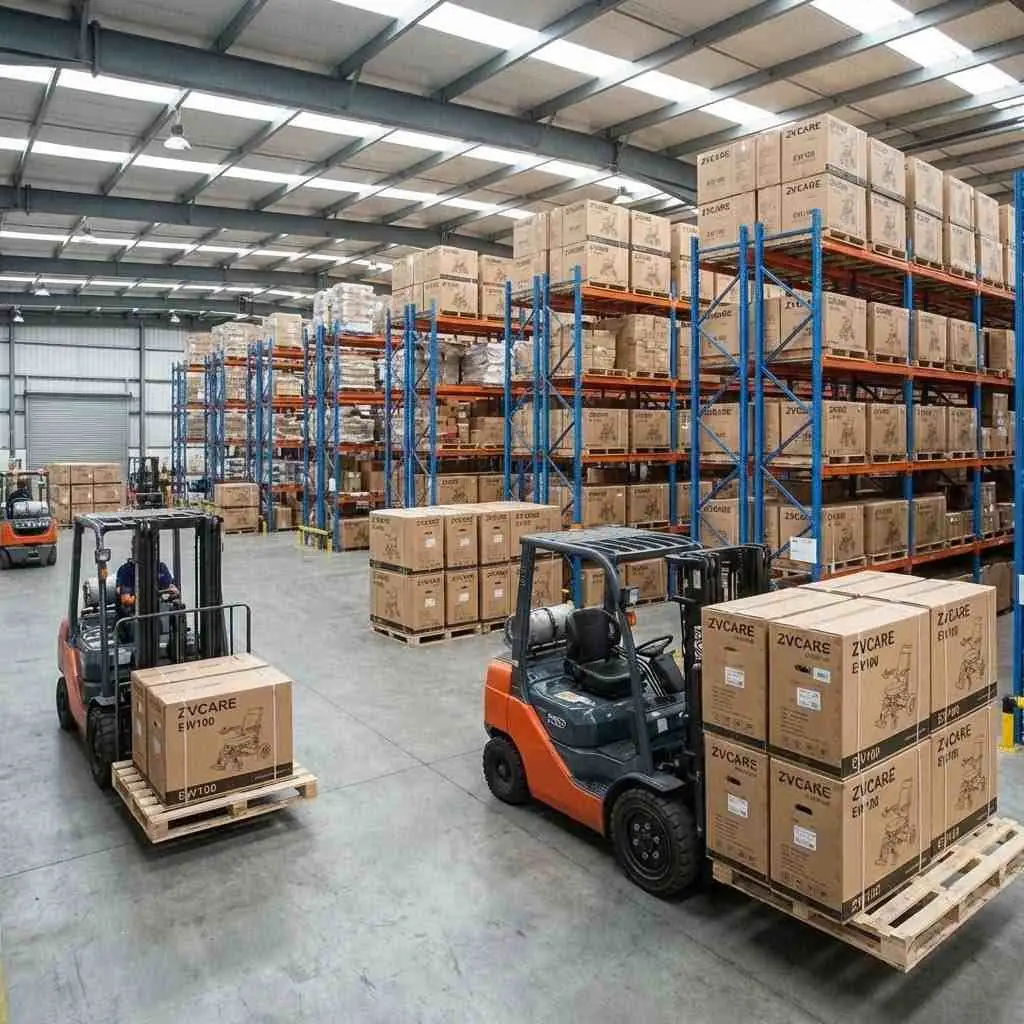
Ask about the order itself, too. With a minimum order quantity of 1 unit and a lead time of 7 days after payment, you can start with a small pilot fleet and add chairs as demand grows. Confirm shipment paperwork, packing, and delivery to the park. Ask whether the supplier can provide a trial chair before the first order, so your team can run the full park loop before committing. Finally, ask about the supplier behind the chairs: ZVCARE runs two production facilities totaling 3,000+ sqm, works with 50+ global partners, and holds ISO 13485:2016 certification.
Conclusion
Electric wheelchairs for theme parks work when the park treats them as a daily operation, not a one-off purchase. Start with a small mixed fleet, build it around sturdy all-day chairs with lighter folding models alongside, and set up the daily routine that keeps it running: overnight charging, a short morning check, a clean handover, and same-day attention to faults. Keep controllers, motors, chargers, and joysticks on the shelf, hold a few reserve chairs, and grow the fleet from the queues you actually see. If you want a supplier who works the same way, ZVCARE offers a minimum order quantity of 1 unit, a lead time of 7 days after payment, and spare parts support. Contact us to discuss your first pilot fleet.
FAQ
What makes electric wheelchairs for theme parks different from a stadium fleet?
A stadium fleet works in bursts on event days, with chairs going out before the event and coming back at the end. A theme park fleet works every day the park is open, from opening to closing, with guests arriving all day. That daily rhythm means charging, cleaning, and repairs are everyday jobs, and chairs need all-day comfort.
Which electric wheelchair is best for a theme park fleet?
There is no single best chair, because guests differ. Sturdy all-day models usually lead the fleet: the EW8722 for comfort, the EW8703G for outdoor paths, and the EW8720 for comfortable daily use. Add lightweight folding models like the EW1000 and EW100 for guests who transfer often. Test shortlisted chairs on a full loop of the park before you order, and let that loop decide the mix.
How do theme parks keep electric wheelchairs charged all day?
The core routine is a full overnight charge, with every chair going out in the morning leaving with a full battery. If chairs turn around mid-day, keep a small number of fully charged chairs ready as swaps, so a returning chair goes straight on charge while a fresh one goes out. Label each charging spot and keep a spare charger on the shelf.
How many electric wheelchairs should a theme park start with?
Start with a small pilot fleet and grow it from real demand. Watch for a queue at the rental desk, guests returning early because the chair did not suit them, and chairs going out without a proper check — all signs to add chairs or adjust the mix. Keep a small reserve for holiday peaks and workshop days, so a repair never leaves the desk empty.
What should a theme park check before lending out an electric wheelchair?
Check the battery indicator, tires, brakes, joystick, seat, and footrests before the chair goes out, and record the check with the chair number and the staff member’s initials. Show the guest the joystick, the speed control, and how to stop, and let them try a short drive before they set off. Tell them who to call if something goes wrong during the day, and keep a replacement chair ready.
Founded in 2015, ZVCARE is an ISO 13485:2016 certified electric wheelchair manufacturer in China, providing OEM & ODM solutions for global distributors and medical stores.