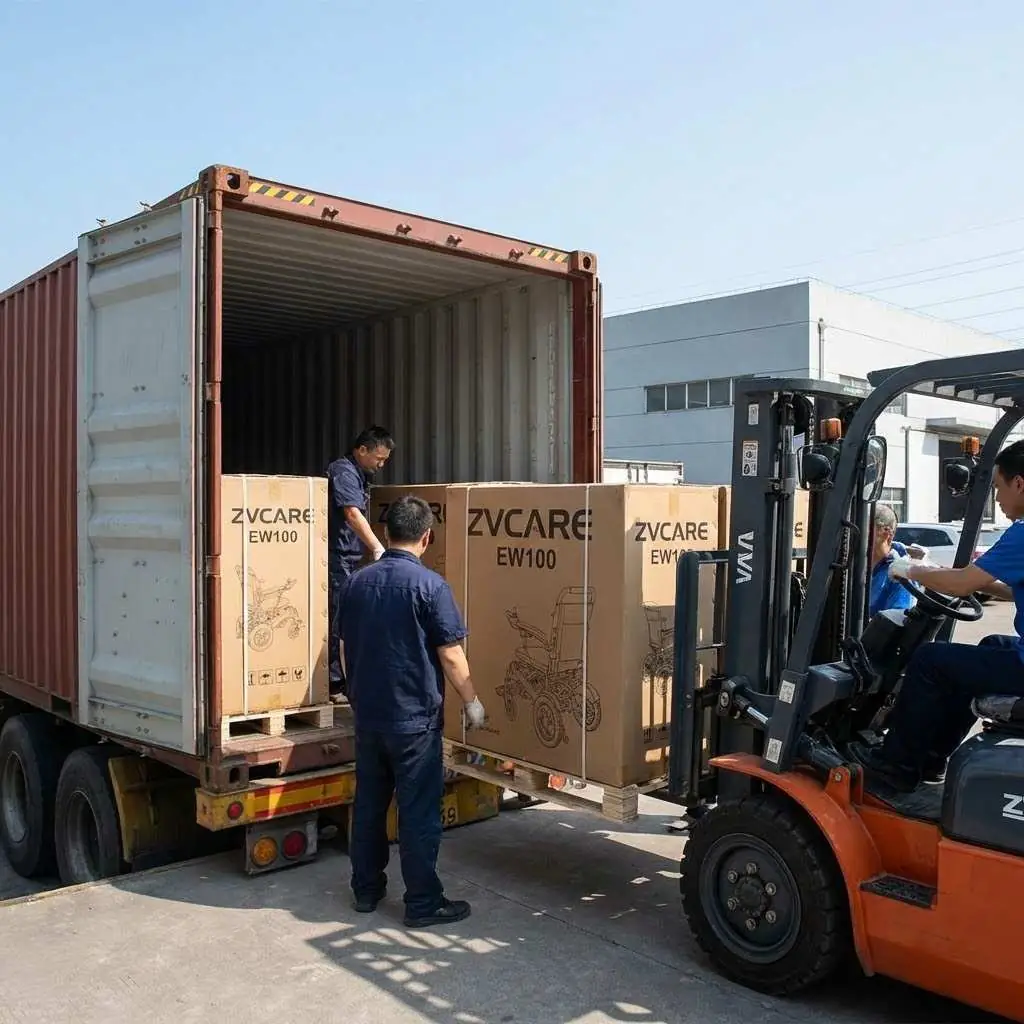
How Distributors Consolidate Electric Wheelchair Shipments
November 6, 2026
A half-empty container costs you money on every chair inside it, and a rushed top-up order costs you money too. This guide explains How Distributors Consolidate Electric Wheelchair Shipments in practical terms: when sharing a container saves money, how to mix models and spare parts safely, and how to split the load fairly when it arrives.
When is it worth consolidating a shipment, and when is it better to ship alone?
Consolidation means combining more than one order into a single container so the space you pay for is actually used. It is worth doing when your order fills only part of a container and you have enough stock on hand to wait while the rest of the load comes together. Waiting a little longer for a fuller container usually beats paying to ship air, and it also beats placing a second small order a few weeks later for the models you left behind.
It is not worth doing when you are already short of a fast-moving model, or when the extra waiting time would leave a customer without a chair. In that case, ship what you need now and consolidate the next order instead. Ask yourself three questions before you decide: do you have enough buffer stock to cover sales while this shipment is being put together, can the models you want travel together without special handling, and is anyone else waiting on your decision? If the answer to any of the three is no, ship alone. Your replenishment plan should already tell you how much buffer you hold, and our replenishment planning guide shows how that buffer is set: electric wheelchair replenishment planning guide.
The same timing question comes up every time you reorder, and our reordering guide covers how to time the next order so consolidation does not leave you short: how distributors reorder electric wheelchairs from China.
Key Takeaway: Consolidate when you have buffer stock and time to fill the container; ship alone when waiting would leave a fast-moving model out of stock.
How Distributors Consolidate Electric Wheelchair Shipments: Should You Book a Full or a Shared Container?
A full container load means the whole container is yours, even if you do not fill every corner of it. A less-than-container load means you share the container with other shippers and pay only for the space your cartons take. The choice is not about which one is cheaper in general; it is about which one fits the size and timing of your order.
Use three variables to decide: how much you are shipping, how many different models are in the order, and how much time you have before you need the chairs. A large order of one or two models usually fills a container on its own. A small order spread across several models usually fits a shared container better. And when timing is tight, a full container avoids waiting for other shippers to finish loading, while a shared container may wait until enough freight has been gathered.
Option
Best when
Watch out for
Full container load
Your order fills most of the container, or timing is tight
You pay for empty space if the order is small
Shared container load
Your order is small and spread across several models
Loading waits until the container is full enough, and your cartons travel with other shippers’ goods
Two orders combined into one full container
You can pair a chair order with a parts order from the same factory
Both orders must be ready at the same time, or one holds up the other
Whichever option you choose, do not reopen the sea, air, or express decision here; that choice belongs before consolidation, and our shipping guide covers it on its own: how electric wheelchairs are shipped from China.
Key Takeaway: Choose a full container when your order is large or time is tight, and a shared container when your order is small and spread across models.
What should you ask your factory before you mix models in one container?
Mixed loads fail on missing information, not on bad intentions. Before the factory starts packing, ask for the packing data of every model in writing: carton size, gross weight per carton, how many chairs go in each carton, and which battery version each model carries. Carton sizes and weights differ between models, so a loading plan built on one model’s numbers will not fit another model’s cartons.
Ask for the same data for anything else going into the container, including spare parts cartons and extra batteries, because those cartons are easy to forget and hard to fit at the last minute. Freight is charged on gross weight, so the factory’s packing data is also what your forwarder needs to book the right space. Our export packaging guide explains which three packing numbers matter and why the factory should confirm them in writing: electric wheelchair export packaging for distributors.
Once you have the numbers, check them against each other. If two models share a name but carry different batteries, treat them as different loads on your packing list, because their cartons, weights, and documents will not match. If one model’s carton cannot be stacked safely under another model’s carton, say so before loading day, not when the forklift is already at the container door.
Key Takeaway: Get carton size, gross weight, chairs per carton, and battery version for every model in writing before packing starts, and treat same-name models with different batteries as separate loads.
How do you mix whole chairs, spare parts, and batteries in one shipment?
Whole chairs, spare parts, and batteries can travel in the same container, and combining them is one of the simplest ways to fill a container well. The rule is separation on paper and separation in the load: parts go in their own cartons, listed on their own lines of the packing list, and never loose inside a chair carton. A controller or a set of tyres buried under chair cartons is a carton you will not find until the whole container is unloaded.
Batteries need more care than parts. Lithium batteries travel under dangerous-goods rules that depend on how they are packed: fitted in the chair, packed with the chair, or shipped on their own. Keep battery cartons in their inner boxes, keep them marked as the documents require, and confirm the paperwork with your forwarder before the container is sealed. The IATA battery guidance explains how those packing rules work for lithium batteries shipped with equipment: IATA lithium battery guidance. Lead-acid and lithium versions of the same model are different loads for this purpose, so check the battery version on every line of the order, not just on the model name.
Finally, keep the documents matched to the load. The packing list, the battery documents, and the shipping documents must describe the same cartons in the same quantities, and our shipping documents guide lists what travels with the container: shipping documents your electric wheelchairs need.
Key Takeaway: Mix chairs, parts, and batteries in one container, but keep parts in their own marked cartons and keep battery paperwork matched to the battery version on every line.
How do you plan the loading order and marks so nothing gets mixed up?
Loading order is decided before the first carton moves. Load the cartons you need last at the back of the container, and the cartons you need first near the doors. Heavy cartons go at the bottom, lighter cartons on top, and nothing heavy sits on a carton marked as fragile or on top of battery cartons. If two distributors share the container, keep each party’s cartons in their own block, with a clear gap or divider between them, so unloading does not turn into sorting.
Marks are what make the plan work at the other end. Mark every carton with the model, the quantity inside, and the owner or destination, in words anyone at the warehouse can read without a codebook. Use the same wording on the carton, on the packing list, and on the loading plan, so a carton can be checked against the list in seconds. Photograph the loaded container before the doors close, including a clear shot of the marks on the cartons nearest the doors, and send the photos to everyone who will receive the load.
If the load changes on the day, update the packing list the same day. A loading plan that describes yesterday’s load is worse than no plan at all, because the receiving team will trust it and count the wrong cartons.
Key Takeaway: Load first-needed cartons near the doors, mark every carton with model, quantity, and owner in plain words, and photograph the load before the doors close.
What should you agree with your consolidation partner before the container leaves?
A shared container without a written agreement is a disagreement waiting for the arrival date. Agree the basics before anything is booked: who books the container, how the freight cost is split, and what basis the split uses, for example by the space each party’s cartons take, worked out from the carton sizes and quantities on the packing list. Agree it before the goods leave, because no split feels fair when it is negotiated after the bill has arrived.
Agree the rest in the same conversation. Who handles the shipping documents for their own goods, and who checks that both sets of documents match the load? Where does the container get opened and split, and who pays for the extra handling? What happens if one party’s goods are held up and the container cannot move? What happens if one party cancels after the container is booked? Write down the answers, even if the partner is a business you have worked with for years, because a short written note prevents a long argument later.
Keep the agreement to the shipment itself. This is not the place to renegotiate prices, warranties, or payment terms; those belong in your supply agreement. The consolidation agreement covers one container, one load, and one split, and it should be short enough that both sides actually read it.
Key Takeaway: Agree in writing before booking who books, how the cost is split, where the load is split, and what happens if one party’s goods hold up the container.
How do you check and split a consolidated shipment when it arrives?
Do not split a shared container until it has been counted. Check the whole load against the packing list first: count cartons per model, read the marks, and confirm that each party’s block matches the plan. Photograph anything that looks wrong before you move it, because a carton that has already been carried away is hard to claim later.
Split only after the joint count, and split in the open, with both parties or their representatives present. Move each party’s cartons into its own bay or marked area, and sign a short split record: date, container number, cartons received per model per party, and anything short or damaged. Record the serial number of every chair as you split the load, because that record is what a later warranty claim is checked against: frames 36 months, motors and controllers 12 months each, lead-acid batteries 6 months and lithium batteries 12 months.
Then store your share as its own delivery, not as part of a mixed pile. Chairs that were counted together but stored apart stay countable; chairs tipped into one mixed stack will need counting again before you can sell them.
Key Takeaway: Count the whole load against the packing list first, split it in the open with a signed record, and record every serial number before storing your share separately.
What do you do when the shared shipment arrives short, damaged, or mixed up?
Stop, photograph, and do not sign a clean receipt. Note the shortage or damage on the delivery receipt in plain words before you sign it, and tell the factory and your consolidation partner the same day. A clean signature says everything arrived in good order, and it is very hard to correct afterwards.
Then work out which kind of problem you have, because each one goes to a different place. Chairs missing from the packing list are a factory short shipment. Cartons crushed or wet in transit are a freight problem, and our freight damage guide covers how to record it and what to claim: how distributors handle electric wheelchair freight damage. Cartons that belong to your partner in your pile, or your cartons in theirs, are a split error, and the fastest fix is usually a direct swap with the partner, recorded on the split record.
Do not let one problem hold up the good stock. Move the chairs that arrived correctly into saleable stock, set the problem cartons aside with their marks visible, and keep a short written log: what arrived, what did not, who was told, and when. That log is what turns a messy arrival into a claim that can actually be settled.
Key Takeaway: Never sign a clean receipt for a short or damaged load; separate the good stock, record the problem in writing the same day, and send each kind of problem to the right place.
Good consolidation rests on five habits: fill the container with orders you already planned, confirm packing data in writing, keep parts and batteries in their own marked cartons, agree the split with your partner before booking, and count before you split. How Distributors Consolidate Electric Wheelchair Shipments is not a trick of finding cheaper freight; it is the discipline of planning one full, well-marked container instead of two half-empty ones.
If you are building or refreshing a wheelchair range and want a supplier whose ordering terms make this planning simpler, talk to us. ZVCARE is a Shenzhen electric wheelchair manufacturer offering OEM and ODM supply with a 1-unit minimum order, a 7-day lead time after payment, and customisation in colours, logo placement, and packaging. Tell us which models you plan to stock, and we will confirm packing data and lead time in writing so your next consolidated shipment starts from real numbers, not guesses.
FAQ
Can I consolidate a new model I have never stocked with a regular order?
Yes, and it is a sensible way to try a new model without booking a container for it alone. Keep the trial quantity small, pack it in its own marked cartons, and list it on its own lines of the packing list so you can count it separately on arrival. Review how it sells before you add it to your regular consolidated orders.
How do I split the freight cost fairly with a consolidation partner?
Agree the split before booking, using a basis both sides can check on the packing list, such as the space or gross weight of each party’s cartons. Do not negotiate the split after the bill arrives, when every basis favours one side. For the full picture of what a shipment costs you once it lands, see our landed cost guide: calculate landed cost of imported electric wheelchairs.
Can spare batteries travel in the same container as the wheelchairs?
Yes, when they are packed in their own inner boxes, marked as the documents require, and listed separately on the packing list. Check the battery version on every line, because lead-acid and lithium versions follow different rules, and confirm the battery documents with your forwarder before the container is sealed.
What if my consolidation partner’s goods delay the whole container?
That is exactly what the written agreement before booking is for. It should say who decides whether the container waits or moves, and who carries the cost of waiting. Keep enough buffer stock of your fast-moving models so a delay on a shared container does not leave you out of stock while you wait.
Do I need separate shipping marks for each model in a shared container?
Yes. Mark every carton with the model, the quantity inside, and the owner or destination, and use the same wording on the carton and on the packing list. Shared containers are sorted by marks at the other end, and unmarked cartons are the ones that end up in the wrong pile.
Founded in 2015, ZVCARE is an ISO 13485:2016 certified electric wheelchair manufacturer in China, providing OEM & ODM solutions for global distributors and medical stores.