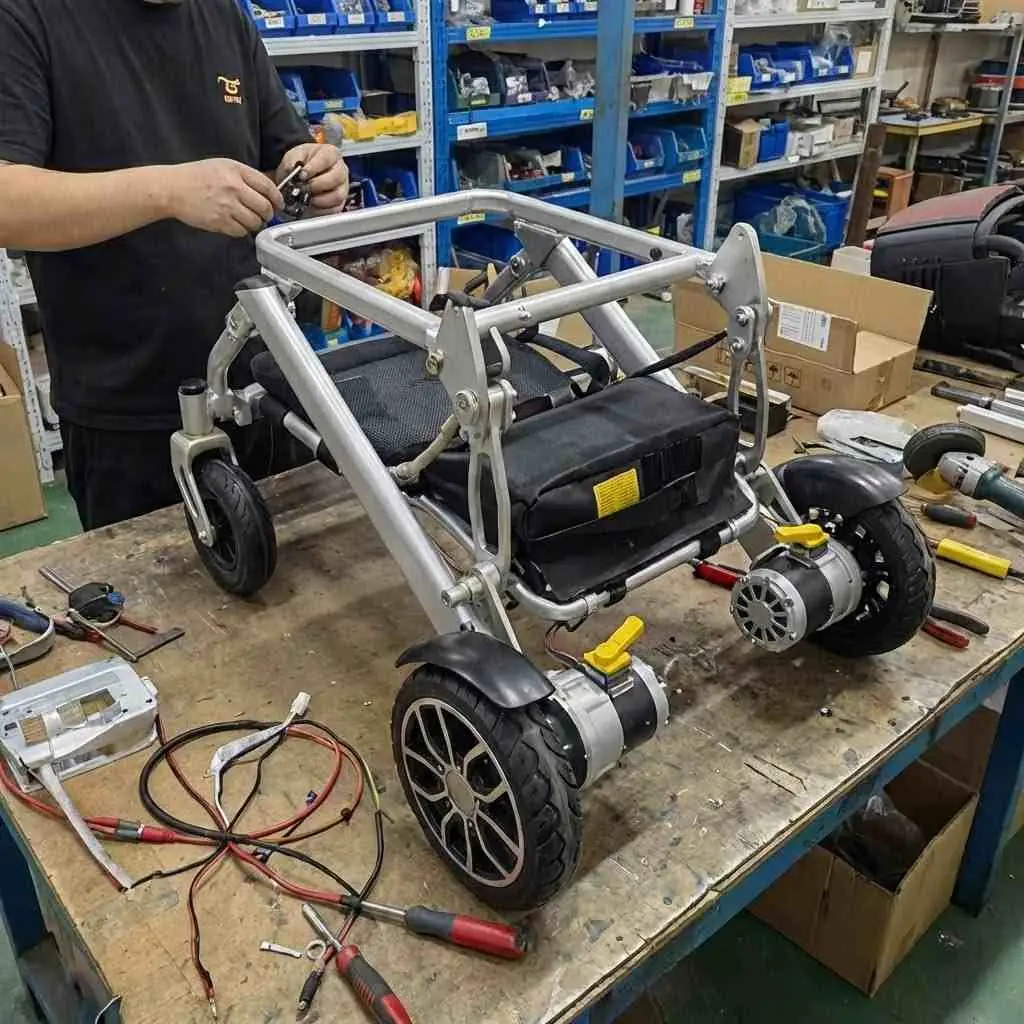
How Distributors Reorder Electric Wheelchairs from China
November 5, 2026
The first order tests a factory. The second order tests the relationship. How Distributors Reorder Electric Wheelchairs from China is a different job from placing that first order, because you are no longer guessing: you know what sold, what sat in the warehouse, which customers came back with questions, and how the factory handled problems. A good reorder uses that knowledge; a careless one repeats the first order and assumes nothing has changed.
The mistake to avoid is treating a reorder as a copy-and-paste of the first purchase order. Models change, specifications drift, and customer feedback accumulates. This guide walks through the reorder: reviewing what happened with the first batch, re-confirming the details that matter, adjusting the model mix, talking terms from real history, consolidating the shipment, and keeping the factory relationship healthy for the order after this one.
If you have not yet placed a first order, start earlier in the sequence. Our guide to evaluating a factory explains what to check before you commit: how to evaluate an electric wheelchair factory. And if you are still choosing who to buy from, our manufacturer guide sets out the selection criteria: how to choose an electric wheelchair manufacturer in China.
What actually changes between the first order and the second?
Almost everything except the factory’s name. On a first order, you buy on research, samples, and promises. On a reorder, you buy on evidence: your own sales records, your own service notes, and your own experience of how the factory communicates when something goes wrong. That evidence should change the order, even if the factory and the models stay the same.
Three things commonly shift. First, your customers have told you something, through sales, returns, or repeated staff questions. Second, the factory may have changed something small since the first order, such as a component supplier or a colour shade, and small changes matter when your listings and spare parts are built around the original version. Third, your own business has moved on: different quantities, different spare parts, or a different balance between models.
A reorder is also the point where a planning habit pays off. This article covers the reorder itself, the conversation and the order you place. For the planning system behind it, deciding when to reorder and how much to hold, see our replenishment guide: electric wheelchair replenishment planning guide.
Key Takeaway: A reorder is not a repeat of the first order; it is a new order informed by everything the first order taught you.
How do you review what sold and what did not before you reorder?
Start with your own records, not with a feeling about which model “did well.” Pull three simple lists before you talk to the factory: what sold and how fast, what is still sitting in stock and for how long, and what service or warranty issues came up. Those three lists are the whole basis for the new order.
Look at sales first, model by model. A model that sold steadily through the whole period is a different case from one that sold in a single burst and then stopped, and both are different from a model that only moved after staff started demonstrating it in the showroom. Note which models needed explaining, which ones customers chose after a trial, and which ones came back with questions about charging, folding, or weight.
Then look at what did not sell, and be honest about why. A model can sit unsold because customers did not want it, because it was priced above what your market accepts, because staff did not know how to demonstrate it, or because it arrived at the wrong time of year. Each reason points to a different reorder decision: drop it, reposition it, train staff on it, or time the next batch differently. Do not reorder a slow model at the same quantity out of loyalty to the first order.
Finally, review service notes. If one model generated repeated questions about the same part, order more of that part with the reorder. For the heavy-duty range, remember that both lead-acid and lithium battery options are offered, so confirm which version your customers actually bought before you reorder either one.
Key Takeaway: The reorder starts at your own desk, with three lists: what sold, what sat, and what went wrong, and every line of the new order should trace back to one of them.
What should you re-confirm in writing instead of assuming?
Everything that matters, even if it was agreed on the first order. Factories change suppliers, update components, and adjust packaging over time, and any of that can quietly change the product your customers receive. A reorder is the moment to put the agreed version back in writing and ask the factory to confirm it, point by point, before production starts.
Your re-confirmation list should cover identity first: model, frame colour, upholstery colour, logo artwork and placement, and packaging. OEM customisation at ZVCARE covers colours, logo placement, and packaging, so name each exactly rather than writing “same as last time.” “Same as last time” is the phrase most reorder disputes start with, because each side remembers last time slightly differently.
Next, confirm the measurable details: folded size, weight, and battery type. State whether a weight figure includes the battery, because that single point causes more confusion than any other. The EW1000, for example, is listed at 15 kg including battery, while the EW100 is listed at 23 kg and 73×55.5×31cm folded. If your listings quote those figures, ask the factory to confirm in writing that the reorder matches them, and check the first units against the same figures when they arrive.
Then confirm warranty terms, spare parts, charger pairing, and the paperwork travelling with the shipment. At ZVCARE the unified warranty is frame 36 months, and battery 6 months for lead-acid or 12 months for lithium, motor, and controller 12 months each. If a chair is designed for air travel, keep the careful wording in your listings: it is designed for air travel (airline approval required), because the airline makes the final decision on the day of travel.
Send the whole list in one message, and ask the factory to confirm each point back in writing. That confirmation becomes the reference for your incoming inspection when the reorder arrives. Our inspection checklist explains how to check a delivery against an agreed specification: electric wheelchair QC checklist for incoming inspection.
Key Takeaway: Never reorder on “same as last time”; re-confirm every point that matters in writing, and let the factory confirm it back before production starts.
How do you adjust the model mix on a reorder?
Adjusting the mix means deciding, model by model, whether to keep, grow, shrink, or drop each line, and the decision should follow the sales review, not habit. A range that made sense for a first order, when you were testing the market, rarely makes sense unchanged for a second order, when you know which models your customers actually choose.
Decision
When it fits
What to do on the reorder
Keep
Steady sales, few service issues, staff can demonstrate it confidently
Reorder at a level your sales review supports, and re-confirm the specification in writing
Grow
Sells faster than you expected, or customers keep asking for it when it is out of stock
Increase its share of the order, and check spare parts cover the larger installed base
Shrink
Sells slowly but has a real place, e.g., a model some customers need even if most choose another
Order a smaller quantity, and give staff a clear reason to recommend it to the right customer
Drop
Sells poorly for a reason you cannot fix, or service issues keep repeating
Leave it out, tell the factory plainly, and put the freed quantity toward a model with proven demand
Test
A model you have not stocked yet, or a variation such as a different battery option, that customers have asked about
Add a small trial quantity alongside proven sellers, not as a replacement for them
Be careful with two traps. The first is dropping a model because it sold slowly while nobody demonstrated it; the fix there is training, not delisting. The second is growing a model because one customer bought several units at once; a single bulk sale is not a trend. Do not judge a model on one bulk sale: a model that sold steadily for three months is a different case from one that sold the same total in a single week.
Key Takeaway: Sort every model into keep, grow, shrink, drop, or test, write the reason down, and let the sales review, not habit, set the new mix.
How do you renegotiate terms when you already have history?
A second order gives you something a first order does not: a track record both sides can point to. You paid on time, the factory delivered, customers were served, and any problems were handled a particular way. That history is worth more in a terms discussion than any bargaining tactic, because it lets both sides talk about what actually happened instead of what might happen.
Start from the facts of the first order. Did delivery arrive when agreed? Were claims handled quickly? Did the factory communicate early when something changed? Bring those points into the conversation plainly, including the good ones, before the next order rather than during it.
Then raise terms as questions, not demands, and keep each one concrete. Payment timing, order quantity, lead time, spare parts inclusion, and claim handling are all fair topics for a reorder discussion, but none of them should be assumed from the first order. At ZVCARE, the confirmed starting terms are a 1pc MOQ and a 7-day lead time after payment, with OEM customisation in colours, logo placement, and packaging. If you want different terms, ask for them explicitly and get the answer in writing; do not treat a friendly conversation as an agreement.
For the mechanics of payment terms themselves, including the structures factories commonly use, see our payment terms guide: payment terms with an electric wheelchair factory. And if the first order involved a written request for quotation, update that document for the reorder rather than starting from a blank page: how to write an RFQ for electric wheelchairs.
Key Takeaway: Negotiate from the first order’s real record, ask for each term explicitly, and get the answer in writing; history earns you a serious conversation, not automatic concessions.
How do you consolidate shipments and spare parts into one reorder?
A reorder is the cheapest moment to fix small gaps, because chairs and spare parts can travel together instead of in separate shipments later. Plan the consolidation before the order is placed, not after the chairs have shipped and you discover the spare parts are coming separately.
Start with the spare parts list. Go back to the service notes from the first batch and list the parts your customers actually needed: controllers, chargers, motors, tyres, and batteries are the usual candidates, but your own records decide the list, not a generic catalogue. Our stocking guide helps you think through which parts a distributor should hold: electric wheelchair spare parts stocking guide. Order those parts with the reorder, in quantities tied to how many chairs of each model you now have in the market.
Next, look at the shipment itself. If you are ordering chairs, spare parts, and perhaps a trial model, ask the factory how they will be packed and whether they can travel in one consolidated shipment, and confirm the packing list matches the order line by line. Carton sizes, battery transport rules, and delivery routes all affect what can travel together, so discuss consolidation with the factory directly rather than assuming it.
Finally, check the paperwork before anything leaves the factory: model names, quantities, colours, battery types, and spare parts, each against your confirmed order. A packing error found at the factory is a message; the same error found in your warehouse is a delay and a customer kept waiting.
Key Takeaway: Plan spare parts and consolidated shipping into the reorder before it ships; fixing a gap later costs a second shipment and a waiting customer.
How do you keep the factory relationship healthy after the second order?
A reorder is where a supplier relationship either becomes a partnership or starts to wear thin, and the difference is rarely about price. It is about how problems are reported, how feedback is given, and whether each side still tells the other the truth early.
Report problems the way you would want to receive them: promptly, with photos, with the model and batch details, and with a clear statement of what you need, whether that is a replacement part, a repair instruction, or an explanation. Separate a single faulty unit from a pattern across several units, and say which one you are reporting, because the factory’s response should be different.
Give positive feedback too, and be specific about it. Telling a factory which model your customers praise, and why, helps them understand your market better than a general “good quality” message.
Keep the relationship honest about the future as well. If you plan to grow, say so, so the factory can plan capacity. If you plan to pause ordering for a season, say that too, rather than going quiet and reappearing with an urgent order. And when a delay happens, as it sometimes will, judge the factory by how early they told you and how clearly they explained the options, not only by the delay itself.
Key Takeaway: Report problems with evidence, share what customers praise, and tell the factory your plans early; that is what turns a second order into a lasting supply relationship.
How Distributors Reorder Electric Wheelchairs from China comes down to one discipline: use what the first order taught you, write it down, and get the factory to confirm it back. Review what sold and what did not, re-confirm the specification instead of assuming it, set the model mix from evidence, talk terms from real history, consolidate parts and shipping into one order, and keep the relationship honest. Do that, and the second order is not just more stock; it is a stronger range, fewer surprises, and a factory relationship that can carry the third order too. If you are planning a reorder, talk to ZVCARE. We offer OEM customisation in colours, logo placement, and packaging, with a 1pc MOQ and a 7-day lead time after payment. Send us your sales review and re-confirmation list, and we will work through the reorder with you before production starts.
FAQ
What if the factory changed a specification since my first order?
Ask for the change in writing, with the reason, and judge it against your listings and spare parts before you accept it. If it affects folded size, weight, battery type, or charger fit, update your listings and check spare parts compatibility before the reorder ships. Never accept an undocumented change on a reorder.
Should I reorder the same quantities as the first order?
Only if your sales review supports it. The first order was a test of the market; the second order should follow what actually sold, what sat in stock, and what service issues arose. Reordering identical quantities without that review repeats the first order’s guesses instead of using its lessons.
Can I add a new model to a reorder?
Yes, and a reorder is a sensible time to do it, because proven sellers carry the order while the new model is tested. Add the new model as a small trial quantity, re-confirm its full specification in writing, and judge it on its own sales and service record before giving it a larger share of the next order.
What if a model sold well but generated many service questions?
Do not drop it automatically, and do not ignore the questions either. Find out whether the questions come from a real fault, from customers needing better instruction, or from staff needing training. Order the spare parts the questions point to, and brief staff on the most common question before the reorder arrives.
Do I need a new sample for a reorder?
Not usually, if the specification is genuinely unchanged and the factory confirms it in writing. If anything changed, colour, logo, packaging, battery type, or a component, treat that part as a new decision and ask for evidence, such as photos or a sample, before the bulk reorder ships.
Founded in 2015, ZVCARE is an ISO 13485:2016 certified electric wheelchair manufacturer in China, providing OEM & ODM solutions for global distributors and medical stores.