How to Choose an Electric Wheelchair Manufacturer in China
October 29, 2026
Choosing a supplier is one of the biggest decisions a distributor makes. The chairs you import carry your name in your market. A missed certificate, a weak sample, or a vague contract becomes your problem with your customers. That is why this guide focuses on one skill: how to choose an electric wheelchair manufacturer in China by checking facts, not by trusting claims.
A good check takes days, not months. You ask for documents, you test a sample, and you read the numbers with care. Each step below gives you the exact question to ask and the answer to expect. If you want the warning-sign side too, our guide to red flags when choosing a supplier covers it from the opposite angle.
What should you verify when choosing an electric wheelchair manufacturer in China?
Start with five checks, and run them in this order. First, check the documents. Second, check the factory claim. Third, test the sample. Fourth, read the specification sheet. Fifth, get the commercial terms in writing. This order matters, because a supplier that fails the document check rarely passes the later checks.
Keep a simple file for each supplier you contact. Save every certificate, sample note, and written answer in one place. Later, when two quotes look similar, this file shows which supplier gave clear answers and which one gave smooth words. After each call, note what the supplier promised, who said it, and the date.
Finally, judge the supplier on evidence, not on speed of reply. A fast reply proves nothing about product quality, while a slower reply with complete documents tells you far more.
Should you look for a factory in China, a manufacturer, or both?
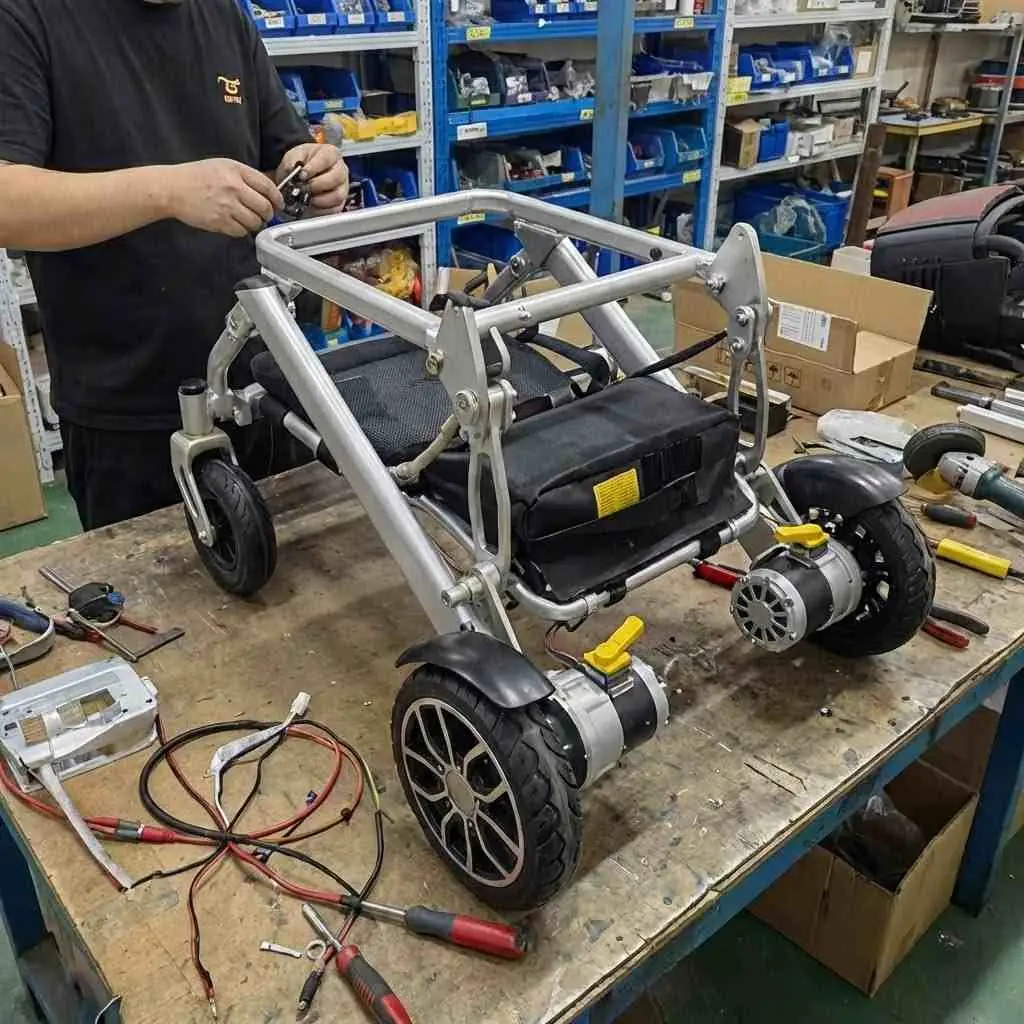
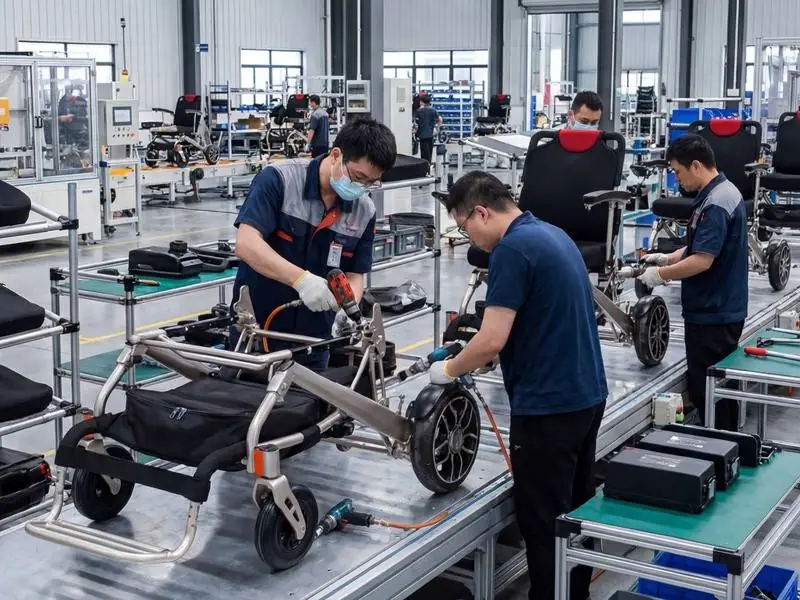
Many buyers treat “manufacturer” and “factory” as two different choices. In practice, they overlap. A manufacturer in China often owns or runs its own factory, and a factory often sells under its own manufacturer name. The real question is not which word the supplier uses. It is whether the supplier controls production or only resells chairs made by someone else.
Ask one direct question: “Do you make these chairs in your own facility, or do you source them from another factory?” A direct supplier answers in one sentence and can show you the production area. A reseller may hedge, change the subject, or offer a visit to a site it does not run. None of that proves bad faith on its own, but it does change what you must check next.
For a fuller walk-through of site checks, our guide to evaluating a factory covers the visit itself in more detail. This guide keeps the point short: confirm who makes the chair, and then verify that claim with the checks in the next sections. Do not run two separate searches, one for manufacturers and one for factories. You will only meet the same companies twice, and spend twice the time on the same shortlist.
A checkable answer names the sites. For example, a supplier might state two production facilities totalling 3,000+ sqm in Longgang, Shenzhen. You can then ask for the address of each site and match it against the business licence. A vague answer, such as “a large modern plant,” gives you nothing to match. Treat vagueness as an unfinished answer, not as a failed one, and ask again in writing.
Which documents should you ask for first?
Ask for documents before you discuss price in detail. Price means little until you know what you are buying and whether the supplier can support it in your market. Request four items: the business licence, the quality management certificate, the market-access filing for your region, and the battery test summary for lithium models.
Start with the business licence. Check that the company name matches the name on every other document. Also check that the address matches the factory address the supplier gave you. A mismatch does not always mean trouble. A company can hold more than one site, but the supplier should explain it clearly and in writing.
Next, check the quality management certificate. ISO 13485 is the quality management standard for medical devices, and you can read its scope on the official ISO page for ISO 13485:2016. A complete copy names the issuer and the scope, and it shows both the renewal date and the expiry date. For example, it might show ISO 13485:2016, issued through NQA/UKAS, renewed 2026-05-11, and valid to 2029-05-04.
For buyers who want more background on this standard, our guide to ISO 13485 for buyers explains what the certificate does and does not prove. The key point is simple: a certificate proves that a system was audited, not that every chair is perfect. You still need the sample check and the specification check below.
Then check the market-access filing for your region. In the EU, a Class I device uses an EU Authorised Representative filing, not a notified-body certificate. Many buyers expect a certificate with a notified-body number, but that expectation fits higher-risk devices, not Class I chairs. Our guide to CE marking for Class I wheelchairs explains this distinction in full, and it is worth reading before you reject a filing for looking too simple.
Finally, ask for the battery test summary when the chair uses a lithium battery. Keep this request separate from the general certificate request, because battery paperwork often comes from a different file. If the supplier cannot produce it, pause the discussion until it can. Battery compliance is not a detail you can fix after shipment.
How can you verify a “factory” claim without flying there?
A visit is useful, but it is not the only way to check a factory claim. A live video walk-through, done well, answers most of the same questions. Ask the supplier to walk through the production area, the warehouse, and the testing area in one continuous call. A pre-recorded video proves far less, since it can show only the best corners.
During the call, ask to see something specific. For example, ask to see the chair model you plan to order on the line, or ask the guide to show the raw material store. Specific requests are hard to stage. Also note the background details: the signage, the work in progress, and the state of the floor. A real working site looks busy and imperfect.
After the call, match what you saw against the documents. Does the site address match the licence? Is the scale of the site consistent with the claimed floor area? Does the testing area match the tests the supplier claims to run? Small gaps are normal, and a good supplier explains them. Large gaps, or a refusal to show a basic area, deserve a direct follow-up question in writing.
One more check costs nothing: search the company name and address on your own. A supplier with a real site usually leaves a consistent trail across business listings and trade profiles. A supplier with no trail at all may still be genuine, but then lean harder on documents and sample tests.
What should you check on the sample before you judge the price?
Judge the sample as your customer would, not as an engineer would. Sit in the chair, fold it, lift it, and drive it. Start with folding and lifting, since these are the actions your customers repeat daily. The mechanism should work smoothly without force, and the folded chair should feel manageable for one person to lift into a car.
Next, check the weight line against your own scale. Always confirm whether the stated weight includes the battery, since a lithium pack adds real weight. A complete weight line reads like this: e.g. 15 kg (including battery). If the sheet gives a weight with no condition attached, treat the number as incomplete and ask for the condition in writing.
Then test the controls and the brakes. Drive slowly, turn in a tight space, and stop on a gentle slope. The joystick should respond smoothly, without jumps or dead zones. The brakes should hold the chair still when you release the control. Also check the charger: it must match the battery type, and its label must match the specification sheet.
Battery paperwork belongs in this check too. For a lithium battery, ask for the UN38.3 test summary and confirm that it covers the battery fitted to your sample. Our guide to UN38.3 for wheelchair batteries explains what the summary contains and why transport carriers ask for it. Do not accept a summary for a different battery size and assume it covers yours.
Finally, inspect the packaging the sample arrived in. The carton, padding, and protection on the joystick and footrest show how the supplier thinks about freight damage. A sample that arrives scuffed predicts how bulk orders will arrive. Note damage with photos, and raise it before you discuss the next order.
How do you read a specification sheet without being misled?
A specification sheet is a set of claims, not a set of facts, until you know how each number was measured. Read it line by line, and ask about the condition behind every number that affects your decision. Weight, folded size, range, and slope all depend on conditions, and a sheet that hides the conditions hides the comparison.
Weight needs two conditions: whether the battery is included, and whether the figure is net or carton weight. Net weight answers the product question, while carton weight answers the freight question. Ask for both, and keep them in separate lines in your notes. Mixing them up later will distort your freight costing.
Folded size needs one condition: whether the footrest and joystick stay fitted during measurement. A folded size measured with parts removed looks smaller on paper but not in your customer’s car. Ask for the folded size in the form the customer will actually lift, and compare that figure across suppliers. For example, a complete line might read: e.g. folded size 73 by 39 by 71 cm, footrest fitted.
Range and slope need the most care. Range depends on rider weight, terrain, and speed, so a single range figure without conditions is only a rough guide. Slope figures work the same way. Our guide to reading a specification sheet walks through each number with worked examples. Keep it open while you compare sheets side by side.
When you find a gap, write it down as a question, not as an accusation. For example: “Your sheet lists range without rider weight. What rider weight and terrain does this figure assume?” Suppliers with solid data answer quickly. Suppliers without it often reply with a vaguer number, which tells you plenty.
What should the quotation and contract state in writing?
A quotation should read like a checklist, not like a sales letter. It should state the model, the configuration, the quantity, the unit price, and the total price, each on its own line. It should also state what is included: battery, charger, and packaging, at minimum. If any of these items is unclear, ask for a revised quotation before you move forward.
Commercial terms deserve the same clarity. A clear written answer states numbers, not adjectives. For example, it might state: e.g. MOQ 1 unit; lead time 7 days after payment; frame warranty 36 months; battery warranty 6 months for lead-acid or 12 months for lithium, motor, and controller warranty 12 months each. Your supplier’s figures may differ, and that is fine. What matters is that the figures exist in writing, with the start point of each period defined.
Warranty wording needs special care. Ask which parts the warranty covers, how a claim starts, and who pays freight on a warranty return. Also ask whether the warranty period starts on shipment, delivery, or first use. Each start point gives a different result, and a supplier that leaves it undefined leaves you exposed. Get the answer in the contract, not only in an email.
Customisation scope should also be defined in writing. A defined scope names exactly what can change, rather than promising broad customisation. For example, a clear scope might cover colours, logo placement, and packaging only. If you need changes beyond that scope, raise them now, while you can still compare suppliers. Late changes cost more and cause more delay than early ones.
How do you run the final check before the first bulk order?
Before the first bulk order, run one last review of your file. Re-read the documents, the sample notes, and the contract terms together. Look for contradictions. Does a certificate name differ from the contract name? Does a weight differ from your scale reading? Did a warranty term change between quotation and contract? Small contradictions often have simple explanations, but resolve them before payment, not after.
Next, confirm the order details in a single written summary. List the model, configuration, quantity, price, lead time, warranty, and delivery terms in one message, and ask the supplier to confirm each line. This summary protects both sides. It removes the risk of a detail agreed in one call and forgotten in the next.
Also agree in writing what evidence you will receive before shipment, such as photos of the finished chairs, the packing list, and the test records for the order. You do not need an exhaustive list, but you do need an agreed list.
Finally, keep the first order at a size you can manage. Starting small lets you test the supplier’s delivery, packaging, and after-sales response with limited risk. If the first order goes well, scaling up is easy. If it goes badly, a small order limits the damage and gives you a clear record for the next discussion.
You can see the current model range on the ZVCARE homepage as a reference point for the configurations discussed here. Use it to compare models, then return to your checklist.
When you are ready to discuss a specific model, the contact page lets you reach the team directly with your checklist and sample notes. A message that includes your model, quantity, and market region gets a faster, more useful reply than a general enquiry.
What do buyers most often ask before choosing?
Is a factory visit necessary before the first order?
A visit helps, but it is not always necessary. A live video walk-through, complete documents, and a careful sample test can support a first small order. Reserve a visit for larger commitments, or for cases where the documents and the video leave real doubts.
Should you choose a manufacturer or a trading company?
Either can work, but the checks differ. With a manufacturer, verify production control and quality systems. With a trading company, verify its relationship with the factory and its control over quality and delivery. In both cases, ask who handles warranty claims and how quickly they respond.
What if the certificate name does not match the company name?
Ask for a written explanation before you proceed. A group structure or a recent name change can explain a mismatch, but the supplier should document it. If no explanation arrives, treat the mismatch as an open item and do not place the order until it closes.
How many chairs should you test before a bulk order?
Test each model you plan to sell, not just the one you like most. Different models can differ in frame, battery, and controls, so a test on one model proves little about another. Test the exact configuration you plan to order, including battery and charger.
Can one supplier cover both lightweight and heavy-duty models?
Possibly, but verify each model on its own merits. A supplier strong in lightweight folding chairs is not automatically strong in heavy-duty models. Run the document, sample, and specification checks separately for each model you plan to carry.
Choosing well takes discipline, and it pays off in fewer surprises after shipment. The supplier that welcomes documents, sample tests, and written terms is usually the supplier that will handle problems well later. That attitude matters as much as any single certificate. If you apply this checklist to every supplier you consider, you will choose an electric wheelchair manufacturer in China on evidence, not on presentation.
Key Takeaway: Ask for documents first, verify the factory claim on video, test the sample as your customer would, read every specification with its conditions, and get MOQ, lead time, warranty, and customisation scope in writing before you pay.
Founded in 2015, ZVCARE is an ISO 13485:2016 certified electric wheelchair manufacturer in China, providing OEM & ODM solutions for global distributors and medical stores.