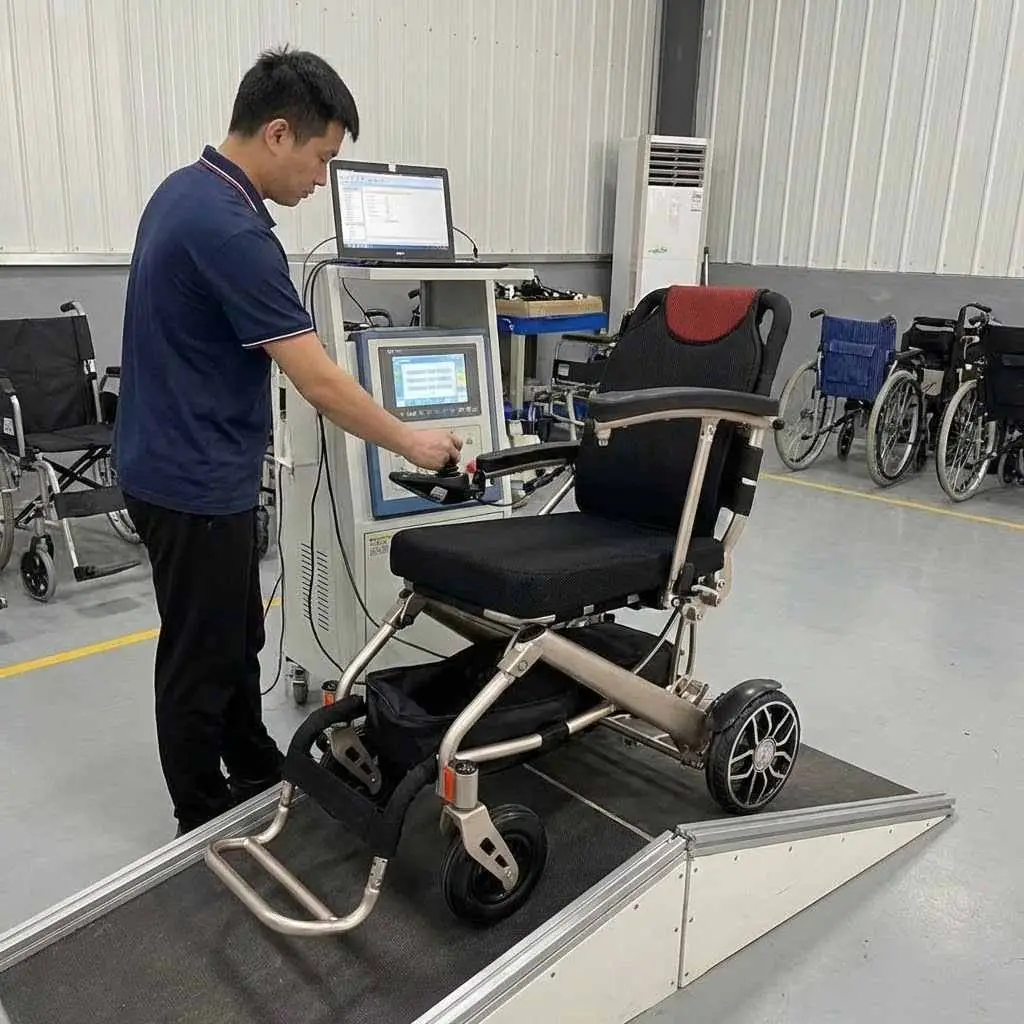
If you are sourcing branded wheelchairs from China, one question matters more than any general definition. What actually happens once your inquiry reaches a real factory? This guide answers that question from the factory side. It walks through how an electric wheelchair OEM project runs at our Shenzhen factory, from the first inquiry to the shipping documents that leave with the order. Every step below is a step we follow. Every term is one we can confirm in writing before production starts.
That level of detail matters because generic process pages cannot tell you what to check. A buyer does not need another definition of OEM work. A buyer needs a checklist: what to send, what to approve, and what to expect at each stage. This guide gives you that checklist, based on our own process.
How does electric wheelchair OEM work in practice?
In short, it runs in six stages. You send an inquiry. We build a sample to the agreed specification. You approve that sample. We produce the order. We check the finished chairs. Then we prepare the shipping documents. No stage starts until the previous one is confirmed. That rule sounds slow, but it prevents a common and costly OEM problem: a batch produced to a specification nobody actually approved.
The table below shows the full flow at a glance. Each stage ends with something concrete, not a verbal assurance.
Stage
What the factory does
What you confirm
Inquiry
Reviews your request and replies with what is possible
Model, quantity, colors, logo placement, packaging
Sample
Builds one unit to the agreed specification
Color, logo placement, packaging, basic functions
Confirmation
Puts the agreed specification in writing
The final specification sheet before production
Production
Produces the order to the confirmed sample
Nothing new at this stage, unless you raise a change early
Quality checks
Checks finished chairs against the sample
The inspection result before shipment
Shipping documents
Prepares the export documents for the order
Destination details and document requirements
The rest of this guide takes each stage in turn. It also flags the points where buyers most often lose time: vague inquiries, unapproved changes, and missing documents.
What should you confirm before you send an inquiry?
A clear inquiry gets a clear answer. Before you write to any factory, settle five points. First, which model platform do you want to brand? Second, how many units is this order for? Third, which colors do you want? Fourth, where should your logo sit, and what artwork file will you supply? Fifth, what packaging do you need? If any of these points is open, say so plainly. An honest “not decided yet” gets better advice than a guess that later changes.
Destination details matter at this stage too. Tell the factory where the chairs are going and which documents your market needs. Some markets ask for specific certificates or test summaries. If you raise these needs at inquiry stage, the factory can confirm what it can supply. If you raise them after production, the answer may come too late to help.
A structured inquiry also protects your own timeline. It reduces back-and-forth emails and gives the factory one document to work from. For a practical template, see this guide to writing a clear RFQ.
Finally, keep your inquiry realistic about scope. Our OEM scope covers colors, logo placement, and packaging. If your request goes beyond those three areas, raise it at inquiry stage. The factory can then tell you plainly whether it is possible, before you invest time in a sample.
What can you actually customize, and what stays fixed?
This is the section to read twice, because it sets the boundary of the whole project. Under our OEM terms, you can customize three things: colors, logo placement, and packaging. Colors change the look of the chair. Logo placement puts your brand where buyers see it. Packaging carries your brand through shipping and storage. Those three areas give a distributor a genuinely branded product without redesigning the chair itself.
Everything else stays as confirmed on the base model. The frame, the motor, the battery, and the controller follow the agreed model platform. That limit is deliberate. It keeps the product tested, consistent, and supportable. A chair with a changed frame or a changed drive system is a different product, and it needs a different kind of evaluation. It does not belong in a branding project.
A request for a wholly new model developed from scratch is a different kind of project, sometimes called ODM, and it sits outside the OEM scope described here. This guide stays on OEM scope only, so you can judge it on its own terms.
For concrete examples of what branding can look like within this scope, see this overview of color, logo, and packaging options.
How does the sample step work?
The sample is the single most important stage in the whole process. It turns words into an object you can check. We build the sample to the specification agreed at inquiry stage: the chosen model, colors, logo placement, and packaging. When it is ready, you check it against that same specification, point by point.
Check the sample the way your own customers will see it. Look at the color in daylight, not only in photos. Check the logo position, size, and clarity. Open the packaging and check how the chair sits inside it. Test the basic functions: folding, driving, braking, and charging. Photos help, but they hide details that hands and eyes catch at once.
If something is wrong, say so at this stage. Feedback now costs little. The same change after production starts costs far more, and it may not be possible at all. List each issue clearly, with a photo where a photo helps. Then wait for the revised sample or the written fix before you approve anything.
Approval must be explicit and written. A message like “looks good” leaves room for dispute later. A short written note works better: the sample is approved as shown, with any listed fixes applied. That note becomes the reference for production and for quality checks.
For a structured way to judge a sample, see this guide to evaluating a sample.
How long does each stage take?
This section is the only place in this guide that talks about time, and that is deliberate. Timelines cause confusion when they appear in several places with different starting points. Here, the rule is simple: the production clock starts when payment is received, not when the first email arrives.
Our production lead time is 7 days after payment is received. That figure covers production of the confirmed order. It does not cover the stages before it, and those stages move at the pace of decisions. Inquiry review depends on how complete your request is. Sample evaluation depends on how fast you check the sample and send feedback. Confirmation depends on how quickly both sides sign off the final specification sheet.
So the honest way to plan is to work backward from your deadline in two parts. First, allow time for inquiry, sample, and confirmation, since those stages depend on your feedback. Second, add the 7-day production period after payment. Buyers who plan this way rarely face surprises. Buyers who count from the first email usually do.
For a fuller discussion of OEM timelines, see this guide on how long OEM production takes.
What happens during production and quality checks?
Production follows the approved sample and the written specification sheet. Nothing new enters the process at this stage unless you raised a change before production started. That discipline is what keeps the finished batch consistent with the sample you approved. Our production runs across two facilities totaling more than 3,000 square meters in Longgang District, Shenzhen. Both sites work to the same confirmed specification for each order.
Quality checks compare finished chairs against the approved sample. Inspectors check the frame, the battery, the motor, and the controller for correct function. They check the color and logo placement against the sample. They check labels and packaging against the agreed specification. A chair that does not match the sample does not ship as a good unit. This check happens before packing, so problems surface while they can still be fixed.
Our quality management system is certified to ISO 13485:2016. The certificate was issued through NQA with UKAS accreditation, renewed on 2026-05-11, and valid until 2029-05-04. You can read what the standard covers on the official ISO 13485:2016 page.
Buyers sometimes ask what a certificate proves. In plain terms, it shows that an independent body audited the quality system behind production. It does not replace checking your own sample and your own shipment. Both layers matter: the system behind the product, and the inspection of the product itself.
What shipping documents should you expect?
Shipping documents close the project, and missing papers are a frequent cause of delays. For a standard order, the document set includes the commercial invoice, the packing list, and the transport document. These papers describe what is shipping, how many units there are, and where they are going. Check them against your confirmation sheet as soon as you receive copies. A wrong quantity or a wrong destination on paper creates real trouble at the port.
Battery documents deserve separate attention. Lithium batteries travel under their own rules, and the UN38.3 test summary is the key paper for air and sea transport. If your order uses lithium batteries, confirm the UN38.3 paperwork at inquiry stage, not after production. This guide to UN38.3 for wheelchair batteries explains what the summary covers and why carriers ask for it.
Compliance papers follow the same rule: ask early. Our CE position is a Class I medical device EU Authorized Representative notification, not a notified-body certificate. Class I devices follow this route: an authorized representative filing plus a manufacturer declaration. Copies of the ISO certificate and the CE filing information are available to buyers on request. Ask for them during confirmation, so they travel with the order rather than behind it.
For the transport side itself, including how chairs move from China to your market, see this guide on how wheelchairs are shipped from China.
What does the warranty actually cover?
Warranty terms should be settled in writing before production, not discovered after a problem. Our unified warranty covers the frame for 36 months. It covers the battery for 6 months for lead-acid or 12 months for lithium, and the motor and controller for 12 months each. Those four figures are the whole warranty in one sentence, and they apply across our models.
A few practical points make the warranty usable. First, keep your order records: the model, the order date, and the confirmation sheet. Second, when a problem appears, describe it clearly and include photos or a short video where that helps. Third, identify which part is involved, since the frame and the electrical parts carry different periods. Clear records and clear descriptions resolve claims faster than long arguments about what was agreed.
Note what the warranty does not do. The warranty period does not pause while a claim is being described. It does not cover damage from misuse or from changes made after delivery. If any of these points is unclear for your market, raise it at confirmation stage. Written terms protect both sides equally.
How should you handle design protection?
Agree in writing who owns your logo and packaging artwork, and where those files may be used, before production starts. For a short checklist on that point, see this guide to protecting your design.
What do buyers ask most often?
Can I order a single unit under OEM terms?
Yes. Our minimum order quantity is 1 unit. That low minimum suits a distributor who wants to test a branded model in a local market before committing to a larger order. It also suits a buyer who needs one branded unit for a showroom or a key customer. The process stays the same at one unit as at larger quantities: inquiry, sample, confirmation, production, checks, and documents.
Do I need to supply my own packaging design?
You supply the brand elements: your logo artwork and any text or layout you want on the packaging. The factory applies them within the agreed packaging specification. If you have no packaging design yet, say so at inquiry stage. The factory can then confirm what standard packaging options exist and what artwork files it needs from you.
Will the chairs carry my brand only?
The chairs carry the logo placement agreed at confirmation stage. That placement is checked on the sample and again during quality checks. If you want your brand on the chair, the packaging, or both, state that clearly at inquiry stage. The confirmation sheet then records exactly what goes where, so production matches your expectation.
What should I check when the shipment arrives?
Count the units first, then check them against the packing list. Next, check the model, color, logo placement, and packaging against your confirmation sheet. Finally, test basic functions on a sample of the chairs. If anything differs from the confirmed specification, report it promptly with photos and the relevant document references. Early, specific reports resolve faster than general complaints weeks later.
Can I change colors or packaging after production starts?
Raise changes before production starts, not during it. Once production runs to the confirmed specification, changes may no longer be possible for that order. If your market needs shift mid-order, tell the factory at once. The factory can then tell you plainly what is still possible and what must wait for the next order.
What should you take into your first OEM order?
You now have the full process in one place, from inquiry to shipping documents. The pattern is simple: confirm the details in writing, approve a sample against those details, and let production follow the approved sample. Most OEM problems come from skipping one of those three steps, not from the factory floor itself. If you run an electric wheelchair OEM project this way, you give the factory a clear target and you give yourself a clear way to check the result.
Key Takeaway: Treat the OEM process as a checklist, not a promise: confirm model, color, logo placement, and packaging in writing, approve a sample against that checklist, and only then let the production clock start.
Founded in 2015, ZVCARE is an ISO 13485:2016 certified electric wheelchair manufacturer in China, providing OEM & ODM solutions for global distributors and medical stores.