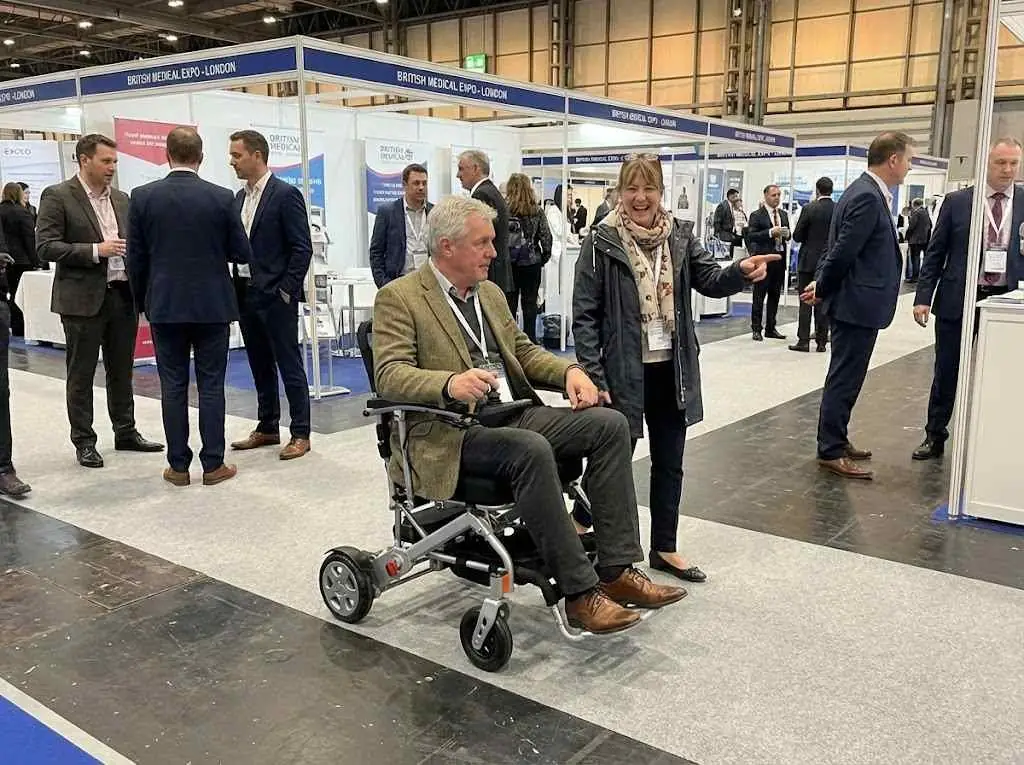
A showroom is where a distributor or retailer turns a product list into a buying decision. Most customers for electric wheelchairs do not buy on a specification sheet alone. They want to sit in the chair, try the joystick, fold it, and feel how it handles a slope or a rough floor. If you are planning how to set up an electric wheelchair showroom, start from that moment: the customer needs space to try, clear choices to compare, and honest answers about charging, service, and delivery.
A warehouse is a different job. It stores stock safely and moves it out in quantity, while a showroom displays a small, well-chosen range and helps one customer at a time. Keeping those two jobs separate is the first planning decision, and it saves a lot of later rearranging.
Renting, meanwhile, is a different job again. Short-term use is a different service with different stock, cleaning, and return handling, described separately in this guide to how to start an electric wheelchair rental business. Your showroom, by contrast, should be built around helping a buyer choose a chair to keep, and supporting that chair after the sale.
What should the front of the showroom do first?
The entrance should do three jobs at once: welcome people, show them where to go, and let them move freely. A wide, step-free entrance with a clear path inside matters more than any decoration, because many visitors arrive with a companion, a carer, or a wheelchair of their own. Keep the entrance clear of boxes, folded chairs, and promotional stands. The first thing a visitor sees should be open floor and a staff member who can greet them, not a wall of stock.
Put a simple sign near the door that explains the layout in plain words: display zones on one side, a test-drive area further in, and a service corner at the back. Customers relax when they know where things are, and they browse better when they are not worried about blocking a walkway. Leave the main walkway wide enough for a wheelchair to pass a standing visitor comfortably, and keep it free all day; a walkway that slowly fills with cartons is a sign that back-of-house storage needs attention.
Lighting matters more than most new showroom owners expect. Bright, even light helps customers see colours, fabrics, and build quality, and helps staff spot dust, scuffs, or a flat tyre on a demo chair. Avoid placing display chairs in direct sun for long periods, since heat and glare make them uncomfortable to sit in.
How should display zones be arranged by use case?
Group chairs by how the customer will use them, not by model number or by the order they arrived. Most buyers arrive with a use in mind: something light to fold into a car, something sturdy for daily use at home and outdoors, or something more comfortable and better finished for long days. Grouped that way, a customer can compare the right chairs against each other instead of wandering past everything.
Start with a lightweight folding zone near the entrance or near the test-drive area, since folding is usually something a customer wants to try on the spot. A chair such as the EW1000, at 15 kg including battery and folded to 73 by 39 by 71 cm, is easy to lift into a demonstration and easy for a customer to picture in a car boot. The EW100, an aluminium model at 23 kg with a folded size of 73 by 55.5 by 31 cm, offers a different balance of weight, size, and feel. Let customers fold and unfold both, and lift the folded chair with help from staff.
For buyers weighing a folding chair against a non-folding one, the trade-offs are worth a plain explanation: folding chairs prioritise transport and storage, while non-folding chairs often prioritise ride comfort and stability. This comparison of folding versus non-folding electric wheelchairs frames the choice around daily life rather than a single feature. In the showroom, keep the two types in separate zones so the comparison is deliberate, not accidental.
Range is the next question most folding-chair buyers ask, and it deserves a straight answer. The EW1000 is rated at 15 plus or minus 3 km, while the EW100 is rated at 12 plus or minus 5 km, with real distance depending on user weight, terrain, and driving habits. Staff should explain range in those terms rather than promising a single figure for every rider. The same point is covered in more detail in this guide to how far a folding electric wheelchair goes.
Folded size matters just as much as range, because a chair that fits one car may not fit another. Keep a tape measure in the folding zone and invite customers to check the folded chair against their own needs. This overview of folding electric wheelchair dimensions helps staff talk about folded size without guessing. Avoid claiming a chair will fit a particular car unless the customer has measured it; a quick check in the showroom beats a return later.
The second zone is durable daily use: chairs built for regular, everyday driving, indoors and out. Models such as the EW8722 and EW8703G belong here, close to the test-drive area, since daily-use buyers often want to try kerbs and slopes before deciding. The third zone is premium: better finish and more comfort features, with space around each chair. Models such as the EW8720 fit naturally here.
Showroom zone
Who it serves
What each display needs
Lightweight folding
Travellers and car users
Space to fold, a tape measure, charging point nearby
Durable daily use
Everyday home and outdoor users
Access to the test-drive area, clear control explanation
Premium
Comfort and long-day users
Space around each chair, calm lighting, full feature walk-through
Behind the display, keep a small, tidy back area for boxed stock, and do not let it spill onto the floor: back-of-house storage protects stock, while front-of-house display helps customers choose. The storage side is covered separately in this guide to storing electric wheelchairs in a warehouse.
What makes a test-drive area actually useful?
A test-drive area is useful when a customer can drive without feeling watched, rushed, or hemmed in. Allow enough room to turn comfortably, to reverse, and to stop and start again. The test is simple: can a first-time driver turn around without hitting a display, and can a companion walk alongside? If the answer is no, the area is too tight, however good it looks in a photo.
Surfaces matter as much as space. A short run of smooth floor, a section of rougher or textured flooring, and a small ramp let customers feel the difference between models in a few minutes. Keep the ramp gentle and safe, with a staff member nearby for a first attempt, and keep the route free of cables and loose rugs.
Set a few house rules and keep them visible. Staff should check the battery before every test drive, adjust the seat and footrest with the customer, and explain the joystick slowly before the chair moves. Let the customer drive at their own pace. A customer who has driven a chair themselves trusts their own judgement, and that trust carries into the sale far better than any sales talk.
How should the charging corner be set up?
Every showroom needs a charging corner, because demo chairs that run flat during a visit help nobody. Place it where staff can reach it easily but customers do not trip over cables: against a wall, out of the main walkway, with enough ventilation and shade.
Labelling is the detail that prevents most charging mistakes. ZVCARE chargers come in 2A and 5A versions, and in lead-acid and lithium versions, and these must be kept straight. Label each charger with its type and current, label the matching chairs, and keep lead-acid and lithium chargers on separate, marked shelves or hooks. Staff should be able to pick the right charger without reading a manual. Charge time depends on battery capacity, so staff should answer charging questions in those terms rather than promising a single time for every chair.
Build charging into the daily routine rather than leaving it to chance. Demo chairs go back on charge after a test drive, not at the end of the day when the battery is already flat. A simple end-of-day check — every demo chair plugged in with the correct charger, every charger back on its hook — prevents the most embarrassing showroom failure: a customer arriving to try a chair that will not move.
Where do service and spare parts fit in a small showroom?
A small service corner earns its floor space many times over, because it answers the question every serious buyer asks: what happens if something goes wrong? Building that answer into a standing network of technicians, local partners, and a response routine is covered in our guide to how distributors build an after-sales service network. You do not need a full workshop on the shop floor. A clean bench, basic tools, a tyre pump, and a small stock of common consumables and spare parts are enough to handle adjustments, checks, and simple replacements.
Stock the parts customers actually need first, and build from sales and service records rather than guessing. For deciding what to hold and what to order on demand, this electric wheelchair spare parts stocking guide is a practical starting point. Keep fast-moving items visible and labelled, and keep the corner tidy. If a repair needs more than the corner can handle, say so directly and explain the next step.
Staff should also know the warranty in plain words, because customers will ask. The frame is covered for 36 months, and the battery is covered for 6 months for lead-acid or 12 months for lithium, and the motor and controller are each covered for 12 months. Saying that clearly, without adding promises the factory has not made, builds more trust than a vague assurance that everything is covered.
How do you keep the demo fleet ready to sell?
A demo fleet is stock that works for a living, and it needs a routine. Rotate demo chairs with boxed stock so no single chair absorbs all the wear, and so customers always try a chair that looks and feels close to new. When a demo chair starts to look tired — scuffed armrests, a worn seat, a joystick that feels loose — retire it from the floor rather than hoping customers will not notice. A worn demo chair sells against you, because customers assume the chair they buy will age the same way.
Cleaning is part of the routine, not an occasional effort. Wipe down seats, armrests, and joysticks between test drives, check tyres and brakes on a regular schedule, and keep folding mechanisms free of grit. Regular care is what keeps a folding chair working smoothly, as this guide to how to maintain a folding electric wheelchair explains.
Ordering replacement demos should be simple. With a minimum order of 1 unit and a lead time of 7 days after payment, a distributor can replace a retired demo chair without committing to a large order. When a demo chair is retired, order its replacement promptly, and keep one boxed unit of the most popular models in the back so the floor is never left with a gap.
What should staff do during a demo?
The best demo habit is the simplest: set the chair up, then step back. Staff should explain the controls once, and then let the customer drive. Talk about what the customer is feeling — the turning, the speed control, the seat comfort — rather than reciting a list of features. If a customer struggles with the joystick, slow down and adjust the settings together rather than taking over. A customer who has folded the chair and asked their own questions leaves with a decision they own.
Answer service questions plainly, even when the answer is not flattering. If a part must be ordered, say so and give the honest timescale. After a test drive, give the customer a moment with the chair and a companion, rather than pressing for a decision on the spot. A showroom that respects that pause sells more chairs over time than one that chases every visit to a close.
Why do real photos work better than stock images on walls and in listings?
Walls and listings should show the chairs you actually sell, in rooms that look like yours. Stock images of generic wheelchairs in unfamiliar settings create a gap between what a customer sees online and what they find in the showroom, and that gap costs trust. Real photos — your display zones, your test-drive area, your staff demonstrating a chair — set an accurate expectation, and they help a customer recognise the showroom when they arrive.
Use the same rule for online listings. A listing with real photos of the actual model, taken in your showroom, answers questions a stock image cannot: what colour does this chair really look like, how does it fold, and what does the seat look like up close? Keep the photos honest: clean the chair, use good light, and photograph the features customers ask about, such as the folding mechanism and the controller. Avoid heavy filters that change colours.
Branding on the walls should follow the same honest approach. If you sell under your own label, keep the branding consistent between the wall, the listing, and the chair itself, so customers are not confused about whose product they are buying. This guide to how to private label electric wheelchairs explains the options for colours, logo placement, and packaging. The two photos used in this article come from exhibition displays rather than a permanent showroom interior, and are shown as the closest real examples of a display zone and a customer demo.
What do buyers ask most often?
Can customers test-drive before they buy?
Yes, and a good showroom expects it. Every display chair offered for test drives should be charged, clean, and adjusted to the customer before the drive begins. If a chair cannot be driven on the day of a visit, staff should say why and offer a clear alternative.
How many wheelchairs should a new showroom display?
Start with breadth of choice, not count. Cover the three use cases — lightweight folding, durable daily use, and premium — with enough choice in each for a real comparison, and add depth only when you know which models your customers ask for. A small, well-chosen floor that is always ready to demonstrate beats a large floor of flat, dusty chairs.
Do you offer service and spare parts after the sale?
Yes, through the showroom service corner and the parts it holds, with the factory warranty behind it: the frame for 36 months, and the battery for 6 months for lead-acid or 12 months for lithium, and the motor and controller for 12 months each. Before buying, ask what the showroom holds in stock and what it orders on demand, and ask how long a typical repair takes.
Can a showroom order a colour or logo version for a customer?
In many cases, yes, because OEM customisation covers colours, logo placement, and packaging, subject to the order being placed with the factory. Ask the showroom early in the conversation, since a customised order follows the normal lead time of 7 days after payment.
What should you get right in the first week after opening?
Opening week is a test of routines, not of decoration. Before the doors open, walk the floor as a customer: enter, find the zones, try the test-drive route, and sit in every display chair. Check that every demo chair is charged with the correct charger, that the service corner is stocked, and that the back area is tidy. Small faults found on that walk are easy to fix; the same faults found by a customer are much harder to undo.
Use the first week to listen. Note which chairs customers ask for, which questions repeat, and where visitors hesitate or get confused. If customers keep asking the same thing about charging or folding, add a sign or change the demo script. Treat the first week as feedback, not as a verdict.
Keep the basics steady while you learn: demos charged, floor clean, staff available, and answers straight. That, in the end, is how to set up an electric wheelchair showroom that keeps working after the opening excitement fades — a room where customers can try honestly, compare fairly, and buy with confidence, and where the business behind it can support every chair it sells.
Key Takeaway: A good showroom groups chairs by use, gives customers room and surfaces to test-drive honestly, keeps demos charged and clean, and answers service questions plainly.
Founded in 2015, ZVCARE is an ISO 13485:2016 certified electric wheelchair manufacturer in China, providing OEM & ODM solutions for global distributors and medical stores.