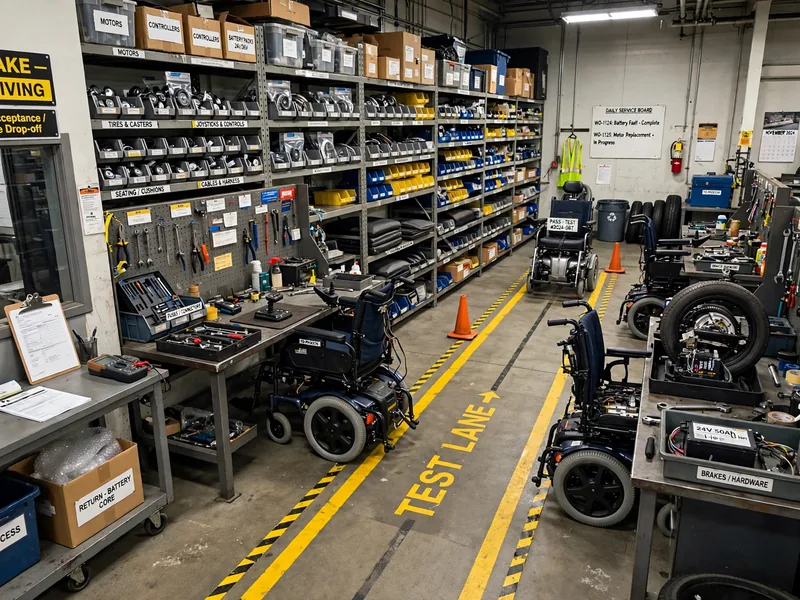
This Electric Wheelchair Service Workshop Setup Guide starts with the room, not the repair, because a well-planned workshop makes every later job faster and easier to prove. Many distributors service chairs in whatever corner is free, and the result is familiar: tools go missing, parts pile up on the bench, and nobody can find the record of what was fitted last time. What follows is a practical checklist for your own space, from zones and tools to bench stock and job cards, so the workshop supports your service promise instead of slowing it down.
How Should You Divide a Service Workshop Into Zones?
Start with five working zones: an intake area, repair benches, a test lane, a parts store, and a small battery corner set apart from the rest. The intake area sits nearest the door, where a chair can be received, tagged, and parked without blocking anyone already working. Your showroom can keep its small service corner, because our showroom setup guide explains that a selling floor does not need a full workshop inside it.
Repair benches sit in the middle of the room, where the light is best, while the parts store sits behind them, so a technician walks a short loop to fetch a part and returns to the same bench. The test lane needs a clear, straight run with room to turn at each end, and it should never double as storage. Keep the battery corner ventilated, dry, and away from the test lane, with its own charging point and a clear surface where nothing else gets stacked. Mark each zone on the floor with tape, and put a simple sign above it, so a new helper can see where things belong on the first day.
Zone
What happens there
What it needs
Intake area
Chairs arrive, get tagged, and wait for a bench
Desk, job cards, chair park
Repair benches
Hands-on work on one chair at a time
Solid bench, light, power, tool storage
Test lane
Clear run and turning space after work
Straight clear floor, no storage in the lane
Parts store
Spare parts kept, counted, and fetched
Labelled shelves, separate from the benches
Battery corner
Batteries charged and kept apart
Ventilation, dry surface, own charging point
Key Takeaway: Five clear zones and one marked route through them keep chairs, tools, and parts from getting in each other’s way.
What Does the Intake Area Need Before a Chair Reaches a Bench?
The intake area needs a desk, a chair park, and a fresh job card for every chair that comes in, because nothing should reach a bench without a written record of why it is there. At the desk, record the customer, the chair model, the serial number, and the fault as the customer describes it, before anyone touches a tool. Take a dated photo of the chair as it arrives, note any visible damage on the card, and attach a tag that matches the card number, so the chair and its record can never be mixed up with another. This written handover later protects a warranty claim, and our warranty repair guide explains how that claim is assessed once the chair is in the workshop.
Keep the intake park close to the door and separate from the repair benches, so chairs waiting for work do not crowd the people doing the work. Resist the urge to diagnose at the desk, since the intake job is to record what the customer reports, and symptom checks such as those in our guide to a chair that pulls to one side belong to the repair bench, not the front door.
Key Takeaway: A tagged chair, a dated photo, and a job card written in the customer’s own words are the whole intake job.
What Belongs on a Repair Bench, and What Does Not?
A repair bench needs a solid, level surface at a height that lets a technician work standing up, with a clamp or stand that holds a chair steady while both hands stay free. Above the bench, fit bright, shadow-free light, and beside it, fit power points at bench height so cables do not cross the floor. On the bench itself, keep only the tools for the job in hand, a small parts tray, and the job card in a holder where it stays clean and visible.
What does not belong on a bench is bulk stock, finished chairs, packaging, and personal items, because each one steals working space and hides the tools that matter. Keep a clear rule that a bench is cleared and wiped at the end of every job, with old parts kept aside until the job card is closed.
Key Takeaway: A bench holds one job, its tools, and its card, and everything else lives somewhere else.
What Tools Should a Complete Workshop Hold?
A complete workshop holds one full set of hand tools for every chair you sell, including spanners, screwdrivers, hex keys, pliers, and a torque wrench. Add a multimeter and a battery tester for electrical checks, a tyre pump and tyre levers, and a lifting support that holds a chair safely off the ground. Single jobs have their own short tool lists, and the tyre change described in our tyre replacement guide is a good example, but the workshop set is the whole collection, not one job’s list.
Store tools where they can be seen, on a shadow board or in labelled drawers, so a missing tool is noticed the same day instead of the day it is needed. Safety gear belongs in the workshop as standard equipment, including eye protection, gloves, and a fire extinguisher rated for electrical and battery fires, kept where it can be reached without crossing the room. Electrical safety is a workplace duty, not a preference, and the OSHA electrical safety overview is a useful reference for the hazards and protections that apply to a workshop that works with powered equipment — check your local workplace safety rules for the requirements in your country.
Key Takeaway: One full tool set, stored where it can be seen, with safety gear within reach.
Which Fast-Moving Parts Belong in Bench Stock?
Bench stock is the small set of parts a technician reaches for again and again, kept in labelled bins at arm’s length from the bench so a routine job never waits on a trip to the store. Typical bench stock includes tyres and inner tubes, common fasteners, fuses, cable ties, and connectors, while anything bulky or costly stays in the parts store. How much of each part to hold in the main store is a separate stocking decision, and our spare parts stocking guide covers that planning in full. The rule is simple: if a part is used on most jobs and fits in a bin, it belongs at the bench, and if it is used rarely or costs enough to need its own record, it stays in the store.
Motors, controllers, and batteries never sit in bench stock, because they are costly, need their own serial-number record, and take space daily-use parts need. Accessories customers ask for alongside a service, such as the items in our accessories guide for distributors, can sit on a small shelf near intake, but they are sales stock, not bench stock, and should never be mixed into the repair bins. Keep a printed bench stock list on the wall above the bins, with each bin labelled to match, so anyone can see at a glance what should be there and what has run out.
Key Takeaway: Bench stock is the small, cheap, often-used set at the bench, and everything bulky, costly, or rarely used stays in the store.
How Do You Keep Bench Stock Filled Without Overstocking the Bench?
Give every bin a refill line marked on the inside, and make topping up the bins part of closing each day, so an empty bin is found in the evening and not in the middle of a job. When a technician takes a part from a bin, the part number goes on the job card, and the card records what left the bench and what needs to come back from the store. Put one person in charge of bench stock, with a short weekly check against the printed list, and let that person pull replacements from the store. Keep bench stock and store stock on separate counts, so a part moved to the bench is recorded as moved, and the store count still tells the truth about what is left to order.
A bin that keeps running out tells you its refill line is set too low or the part is used more often than the list assumed, and either answer is worth acting on. A bin that never moves tells you the opposite, and the part should go back to the store to free the space for something that earns its place at the bench.
Part at the bench
Why it sits there
Refill signal
Tyres and inner tubes
Fitted on routine jobs
Bin reaches its marked refill line
Common fasteners
Used on most jobs
Daily check finds the bin below its line
Fuses and connectors
Small, cheap, often needed
Job cards show the bin emptying fast
Small wear items
Turn up again and again
Weekly check against the printed list
Key Takeaway: A marked refill line, a job card for every part taken, and one owner for the weekly check keep the bench full without flooding it.
What Should a Workshop Job Card Record?
A job card should record the customer, the chair model and serial number, the date the chair came in, the fault in the customer’s own words, and the technician who takes the job. As the work goes on, the card gains the parts fitted with their part numbers, the date the chair goes back, and photos taken before and after the work. The serial number ties the whole record together, because it lets you trace every part fitted to one chair and every visit that chair has made. Keep the card with the chair while the work is open, and file it under the serial number the day the chair leaves, so the next visit starts from the full history instead of from zero.
Filed job cards are also your warranty evidence, since a dated card with a serial number, photos, and part numbers shows what was done and what was fitted. That evidence matters most inside the warranty periods your customers rely on: the frame is covered for 36 months, the motor and the controller for 12 months each, and the battery for 6 months for lead-acid and 12 months for lithium. Store the cards where they cannot be lost to a spill or a clear-out, with a digital copy filed under the same serial number, and keep the system the same for every chair. A record that is kept for one chair and skipped for the next is not a system at all, and it will fail exactly when a customer asks you to prove what happened.
Key Takeaway: One card per chair, filed by serial number with parts, dates, and photos, is both the workshop’s memory and its warranty evidence.
How Do You Turn Workshop Records Into a Monthly Review?
Once a month, sit down with the filed job cards and look for patterns instead of single jobs: the faults that repeat, the models that come back most often, and the parts that run out first. Ask what the pattern means for the room itself, because a repeat fault may point to a bench stock gap, a missing tool, or a zone that keeps getting in the way. This monthly habit belongs to the wider service network as well, and our after-sales service network guide shows how the same review works across every service point. Write down the two or three changes the review suggests, give each one an owner and a date, and check at the next review whether they actually happened.
If the review shows a bench stock problem, adjust the bins and the refill lines, and if it shows a layout problem, move the bench or the shelf before the next busy week. If it shows a skills gap instead, that is a training question, and our distributor staff training guide covers how demo and service skills are built, which is a separate job from setting up the room. A workshop reviewed every month keeps getting better, while one that is never reviewed slowly fills up with the same problems.
Key Takeaway: A short monthly review of the job cards turns yesterday’s records into tomorrow’s bench stock, layout, and training decisions.
Conclusion
This Electric Wheelchair Service Workshop Setup Guide comes down to a simple idea: the room should do half the work, with clear zones, a full tool set, bench stock with a refill routine, and a job card for every chair. Build the space first, keep the records honest, and review them every month, and the workshop will make every service job faster and easier to stand behind. When you are ready to stock the room, build the bench stock list around the models you actually service.
At ZVCARE, we supply electric wheelchairs from our Shenzhen facility with a 1 pc MOQ and a 7-day lead time after payment, plus the spare parts your workshop needs. Tell us which models you service, and we will help you match the right parts to your bench stock and your store. A workshop that is set up well is a promise you can keep, and it starts with the room you build today.
FAQ
How Much Space Does a Service Workshop Need?
There is no single size that fits every distributor, because the room must hold your intake park, benches, test lane, and parts store, and each grows with the chairs you service. Start by marking out the five zones on the floor with tape, walk the route a chair would take from the door to the bench and back, and give the test lane its clear run before you fill the rest with shelves. If the route feels cramped on foot, it will feel worse with a chair in it, so take space from storage, not from the working zones.
Can a Service Workshop Share Space With a Showroom?
A small service corner can sit in a showroom for quick checks and minor adjustments, but a full workshop belongs in its own room, away from customers who are trying out chairs. Workshop work brings noise, dust, and chairs in pieces, and none of that helps a customer choosing a chair a few steps away. Keep the showroom corner tidy and limited, and move anything bigger into the workshop.
What Is Bench Stock, and How Is It Different From Warehouse Stock?
Bench stock is the small set of fast-moving parts kept in labelled bins at the repair bench, and warehouse stock is the full store of parts held behind it, including the bulky and costly items that never sit on a bench. A part moves to the bench when it is used often enough to earn the space, and every move is recorded on the job card so both counts stay true. The bench stays fast because it holds little, and the store stays useful because it holds the rest.
How Long Should Workshop Repair Records Be Kept?
Keep every job card at least through the warranty period of the part it covers, because the card is the evidence that shows what was fitted, when it was fitted, and to which serial number. In practice that means keeping frame records for 36 months, motor and controller records for 12 months each, and battery records for 6 months for lead-acid and 12 months for lithium. Many distributors keep them longer, filed by serial number, because a chair that returns years later is far easier to help when its full history is still on the shelf.
Does a Workshop Need a Separate Battery Area?
Yes, and it does not need to be large, because a battery area is a ventilated, dry corner with its own charging point, a clear work surface, and nothing stacked on top of it. Keep batteries away from the test lane and anything that sparks, and keep the charging point where a battery can sit undisturbed. All ZVCARE chairs run on a 24V system, so one charging setup serves the range.
Founded in 2015, ZVCARE is an ISO 13485:2016 certified electric wheelchair manufacturer in China, providing OEM & ODM solutions for global distributors and medical stores.