How Distributors Handle Electric Wheelchair Warranty Repairs
November 6, 2026
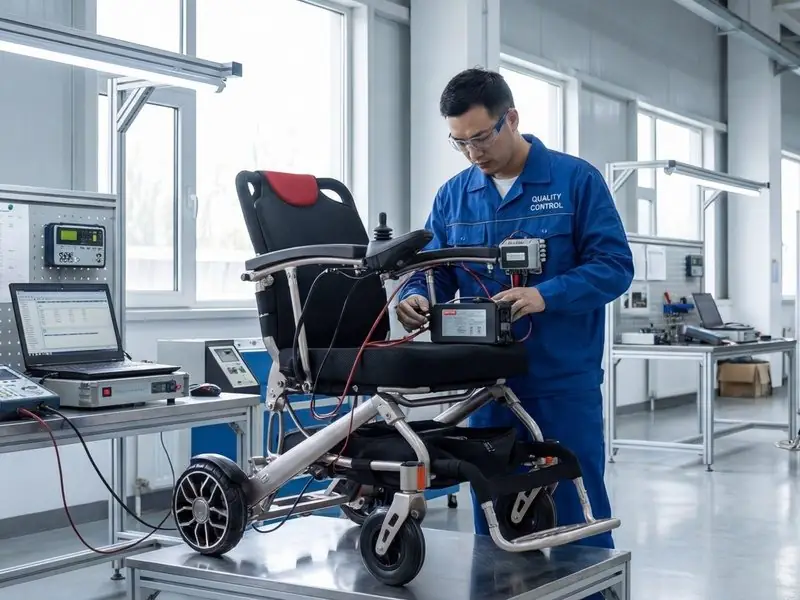
A warranty claim is only the paperwork. The real test of your after-sales service starts when the chair arrives at your workshop and the customer asks when they can have it back. This guide explains How Distributors Handle Electric Wheelchair Warranty Repairs in the workshop: how to judge whether a fault is covered, how to order the work, how to keep the customer moving, and how to close the job so the same fault does not come back.
What does a warranty repair cover, and what does it not?
A warranty repair covers a fault caused by a defect in materials or workmanship, inside the warranty period of the part that failed. Our warranty periods are straightforward: the frame is covered for 36 months, the motor and the controller for 12 months each, and the battery for 6 months for a lead-acid battery and 12 months for a lithium battery. Coverage is judged part by part, not chair by chair, so a motor fault in month eleven is a different question from a battery fault in month eleven.
What falls outside warranty is just as important to know. Damage from an accident or a fall, damage from misuse or overloading, normal wear on consumable parts, and faults caused by unauthorised modification are not warranty repairs. That does not mean you refuse the customer; it means the job is a paid repair, and the customer should know that before work starts, not after. Our warranty claims guide sets out the claim steps that sit around this workshop decision: electric wheelchair warranty claims process.
Part
Warranty period
Covered when
Frame
36 months
Manufacturing defect within the period
Motor
12 months
Manufacturing defect within the period
Controller
12 months
Manufacturing defect within the period
Battery, lead-acid
6 months
Manufacturing defect within the period
Battery, lithium
12 months
Manufacturing defect within the period
Key Takeaway: Judge coverage part by part against its own warranty period, and tell the customer before work starts when a fault is outside warranty and the repair will be charged.
How Distributors Handle Electric Wheelchair Warranty Repairs: What should happen first when the chair reaches the workshop?
The job starts with intake, not with tools. Log the model, the serial number, the customer name, and the date the chair arrived on the job sheet, and note the battery type and the condition of the chair as received. The photos and fault description that support the claim are set out in our warranty claims guide: electric wheelchair warranty claims process. A clear intake record protects both sides: the customer can see what they handed over, and your technician starts from facts rather than from a phone message.
Next, diagnose before you decide anything. Reproduce the fault yourself rather than taking the description at face value, and check the simple causes first, such as a loose connection, a flat battery, or a worn tyre. Then confirm which part is at fault and whether that finding matches the warranty decision from the previous section. Write the diagnosis on the job sheet, with the test result and the part involved, because every later step in this guide depends on that record being right.
Key Takeaway: Intake first, diagnosis second: log the serial number, the fault as described, and photos of the chair as received, then reproduce the fault and name the faulty part before deciding the fix.
How do you decide between repairing, replacing a part, and swapping the whole chair?
Your supplier claim decision under our warranty claims guide settles whether the job is covered; this section is the workshop call that follows — which fix gets the chair back to the customer fastest. Most warranty jobs end with one part replaced and the chair returned. Repair the chair when the fault is isolated to one part and a replacement part is on your shelf or on its way. Replace the part rather than the chair when the part itself has failed and everything else on the chair tests normally. A whole-chair swap is the exception, for cases such as a frame fault that cannot be put right, a fault that has already failed twice, or a customer who cannot wait for a part and has no loaner available.
Weigh the decision in time and cost, not only in parts. A repair that waits on a part you do not stock may leave the customer without a chair longer than a swap from your demonstration stock would. Agree the decision with your supplier where your warranty terms require it, and tell the customer the decision and what happens next in plain words before any work starts. When the choice is between repairing a returned chair and replacing it outright, our returns guide sets out the same decision from the returns side: how distributors handle electric wheelchair returns.
Key Takeaway: Replace the faulty part in most cases, repair only what is genuinely repairable, and reserve a whole-chair swap for frame faults, repeat failures, or a customer who cannot wait.
How do you set repair priorities when several chairs are waiting?
Do not work strictly first in, first out. Priority should follow customer impact, not arrival order. A customer with no working chair comes before a customer who has a spare chair at home. A safety-related fault, such as brakes that do not hold or a controller that cuts out, comes before a cosmetic fault, and a chair already promised a return date keeps its date unless a more urgent job forces a change you explain to the customer.
Make the order visible so nobody has to guess. Put the queue on a workshop board or a shared sheet, with one priority level per job and the reason written next to it. Review the board at the start of each working day, and move jobs only when a new urgent case arrives or a part lands. A visible queue also gives your front-of-house staff an honest answer when a customer phones to ask where their chair stands.
Priority
Who it covers
What it means in the workshop
Urgent
Customer without a working chair, or a safety-related fault
Worked on first
Standard
Chair usable with a workaround, or customer has a spare chair
Worked on in order of arrival
Scheduled
Cosmetic or minor fault, customer agrees to wait
Booked into the next free slot
Key Takeaway: Rank jobs by customer impact and safety, keep the queue visible on a workshop board, and review it at the start of each working day.
How do you keep the customer moving while their chair is in the workshop?
A loaner chair is the simplest way to keep a customer mobile while their own chair is being repaired. Keep one or two demonstration or loaner chairs ready for this purpose, charged and tested, so a loaner is available the day the customer brings their chair in. A loaner is a loan, not a gift: record the model, the serial number, the date it went out, and the condition it went out in, and have the customer sign for it.
If no loaner is available, say so honestly and offer the next best option. That may mean moving their repair up the queue, or arranging a short-term chair through a local service partner while the repair is under way. Whatever you offer, set the next update: tell the customer when you will contact them again, and contact them even if the news is only that a part is still on its way. Silence is what turns a repair delay into a lost customer.
Key Takeaway: Keep one or two loaner chairs charged and ready, record every loan with model, serial number, and date, and update the customer on the date you promised even when there is no new progress.
How do you get the right spare part without stalling the job?
Start with your own shelf. The parts that fail most often and the parts that take longest to arrive from the factory are the ones worth holding, and our spare parts page lists the range you can draw on: electric wheelchair spare parts.
A practical stocking system, with a separate buffer for the fast-moving parts, is set out in our spare parts stocking guide: electric wheelchair spare parts stocking guide. When the part you need is on your shelf, the repair moves the same day the diagnosis is confirmed.
If the part is not on your shelf, order it from the factory and give the customer a realistic update rather than a guessed date. Record every part used against the job sheet and the chair serial number, so your shelf count stays accurate and you can reorder before the buffer runs out. One detail matters when ordering electrical parts: all our chairs run on a 24V system, so confirm the replacement part matches the 24V system of the chair before you order.
Key Takeaway: Hold the common and slow-to-arrive parts on your own shelf, record every part used against the job sheet and serial number, and confirm any electrical part matches the 24V system before ordering.
How do you test a chair before you hand it back?
Never hand a chair back on the strength of the repair alone; test the whole chair. Drive it, fold and unfold it if it is a folding model, check that the brakes hold, check that the joystick responds smoothly, check that the battery charges, and confirm the original fault is gone. Where possible, test it with the customer’s own settings, such as the seat position and the speed setting they normally use, because a chair that works on your settings and fails on theirs is not fixed.
Then write it down and walk the customer through it. Record the test result, the parts used, and the date on the job sheet, and show the customer what was done at handover. Our delivery handover checklist works just as well for a repaired chair coming home as for a new chair going out: electric wheelchair delivery handover checklist. Keeping a clear service record for every repair is also part of what good quality management expects from medical device servicing, and ISO 13485, the quality management standard for medical devices, covers servicing as well as manufacture.
Key Takeaway: Test the whole chair, including the original fault, the brakes, the joystick, and charging, then record the result and walk the customer through what was done at handover.
What do you do when the same fault comes back a second time?
A repeat fault is a different job from the first one, and repeating the same fix is a common mistake. Re-diagnose from the start instead of assuming the first diagnosis was right. Check whether the first repair fixed the cause or only the symptom, look at the job history for that serial number, and check whether another part is causing the fault to appear again. The job sheet from the first repair, with its photos, parts used, and test result, is what makes this possible.
If a second repair does not hold, escalate with the full history. Send the factory the serial number, the fault description, both job sheets, the photos, and the parts already used, and agree the next step together: a different part, a replacement chair, or a return to the factory. Our after-sales service network guide sets out the escalation route to the factory: how distributors build an after-sales service network. Tell the customer what is happening and what you are doing about it; a repeat fault handled openly keeps trust, while a repeat fault handled quietly loses it.
Key Takeaway: On a repeat fault, re-diagnose from the start using the first job sheet, and if the second repair does not hold, escalate to the factory with the full job history rather than trying the same fix a third time.
How Distributors Handle Electric Wheelchair Warranty Repairs works when five habits hold together: judge coverage part by part, diagnose before deciding, rank jobs by customer impact, keep a loaner ready, and test the whole chair before handover with the result written down. None of these habits needs expensive equipment; they need a job sheet, a visible queue, and a shelf of the right spare parts.
After the chair goes home, the job is not quite finished. A short follow-up call a few days later catches a fault that only shows up in daily use, and our after-delivery follow-up guide explains how to run that check: after-delivery follow-up for electric wheelchair distributors. If you are building or refreshing a wheelchair range and want a supplier whose warranty and parts support make this work simpler, talk to us. ZVCARE is a Shenzhen electric wheelchair manufacturer offering OEM and ODM supply with a 1-unit minimum order, a 7-day lead time after payment, and spare parts support for the models you stock.
FAQ
Who pays for the parts used in a warranty repair?
That depends on your agreement with your supplier and on the claim being approved. In most distributor arrangements, the distributor does the workshop work and the supplier provides the replacement part or reimburses it under the warranty terms. Check your distributor agreement before promising a customer that a repair is free, and keep the job sheet and photos as the record that supports the claim.
How long does a warranty repair take?
There is no single answer, because it depends on the fault, whether the part is on your shelf, and how busy your workshop is. A repair with the part in stock can be finished quickly, while a repair waiting on a part from the factory takes as long as that part takes to arrive. The honest practice is to give the customer a realistic update based on part availability, and to contact them again on the date you promised.
Can a customer get a loaner chair during a warranty repair?
Yes, if you keep loaner chairs ready. A loaner is a service decision you make, not a warranty right the customer holds, so it is worth telling customers in advance that a loaner is available while stocks last. Record the loan with the model, the serial number, and the date, and agree a return date when the repaired chair is handed back.
What happens if the fault is not covered by warranty?
Then the repair becomes a paid job. Explain the cause and the cost to the customer before any work starts, and let the customer decide whether to go ahead. Record the decision on the job sheet, including the quoted cost the customer agreed to, so there is no argument when the chair is collected.
What records should a warranty repair leave behind?
A complete job sheet: the model and serial number, the fault as the customer described it, photos of the chair as received, the diagnosis, the parts used, the test result, and the date the chair was handed back. Those records support the warranty claim, make a repeat fault diagnosable, and give you the history you need if the factory asks what has already been tried.
Founded in 2015, ZVCARE is an ISO 13485:2016 certified electric wheelchair manufacturer in China, providing OEM & ODM solutions for global distributors and medical stores.