How Distributors Clear Held Electric Wheelchair Shipments
November 7, 2026
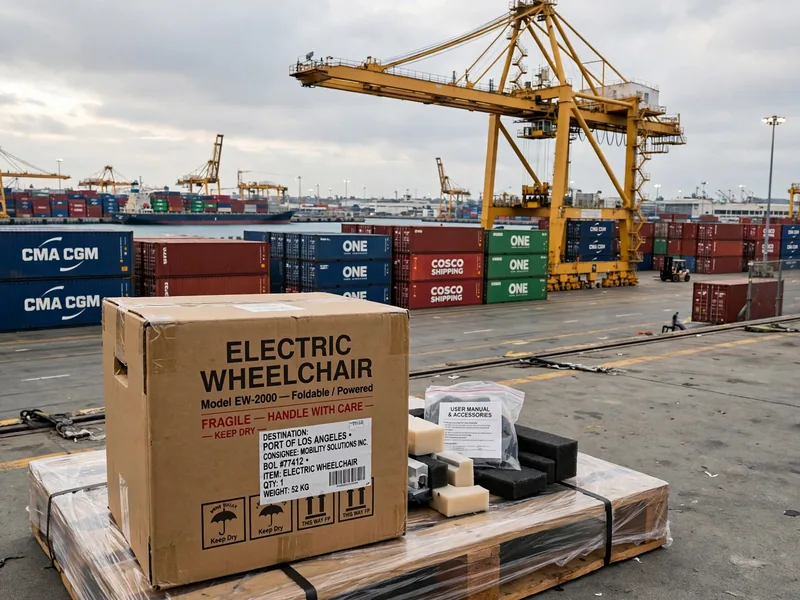
Your container has reached the destination port, your customers are asking for delivery dates, and then the message lands: customs has held your shipment. This is exactly the situation that How Distributors Clear Held Electric Wheelchair Shipments is written for — a practical guide to getting your chairs released without panic, guesswork, or a bill that eats your margin. Read it once now, and keep it where your team can find it the next time a hold notice arrives.
How Do You Find Out Your Shipment Has Been Held?
A hold is rarely announced by customs directly to you. Usually the first person to tell you is your freight forwarder or your customs broker, by email or a message with a short reference number and a one-line reason such as “documents required” or “selected for examination.” The terminal portal may also show the container as held, but that status alone says nothing about why — treat the forwarder’s message as your starting point and ask for the written hold notice itself.
The notice matters because it names the exact problem customs wants solved. It lists the container or bill of lading number, the reason, the office handling the case, and what customs expects from you next. Ask your broker to forward the original notice rather than a summary, and confirm who formally replies to customs — in many destination ports that is your broker, acting on your instructions. If your shipment is still on the water when you hear about a problem, that is a different situation — our guide to how electric wheelchairs are shipped from China explains the stages a shipment passes through before it reaches the port.
Key Takeaway: The hold notice is your roadmap — get the original from your broker before you do anything else, and confirm who replies to customs for you.
What Should You Do in the First 24 Hours After a Hold?
Start with three actions, in this order: confirm the facts, stop the clock, and assign one owner. First, get the hold notice, the container number, and the response deadline from your broker, then check them against your own shipping file. Second, find out whether the container is sitting in a chargeable area, because storage and demurrage charges usually start running from the day the container is discharged, not from the day you learn about the hold. Third, name one person on your team to own the case, so the broker, the supplier, and your warehouse all hear the same message.
Meanwhile, pull your document set together in one place: commercial invoice, packing list, bill of lading, and any battery paperwork. Do not send customs anything until your broker has told you exactly what is being asked for, because an extra document that contradicts the first one can create a second problem. If you are unsure which papers your shipment should have carried, our guide to shipping documents for electric wheelchairs lists the full set and what each one is for.
Key Takeaway: In the first 24 hours, confirm the hold in writing, find out where charges are running, and put one person in charge — speed matters, but sending the wrong document matters more.
What Does a Document Mismatch Hold Look Like — and How Do You Fix It?
A document mismatch is one of the common reasons a wheelchair shipment is held, and it is usually a small error with an outsized effect. The invoice may show a different quantity from the packing list, a model name may be spelled differently on the bill of lading and the invoice, or the declared weight may not match the weight the port scales recorded. Customs software compares these documents line by line, so even a difference that looks trivial to a human reader can stop a container.
The fix is a corrected document, not an argument. Ask your broker exactly which field customs is questioning, then go back to your supplier for a corrected invoice or packing list that matches the other documents word for word. The corrected paper should note clearly that it replaces the earlier version, and your broker should submit it with a short written explanation of what changed and why. Never ask a supplier to change a value to suit a customs question — the correction must reflect what is actually in the cartons, and the cartons are the evidence if customs opens them.
Key Takeaway: A mismatch hold is fixed with one corrected document that matches the rest of the file — find the field customs flagged, correct it truthfully, and let your broker submit it with a short explanation.
What Happens When Customs Questions Your HS Code Classification?
When customs questions your classification, it is asking whether your wheelchairs were declared under the right HS code, and that question carries real money because the code decides the duty rate. The usual trigger is a code that looks wrong for the goods described — a powered wheelchair declared under a code meant for a different type of vehicle, for example, or a code that does not match the invoice description. Customs may ask for a technical description, photographs, or a catalogue page to support the code you used.
Your first move is to check the code your supplier declared against the product itself, not against the last shipment. Wheelchair codes depend on the product’s design and function, so a folding powered wheelchair and a manual wheelchair do not share the same treatment, and an accessory shipped in the same container may need its own line. If the code turns out to be wrong, your broker can usually file an amended declaration with the correct code and an explanation. If you believe the original code was right, your broker should prepare a short technical case — product description, key features, and the reasoning behind the code — rather than simply restating the number, and the background in our article on what HS code electric wheelchairs ship under is the reference to share with your broker.
Key Takeaway: Answer a classification question with product evidence, not insistence — check the code against the actual chair, then amend it or defend it with a short technical case from your broker.
What If the Hold Is About Missing Battery Paperwork?
Battery paperwork is the hold that catches distributors by surprise, because the chairs themselves are fine and everything else in the file can be perfect. Lithium batteries are regulated as dangerous goods in transport, so customs may ask for the UN38.3 test summary, the safety data sheet, or the dangerous goods declaration, depending on the destination and the mode of transport. If any of those papers is missing, the container can be held even though the batteries passed their tests months ago.
The fix starts with your supplier, who should hold the test reports for the exact battery model fitted to your chairs. Ask for the UN38.3 test summary for your battery model and capacity, and check that its details match the batteries actually in the cartons — a summary for a different capacity does not help you. Your broker can then submit the summary with the safety data sheet, and in most cases that is enough for customs to release the hold. For what the test covers, see our guide to UN38.3 for wheelchair batteries.
For the transport rules behind it, the IATA lithium battery guidance explains how shippers should handle battery documentation.
Key Takeaway: A battery hold is a paperwork gap, not a product failure — get the UN38.3 test summary for the exact battery model in your cartons, and let your broker file it with the safety data sheet.
Hold reason
What customs usually asks for
Who supplies it
Document mismatch
Corrected invoice or packing list
Supplier, via your broker
Classification question
Technical description, photos, or catalogue page
Supplier, via your broker
Missing battery paperwork
UN38.3 test summary and safety data sheet
Supplier, via your broker
How Do You Respond to a Reclassification or Extra Duty Demand?
First, read the demand carefully: it should state the code customs proposes, the duty rate that follows, and the deadline for payment or objection. Do not pay first and ask questions later if your broker believes the original classification was correct, because paying can be treated as accepting the new code.
Ask your broker whether the demand can be challenged before payment and what the objection process looks like in that destination — in many ports you can file a written objection with technical evidence while the goods are released against a guarantee. If the new code is actually correct, accept it, pay the difference, and record the correct code for your next order so the same dispute does not repeat. Either way, update your landed-cost record for that shipment, since a higher duty rate changes what the chairs really cost you — our guide on how to calculate the landed cost of imported electric wheelchairs shows which cost lines a reclassification touches.
Key Takeaway: Read the demand before you react — challenge it through your broker with technical evidence if the original code was right, or accept it, pay the difference, and fix the code next time.
How Do You Keep Demurrage and Storage Charges Under Control?
Demurrage and storage are the quiet costs of a hold, and they grow every day the container sits. Demurrage is charged by the shipping line for keeping the container beyond the free days after discharge, while storage is charged by the terminal for the space it occupies. The free-days window is usually short, so a hold that drags on can cost more in charges than the duty under dispute.
There are three practical ways to limit the bill. First, move fast on the document your broker asked for, because every day of delay is a day of charges. Second, ask your broker whether the container can move to a cheaper holding area or a bonded warehouse while the case is examined — in some ports the daily rate there is lower than the terminal’s. Third, keep a written record of every date — discharge date, hold notice date, the date each document was submitted, and the release date — because that timeline is your evidence if you later dispute a charge, and accurate packing lists and clearly marked cartons also help, since they make a physical examination faster; our guide to electric wheelchair export packaging for distributors covers the marking and packing habits that speed up inspections.
Key Takeaway: Charges run from discharge, not from the day you hear about the hold — submit what customs asked for fast, ask about cheaper storage, and log every date in writing.
Charge
Charged by
How to limit it
Demurrage
Shipping line, after free days expire
Submit documents fast; ask about moving the container
Storage
Port terminal, for space used
Same as above; keep a dated record for any dispute
Examination fee
Port or customs, if the container is opened
Accurate packing list and clear carton marking
When Does a Held Shipment Become a Return or an Abandonment?
Most holds end with release, but a small number end with the goods going back or being given up. A return — formally called re-export — happens when the problem cannot be fixed in that destination: the goods are not permitted in, the paperwork cannot be produced, or fixing it costs more than the shipment is worth. Abandonment happens when the distributor stops responding or decides the goods are not worth the charges built up, and the port eventually disposes of them.
Before either outcome, there is a point where your broker will ask you to decide, and that decision should be made on numbers, not on frustration. Compare the full cost of getting the goods out — duty, charges to date, and any further charges while the case runs — against the value of the chairs inside. If the chairs are undamaged and the problem is only paperwork, release is almost always the better outcome, but if the shipment is returned, agree the return shipping and handling with your supplier in writing before the container moves, and check who bears each cost. Note that a return or abandonment is a customs outcome, not a damage claim — if your chairs were actually damaged in transit, that is a separate process covered in our guide to how distributors handle electric wheelchair freight damage.
Key Takeaway: Release is the goal until the numbers say otherwise — compare the full cost of getting the goods out against their value before agreeing to a return, and never let silence turn a hold into an abandonment.
Conclusion
A held shipment feels like a crisis, but it is usually a fixable paperwork problem with a clear sequence: get the notice, find the single reason, supply the document that answers it, and keep the charges from running while you do. That sequence is what How Distributors Clear Held Electric Wheelchair Shipments comes down to — know the three common causes, keep one person in charge, and make sure the lesson sticks so the next container clears without drama — after a hold is cleared, write down what caused it in one paragraph and attach it to your ordering checklist. If you want a supplier who prepares the battery and classification paperwork with the order, talk to us about your next shipment: we work on a 1pc MOQ with a 7-day lead time after payment, and we keep spare parts available so a delayed container does not become a delayed customer. For the wider picture of bringing chairs in from China, our guide on how to import electric wheelchairs from China covers the full process from order to delivery.
Frequently Asked Questions
How long does it usually take to clear a held electric wheelchair shipment?
There is no fixed time — it depends on the reason for the hold and how fast the missing document arrives. A simple document correction is resolved quickly once your broker submits the corrected paper, while a classification dispute or a physical examination takes longer. The fastest way to shorten the wait is to send your broker exactly what customs asked for, with nothing extra and nothing missing.
Who should I contact first when my shipment is held at customs?
Contact your customs broker or freight forwarder first, not the port and not customs directly. Your broker holds the formal relationship with customs in most destination ports and knows what the hold notice is asking for. Your supplier comes second, because the corrected documents and battery paperwork almost always come from the factory.
Can customs open my container during a hold?
Yes — customs can select a container for physical examination, and that is a normal part of the process, not a sign of wrongdoing. An accurate packing list and clearly marked cartons make the examination faster and reduce the chance of a second query. If anything is found to differ from the documents, your broker will tell you what customs wants corrected before the container is released.
What happens if I cannot produce the battery paperwork customs asks for?
Ask your supplier for the UN38.3 test summary and safety data sheet for the exact battery model in your chairs. If the supplier cannot provide them, the shipment may have to be returned, because lithium battery documentation is a transport safety requirement, not a formality. This is why the battery paperwork should be confirmed before the goods leave the factory, not after they reach the port.
Do I still have to pay demurrage if the hold was not my fault?
In most ports, demurrage and storage run regardless of who caused the hold — the charges are for the container’s time and space, not for the fault itself. That is why the first 24 hours matter so much, and why a dated record of every step helps if you dispute a charge later. Check the terms in your freight booking and ask your broker whether any of the charges can be challenged.
Founded in 2015, ZVCARE is an ISO 13485:2016 certified electric wheelchair manufacturer in China, providing OEM & ODM solutions for global distributors and medical stores.