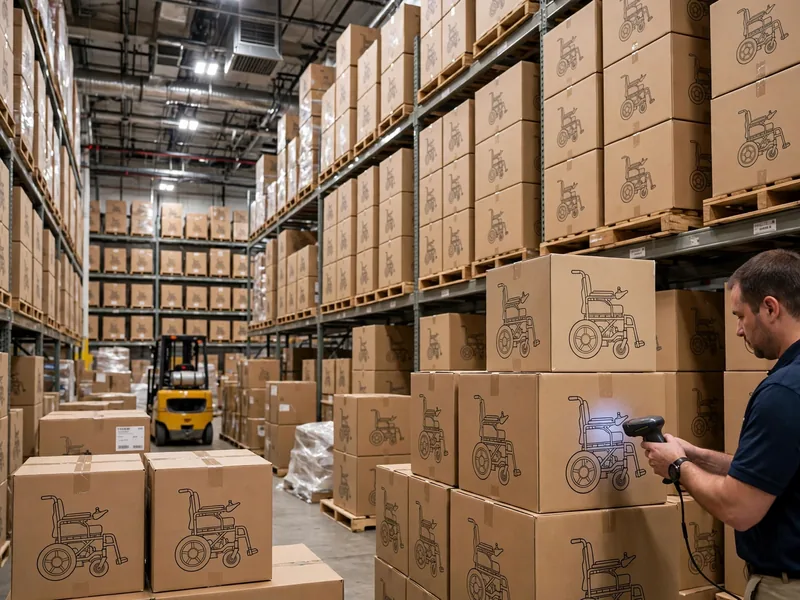
A customer walks into your second branch on a Tuesday morning. They want a folding chair, the one they saw online. Your branch does not have it. Your main warehouse does, forty minutes away. The customer will either wait for the chair to arrive or walk out and buy it somewhere else. The difference is whether your branches share stock — and whether they can prove where every chair is.
How Distributors Share Electric Wheelchair Stock: this guide covers how a distributor moves chairs, demo units, loaner chairs, and spare parts between branches and warehouses — and how to keep track of every move. It stays with transfers and visibility. It does not cover counting your stock, setting safety stock, or reordering from the factory. Those are separate jobs with their own guides.
What does sharing stock actually mean for a distributor?
Sharing stock means any branch can sell any chair the company owns, not just the chairs on its own floor. A customer asks at branch B. The chair sits at branch A or in the warehouse. Branch B promises it, the chair moves, and the customer picks it up. The sale happens because the stock is shared. Without sharing, each branch can only sell what it holds, and the rest of the company’s stock might as well not exist.
Sharing only works if everyone can see the stock. Each branch needs to know what the other branches hold, in real time, without phoning around. A shared list — a simple spreadsheet or a stock system — shows each chair by model and serial number, and which branch holds it. If the list is out of date, branches promise chairs they do not have, and customers wait for chairs that never arrive.
Sharing is not counting. Counting your stock — a full physical count of what you hold — is a separate job with its own method. Our guide to counting electric wheelchair stock covers that job. This guide stays with the moves: how a chair gets from one branch to another, and how you know where it is at every step.
Key Takeaway: Shared stock means any branch can sell any chair the company owns. It only works if every branch can see the same up-to-date list, by model and serial number.
How does a transfer between branches work, step by step?
A transfer starts with a request, not with a van. Branch B asks branch A for a chair by model and serial number. Branch A checks the list, confirms the chair is there and free, and marks it as moving. That mark matters: from that moment, no other branch can promise the same chair to another customer. A chair that is promised twice is a customer lost twice.
Then comes the pick and the pack. Branch A picks the chair, checks it works, and packs it the way it arrived: folded, in its carton, with the battery and charger inside. A chair that arrives at branch B scratched or missing its charger is a sale delayed. The pack is part of the transfer, not an afterthought.
Then the move itself. A van, a courier, or a staff member driving between branches — the method matters less than the record. The chair leaves branch A with a note: model, serial number, date, and who sent it. Branch B signs for it on arrival and checks it the same way. Our guide to tracking electric wheelchair shipments covers the same habit for longer journeys, and the same rule applies here: no chair moves without a note, and no note goes without a signature at the other end.
Key Takeaway: Request, confirm, mark it moving, pick and pack it properly, move it with a note, and sign for it on arrival. A transfer without a record is a chair you have lost track of.
How do you keep track of every chair that moves?
By serial number, one chair at a time. A model name is not enough: ten EW100s on the shelf are ten different chairs, and only the serial number tells them apart. Every move records the serial number, the model, where it came from, where it went, and the date. That is the whole system. It fits on one line per move.
Keep one list for the whole company, not one list per branch. A branch list tells you what that branch holds. A company list tells you where every chair is. When branch B needs a chair, it reads the company list, finds the nearest branch that holds it, and asks for it. When a customer calls about a chair they bought, the list shows which branch sold it and which serial number went out the door.
Check the list against reality every week. Pick five chairs from the list and go and look at them. Are they where the list says they are? If one is not, find out why before the list drifts further. A list that is checked weekly stays honest. A list that nobody checks becomes fiction in a month.
Transfer record
What to write
Why it matters
Model
EW100, EW1000, EW8722, EW8703G
The customer asked for a model, not a serial number
Serial number
The number on the chair and the carton
The only way to tell two chairs of the same model apart
From / To
Branch A to branch B
Shows where the chair is now
Date
The day it moved
Shows how long a chair has been away
Sent by / Received by
Two names
Someone owns each end of the move
Key Takeaway: Track by serial number, keep one company-wide list, and check five chairs against the list every week. A list nobody checks becomes fiction.
What about demo units — how do they move without getting lost?
Demo units move more than any other chair, so they get lost first. A demo chair goes to a customer for a trial, comes back, goes to a branch for a demo day, comes back, and goes out again. Each move is a chance to lose track of it. The fix is to treat a demo unit like a sale in the record: every move gets a line, with the serial number, the customer or branch, and the date it should come back.
Give demo units their own mark. A tag on the chair, a different color on the list, or a separate section — anything that tells staff at a glance that this chair is a demo, not a sale chair. A demo chair that is sold by mistake leaves a customer without a trial and a branch without a demo. Our guide to managing demo stock covers the full routine for demo units, including how long a trial should run.
Check every demo chair when it comes back. Drive it a few meters, test the joystick, and look at the wheels and the seat. A demo chair that goes out again without a check will fail in front of the next customer. The check takes minutes. A failed demo costs a sale.
Key Takeaway: Demo units move the most, so they need the strictest record: every move logged, a clear mark that says demo, and a check on every return.
How do loaner chairs fit into shared stock?
A loaner chair is a chair your company owns and lends to a customer while their own chair is being repaired. It is shared stock at its most useful: the customer stays mobile, the repair takes the time it needs, and the sale is protected. Our guide to providing loan chairs during repairs covers the service side. This section covers the stock side.
A loaner needs the same record as a transfer: serial number, customer, date out, date due back. It also needs a return check, because a loaner comes back used. Drive it, test the joystick, look at the tires, and clean the seat before it goes out again. A loaner that goes to the next customer dirty or faulty tells that customer what your service is worth.
Keep loaners separate on the list. Mark them as loaners so no branch sells one by mistake and no branch promises one as a demo. A small pool of loaners — two or three chairs for a small distributor — covers most repair weeks. If loaners are out all the time, your repair queue is too long, and that is a different problem.
Key Takeaway: A loaner is shared stock with a customer attached: same record, same return check, and a clear mark on the list so it is never sold by mistake.
How do spare parts move with the chairs?
Spare parts move two ways: with a chair, or on their own. When a branch sends a chair to another branch, the charger and the battery go with it, in the same carton. A chair that arrives without its charger is a sale delayed by days. When a branch needs a part for a repair, the part ships on its own, in a small parcel, with the same record: part name, chair serial number it belongs to, and the date.
Hold fast-moving parts at every branch. A joystick, a charger, and a set of tires at each branch cover most repairs without a transfer. Slow parts — a motor, a controller — can sit at the main warehouse and move when needed. Our guide to electric wheelchair spare parts stocking covers which parts to hold where. The point for this guide is simple: a part that is not where the repair is, is not stock. It is a parcel in transit.
Record parts the same way you record chairs: what, where, and when. A part that leaves the warehouse without a note will be searched for twice — once when it is needed, and once when the count does not add up.
Item
How it moves
What to record
Sale chair
Branch to branch, or warehouse to branch
Model, serial number, from, to, date
Demo unit
Branch to customer, back to branch
Serial number, customer, date out, date due
Loaner chair
Branch to customer during a repair
Serial number, customer, date out, date due
Spare part
With a chair, or alone in a parcel
Part name, chair serial number, date
Key Takeaway: Parts move with the chair or on their own, but always with a record. Hold fast-moving parts at every branch, and keep slow parts at the warehouse.
What goes wrong when branches share stock badly?
The same three things, every time. First, a chair is promised twice. Branch A promises it to a walk-in customer. Branch B promises it to a phone customer. One of them waits, and one of them leaves. The fix is the mark: a chair that is moving or promised is marked, and no one promises it again.
Second, a chair goes missing. It moved without a note, or the note was never filed. Nobody knows which branch holds it. The fix is the rule: no chair moves without a note, and no note goes without a signature at the other end. A chair that cannot be found on the list is a chair the company has lost, even if it is sitting in a back room.
Third, the wrong chair arrives. Branch B asked for an EW1000 and got an EW100. The customer wanted the lightest chair, and the branch has the heavier one. The fix is the serial number on the note, checked against the chair on arrival. A branch that signs for a chair without checking the serial number owns the mistake.
How much stock each branch should hold is a separate question from sharing it. Setting safety stock — the buffer each branch keeps — has its own method, and reordering from the factory has its own too. Sharing is about moving what you already own. Holding the right amount is a different job.
Key Takeaway: Three failures repeat: promised twice, moved without a note, wrong chair delivered. The mark, the note, and the serial number check stop all three.
What should you ask the factory when your stock is spread out?
Ask about the carton first. Your chairs move between branches in their cartons, so the carton must survive the trip. Ask how the chairs are packed, what the carton size is, and whether the battery and charger travel inside. The EW1000 ships in a carton of 80×41×76 cm, with a gross weight of 21 kg. Ask for the same details on every model you stock, so your branches know what to expect at the door.
Ask about spare parts and how fast they ship. Branches that share stock still need parts where the repair is. Ask what parts to hold at each branch, and what the lead time is for the rest. Ask about the warranty in plain words: frame 36 months, motor and controller 12 months each, battery 6 months for lead-acid and 12 months for lithium. Get the answer in writing before you order.
Ask about ordering in small steps. Your branches share stock so that no branch has to hold everything. The factory should support that: MOQ is 1 unit, and lead time is 7 days after payment. Order one chair when a branch needs it, not a container when it does not. A factory that sells one unit at a time is a factory that fits a shared-stock distributor.
Key Takeaway: Ask the factory about the carton, the spare parts, and ordering one unit at a time. Shared stock needs a factory that ships small and ships fast.
How Distributors Share Electric Wheelchair Stock — The Short Answer
The short answer is the record. One company-wide list, tracked by serial number. Every move gets a line: model, serial number, from, to, date, and two names. Demo units get a clear mark and a check on return. Loaners get the same record with a customer attached. Spare parts move with the chair or on their own, always with a note. Three failures repeat — promised twice, moved without a note, wrong chair delivered — and the mark, the note, and the serial number check stop all three.
How Distributors Share Electric Wheelchair Stock comes down to this: sharing is not about owning more chairs. It is about knowing where every chair is, so any branch can sell any chair the company owns. ZVCARE is Shenzhen Zhiwei Health Technology Co., Ltd. Founded in 2015 and ISO 13485:2016 certified, we build the folding and big-wheel models distributors share between branches, with spare parts support behind them. MOQ is 1 unit. Lead time is 7 days after payment. The warranty runs 36 months on the frame and 12 months each on the motor and controller. Batteries carry 6 months for lead-acid and 12 months for lithium. If your branches are ready to share stock, talk to us before you place the order.
Frequently Asked Questions
How do we start sharing stock between two branches?
Start with one list. Put every chair on it by model and serial number, with the branch that holds it. Then move one chair by the full routine: request, confirm, mark it moving, pack it properly, move it with a note, and sign for it on arrival. When that works, the rest follows.
What if two branches promise the same chair?
Mark a chair the moment it is promised or moving, and no other branch can promise it again. The mark is the fix. If it still happens, the list was out of date, and the weekly check of five chairs against the list will show you where it drifted.
Do demo units need the same record as sale chairs?
Yes, and a stricter one. Demo units move more than any other chair, so every move gets a line, with the serial number, the customer or branch, and the date it should come back. Mark them clearly as demos so no branch sells one by mistake.
How do loaner chairs work with shared stock?
A loaner is a chair your company owns and lends while a customer’s own chair is repaired. Record it like a transfer, with the customer and the date due back. Check it and clean it on return before it goes out again.
Does sharing stock mean we need less stock overall?
It means you use what you own better. A chair sitting in one branch while another branch turns a customer away is stock wasted. Sharing lets any branch sell any chair the company owns. How much to hold at each branch is a separate question from sharing it.
Founded in 2015, ZVCARE is an ISO 13485:2016 certified electric wheelchair manufacturer in China, providing OEM & ODM solutions for global distributors and medical stores.