Electric Wheelchairs for Golf Courses Buyers Guide
November 23, 2026
A member arrives for a Saturday round. He has played this course for twenty years. His knees no longer carry him around all 18 holes, so he has stopped booking. The course loses a regular, and the regular loses the game he loves. A fleet of electric wheelchairs at the pro shop would have kept him playing — and kept his friends booking alongside him.
Electric Wheelchairs for Golf Courses Buyers Guide: this guide helps a golf course operator build a shared fleet for players who cannot walk the course. It is written for the operator, not for a golfer buying a chair for himself. It covers the ground a course chair must handle and which models fit, how lending works during a round, and what to ask the factory before you order.
Why would a golf course run a fleet of electric wheelchairs?
Because a course is big, and not every player can walk it. A full round takes hours and covers a long distance on foot. Players with bad knees, a heart condition, or simply older legs stop coming. It is not because they stopped loving golf. It is because they cannot walk the course any more. A chair at the pro shop brings them back, and it brings their playing partners back with them.
A fleet also opens the course to new players: visitors who have never played, older guests at a society day, and players recovering from an injury. A course that offers chairs is a course that says everyone is welcome. That message is stronger than any discount, and it costs less than one lost membership.
The fleet is a service, not a product display. The course lends chairs for a round, charges them overnight, and keeps them ready. The operator’s job is the routine: booking, handover, return, and charging.
Key Takeaway: A course fleet keeps regulars playing when their legs give out. It welcomes players who could never walk the course. The fleet is a service the pro shop runs, not a product it sells.
What ground does a golf course chair have to handle?
A golf course is not a pavement. The chair must cross fairways, rough, cart paths, and slopes, often on wet grass after rain. It must climb the small rise from a path to a tee. It must hold steady on a slope while the player takes a shot. A chair built for indoor floors will not last a season on a course. Pick chairs for your course’s ground — the fairways, the rough, the slopes — not for a showroom floor.
Walk your course the way a chair would drive it. Start at the pro shop and follow a normal round: the first tee, the fairway, the green, and back to the clubhouse. Note every surface: paved cart path, short grass, long grass, and any steep slope. Note every narrow spot: bridges, gates, and the path around the green. A chair that passes only the easy parts will fail on the rest of the course.
Check your course after rain. A fairway that looks firm in dry weather turns soft after rain, and small wheels sink. A slope that looks gentle can stop a small-wheel chair halfway up. Soft ground or slopes are where big wheels earn their keep. Our guide to big-wheel vs small-wheel electric wheelchairs covers the trade-off in full — read it before you pick a model.
Key Takeaway: A course chair crosses fairways, rough, cart paths, and slopes, often on wet grass. Walk a full round in a chair’s shoes before you order, and check the ground after rain.
Which chairs fit a golf course: big wheels or folding?
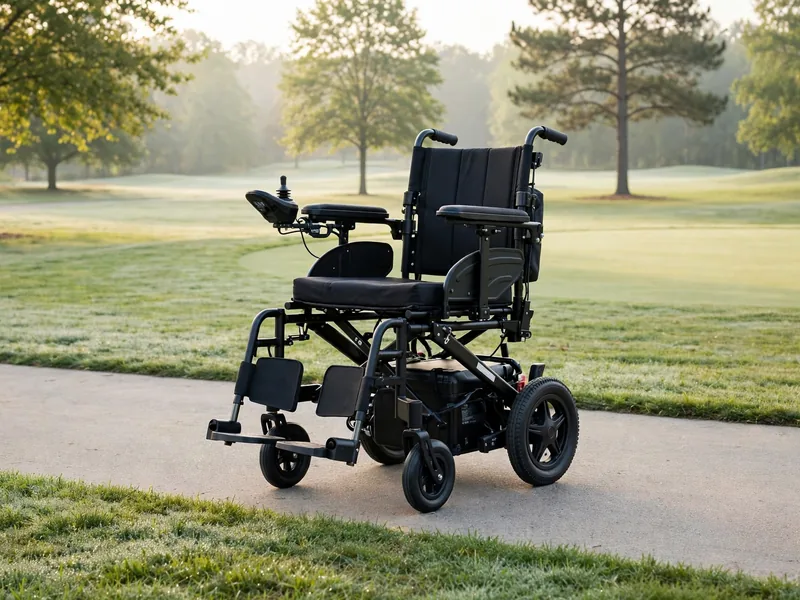
A course rarely needs one type only. Mix big and small wheels, and let the ground set the split. Big-wheel chairs suit the grass. The EW8703G is the big-wheel model: 46 kg, range 18–22 km. It crosses fairways and rough with less effort, and it holds steady on slopes. The small-wheel EW8722 weighs 45 kg and shares that range. It turns tighter on cart paths and in the clubhouse, but it struggles on soft grass.
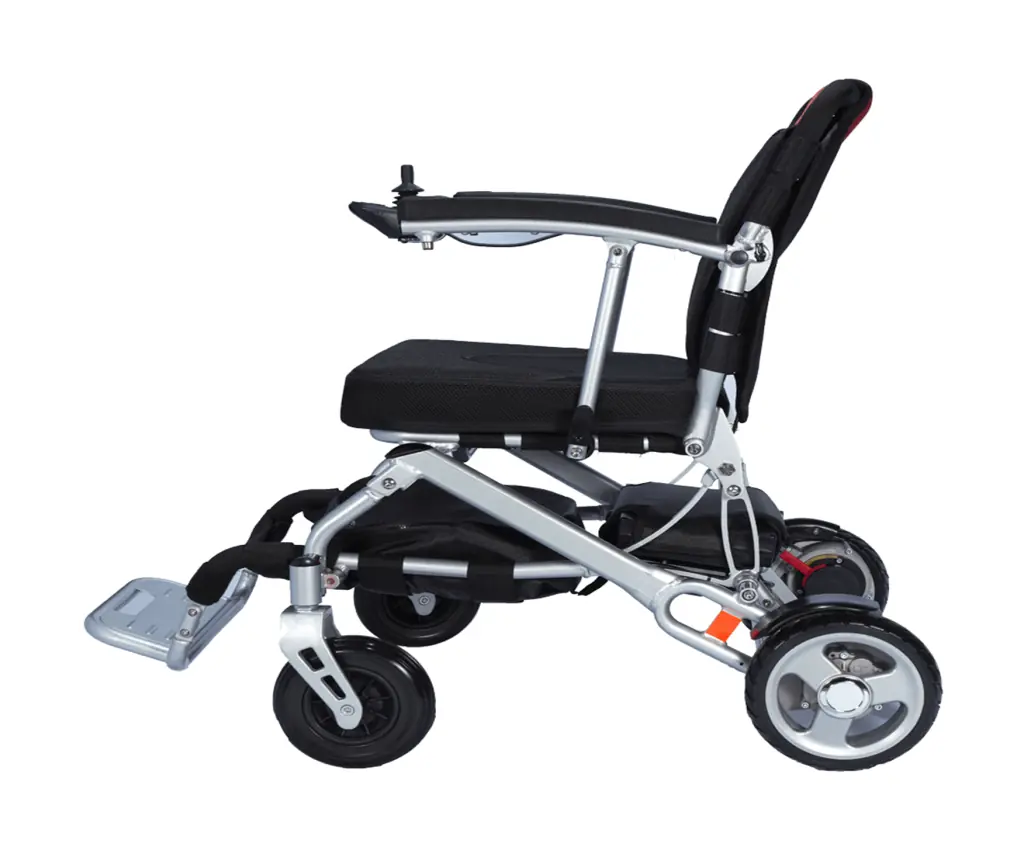
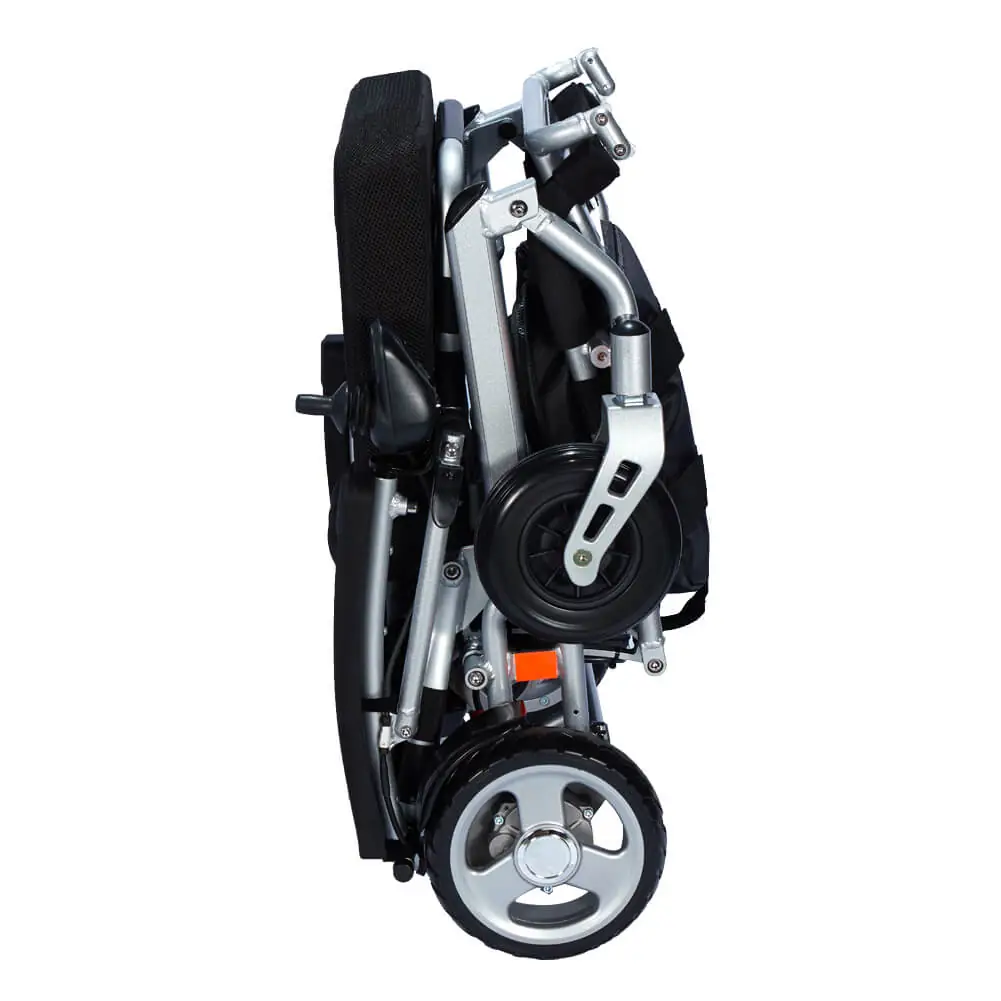
Folding chairs suit the storage room. The EW1000 is the lightest of the four: 15 kg with the battery, folding to 73×39×71 cm. The EW100 weighs 23 kg, folds to 73×55.5×31 cm, and slides straight into the store. Folding matters in a small store, and both models fold down small. Both are designed for air travel (airline approval required) — a sign of how portable they are. A course that stores chairs in a small room needs folding models. A course with a big cart shed can keep the bigger models assembled and ready.
Range is rarely the limit on a course. A full charge takes the EW1000 15±3 km, the EW100 12±5 km, and the bigger models 18–22 km. A player drives a short distance in a round, mostly on the cart path. The range number matters less than the morning routine. A dead battery ends a round; a short range does not.
Model
Weight (with battery)
Folded size
Range
Best for on a course
EW8703G
46 kg
89×43×76 cm
18–22 km
Fairways, rough, and slopes
EW8722
45 kg
80×39×74 cm
18–22 km
Cart paths and tight turns
EW1000
15 kg
73×39×71 cm
15±3 km
Lightest chair of the four
EW100
23 kg
73×55.5×31 cm
12±5 km
Slim fold, familiar frame
Key Takeaway: Mix the fleet to match your ground: big wheels for grass and slopes, small wheels for cart paths, folding chairs for a small store. A full charge every morning matters more than range.
How does a course lend chairs during a round?
Keep booking simple. A player books a chair with the tee time, by phone or at the pro shop desk. A paper sheet works fine: name, tee time, and the chair number. Do not build a booking system before you know how many players ask. A month of tee-time bookings tells you how many chairs the course needs.
Hand the chair over with a two-minute demo at the pro shop. Show the player the joystick, the speed control, and how to stop, then walk to the first tee together. Let them drive a short loop on the practice ground before they head to the first tee. A player who drives once with staff watching will not need help on the third hole. A player handed a chair with no demo will be back at the pro shop by the third hole.
Check the chair back in with the player. Walk around it, look at the wheels, the seat, and the joystick, and note any damage on the sheet. That minute at the desk stops an argument later. Our guide to how much a folding electric wheelchair weighs helps staff talk about the chairs with players. It covers who can load one into a car without help.
Key Takeaway: Book with the tee time, demo every chair for two minutes at handover, and check it back in with the player present. That routine stops most problems before they reach a player.
Where do the chairs charge, and who looks after them?
Overnight, every chair plugs in — in the cart shed or the pro shop store, one power point per chair. Staff plug each chair in when it comes back after the last round, and the morning check confirms the charge before the first tee time. That is all the charging plan there is. No software, no extra staff — just one person who owns it every night.
Before the first tee, run a short check on every chair. Drive it a few meters, work the joystick both ways, and listen for anything loose. A chair that fails stays in the shed and a spare goes out. A chair that fails halfway around the course costs you a rescue trip and a ruined round.
Keep one spare charged and ready at the pro shop. It covers the chair that fails the morning check, the chair that comes back with a dead battery, and the player who turns up without a booking. One spare is enough at this size. If the spare goes out every morning, the fleet needs another chair. Clean every chair after a round: wipe the seat, the armrests, and the joystick, and brush the grass and mud off the wheels. A clean chair tells the next player the course cares, and cleaning is the moment to spot damage.
When
What happens
Who does it
Before first tee
Morning check: drive, joystick, brakes
Pro shop staff
During play
Chairs out with players, spare on standby
Pro shop staff
After last round
Sign-in, wipe down, brush off grass
Pro shop staff
Overnight
Plug in to charge, one point per chair
Pro shop staff
Key Takeaway: One power point per chair, overnight charging, and a short morning check before the first tee. Keep one spare charged, and clean every chair after a round.
What happens when a chair gets stuck or damaged on the course?
Chairs get stuck. A wheel sinks into soft ground after rain, or a chair catches on a slope. Plan for the bad day instead of hoping it will not come. Keep a utility vehicle or a cart ready to fetch a stuck chair. Keep the pro shop phone number on the chair so a player can call for help. A player who waits an hour on a far fairway will not book a chair again.
Chairs come back damaged too. Players bump bridges, catch wheels on stones, and scrape armrests on gates. Plan for it the same way: the return check catches most damage at the desk, and a small stock of spare parts covers the rest. Keep a spare joystick, a spare charger, and a set of tires at the pro shop. Spare parts decide whether a broken chair is back in a day or out for a month.
Know the warranty before the first claim. Warranty, in plain words: 36 months on the frame, 12 months each on the motor and the controller, and 6 months on a lead-acid battery or 12 months on a lithium one. Damage from play is not a warranty claim, and the course pays for that. A part that fails in normal use is a different story. Staff can learn the weekly checks from our guide to maintaining a folding electric wheelchair — it is written for people without a technical background.
Key Takeaway: Expect stuck chairs and bumps: keep a rescue cart ready, keep the pro shop number on every chair, and stock a few spare parts. Know the warranty, and check every chair at return.
How do you introduce the fleet to members without friction?
Start with a trial day, not an announcement. Pick a quiet weekday, put two or three chairs by the pro shop, and let members try them on the practice ground. Staff show the joystick, members drive a short loop, and the chairs sell themselves. A member who drives a chair once will book it for a round. A member who only reads about it will not.
Train the pro shop staff first — they hand the chairs out, so they must know them. Show them how to demo the joystick and fold a chair for storage. Show them how to move a chair by hand when the power is off. A staff member who knows the chairs lends them with confidence. A staff member who does not will keep the chairs in the shed.
Put the fleet where members can see it. A sign at the pro shop desk helps. So does a note on the booking sheet, and a chair parked by the door. Together they do more than a poster in the clubhouse. Members ask about what they can see. When the first members play a full round in a chair and enjoy it, they tell the rest.
Key Takeaway: A trial day on the practice ground, staff trained first, and the fleet visible at the pro shop desk. Members who drive a chair once will book it for a round.
What should a golf course ask the factory before ordering?
Start with the course itself: fairways, slopes, wettest rough. Then ask which model the factory would put on that ground. The test is the answer. A factory that has sold into golf courses talks about fairways, slopes, and wet grass. One that has not talks about the catalog.
A chair out of service mid-season is a member without a round. Ask which parts to keep at the pro shop, and how fast the rest ship. Warranty, in plain words: 36 months on the frame, 12 months each on the motor and the controller, and 6 months on a lead-acid battery or 12 months on a lithium one. Get the answer in writing.
Ask about a trial. Can the factory send two chairs for a trial day so your members can drive them on your fairways and your paths? The photo is the easy part. The rough is the test: a chair that looks right online and wrong on your fairway costs you. A trial day costs little and answers it. Our guide to how far a folding electric wheelchair goes on one charge helps you talk about range with members. It helps you set expectations honestly before the first round.
Key Takeaway: Ask about the ground, the spare parts, and a trial day — in that order. Three plain answers tell you the factory is one you can work with.
Electric Wheelchairs for Golf Courses Buyers Guide — The Short Version
The short answer is the course, the player, and the routine. Match the chairs to your ground: big wheels for fairways and slopes, small wheels for cart paths, folding chairs for a small store. Book with the tee time, demo every chair for two minutes, charge overnight, and check every chair in the morning. Start with a trial day. Let members drive the chairs. Grow the fleet one chair at a time as the booking sheet proves the demand.
Electric Wheelchairs for Golf Courses Buyers Guide comes down to this: a course fleet keeps players playing. The course that lends chairs keeps its regulars, welcomes new players, and fills tee times that would otherwise stay empty. ZVCARE is Shenzhen Zhiwei Health Technology Co., Ltd. Founded in 2015 and ISO 13485:2016 certified, we build the big-wheel and folding models courses use, with spare parts support behind them. MOQ is 1 unit. Lead time is 7 days after payment. The warranty runs 36 months on the frame and 12 months each on the motor and controller. Batteries carry 6 months for lead-acid and 12 months for lithium. When the course is ready for a fleet, talk to us before you order.
Frequently Asked Questions
Can players use the chairs on the fairway, or only on cart paths?
They can use them on the fairway if you pick the right model. On grass and slopes, the big-wheel EW8703G does better than any small-wheel model. Walk your fairways after rain before you order, and test a demo chair on the worst ground on the course, not the best.
Can the chairs fold away in the store?
Yes. The EW1000 folds to 73×39×71 cm and the EW100 to 73×55.5×31 cm, so both fit a small store. The bigger models fold too, but they take more room. Measure the store before you order.
What if a chair gets stuck on the course?
Keep a utility vehicle or a cart ready to fetch it, and keep the pro shop phone number on the chair so a player can call for help. A player who waits an hour on a far fairway will not book a chair again. Check the ground after rain, and keep one spare chair charged at the pro shop.
How far can a player go on one charge?
Far enough for a round. A full charge takes the EW1000 15±3 km, the EW100 12±5 km, and the EW8703G and EW8722 18–22 km. Most players drive a short distance in a round, mostly on the cart path. Start every chair fully charged each morning. Range will rarely be the limit.
How should a course start a fleet?
Start with a trial day. Put two or three chairs by the pro shop, let members drive them on the practice ground, and read the booking sheet for a month. MOQ is 1 unit, with a 7-day lead time after payment. Add chairs one at a time as the sheet proves you need them.
Founded in 2015, ZVCARE is an ISO 13485:2016 certified electric wheelchair manufacturer in China, providing OEM & ODM solutions for global distributors and medical stores.