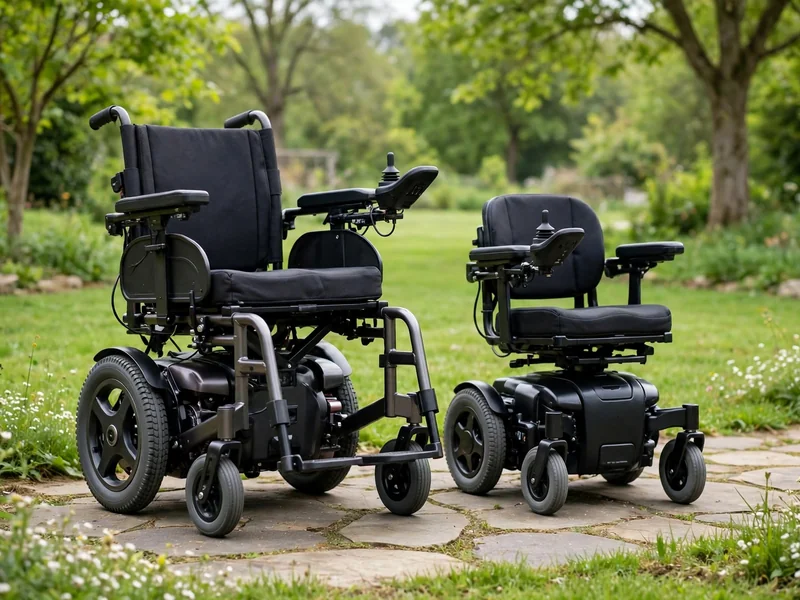
A buyer rolls two chairs across your showroom floor. One glides over the doorstep strip without a pause. The other turns inside a tight hallway without touching the walls. Both chairs look alike from the seat. The difference is underneath: the size of the wheels.
Big-Wheel vs Small-Wheel Electric Wheelchairs. This guide compares wheel size the way a distributor needs to compare it: ground, doorways, transport, and the buyers each size fits. It uses two real models from the same factory, the EW8703G and the EW8722, so every difference in this post is a difference you can show a buyer.
What does wheel size actually change on an electric wheelchair?
Wheel size changes two things: how the chair meets the ground, and how much room it needs to turn. A bigger wheel meets a bump at a shallower angle, so it rolls over it more easily. A smaller wheel meets the same bump head-on, so it stops harder and climbs slower. That is the whole physics of the choice, and everything else in this post follows from it.
The second change is space. A small wheel needs less room to swing around, so the chair turns in a tighter space and fits through narrower gaps. A big wheel needs more room, but it forgives rough ground. Neither size is better on its own. A big wheel is better on rough ground. A small wheel is better in tight rooms. The buyer who uses the chair in both places needs to know that before they choose.
Key Takeaway: A big wheel rolls over bumps more easily, and a small wheel turns in less space. Wheel size is a choice between ground and room, not between good and bad.
Where does a big wheel earn its keep?
A big wheel earns its keep outdoors. Parks, gravel paths, uneven paving, and curbs are where it pays for itself. The large rear wheel rolls over a curb edge instead of stopping against it. It carries the chair across a lawn, sinking less into soft ground. A buyer who spends the day outside feels that difference on the first trip.
The EW8703G is the big-wheel model in this comparison. It carries its rider on large rear wheels, and it is built for buyers who use the chair outside most of the day. Rehabilitation centers are one such buyer: their chairs cross gardens, paths, and ramps all day long. Our guide to electric wheelchairs for rehabilitation centers covers what a center needs from a fleet. When a buyer tells you their chair lives outdoors, start the conversation with the big wheel.
Key Takeaway: Big wheels earn their keep outdoors, on parks, gravel, and curbs. When a buyer says the chair lives outside, start with the big wheel.
Where does a small wheel win?
A small wheel wins indoors. Doorways, elevators, narrow hallways, and tight bathrooms are where it pays for itself. The compact wheels let the chair turn where a big-wheel chair would need a three-point turn. A buyer who uses the chair at home, in a care home, or in a shop will notice that on the first day.
The EW8722 is the small-wheel model in this comparison. It is built for buyers who need a steady, comfortable chair that fits the rooms they actually live in. Nursing homes are one such buyer: their chairs move between bedrooms, dining rooms, and elevators all day. Our guide to selling electric wheelchairs to nursing homes covers that buyer in full. When a buyer tells you the chair lives indoors, start the conversation with the small wheel.
Key Takeaway: Small wheels win indoors, in doorways, elevators, and tight rooms. When a buyer says the chair lives inside, start with the small wheel.
How do the EW8703G and the EW8722 compare on paper?
On paper the two models look close. Both weigh about the same. Both go about as far on a charge. The real gap is size: the EW8703G is the wider, longer chair, and the EW8722 is the more compact one. The numbers below put the two models next to each other.
EW8703G, big wheel
EW8722, small wheel
Size, unfolded
89×71×97 cm
80×65×98 cm
Size, folded
89×43×76 cm
80×39×74 cm
Weight
46 kg
45 kg
Range
18–22 km
18–22 km
Packing size
90×45×80 cm, 49 kg gross
81×42×78 cm, 48 kg gross
Read the table the way a buyer reads it. The weight gap is one kilogram, and the range is the same. No buyer chooses between these two models on weight or range. They choose on wheel size, on folded size, and on where the chair will spend its day. If a buyer asks you which number matters most, point at the folded size. That is the number that decides whether the chair fits the car and the storeroom.
Key Takeaway: Weight and range barely differ between the two models. Wheel size and folded size decide the sale, not the spec sheet.
Do big wheels need different tires?
No. Tire type and wheel size are two separate choices. A big wheel can run solid tires or pneumatic tires. A small wheel can run solid tires or pneumatic tires. The tire decides grip, comfort, and punctures. The wheel decides how the chair meets bumps and how much room it needs to turn. Do not let a buyer mix the two choices into one.
Our guide to solid vs pneumatic wheelchair tires covers the tire choice in full, so this post will not repeat it. When a buyer asks about tires, answer the tire question. When they ask about wheel size, answer the wheel question. Keep the two choices apart, and the buyer can decide each one clearly.
Key Takeaway: Tires and wheel size are separate choices. Do not let one question swallow the other.
How does wheel size affect transport and storage?
Wheel size shows up in the folded chair. The EW8703G folds to 89×43×76 cm. The EW8722 folds to 80×39×74 cm. The big-wheel model folds larger in every direction, and it packs larger too: 90×45×80 cm against 81×42×78 cm. That gap decides how many chairs fit in a van, and how much shelf space they take in your warehouse.
Check the buyer’s transport before you promise anything. Ask what vehicle carries the chair, and how many chairs ride at once. A buyer who moves one chair in a car will fit either model. A buyer who moves four chairs in a van will feel the folded size on every load. Our guide to folding vs non-folding electric wheelchairs covers the folding choice itself. Let the buyer fold both chairs and try the trunk themselves, and the size difference speaks for itself.
Key Takeaway: The big-wheel model folds larger and packs larger. Check the buyer’s vehicle and warehouse before you promise a fit.
Which buyers ask for big wheels, and which ask for small?
Fit the wheel to the buyer’s ground, not to the catalog. A buyer whose chair crosses parks and curbs every day needs the big wheel. A buyer whose chair moves between rooms and elevators needs the small wheel. A buyer who does both needs to try both before deciding. The table below turns that conversation into one glance.
Buyer
Best fit
Why
Uses the chair outdoors daily, on parks and uneven paths
EW8703G, big wheel
Large wheels roll over bumps and curbs more easily
Uses the chair mostly indoors, at home or in a care home
EW8722, small wheel
Compact size fits doorways, elevators, and tight rooms
Uses the chair both indoors and outdoors
Trial both models
Let the buyer test the doorway and the curb before deciding
Runs a mixed fleet for different venues
Both models
Match the wheel to the venue, not to the catalog
Do not sell a big wheel to a buyer who never leaves the house. Do not sell a small wheel to a buyer who crosses a park every day. A wheel that does not fit the ground comes back as a complaint. A wheel that fits turns into a referral.
Key Takeaway: Match the wheel to the buyer’s ground: outdoors points to the big wheel, indoors points to the small wheel, and a mixed day needs a trial of both.
How do you demo wheel size so the buyer feels the difference?
A good demo takes ten minutes and uses two obstacles: a curb and a doorway. Start outside. Drive the big-wheel chair over a curb, then drive the small-wheel chair over the same curb. The buyer feels the difference at once. Then go inside. Drive the small-wheel chair through a narrow doorway, then try the big-wheel chair through the same doorway. The buyer feels that difference too.
Do not describe the difference. Let the buyer drive it. A buyer who feels the curb and the doorway needs no explanation. End the demo by asking where the chair will spend most of its day. The answer tells you which model to quote, and the buyer trusts the answer because their own hands gave it.
Key Takeaway: Demo two obstacles, a curb and a doorway. Let the buyer drive both chairs over both, and the right wheel picks itself.
What do you stock when your buyers use chairs both indoors and outdoors?
Stock both, and let the trial decide. MOQ is 1 unit, so you can stock one of each without tying up your warehouse. Put the big-wheel chair with the outdoor buyers and the small-wheel chair with the indoor buyers, and keep one of each on the floor for trials. A buyer who uses the chair in both places should try both models before they buy. The trial costs you ten minutes. The wrong choice costs you a return.
When the budget only stretches to one size, follow demand: order the size your buyers already ask for. Your sales records answer that question better than any guide can. Read them before you order, and add the second model when the first one starts selling. Stock what your buyers already ask for, and you will never need to discount a chair that does not move.
Key Takeaway: Stock one of each when you can, and let the trial decide. With a 1-unit MOQ, you can start small and add the second size when sales tell you to.
Does wheel size change servicing and spare parts?
No. Both models run on a 24V system, and both use the same four part types: controllers, motors, chargers, and batteries. Keep those four on your shelf, matched to each model, and a repair takes days instead of weeks. A part on the shelf means the buyer keeps moving. A part that is missing means the buyer waits, and the buyer remembers.
The warranty terms are the same for both models. The frame carries 36 months, the motor and the controller carry 12 months each, and the battery carries 6 months for lead-acid and 12 months for lithium. Say those terms out loud at handover, and write them on the handover sheet. Wheel size changes what the chair can do. It does not change how you service it.
Key Takeaway: Wheel size does not change servicing. Stock controllers, motors, chargers, and batteries, and state the warranty terms at handover for either model.
Big-Wheel vs Small-Wheel Electric Wheelchairs — The Short Answer
The short answer is where the chair spends its day. The EW8703G is the big-wheel model: 46 kg, 18–22 km on a charge, folded to 89×43×76 cm, built for parks, paths, and curbs. The EW8722 is the small-wheel model: 45 kg, 18–22 km on a charge, folded to 80×39×74 cm, built for doorways, elevators, and tight rooms. Weight and range barely differ. Wheel size and folded size decide the sale.
Big-Wheel vs Small-Wheel Electric Wheelchairs comes down to the buyer’s ground. Let them drive both over a curb and through a doorway, and the right wheel picks itself. ZVCARE — Shenzhen Zhiwei Health Technology Co., Ltd., founded in 2015 and ISO 13485:2016 certified — works with distributors on that basis. MOQ is 1 unit, lead time is 7 days after payment, and spare parts support covers the models you stock. If your next order needs a factory that stands behind it, talk to us before you place the order.
Frequently Asked Questions
Can a small-wheel chair handle a park path?
A short, smooth park path is fine. Rough ground, loose gravel, and high curbs are where the small wheel struggles and the big wheel earns its keep. If the buyer’s daily route includes rough ground, show them the big-wheel model and let them drive both over the same ground.
Do big wheels make a chair harder to transport?
They make the folded chair larger. The EW8703G folds to 89×43×76 cm, and the EW8722 folds to 80×39×74 cm. A buyer who moves one chair in a car will fit either model. A buyer who moves several chairs in a van should measure the load space before choosing.
Are the tires on a big-wheel chair different?
Not by rule. Tire type and wheel size are separate choices. A big wheel can run solid tires or pneumatic tires, and so can a small wheel. The tire decides grip, comfort, and punctures. The wheel decides how the chair meets bumps. Read our guide to solid vs pneumatic tires to decide the tire separately from the wheel.
Which size suits a care home?
The small wheel suits a care home best. Chairs there move between bedrooms, dining rooms, and elevators all day, and the compact wheels turn in the tightest spaces. The EW8722 is built for that use. If the care home also has gardens and paths, trial the big-wheel model there too before deciding.
Should I stock both wheel sizes?
Stock both if your buyers split into indoor and outdoor users. With a 1-unit MOQ, you can stock one of each without tying up your warehouse. When the budget only stretches to one size, order the size your buyers already ask for, and add the second size when sales tell you to.
Founded in 2015, ZVCARE is an ISO 13485:2016 certified electric wheelchair manufacturer in China, providing OEM & ODM solutions for global distributors and medical stores.