Electric Wheelchairs for Holiday Parks Buyers Guide
November 23, 2026
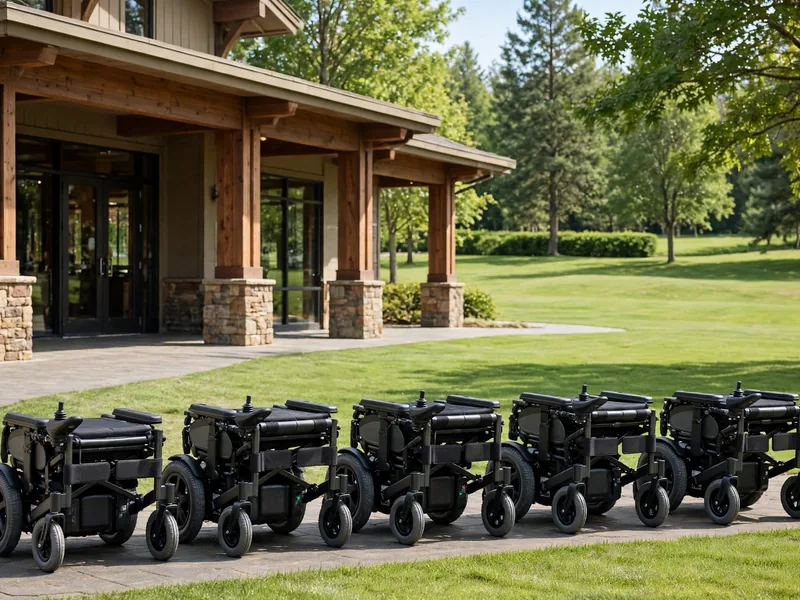
A family arrives at your holiday park on a Friday afternoon. They have booked a lodge for the weekend. One of them uses a wheelchair, and the park is bigger than they expected. The lodge sits at one end, the lake and the play area sit at the other, and the paths between them are long. That guest will either enjoy the weekend or spend it stuck near the lodge. The difference is often a chair you lend them at reception.
Electric Wheelchairs for Holiday Parks Buyers Guide: this guide helps a holiday park operator build a shared fleet that fits the park, the guests, and the staff who run it. It covers the ground your chairs must handle, the models that fit a park, how booking and charging work in practice, and what to ask the factory before you order.
What does a holiday park fleet actually have to do?
A holiday park fleet does one job: it lets guests reach the whole park. A guest who can only reach the lodge does not get the holiday they paid for. A guest who can reach the lake, the play area, and the restaurant tells friends about the park. That is the whole case for the fleet, and it is a strong one.
The fleet is shared, so it must suit many bodies, not one. Guests differ in size, strength, and experience. Some have used a power chair for years. Some have never driven one. Your chairs must be simple to drive, simple to adjust, and forgiving of a first-time driver. A joystick that feels natural in five minutes beats a chair with features nobody uses.
The fleet also has to survive the park itself. Chairs go out in sun, wind, and rain. They cross grass, gravel, and paved paths. They get bumped at doorways and loaded into cars. A chair built for indoor use will not last a season in a park. Pick chairs for the ground your park actually has, not the ground in the catalog photo.
Key Takeaway: A park fleet exists so every guest can reach the whole park. Simple controls, room for different bodies, and outdoor-ready build matter more than extra features.
What should you check on your park before you order?
Walk your park the way a guest in a chair would. Start at reception and go to the lodge, the lake, the play area, and the restaurant. Note every surface: paved path, gravel track, grass, and any slope. Note every narrow spot: gates, doorways, and bridges. The chairs you buy must pass every part of that route, not just the easy stretches.
Check your paths after rain. A gravel path that looks firm in dry weather turns soft when it rains, and small wheels sink into it. A grass slope that looks gentle can stop a chair with small wheels. If your park has soft ground or slopes, big wheels earn their keep. Our guide to big-wheel vs small-wheel electric wheelchairs explains how wheel size changes what a chair can cross.
Check where the chairs will sleep. A fleet needs a dry room near reception with power for charging and space to fold chairs down. Count the power points, not the chairs. Each chair needs its own point for an overnight charge. A room with two points and six chairs will leave chairs uncharged every morning.
Key Takeaway: Walk the park in a chair’s shoes before you order. Surfaces, slopes, narrow spots, and charging points decide the fleet, not the catalog.
Which chairs fit a holiday park: folding or fixed?
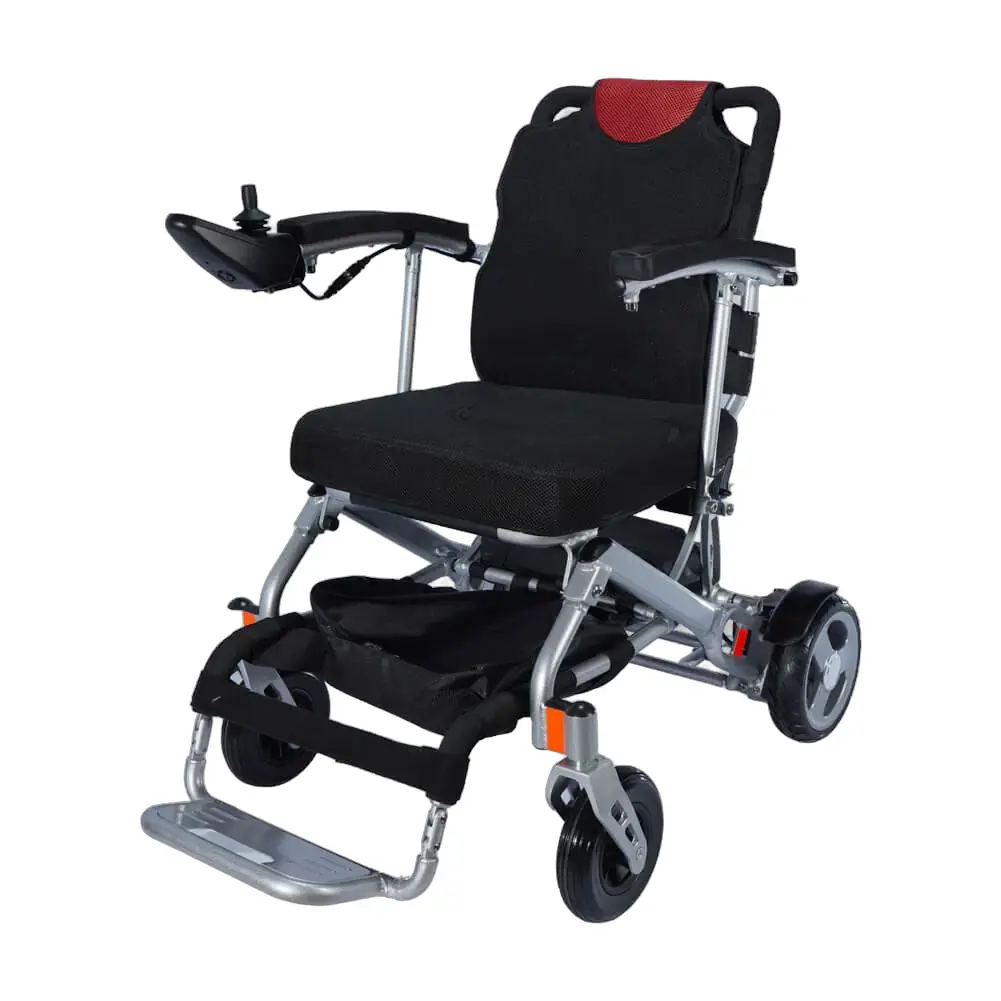
Most parks run a mix of big and small wheels, and the ground decides the split. Folding chairs suit the paved parts of a park and the storage room. For the storage room, the lightest option is the EW1000: 15 kg with the battery, folding to 73×39×71 cm. The EW100 is heavier at 23 kg, but it folds thinner — 73×55.5×31 cm — so it stands slim against a wall. Both fold down small enough to stack in a small room, and both are designed for air travel (airline approval required) — a sign of how portable they are.
Big-wheel chairs suit the rough parts. For the rough parts, the big-wheel EW8703G fits best: 46 kg, and a range of 18–22 km. The small-wheel EW8722 is lighter at 45 kg, with the same 18–22 km range. The big-wheel model crosses grass and gravel with less effort. The small-wheel model turns tighter on paved paths and in buildings. If your park is mostly paved, the small-wheel model does fine. If guests cross lawns and gravel every day, the big-wheel model is the safer pick.
Range matters less than most parks think. On one charge, the EW1000 goes 15±3 km, the EW100 12±5 km, and the bigger models 18–22 km. A guest rarely drives more than a few kilometers in a day at a park. What counts is the charge, not the range on the label. A fully charged chair with a short range still does the job, and a long-range chair with a dead battery does not.
Model
Weight, with battery
Folded size
Range
Best for in a park
EW1000
15 kg
73×39×71 cm
15±3 km
Lightest to load, folds tall
EW100
23 kg
73×55.5×31 cm
12±5 km
Thinnest fold, familiar frame
EW8703G
46 kg
89×43×76 cm
18–22 km
Grass, gravel, and slopes
EW8722
45 kg
80×39×74 cm
18–22 km
Paved paths and tight turns
Key Takeaway: Mix the fleet to match your ground: folding chairs for paved areas and storage, big wheels for grass and gravel. Range is rarely the limit; a full overnight charge is.
How do guests book and pick up a chair?
Keep booking simple. A guest books a chair at reception when they book the lodge, or on arrival if one is free. A paper sheet at the desk works fine: name, lodge number, and the day the chair goes back. Start with the sheet, not software — a month of marks on paper tells you how many chairs the park needs.
Hand the chair over with a two-minute demo. Show each guest the joystick, the speed control, and how to stop — before they drive away from reception. Let them drive a short loop near reception before they head off. A guest who drives once with staff watching will not call you from the far end of the park. A guest handed a chair with no demo will come back stuck on the first slope.
Check the chair back in the same way it went out. Walk around the chair with the guest before they leave: wheels, seat, joystick, and any mark already on it. Write it down. That check takes a minute and stops arguments later. Our guide to how much a folding electric wheelchair weighs helps staff talk about the chairs with guests, including who can load one into a car without help.
Key Takeaway: Book with a simple sheet, demo every chair for two minutes at handover, and check it back in with the guest present. The routine prevents most problems.
Where do the chairs charge, and who checks them?
Every chair plugs in overnight in the storage room, one power point per chair. Staff plug each chair in when it comes back, and the morning check confirms the charge light before the chair goes out again. That is the whole charging plan. It needs no software and no extra staff — just one person who owns the job every night.
The morning check is short, and it is worth doing every day. Drive each chair a few meters, test the joystick in both directions, and listen for anything loose. A chair that fails the morning check stays in the room and a spare goes out. A chair that fails on a guest halfway across the park costs you a rescue trip and a ruined day for that guest.
Keep one spare chair charged and ready. It covers the chair that fails a check, the chair that comes back with a dead battery, and the guest who arrives without a booking. One spare is enough for a small fleet. If your spare goes out every day, your fleet is too small. Add a chair. A trial fleet is a good way to test demand before you grow: run a small fleet for a season, read the booking sheet, and order the chairs the sheet proves you need.
Key Takeaway: One power point per chair, overnight charging, and a short morning check by a named member of staff. Keep one spare charged, and let the booking sheet tell you when to grow.
What happens when a chair comes back damaged?
Chairs come back damaged. Guests bump doorways, catch wheels on stones, and scrape armrests. Plan for it instead of hoping it will not happen. The return check catches most damage at the desk, and a small stock of spare parts covers the rest: a spare joystick, a spare charger, and a spare set of tires. Spare parts are the difference between a chair out of service for a day and one out of service for a month.
Know your warranty before you need it. The frame carries 36 months, the motor and the controller carry 12 months each, and the battery carries 6 months for lead-acid and 12 months for lithium. Damage from a guest is not a warranty claim, but a motor that fails in normal use is. Our guide to electric wheelchair warranty questions lists what to ask your supplier before you order, so you know where you stand when a chair fails.
Clean every chair between guests. Wipe the seat, the armrests, and the joystick. A clean chair tells the next guest the park cares, and it lets staff spot damage while they clean. Cleaning is also the moment to check tire wear and loose bolts. A chair that is cleaned daily lasts longer than a chair that is only cleaned when it looks dirty.
Key Takeaway: Expect damage, stock a few spare parts, and know the warranty by heart. Clean each chair between guests, and the cleaning itself becomes the daily inspection.
How do you keep the fleet running through the busy season?
The busy season tests everything: more guests, more hours, more wear. The fix is routine, not extra staff. The morning check, the overnight charge, and the cleaning between guests do not change in the busy season. They just matter more. Write the routine on a card in the storage room so any member of staff can follow it, including a new starter.
Rotate the fleet so no single chair does all the work. If one chair goes out every day and another sits in the corner, the busy chair wears out first and the spare is untested. Rotate by the booking sheet: the chair that went out yesterday rests today. A rotated fleet ages evenly, and every chair is known to work.
Watch the booking sheet for the pattern. If chairs are booked out every weekend and guests are turned away, you need more chairs. If chairs sit unused for weeks, you have the wrong mix, not too few chairs. The sheet tells you which. Order one more chair when the sheet shows regular turnaways, not when a single busy weekend makes you nervous. MOQ is 1 unit. Lead time is 7 days after payment. Add chairs one at a time as demand proves itself.
Key Takeaway: The busy season runs on the same routine, done every day. Rotate chairs so they age evenly, and let the booking sheet — not one busy weekend — decide when to add a chair.
What should a holiday park ask the factory before ordering?
Lead with the ground: describe your paths, your slopes, and your worst stretch of gravel, then ask which model they would put on it. Experience shows in the answer. A factory that has sold into parks talks about gravel, slopes, and wet grass. A factory that has not talks about the catalog.
A broken chair in peak season is a guest without a chair. Ask which parts a park should hold on the shelf, and how fast the rest ship. Ask about the warranty in plain words. The frame carries 36 months, the motor and the controller 12 months each, and the battery 6 months for lead-acid and 12 months for lithium. Get that answer in writing before you order.
Ask about the chairs your guests will actually meet. Can the factory send a demo chair for a weekend so your staff can try it on your paths? A chair that looks right in a photo and wrong on your gravel is a costly mistake. A demo weekend costs little and answers the question properly. Our guide to folding electric wheelchair travel is written for buyers who move chairs often, and much of it applies to a park fleet that loads chairs into cars and stores them between seasons.
Key Takeaway: Ask the factory about your ground, your spare parts, and a demo weekend — in that order. A factory that answers those three questions plainly is one you can work with.
Electric Wheelchairs for Holiday Parks Buyers Guide — The Short Answer
The short answer is the ground, the guest, and the routine. Match the chairs to your paths: folding chairs for paved areas and storage, big wheels for grass and gravel. Keep booking simple, demo every chair at handover, charge every chair overnight, and check every chair in the morning. Rotate the fleet, read the booking sheet, and grow one chair at a time.
Electric Wheelchairs for Holiday Parks Buyers Guide comes down to this: a park fleet is a guest service, not a product display. The park that treats it that way gets guests who come back, and guests who tell friends. ZVCARE — Shenzhen Zhiwei Health Technology Co., Ltd., founded in 2015 and ISO 13485:2016 certified — builds the folding and big-wheel models parks use, with spare parts support behind them. MOQ is 1 unit, lead time is 7 days after payment, and the warranty runs 36 months on the frame, 12 months each on the motor and controller, and 6 months for lead-acid and 12 months for lithium batteries. If your park is ready for a fleet, talk to us before you place the order.
Frequently Asked Questions
Can guests use the chairs on grass and gravel paths?
Yes, if you pick the right model for the ground. The big-wheel EW8703G handles grass and gravel better than small-wheel models. Walk your paths after rain before you order, and test a demo chair on the worst surface in the park, not the best one.
Do the chairs fold for storage?
Yes, the folding models do. The EW1000 folds to 73×39×71 cm and the EW100 to 73×55.5×31 cm, and both stack in a small storage room. The bigger models fold too, but they take more room. Measure your storage room before you order.
What if a guest damages a chair?
Check the chair back in with the guest present and note the damage on the booking sheet. Keep a small stock of spare parts — a spare joystick, a spare charger, and spare tires — so a damaged chair is out of service for a day, not a month. Guest damage is not a warranty claim. A part that fails in normal use may be.
How far can a guest go on one charge?
Far enough for a day at a park. On a charge, the EW1000 goes 15±3 km, the EW100 12±5 km, and the EW8703G and EW8722 18–22 km. Most guests drive only a few kilometers in a day. Start every chair fully charged each morning, and range will rarely be the limit.
How do we start a fleet?
Start small. Run a trial fleet for a season, keep the booking sheet, and let it show you the demand. With a 1-unit MOQ and a 7-day lead time after payment, you can add chairs one at a time as the sheet proves you need them. Order the model that fits your ground, not the model that looks best in a photo.
Founded in 2015, ZVCARE is an ISO 13485:2016 certified electric wheelchair manufacturer in China, providing OEM & ODM solutions for global distributors and medical stores.