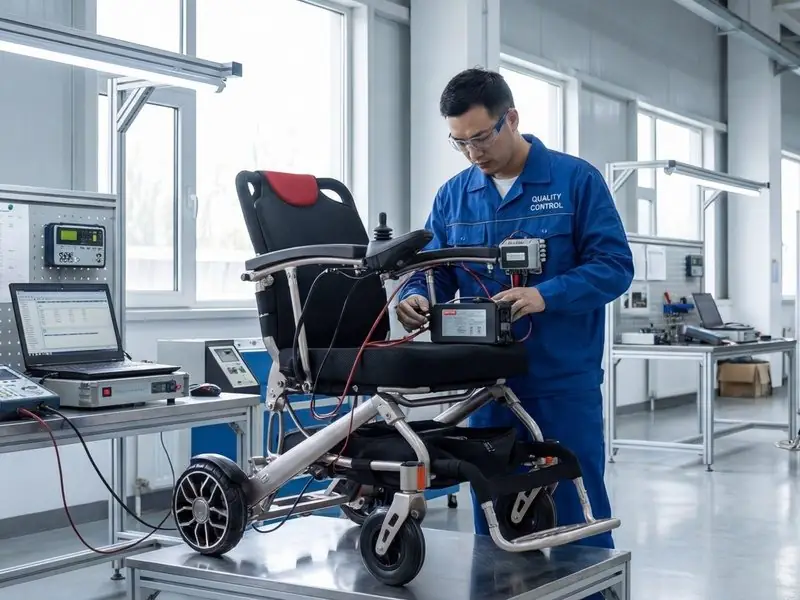
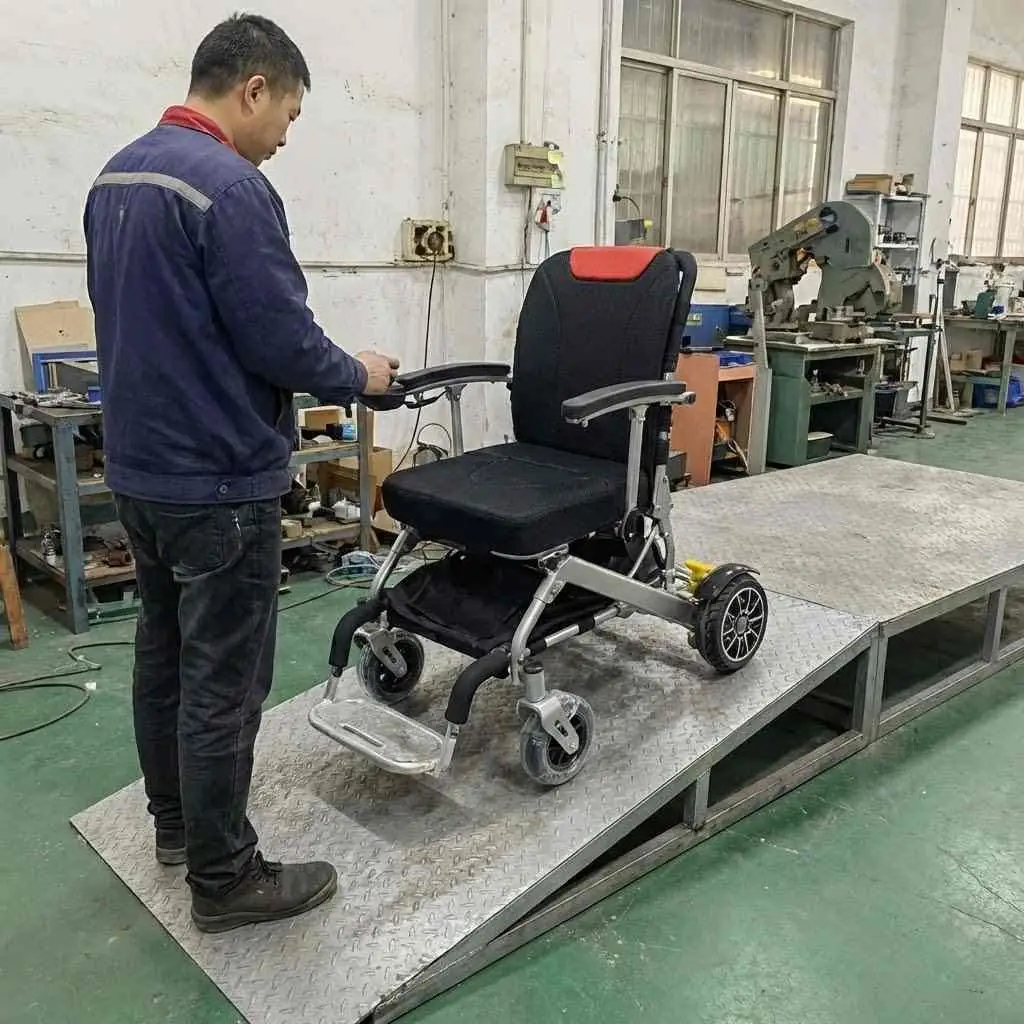
Buying electric wheelchairs for rehabilitation centers is a fleet decision, not a single-chair purchase. One good chair can still be the wrong choice when several must be charged, cleaned, stored, and kept running daily. A good buying decision therefore starts with how the chairs will actually be used across the building, who will look after them, and what happens when one of them stops working.
A rehabilitation center is not the same buyer as a nursing home, even though both buy chairs for people who need mobility support. A nursing home buys mainly for daily living and long-term residential use, while a rehab setting buys for a working therapy floor: chairs move between rooms, go out on trips, get folded and loaded for transport, and are handed from one user to the next during the day. That difference changes what matters most. For the residential-care angle, see this guide to selling electric wheelchairs to nursing homes.
This guide stays on the procurement side: fleet mix, durability and cleaning, trials, staff training, service and spare parts, warranty terms, and total cost. It does not cover clinical decisions, which belong to the center’s own clinical team. What it does cover is how a manager can compare suppliers on practical grounds and ask the right questions before ordering.
What does a rehabilitation center actually need from a fleet?
Start with the working day, not the specification sheet. Walk the routes the chairs will take: door widths, lift size, storage space, charging points, and the distance between the therapy gym, treatment rooms, and the vehicle used for outings. A chair that cannot be stored where staff can reach it, or charged where staff can manage it, will cause friction every day, no matter how good its other features are.
Next, list the jobs the fleet has to do. Most centers need chairs for movement around the building during therapy sessions, for trips outside the building, and for general transfer between areas. Some chairs will be used heavily all day, while others will be used mainly for transport and outings. When those jobs are written down, the buyer can stop comparing chairs in the abstract and start matching each model to a job.
Buying route matters too. Rehabilitation centers often buy direct or at department level, rather than through a formal hospital tender. That changes the paperwork, the timeline, and who signs off. For contrast, see how hospitals buy electric wheelchairs by tender. A direct purchase can move faster, but it also means the buyer has to do the comparison work that a tender process would otherwise force: checking suppliers, testing chairs, and confirming service terms before the order is placed.
How should you mix lightweight folding chairs and durable daily-use chairs?
Very few centers need a fleet of identical chairs. A mixed fleet usually works better, because folding chairs and heavier daily-use chairs solve different problems. Folding chairs are easy to load, store, and take on outings. Heavier, sturdier chairs are better suited to constant use on the therapy floor, where they are driven all day and handed between users.
The table below is a simple way to think about the split. It is a planning aid, not a rule; the right balance depends on your building and transport.
Fleet role
Best fit
Watch out for
Transport and outings, e.g. trips outside the building
Lightweight folding chair
Weight when lifting, folded size, and charging routine
Daily therapy-floor use, e.g. movement between rooms all day
Durable, sturdier chair
Cleaning time between users and wear on shared parts
Backup and cover
A chair staff already know how to operate
A backup that nobody is trained on is not really a backup
Weight and folded size are worth checking with real numbers from the supplier, not general claims. For example, the EW1000 weighs 15 kg including battery and folds to 73×39×71 cm, while the EW100 is a 23 kg aluminum chair that folds to 73×55.5×31 cm. Heavier models, such as the EW8722 at 45 kg, the EW8703G at 46 kg, and the EW8720 at 45 kg, should be judged on durability and daily use rather than lifting ease.
Range matters in the same practical way. The EW1000 is rated at 15±3 km on its 24V 10Ah lithium battery, the EW100 at 12±5 km, and the heavier models at 18–22 km. Ask the supplier what those figures assume, and test them against your own daily routes. A chair that covers a full working day without a midday charge saves staff time. The choice between folding and non-folding designs also affects storage and transport, and this comparison of folding and non-folding electric wheelchairs is a useful second check before you fix the mix.
What makes a shared chair durable and easy to clean?
A chair for private home use is used by one person and looked after by one household. A chair in a rehab center is shared, used many times a day, and cleaned many times a day. That shared use is where durability problems show up first: armrests, footrests, joystick housings, seat covers, and folding joints take repeated handling, and small weaknesses become daily annoyances.
When you compare models, look at the parts that staff touch most. Ask how the seat cover is removed and cleaned, whether the joystick and controller are protected from knocks, and how the folding mechanism holds up after repeated folding. Ask what the supplier regards as a wear part and what it regards as a fault. Wear parts will need planned replacement, while faults should be covered under warranty.
Cleaning routine is part of the buying decision, not an afterthought. Before you order, agree who cleans the chairs, when, and with what materials, and check with the supplier that those materials suit the chair’s surfaces and electronics. A chair that is simple to wipe down and inspect is more likely to be cleaned and inspected on schedule. For routine care of folding models, see this guide to maintaining a folding electric wheelchair.
How do you run a trial or demo before committing to a fleet?
Never commit to a full fleet on the strength of a brochure or a single showroom visit. Ask for a trial or demo with the exact models you are considering, and run it in your own building. A short, structured trial tells you more than any specification sheet, because it tests the chairs against your doors, lifts, floors, storage, and charging points.
Set the trial up so staff can judge the chairs properly. Give the trial chairs real jobs for several days: therapy-floor movement, transport to and from a vehicle, folding and storage, and charging at the end of the day. Ask the staff who will actually operate and clean the chairs to use them, not only the manager. Their feedback will be more useful than any first impression in a showroom.
Use the trial to test the supplier as well as the chair. Note how quickly the supplier answers questions, whether it sends the right model and the right charger, and whether it explains operation and charging clearly. If support is slow or vague during a trial, when the supplier is trying to win the order, it is unlikely to improve after the order is placed. This guide to evaluating an electric wheelchair factory sets out factory checks worth making before you rely on a new supplier.
What should staff training cover?
Staff training does not need to be long, but it does need to cover the tasks staff will actually do every day. The essentials are basic operation, safe driving in indoor spaces, folding and unfolding, battery charging, and the daily check before a chair goes into service. Keep the training practical and hands-on, with the actual fleet models in the room, not a generic presentation about a different chair.
Charging deserves its own place in the training. Staff should know where each chair charges, how to tell when charging is complete, what to do if a chair is left uncharged, and who is responsible for the end-of-day charging routine. Chargers come in versions such as 2A and 5A, with lead-acid and lithium versions, and charging time depends on battery capacity, so staff should be trained on the charger that matches each chair in your fleet rather than on a general rule. A simple written routine, posted where chairs are stored, prevents most charging problems before they start.
Training should also cover what to do when something goes wrong. Staff do not need to repair chairs, but they do need to know how to take a chair out of service safely, how to report a fault, and who to contact. A clear fault-reporting route, with a named contact at the supplier, prevents a faulty chair from staying in circulation while everyone assumes someone else has reported it. Refresh training when new staff join or a new model arrives.
How do you plan service and spare parts?
Service planning is where many fleet purchases succeed or fail. A chair that cannot be serviced locally, or for which parts take a long time to arrive, will spend too much time out of service, and the rest of the fleet has to absorb the extra work. Before ordering, ask the supplier who carries out service, where parts are stocked, and how long a typical repair takes. Ask for those answers in writing, so they form part of the purchase record rather than a conversation that is hard to recall later.
Spare parts planning starts with the parts that wear or break most often on shared chairs: tires, armrest and footrest parts, joystick components, batteries, and chargers. Holding a small stock of the most common parts, agreed with the supplier, can keep a chair in service while a larger repair is arranged. This spare parts stocking guide for electric wheelchairs explains how to choose that first stock list without over-ordering parts you may never use.
Build a simple maintenance routine around the fleet: a weekly check of tires, brakes, folding joints, and battery condition, plus a simple log for each chair, so a part that fails repeatedly shows up as a fleet issue to raise with the supplier.
What should you check in the warranty terms?
Warranty terms should be stated plainly, and a buyer should not have to guess what is covered. At ZVCARE, the unified warranty is straightforward: the frame is covered for 36 months, and the battery is covered for 6 months for lead-acid or 12 months for lithium, and the motor and controller are each covered for 12 months. Compare suppliers on that same basis, rather than comparing a headline period that covers only one part.
Ask the questions that reveal how the warranty works in practice. Who pays for transport to and from repair, and who carries out the repair? What counts as a warranty fault and what counts as wear or misuse? How quickly will the supplier respond to a claim, and what happens to your fleet cover while a chair is away? The answers matter more than a single warranty number, because they decide how much disruption a fault actually causes. For the questions worth asking any supplier, see this checklist of what to ask a supplier about electric wheelchair warranty.
Also ask how claims are handled step by step, from the first report to the return of the repaired chair. A clear claims process, with a named contact and a realistic timeline, protects both sides. If the process is unclear before you buy, it will not become clearer after a fault appears, so settle it — including the stages in this guide to the electric wheelchair warranty claims process — while you still have the leverage of an unplaced order.
How do you think about total cost without a price list?
Total cost is not the purchase price alone. A cheaper chair that needs frequent parts, spends time out of service, or has no clear service route can cost more over its working life than a chair with a higher purchase price and a solid service plan. Compare fleets by adding up purchase, service, and parts over the period you expect to run them.
Start with the service and parts picture you have already built. How often will wear parts need replacing, what does the supplier charge for them, and how long will chairs be out of service for repair? Then add staff time: charging, cleaning, inspection, and fault reporting all take time, and a simple fleet saves hours every week.
Certification and factory background belong in the same total-cost thinking, because they reduce risk. ZVCARE manufactures under ISO 13485:2016 certification via NQA/UKAS, with a CE Class I EU Authorized Representative notification via Humiss, China NMPA registration, and Saudi SFDA status recorded as Registered with renewal in progress.
Other practical terms also affect total cost. A minimum order of 1 unit means a center can start with a trial chair or a small first batch without committing to a full fleet at once. A lead time of 7 days after payment helps planning, because the buyer knows when chairs will arrive and can schedule training and storage around delivery. OEM customization, including colors, logo placement, and packaging, is available, and is worth agreeing before ordering.
What do buyers ask most often?
Can we start with a small order and add chairs later?
At ZVCARE, yes: a minimum order of 1 unit means you can start with a trial chair or a small first batch, learn how the chairs work in your building, and then add chairs with the same models and the same training. With any other supplier, confirm the minimum order before you buy. That staged approach reduces risk.
Should the whole fleet be one model, or a mix?
A mix usually serves a rehab center better than a single model, because transport and daily therapy-floor use are different jobs. Lightweight folding chairs suit outings and loading, while sturdier chairs suit constant indoor use. The key is to keep the mix simple enough that staff can operate, charge, and clean every model in it. Many different models create training and parts problems that outweigh any small advantage.
How do we keep shared chairs in good condition?
Agree a cleaning and inspection routine before the chairs arrive, and train staff on the actual fleet models. A short daily check, a regular cleaning routine using materials the supplier confirms as suitable, and a simple log for each chair will catch wear early. Keep a small stock of common wear parts, and take any chair with a fault out of service and report it promptly, so a minor problem does not become a larger repair.
What should we settle in writing before ordering?
Settle the warranty terms, the service route, parts availability, lead time, and the claims process in writing. Confirm who carries out repairs, who pays for transport, and how quickly the supplier will respond to a fault. Also confirm delivery timing, training, and any customization such as colors, logo placement, or packaging. Getting those points agreed before payment avoids most later disputes.
How do you make the final decision?
The final decision is easier when the earlier steps have been done properly. By this point you should know the jobs the fleet has to do, the mix that fits those jobs, how the chairs performed in your building during a trial, what staff think of them, and what the warranty, service, and parts picture looks like in writing. If any of those points is still unclear, clarify it now, not after delivery.
When you choose electric wheelchairs for rehabilitation centers, the test is simple: can your staff run, clean, charge, and keep this fleet in service every working day, without depending on one expert or one supplier promise that is not written down? If the answer is yes, and the trial chairs have proved themselves in your own building, the fleet is ready to order. If the answer is no, change the mix, the supplier, or the service terms until it becomes yes.
Key Takeaway: Choose the fleet mix your staff can actually run day to day — not the longest list of features.
Founded in 2015, ZVCARE is an ISO 13485:2016 certified electric wheelchair manufacturer in China, providing OEM & ODM solutions for global distributors and medical stores.