EW100 vs EW1000: Which Lightweight Electric Wheelchair?
November 21, 2026
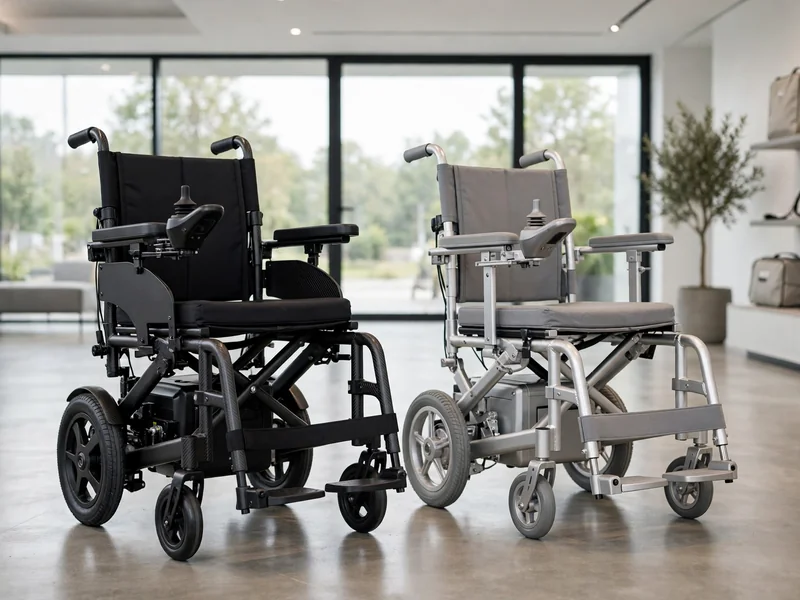
A buyer stands in your showroom between two lightweight chairs. Both fold. Both run on a 24V system. Both come from the same factory. One weighs 15 kg. The other weighs 23 kg. The buyer looks at you and asks the question every distributor hears: which one should I buy?
EW100 vs EW1000: Which Lightweight Electric Wheelchair? This guide compares the two models the way a distributor needs to compare them: weight, folded size, range, battery, and the buyers each one fits. It also covers flying, pricing, and the demo, so you can answer the question in the showroom instead of guessing.
What is actually different between the EW100 and the EW1000?
The first difference is the frame. The EW1000 uses a carbon-fiber frame. The EW100 uses an aluminum alloy frame. That one choice drives the weight gap, and the weight gap drives most of the buying decision. Our guide to carbon fiber vs aluminum frames explains the material side in full, so this post stays on the models themselves.
Everything else follows from that frame choice. The EW1000 is lighter, folds taller in one direction, and goes further on a charge. The EW100 is heavier and folds flatter, and aluminum is the material most buyers already know, so it needs less explaining. Here are the two models side by side.
EW1000
EW100
Frame
Carbon fiber
Aluminum alloy
Weight, with battery
15 kg
23 kg
Size, unfolded
96×60×89 cm
102×58×87 cm
Size, folded
73×39×71 cm
73×55.5×31 cm
Range
15±3 km
12±5 km
Battery
24V 10Ah lithium, 240Wh
24V system
Key Takeaway: The frame is the difference that matters. Carbon fiber makes the EW1000 lighter, and aluminum alloy makes the EW100 the familiar choice. Start every comparison there.
How much does the weight difference matter to a buyer?
Eight kilograms sounds small on a spec sheet. It does not feel small when a buyer loads the chair into a car trunk alone. The EW1000 weighs 15 kg including the battery. The EW100 weighs 23 kg. That gap decides who can load the chair without help, and who needs a second pair of hands.
Ask the buyer who loads the chair. A buyer who travels alone and loads the chair every day will feel the 8 kg on every trip. A buyer who keeps the chair at home and drives it out of the front door will barely notice it. Our guide to how much a folding electric wheelchair weighs shows how to talk about weight without turning it into a number on a page. Let the buyer pick up both chairs in your showroom. The hands decide faster than the spec sheet.
Key Takeaway: Eight kilograms matters most to the person who loads the chair alone. Ask who loads the car before you recommend a model.
Which one folds smaller, and does the folded size change the sale?
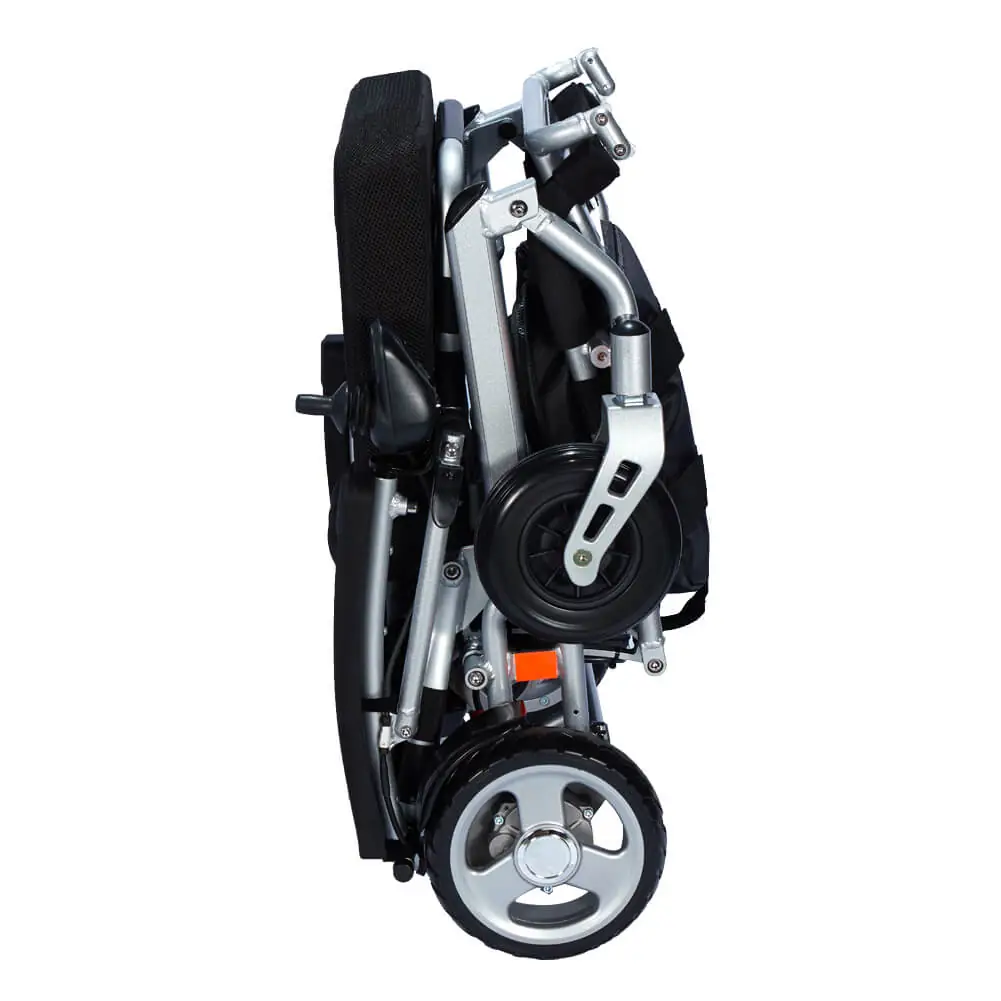
Both chairs fold, but they fold into different shapes. The EW1000 folds to 73×39×71 cm. The EW100 folds to 73×55.5×31 cm. Read those numbers the way a car trunk reads them: the EW1000 is taller when folded, and the EW100 is flatter. A flat fold slides under a cargo cover. A tall fold stands upright in a narrow trunk.
Measure the buyer’s car before you promise anything. Ask what else rides in the trunk: shopping bags, a walker, a suitcase. A chair that fits on paper and not in the car comes back to your showroom, and the buyer does not come back with it. Our guide to folded vs unfolded dimensions lists the sizes to check before the buyer drives home. Fold both chairs in front of the buyer, and let them try the trunk themselves.
Key Takeaway: The EW1000 folds taller, the EW100 folds flatter. Measure the buyer’s car trunk, not the spec sheet, before you promise a fit.
How far does each model go on a charge?
The EW1000 goes 15±3 km on a charge. The EW100 goes 12±5 km. The gap is real, but it is smaller than the weight gap, and it matters less to most buyers than they think. A buyer who drives to the shops and back uses a small part of either range. A buyer who spends a full day out will notice the extra kilometers.
The battery explains part of the gap. The EW1000 runs a 24V 10Ah lithium battery, rated at 240Wh. The EW100 runs on a 24V system. Do not swap batteries between the two models. Match the battery to the model, and match the charger to the battery. Our guide to how far a folding electric wheelchair goes on one charge explains what shortens range in daily use, so you can set the buyer’s expectations honestly. Tell the buyer the range is a guide, not a promise. Hills, weight, and cold weather all pull it down.
Key Takeaway: The EW1000 goes further, but most buyers will not use the full range of either model. Set expectations on real use, not on the best-case number.
Which buyers fit the EW1000, and which fit the EW100?
Fit the chair to the buyer’s week, not to the catalog. A buyer who flies often and loads the chair alone needs the lightest chair you stock. A buyer who wants the flattest fold for a small car trunk needs the EW100. A buyer who drives long distances each day needs the longer range. The table below is the short version of that conversation.
Buyer
Best fit
Why
Flies often and loads the chair alone
EW1000
15 kg, folds to 73×39×71 cm
Needs the flattest fold for a tight trunk
EW100
Folds to 73×55.5×31 cm
Drives long distances each day
EW1000
15±3 km range, 24V 10Ah battery
Uses the chair daily at home and nearby
Either model
Both fold for the car and run on a 24V system
Do not sell the EW1000 to a buyer who will never load it. Do not sell the EW100 to a buyer who flies twice a month and loads the chair alone. The wrong fit comes back as a complaint. The right fit comes back as a referral.
Key Takeaway: Match the model to the buyer’s week: flying and loading alone points to the EW1000, a tight trunk points to the EW100, and daily local use fits either one.
Can both chairs fly?
Both models are designed for air travel (airline approval required). That sentence is the whole answer, and the words in parentheses carry the weight. No airline takes a wheelchair on the word of a brochure. The buyer must get approval from the airline before the flight, and the approval depends on the airline, the route, and the battery.
The paperwork helps. The EW1000 carries a 24V 10Ah lithium battery, and its UN38.3 report S03A25010237U00201 covers that battery. The EW100 is covered by a UN38.3 report for the EW01. Keep both reports on file, and hand the buyer a copy before they travel. Our folding electric wheelchair travel guide walks through the steps to take before the flight. Tell the buyer to call the airline early, and to carry the battery report with the chair. A buyer who is turned away at check-in blames the chair, not the airline.
Key Takeaway: Both chairs are designed for air travel, and both need airline approval before the flight. Hand the buyer the UN38.3 report and tell them to call the airline early.
How do you price two lightweights without stealing your own sales?
Two lightweights on the same shelf can steal each other’s sales. The fix is positioning, not discounting. Present the EW1000 as the lightest chair you stock, for buyers who load it alone and fly often. Present the EW100 as the everyday lightweight, for buyers who want a folding chair at a more modest outlay. Do not pitch both to the same buyer in the same breath. Let the buyer’s week choose the model, and the price follows the choice.
Keep the conversation on the buyer, not on your margin. A buyer who understands why the EW1000 weighs 15 kg accepts its position. A buyer who only hears a price walks out to compare prices elsewhere. Show both chairs, fold both chairs, and let the buyer pick up both. The chair that fits the buyer’s week sells itself, and the other one stays on the shelf for the next buyer it fits.
Key Takeaway: Position the EW1000 as the lightest chair for buyers who load it alone and fly often, and the EW100 as the everyday lightweight. Let the buyer’s week choose, and do not pitch both at once.
What should the demo look like when a buyer tries both?
A good demo takes ten minutes and answers three questions: can the buyer fold it, can the buyer load it, and can the buyer drive it? Start with the fold. Show the buyer the folding joint on each model, then let them fold it themselves. A buyer who folds the chair once trusts it. A buyer who only watches you fold it does not.
Then the car trunk test. Ask the buyer to load each chair into a car trunk, or onto a low table if no car is nearby. Eight kilograms shows up at once in the hands. Then the drive. Let the buyer drive each chair across the showroom, turn it in a tight space, and stop it. Watch how they handle the joystick, and watch whether they look comfortable. End the demo by asking which chair they would take home today. The answer tells you which model to quote.
Key Takeaway: A ten-minute demo answers three questions: fold it, load it, drive it. Let the buyer do all three with both models, then ask which one they would take home.
What do you tell a buyer who asks which one is better?
Tell them neither one is better. Tell them one of them fits their week better, and then show them why. A buyer who asks “which is better” is really asking you to decide for them. Do not take that decision. Give them the facts that decide it: the weight in their hands, the folded size in their car trunk, and the range on their longest day out.
Use a short checklist, out loud, in front of the buyer. Who loads the chair? How big is the car trunk? How far is the longest day out? Does the buyer fly? Four answers, and the model picks itself. A buyer who chooses from their own answers trusts the choice. A buyer who is told which chair is better doubts it on the way home.
Key Takeaway: Neither model is better. Ask who loads it, how big the trunk is, how far the longest day runs, and whether the buyer flies. The answers pick the model.
Which one should you stock first if you can only stock one?
Stock the one your buyers ask for. If your buyers are mostly travelers who fly and load their own chairs, stock the EW1000 first. If your buyers are mostly local users who want a folding chair for daily trips, stock the EW100 first. Your order book knows the answer better than any guide does. Read it before you order.
You do not have to choose forever. MOQ is 1 unit, and lead time is 7 days after payment, so you can add the second model when the first one starts selling. Stock one, demo both if you can borrow the second for a demo day, and let the buyers tell you which one to add next. A distributor who stocks what their buyers ask for never has to discount a chair that does not move.
Key Takeaway: Stock the model your buyers already ask for, and add the second one when sales tell you to. With a 1-unit MOQ, you can start with one and grow to two.
EW100 vs EW1000: Which Lightweight Electric Wheelchair? — The Short Answer
The short answer is the buyer’s week. The EW1000 is the lightest chair in the range at 15 kg, with the longest range at 15±3 km and a 24V 10Ah lithium battery. The EW100 is the everyday lightweight at 23 kg, with the flattest fold at 73×55.5×31 cm and a 24V system. Both fold, both are designed for air travel (airline approval required), and both come from the same factory with the same warranty: frame 36 months, motor and controller 12 months each, battery 6 months for lead-acid and 12 months for lithium.
EW100 vs EW1000: Which Lightweight Electric Wheelchair? comes down to the buyer in front of you. Let them fold both, load both, and drive both, and the right chair picks itself. ZVCARE — Shenzhen Zhiwei Health Technology Co., Ltd., founded in 2015 and ISO 13485:2016 certified — works with distributors on that basis. MOQ is 1 unit, lead time is 7 days after payment, and spare parts support covers the models you stock. If your next lightweight order needs a factory that stands behind it, talk to us before you place the order.
Frequently Asked Questions
Which model should I recommend to a buyer who flies often?
Recommend the EW1000 first, and let the buyer pick it up. At 15 kg it is the lightest chair in the range, and it folds to 73×39×71 cm. Both models are designed for air travel (airline approval required), so the buyer still needs approval from the airline before the flight. Hand them the UN38.3 report for the model they choose.
Can the EW1000 battery fly in the cabin?
That depends on the airline, not on the battery alone. The EW1000 runs a 24V 10Ah lithium battery, and its UN38.3 report S03A25010237U00201 covers that battery. Tell the buyer to call the airline early, carry the battery report, and follow the airline’s instructions for the battery. Never promise a buyer that any battery will fly without airline approval.
Does the EW100 use the same battery as the EW1000?
No. The EW1000 runs a 24V 10Ah lithium battery rated at 240Wh. The EW100 runs on a 24V system. Do not swap batteries between the two models. Match the battery to the model, and match the charger to the battery, or the chair will not run as it should.
How do I explain the 8 kg difference to a buyer?
Let them pick up both chairs. The EW1000 weighs 15 kg including the battery, and the EW100 weighs 23 kg. Eight kilograms is the difference between loading the chair alone and needing a second pair of hands. A buyer who loads the chair every day feels it on every trip. A buyer who never loads it will barely notice it.
Should I stock both models?
Stock both if your buyers split into two groups: frequent travelers who load alone, and everyday users who want a folding chair for local trips. If you can only stock one, stock the model your buyers already ask for. With a 1-unit MOQ and a 7-day lead time after payment, you can add the second model as soon as sales tell you to.
Founded in 2015, ZVCARE is an ISO 13485:2016 certified electric wheelchair manufacturer in China, providing OEM & ODM solutions for global distributors and medical stores.