How Distributors Verify Electric Wheelchair Certificates
November 16, 2026
Before you place an order with a new electric wheelchair supplier, the certificate file on your screen is the first thing to check. How Distributors Verify Electric Wheelchair Certificates is a hands-on job, and this guide walks through it file by file. You will learn what to read on the certificate itself, how to cross-check it with the issuing body, and how to match the test report to the exact model and battery you plan to order.
How Distributors Verify Electric Wheelchair Certificates, Step by Step
A certificate check is not a single look. It is a short workflow with five steps, and each step answers a different question. First, you read the certificate itself. Second, you cross-check it with the issuing body. Third, you match the test report to the exact model and battery. Fourth, you look for the common mismatches. Fifth, you act on what you find.
Start by asking the supplier for the full file set. That set has three parts: the certificate, the test report behind it, and the declaration that goes with it. Ask for the original files, not a photo of a printed page. A photo can hide a changed date or a cut-off line. An original file shows the whole page.
Work through the files in order, and write down what you find. A short note for each file keeps the check honest. If two files disagree, the note shows it at once. Do not rely on memory when the order is on the line.
Key Takeaway: Treat certificate checking as a five-step workflow — read the certificate, cross-check it, match the report, spot mismatches, then act — and keep a written note for each file.
What Five Things Should You Read on the Certificate Itself?
Every certificate carries the same five items, and each one tells you something different. Read them in this order, and check each one against what the supplier told you.
Item on the certificate
What to look for
What it tells you
Issuing body
The name of the body that issued it
Who stands behind the certificate
Certificate number
The unique reference number
How to ask about this exact file
Scope
Which products it covers
Whether your chair is inside it
Production address
Where the product is made
Whether it matches the factory you checked
Validity dates
The start date and the end date
Whether the certificate is still live
The issuing body is the name at the top of the file. It tells you who did the checking. Write the name down exactly as it appears, because you will need it for the cross-check in the next step.
The certificate number is the reference for this one file. Two certificates from the same body can look alike, so the number is what sets them apart. Quote it in every message about the file.
The scope is the part most buyers skip, and it is the part that causes the most trouble. The scope lists what the certificate covers. If it does not name electric wheelchairs, or does not name your model, the certificate does not cover your order. Read the scope line by line, not just the title.
The production address should match the factory you evaluated. If the address on the certificate is not the factory that will build your chairs, ask why. A different address can mean the chairs come from another site, and that site may not be covered.
The validity dates show whether the certificate is still live. Check the end date against the date you plan to order. A certificate that ends before your goods ship is a problem you should catch now, not later.
Key Takeaway: Read five items on every certificate — issuing body, certificate number, scope, production address, and validity dates — and check each one against what the supplier told you.
How Do You Cross-Check a Certificate With the Issuing Body?
Reading the certificate is only the first half. The second half is asking the issuing body to confirm what the file says. A certificate file on its own proves that a file exists. A confirmation from the issuing body proves that the file is real.
Contact the issuing body and ask them to confirm four things: the certificate number, the holder name, the scope, and the validity dates. Give them the number exactly as it appears on the file. Ask for the answer in writing, and keep that reply with your order file.
If the issuing body confirms all four points, the certificate has passed this step. If they cannot confirm the file, or if the details they give do not match the file in your hand, stop and treat that as a warning sign. Do not place the order until the gap is explained.
Never trust a check that only looks at the paper. A clean-looking file can still carry a wrong number, a changed date, or a scope that was never granted. The cross-check is what catches those cases. It costs little time, and it protects the whole order.
If you are unsure how a certificate relates to the rules behind it, our guide to ISO 13485 for electric wheelchair buyers explains what that certificate actually guarantees, and our CE marking guide explains what Class I means for electric wheelchairs. Those guides explain what the certificates are. This guide is about how to check them.
Key Takeaway: Ask the issuing body to confirm the certificate number, holder name, scope, and validity dates in writing — a file alone proves nothing until the issuer confirms it.
How Do You Match the Test Report to the Exact Model and Battery?
The certificate is the headline. The test report is the proof behind it. The two must agree on the model, and the report must name the exact battery your chair will carry. A report for another model’s battery does not cover your chair.
Start with the model number. The report should name the exact model you plan to order, in full, with no missing letters or digits. Compare it with the model number on the quote and on the chair itself. All three must agree. A report that names a different model belongs to a different chair.
Then check the battery. The report should state the battery type, the voltage, and the capacity. Compare those figures with the battery in the product specification. For example, our EW1000 carries a 24V 10Ah lithium battery, and its test report S03A25010237U00201 covers that exact battery. Our UN38.3 report covers the EW100. If the report in your hand names a different battery, it does not cover the chair you want to buy.
Also check the battery chemistry. A lead-acid battery and a lithium battery are tested in different ways, and one report does not stand in for the other. The EW8720, for example, uses a dual 12V 22.3Ah lead-acid battery set in series, which gives 24V 22.3Ah. That is a different battery from a 24V 10Ah lithium pack, and it needs its own report. All of our systems are 24V, but the same voltage does not mean the same battery.
Watch the folded models too. The EW1000 folds to 73×39×71 cm and weighs 15 kg including the battery, while the EW100 folds to 73×55.5×31 cm and weighs 23 kg. Both are folding models designed for air travel (airline approval required). A test report does not change those facts, but it must still name the right model. Never accept a report that names a model you are not ordering.
Key Takeaway: The test report must name your exact model and your exact battery — model number, voltage, chemistry, and capacity — or it does not cover your chair.
What Does a Mismatch Look Like in Real Files?
Most mismatches are easy to spot once you know what to look for. Here are the four that come up most often, and what each one looks like in the file.
Mismatch
What you see in the file
What it means
Expired certificate
The end date has already passed
The certificate is no longer live
Scope does not include wheelchairs
The scope names other products, not wheelchairs
Your chair is outside the certificate
Report for a different model
The report names another model or battery
The proof belongs to a different chair
Certificate looks altered
Fonts, dates, or numbers that do not line up
The file may have been changed
An expired certificate is the simplest mismatch. The dates are on the file, so check them first. A certificate that ended last month is not a live certificate, even if the supplier still sends it out.
A scope mismatch is harder to see, because the file looks fine at first glance. The title says the right thing, but the scope section names other products. Read the scope itself, not the title.
A report for a different model is the mismatch that costs distributors the most. The report is real, the tests are real, but they belong to another chair. The model number on the report is the giveaway. If it does not match your order, the report does not help you.
An altered certificate is the one to take most seriously. Look for dates or numbers in a different font, edges that do not line up, or a number that the issuing body cannot confirm. Any of those signs means you should stop and ask the supplier for a clean, original file. If the supplier cannot provide one, walk away from that file.
For battery reports in particular, our guide to UN38.3 for wheelchair batteries explains what distributors need to know about the report itself, so you can see what a complete battery report should contain.
Key Takeaway: The four common mismatches are an expired certificate, a scope that leaves out wheelchairs, a report for a different model or battery, and a file that looks altered — and the model number on the report is the giveaway in most cases.
What Should You Do When Something Does Not Match?
Finding a mismatch is not the end of the order. It is the start of a short, clear process. Follow it in order, and do not skip a step because the supplier sounds confident.
First, stop the order. Do not pay a deposit while a certificate question is open. A deposit paid before the file is fixed is much harder to deal with than a question asked before payment.
Second, tell the supplier exactly what does not match. Name the file, quote the certificate number, and point to the line that is wrong. Be specific. A clear message gets a clear answer, and it also creates a written record of what you asked.
Third, ask the supplier to correct it in writing. That means a new file, or a written note from the issuing body that explains the gap. A phone call is not enough. You need something you can keep with the order file.
Fourth, hold the order until the fix arrives. When the corrected file comes in, run the same five-step check on it again. A corrected file can still carry a new error, so check it the same way you checked the first one.
If the supplier cannot fix the mismatch, or cannot explain it, that is your answer. A supplier who cannot produce a clean file for the model you want to order is not ready for your order. Move on, and keep your notes for the next supplier you check.
Key Takeaway: When something does not match, stop the order, point to the exact line, ask for a correction in writing, and hold the order until the fixed file passes the same five-step check.
What Does a Clean Certificate File Look Like?
It helps to see what a complete file looks like, so here is how our own file reads. Use it as a reference, not as a shortcut. Your supplier’s file should give you the same five items, just as clearly.
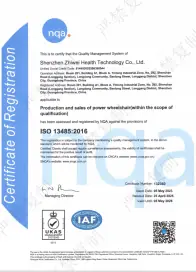
Our ISO 13485:2016 certificate comes via NQA/UKAS. It was renewed on 2026-05-11 and is valid to 2029-05-04. Those dates are on the file, and the issuing body can confirm them.
Our CE notification comes via Humiss, under number H-YQ-MD-210419012. It covers our five hero models: the EW1000, the EW100, the EW8722, the EW8703G, and the EW8720. If you order one of those models, the scope names it.
Our UN38.3 report covers the EW100. The EW1000 has its own report, S03A25010237U00201, which covers its 24V 10Ah lithium battery. Each report names its own model and its own battery, because one report does not cover another chair.
That is the standard to hold every supplier to. The file should name the body, the number, the scope, the address, and the dates. The report should name the model and the battery. Nothing in the file should need guessing.
How Do Certificates Fit Into the Rest of Your Pre-Order Checks?
Certificate checking is one step before you order, not the whole job. It sits between choosing a supplier and placing the order, and it works best with the checks on either side of it.
Before you check certificates, evaluate the factory itself. Our guide on how to evaluate an electric wheelchair factory before you order walks through what to look for on site and in the supplier’s records. A good certificate from a weak factory is still a weak order.
After the goods arrive, the check continues on the chairs themselves. Our QC checklist for incoming inspection covers what to look at when the shipment lands. Certificates check the paper before the order. Inspection checks the chairs after they arrive. You need both.
Keep the certificate file with the order, and keep it with the inspection notes too. If a question comes up later, the file, the cross-check reply, and the inspection notes together tell the full story of that order.
Key Takeaway: Certificates are the pre-order paper check — factory evaluation comes before them, and incoming inspection comes after them, and the three checks together cover one order.
Conclusion
How Distributors Verify Electric Wheelchair Certificates comes down to a habit, not a single trick: read the five items on the certificate, ask the issuing body to confirm them, match the test report to your exact model and battery, watch for the four common mismatches, and hold the order until a mismatch is fixed in writing. Do that for every new supplier and every new model, and the certificate file becomes a real check instead of a formality.
If you want a supplier whose file stands up to that check, talk to us. We are ZVCARE, an electric wheelchair manufacturer in Shenzhen, founded in 2015, with two production facilities totaling 3,000+ sqm. We work with 50+ global partners, we run 100% visual inspection, and we offer 1 pc MOQ with a 7-day lead time after payment, plus spare parts support. Send us your model list, and we will send you the matching certificate files to check.
Frequently Asked Questions
How long does it take to verify a certificate?
Reading the file takes a short time. The cross-check depends on how fast the issuing body replies, so start the check early, before you need the order placed. Ask for the files as soon as you start talking to a supplier, not on the day you plan to pay.
What if the supplier only sends a photo of the certificate?
Ask for the original file. A photo can hide a changed date or a cut-off scope line, and it cannot be checked properly. A supplier with a real certificate can send the original file without trouble.
Can one certificate cover several wheelchair models?
Only if the scope names each model. Read the scope line by line. If your model is not listed, the certificate does not cover it, even if another model from the same supplier is listed.
What if the test report names a different battery?
Then the report does not cover your chair. A report for another model’s battery proves nothing about your battery. Ask the supplier for the report that names your exact model and your exact battery, with the voltage, chemistry, and capacity matching your specification.
Should I check certificates again for a repeat order?
Yes. Dates change, scopes change, and a supplier can add or drop a model. Run the same five-step check on the current file before each repeat order, even with a supplier you already trust.
Founded in 2015, ZVCARE is an ISO 13485:2016 certified electric wheelchair manufacturer in China, providing OEM & ODM solutions for global distributors and medical stores.