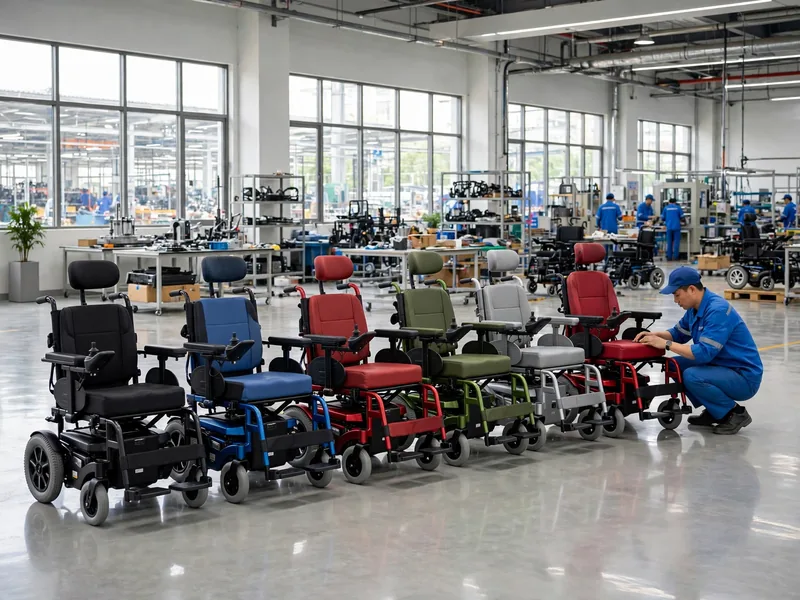
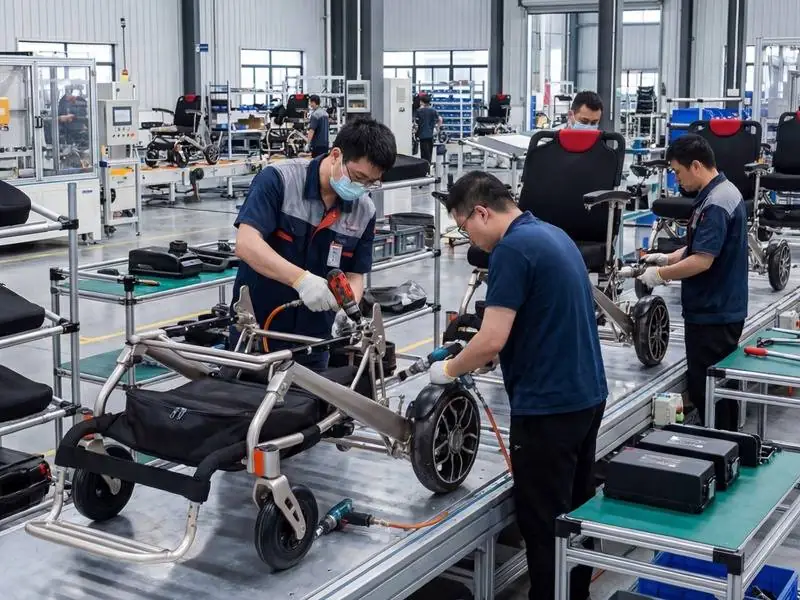
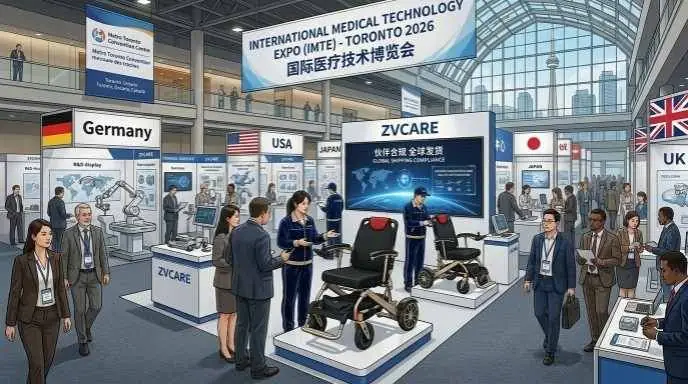
When you source electric wheelchairs from China, the first question is not price or model. It is who sits on the other side of the table. The Electric Wheelchair Factory vs Trading Company decision shapes your price, lead time, and warranty. It also shapes every design change you will ask for. Settle it before you talk numbers.
Why Does the Factory or Trading Company Question Come First?
Everything downstream depends on who you are dealing with. A factory builds the chair. A trading company buys it from a factory and sells it to you. That extra layer changes who answers your questions, who fixes a problem, and who controls the line.
Think about a difficult order — a different seat width, a late shipment, or a motor that failed in the first month. In each case the question was the same: who could act, and how fast? With a factory, the answer sits in the same building as the production line. With a trader, it travels from you to the trader, then to the factory, then back. Each step adds time and room for misunderstanding.
The basic identity checks are covered in full in our guide on how to import electric wheelchairs from China: business-license scope, production-floor photos and video, a video walkthrough of the factory address, an ISO 13485 certificate-holder match, a live video tour of the production floor, motor test bench and warehouse, technical-depth questions, a spec-sheet test, and a scheduled factory visit. This guide starts where that one stops. It covers what changes once you know who you are dealing with. It also shows how to check the real maker behind a trader. It is the step before how to choose an electric wheelchair manufacturer in China. You cannot judge a manufacturer until you know whether you are talking to one.
Key Takeaway: Settle identity first. Price, lead time, warranty, and design changes all flow from it.
Electric Wheelchair Factory vs Trading Company: What Actually Changes When You Buy Through a Trader?
Four things change when a trader sits between you and the factory. You pay the trader, who pays the factory. Your request passes through one more pair of hands. You cannot ask the production line directly. And when something goes wrong, two companies can each point at the other.
None of this makes a trader a bad choice — it makes the choice a real one, with real trade-offs. A trader who holds stock and answers fast can beat a slow factory. The mistake is buying from a trader while thinking you bought from a factory. Then you expect factory speed from a company that does not own the line.
What changes
Buying direct from a factory
Buying through a trading company
Warranty
The factory that built the chair handles the claim
The trader handles the claim, then asks the factory
Design changes
You talk to the engineers
Your request travels via the trader
Lead time
The factory sets its own schedule
The trader books a slot with the factory
Export paperwork
The factory ships as exporter
The trader often handles it for you
Key Takeaway: A trader adds a layer between you and the factory. Know whether that layer helps or slows you down before you order.
Who Holds the Warranty When Your Supplier Is a Trading Company?
Warranty is where the factory-or-trader question bites first. A warranty is only as strong as the company that honors it. When you buy direct, the factory that built the chair decides the claim and ships the part. Through a trader, the trader decides the claim and asks the factory for the part. That is one more decision, one more wait, and one more chance for the answer to change.
Ask three plain questions before you order. Who pays for a failed part? Who ships the replacement, and from where? Who decides whether a claim is valid? Get the answers in writing from the company you pay. A promise in a chat message is not a warranty term. A warranty term names the part, the period, and the party who acts. At ZVCARE, the factory sets its own warranty: frame 36 months, motor and controller 12 months each, battery 6 months for lead-acid and 12 months for lithium. If your supplier is a trader, ask whether the factory behind them stands behind the same terms in writing. A vague answer is a warning sign. Our guide on red flags when choosing an electric wheelchair supplier lists the ones that matter most.
Key Takeaway: Find out who holds the warranty before you order. Get it in writing from the company you pay.
Who Can Change a Design, and How Long Does It Take?
A factory can change a design because its engineers sit next to the line. A trader cannot change a design — it can only ask the factory to. That difference shows up in speed and in accuracy.
A direct request to a factory engineer gets a direct answer. A request through a trader waits for the trader to pass it on. Then it waits for the factory to reply, and for the answer to come back. Each round trip adds days, and a small change can take a week of messages instead of one call.
Accuracy matters more. A design change is a technical instruction. Seat width, armrest height, controller settings, battery type — each one must be exact. Every hand it passes through is a chance for a detail to shift. A trader who understands the product passes the detail on cleanly. One who does not may pass on a rough summary.
The models show why design control matters. The EW1000 weighs 15 kg including the battery and folds to 73×39×71 cm. The EW100 weighs 23 kg and folds to 73×55.5×31 cm. Both are designed for air travel (airline approval required). Those sizes and weights come from frame and battery decisions on the factory floor. A buyer who needs a different folded size needs a factory that can change the frame. A trader can only ask.
Key Takeaway: A factory changes a design. A trader asks for the change. Test the chain with one small change before you trust it with a big one.
Who Expedites Production When Your Order Is Urgent?
An urgent order tests who controls the line. A factory controls its own schedule and can move your order forward or re-sequence the line. A trading company controls none of that. It can ask the factory to hurry and pay for priority, but the factory still decides.
That is not a criticism of traders. A good trader knows which factories have spare capacity and which are full. That knowledge is worth paying for in a hurry. But know what you are buying: the trader’s knowledge and its place in the queue, not control of the line.
Ask how urgency works before you need it. Who do you call when a shipment must move? What happens if the factory is full? Can the trader move your order to a second line without changing the chair you approved?
Lead time is part of the same question. A factory quotes the time its own line needs. A trader quotes the time the factory gave it, plus its own handling time. Both can be honest, but only one can shorten the time when things go wrong. At ZVCARE, the lead time is 7 days after payment, set by two production facilities totaling 3,000+ sqm.
Key Takeaway: A factory can move its own line. A trader can only ask. Find out which one you have before the urgent order arrives.
Who Handles Export Paperwork When You Buy Through a Trading Company?
Export paperwork is the one place where a trading company often does more, not less. A trader that ships every week knows the documents and the common mistakes. So does a factory that ships every week. The difference is whose name goes on the papers.
Ask whose name appears as exporter on the shipping documents, and who is responsible if a document is wrong. The exporter of record is the company customs will talk to if there is a problem. The trader’s name on the papers means the trader owns that conversation. The factory’s name means the factory does.
A mismatch is worth a question, not a panic. The company on the invoice, on the export declaration, and the company that built the chair can be three different names. But each one should be able to explain why. If nobody can, stop and ask again before you pay.
Key Takeaway: Know whose name is on the export papers. Know who owns the conversation with customs if a document is wrong.
How Can You Verify the Real Factory Behind a Trading Company?
A trader does not have to hide its factory. Many good ones will name it and share its export history. The check is whether the story holds up when you verify it yourself, without the trader in the middle.
Start with export records. Ask for the export history that shows the factory as shipper. Look for a pattern over time, not a single shipment. A steady record is a good sign; one that jumps between unrelated products is worth a question.
Next, follow the money. Ask who you pay, and compare that name with the company that builds the chair. If you pay a different company than the one on the factory gate, ask why. There can be a fair reason, such as a group company that handles sales. Get the reason in writing, and pay the party named in the contract. Never pay a personal account, or a company name that appears nowhere in your agreement.
Then verify the factory name on your own. Search it yourself instead of clicking a link the trader sent, and call the factory’s own public number. Check that the name on the export record matches the name on the factory gate and the warranty terms. One name in three places is a good sign. Three different names with no explanation is not.
Finally, check sample-to-production consistency. Compare your approved sample with the first production batch — frame, motor, battery, and controller. The EW8722 and EW8703G are comfortable daily chairs at 45–46 kg with a range of 18–22 km. The EW8720 runs a dual 12V 22.3Ah lead-acid battery in series, which is 24V 22.3Ah. Whatever model you ordered, the production chairs should match the sample where it matters. A batch that differs without a clear reason is a reason to pause.
Key Takeaway: Verify the factory yourself: export records, payment routing, the factory’s own name, and the sample against the batch.
When Is a Trading Company the Right Choice for Your Order?
A trading company is the right choice more often than factory guides admit. The question is which one fits your order.
A trader fits a small and mixed order. If you need a few folding chairs, a few daily chairs, and a few spare parts in one shipment, a trader can gather them from more than one line. A single factory may not build every model you need.
A trader fits when you need stock now. Some traders hold finished chairs in their own warehouse, and stock on hand beats a production slot next month. Ask what is actually in the warehouse, and ask to see it.
A trader fits when export paperwork is not your strength. If your team has never handled a customs declaration, a trader that does it weekly removes a real risk. Paying for that service is fair. Just know it is a service, not a factory you never met.
A trader also fits a first trial order. A small first order through a trader lets you test the market and the models. Do that before committing to a factory relationship. Keep it small. Check the sample against the batch, and move to a direct factory order once you know what sells.
Key Takeaway: Choose a trader for mixed orders, spot stock, paperwork help, or a first trial. Choose it on purpose, not by accident.
How Do You Decide Between a Factory and a Trading Company for Your Next Order?
Use four questions. First, how big is the order, and how mixed? A single model in volume points to a factory; a small mixed order points to a trader. Second, do you need a design change? A real change to the frame, seat, or battery points to a factory; a standard model fits either one. Third, who will handle warranty claims? If your customers expect fast parts and clear answers, you need to know who acts. Fourth, how urgent is it, and who controls the line if it slips?
Write the answers down before you choose — a decision on one page is easy to check later.
If the answers point to a factory, check it the same way you would check any supplier. Our guide on how to evaluate an electric wheelchair factory walks through it step by step. If they point to a trader, run the four verification checks above. Get the warranty, payment route, and factory name in writing.
Either choice can work. The one that fails is the one you never made. You buy from a trader while expecting a factory, or from a factory while expecting a trader’s service. Name the other side, check the story, and order with your eyes open.
Key Takeaway: Order size, design change, warranty, and urgency. Answer those four, write them down, and the choice makes itself.
Conclusion
The Electric Wheelchair Factory vs Trading Company decision comes first in any sourcing trip to China, because it decides who holds the warranty, who changes the design, who moves the line, and who signs the export papers. A factory gives you direct control; a trading company gives you mixed orders, spot stock, and paperwork help. Neither is right for every order, and either one fails if you buy from one while expecting the other.
If your next order points to a factory, talk to one that builds what it sells. ZVCARE — Shenzhen Zhiwei Health Technology Co., Ltd., founded in 2015 — runs two production facilities totaling 3,000+ sqm. It works with 50+ global partners, applying 100% visual inspection. The minimum order quantity is 1 unit. The lead time is 7 days after payment. Spare parts support comes with every order. Contact us to discuss your next order.
FAQ
How can I tell if my supplier is a factory or a trading company?
Ask who builds the chair, who holds the warranty, and whose name appears on the export records. Then verify each answer yourself. A factory names its own line and warranty terms. A trader names its factory and shows the link between the two. If the answers are vague, or no one can name the factory, do not order yet.
Does a trading company always cost more than a factory?
Not always. A trader adds a layer, and that layer has a cost. But a trader can also save you money elsewhere. Think of one combined shipment, stock you can buy at once, or paperwork your team would otherwise have to learn. Compare the full cost of the order, not just the unit price.
Can a trading company offer a real warranty?
Yes, if the warranty is written down and backed by the factory that built the chair. Ask who pays for the part, who ships it, and who decides whether a claim is valid. Get those answers in writing from the company you pay. A warranty that names the part, the period, and the acting party is real. One that only says “we will take care of it” is not.
Should I buy my first order from a factory or a trading company?
It depends on the size and shape of the order. A small trial order with several models fits a trading company, which can gather the mix and handle the paperwork. A single model in volume, or an order with a design change, fits a factory. There you deal direct with the engineers and the line. Start small either way, and check the batch against the sample.
What should I ask before I pay a trading company?
Ask for the factory name, the payment route, and the export history showing the factory as shipper. Verify the factory name yourself, through its own public contact. Check that the company you pay is the one named in the contract. Confirm the warranty terms in writing — who pays, who ships the part, and who decides a claim. If any answer is missing, wait until it is there.
Founded in 2015, ZVCARE is an ISO 13485:2016 certified electric wheelchair manufacturer in China, providing OEM & ODM solutions for global distributors and medical stores.