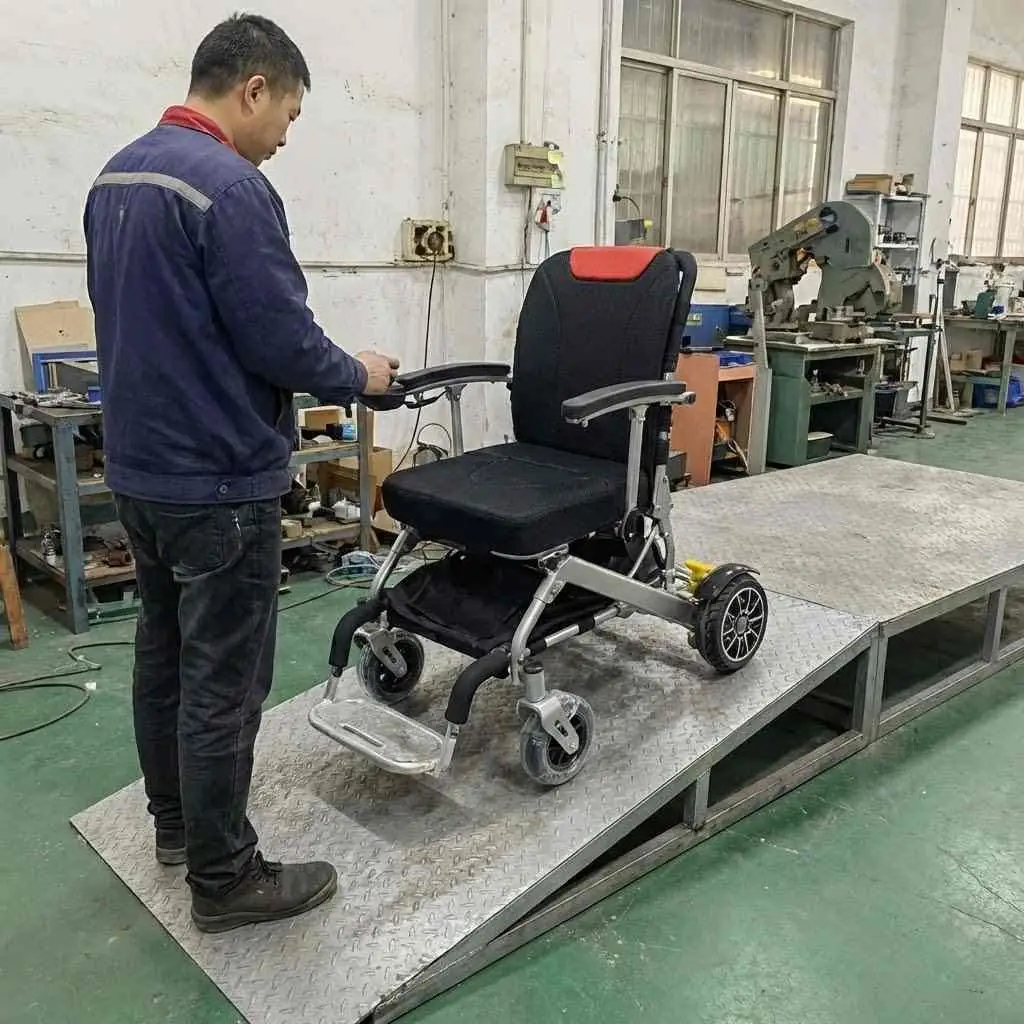
How Much Weight Can a Folding Electric Wheelchair Hold
November 2, 2026
When you are choosing folding electric wheelchairs for your customers, one of the first questions you will ask is how much weight can a folding electric wheelchair hold. It sounds simple, but it is one of the easiest specifications to misunderstand, and getting it wrong can lead to returns, complaints, and a customer who loses confidence in the chair. This guide explains what load capacity really means, what affects it, and how to check it properly before you order, so you can match each customer to a chair that will hold up in daily use, not just on paper.
What Is the Difference Between Load Capacity and the Chair’s Own Weight?
The most common confusion here is mixing up two very different numbers. Load capacity, sometimes called rated load, is the maximum weight of the user that the manufacturer rates the chair to carry. The chair’s own weight is how heavy the chair itself is when you lift it, fold it, put it in a car, or store it. One number describes the person sitting in the chair; the other describes the chair. A lighter chair is not automatically rated for a heavier user, and a heavier chair is not automatically rated for more load.
This matters when you compare models and when you talk to customers. A customer who asks for a light chair is often really asking for a chair that is easy for a family member to lift into a car, while a customer who asks about load is asking whether the chair will support them comfortably every day. Those are different needs, and they can point to different models. If a listing only gives a weight figure without saying whether it is the chair or the user, ask before you assume. For chair weights on their own, see our guide on how much a folding electric wheelchair weighs on its own, kept separate from load ratings here.
Key Takeaway: Load capacity is about the user the chair can carry; the chair’s own weight is about handling and transport, and the two numbers must never be swapped.
What Does Total Load Really Include?
Even when you have the rated load right, the real load in daily use is often higher than the user’s body weight alone. Total load means everything the chair has to carry and move: the user, plus clothing, a bag, shopping, a cushion, and any accessory fitted to the chair. None of these items is large on its own, but together they add up, and they add up every day, not just on a test run.
Think of it this way: e.g. a 100 kg rider is not a 100 kg load once you add a winter coat, a backpack, and a cushion. The chair still has to start, stop, and climb with all of that weight on board. If you only match body weight to the rating and leave no room for the rest, the chair will spend its working life at or near its limit, which can mean slower starts, shorter range, and faster wear on tyres and bearings.
The practical habit is simple. Ask what your customers normally carry. Do they use the chair for shopping trips, for work, or for travel with luggage? Do they need a thick cushion or extra storage? Add those items to the picture before you choose a model, and look at electric wheelchair spare parts and accessories with total load in mind, not just as extras.
Key Takeaway: Judge a chair by total load — user plus belongings and accessories — not by body weight alone.
What Decides How Much a Folding Chair Can Hold?
Load capacity is not decided by one part. It is the result of the whole chair working together. The frame is the starting point: its material, its joints, and the way it folds all affect how much weight it can support without flexing or loosening over time. A folding mechanism deserves particular attention, because a chair that folds must stay rigid when it is open and in use, so a well-made hinge and locking mechanism matters just as much as the frame itself.
The motor and battery also play a part, but not in the way many buyers assume. A stronger drive system does not by itself raise the rated load if the frame is not built for it, and a large battery does not by itself make a chair suitable for a heavier user. What the drive system does affect is how well the chair performs under load: how smoothly it starts, how steadily it climbs, and how far it goes before it needs charging. Wheels and tyres matter too, especially outdoors, where larger wheels tend to cope better with kerbs and rough paths than very small wheels.
Seat size is part of the picture as well. A chair rated for a heavier user still needs to fit that user comfortably, with enough width and support to sit well for hours. Assess the frame, folding lock, drive system, wheels, and seat together, rather than stopping at one headline figure.
Key Takeaway: Load capacity comes from the frame, folding mechanism, drive system, wheels, and seat working together, not from any single part.
How Do Lightweight Folding Models Differ From Heavy-Duty Models?
Lightweight folding models and heavy-duty models are built for different priorities, and understanding that trade-off helps you guide your customers honestly. Lightweight models put ease of handling first. They fold down small, they are easier to lift into a car, and they suit customers who travel often or who rely on a family member to handle the chair. Where a chair is designed for air travel, say so plainly — designed for air travel (airline approval required) — because final approval always sits with the airline.
Heavy-duty models put strength and stability first. They tend to have a sturdier frame, a wider seat, and larger wheels, and they are built for customers who need more support and more headroom in daily use. They are heavier to lift and take up more space when folded, so they suit customers who value a solid ride over the lightest lift.
Neither type is better in general. The right question is which priority fits this customer: a frequent traveller who needs a chair that one person can lift, or a customer who mainly uses the chair at home and outdoors and wants stability and durability. Compare the two directions in our lightweight electric wheelchair models and our heavy-duty electric wheelchair models, and then match the model to the customer’s daily routine, not just to a single number.
Key Takeaway: Lightweight models prioritise easy lifting and travel; heavy-duty models prioritise strength and stability, so match the type to how the customer actually lives.
How Do You Read a Load Rating on a Specification Sheet?
Start by finding the exact wording. Does it say rated load, maximum user weight, or maximum load capacity? Those phrases usually mean the same thing, but check whether the figure refers to the user alone or to total load including belongings. If the sheet does not say, treat that as a question to ask, not a detail to guess. Next, check whether the chair’s own weight is listed separately, and whether that weight includes the battery, since some listings include it and some do not.
Then look at the rest of the sheet in the same careful way. Folded size tells you about storage and transport. Range tells you about distance on a charge, but it is measured under particular test conditions, so ask what load and terrain were used. The table below can help your team check a new model in the same way every time.
Item on the spec sheet
What it tells you
Question to confirm
Rated load
Who the chair is rated to carry
Is this user weight alone, or total load?
Chair’s own weight
How heavy the chair is to lift and transport
Does this weight include the battery?
Folded size
How much space it needs in a car or storeroom
Was it measured with the battery fitted?
Range
How far it can travel on a charge
Under what load and terrain was this tested?
Seat size
Whether the chair will fit the user comfortably
What seat widths are available?
To keep the two weight figures clear, use confirmed chair weights as examples of self-weight only. The EW1000 weighs 15 kg including the battery, folds to 73×39×71cm, and offers a range of 15±3km. The EW100 weighs 23 kg, folds to 73×55.5×31cm, and offers a range of 12±5km. The EW8722, EW8703G, and EW8720 each weigh 45–46kg and offer a range of 18–22km. Those are chair weights and ranges, not load ratings, and they show why you must never read a chair-weight figure as a load figure.
Key Takeaway: Read every figure with its exact wording, check whether battery weight is included, and never read a chair-weight figure as a load rating.
What Questions Should You Ask the Manufacturer Before You Order?
Before you commit stock to a model, a short set of direct questions can save you a lot of trouble later. Ask the manufacturer to confirm the rated load in writing, and to state clearly whether it means user weight alone or total load. Ask how the rating was determined, and whether it covers everyday use or only a short test. Ask what happens if the chair is regularly used near its limit: does that affect the warranty, the expected service life, or the recommended maintenance?
You should also ask about the details your customers will notice. What seat widths are available? How does the folding lock work, and how is it checked during production? What spare parts are most commonly needed, and how quickly can they be supplied? How should your team check a chair on arrival, before it goes to a customer? Start by browsing our full product range and then asking for the rated load, its basis, and the warranty terms for the specific models you are considering.
Key Takeaway: Get the rated load, its exact meaning, and its basis in writing before you order, along with seat options and after-sales support.
How Much Safety Margin Should You Leave?
A safety margin, sometimes called headroom, is the gap between the user’s total load and the chair’s rated load. Leaving a margin is good practice, not overcaution. A chair used well below its rating will generally start more smoothly, climb more steadily, and place less strain on its frame, motor, and battery than the same chair used right at its limit every day. It also leaves room for real life: a heavier coat in winter, a bag of shopping, or a new accessory fitted later.
How much margin is enough depends on the customer. For a user whose weight is stable and who travels light, a modest gap may be fine. For a user whose weight may change, who carries bags regularly, or who uses the chair outdoors on uneven ground, a larger gap is the safer choice. The point is not to chase the highest rating for every customer, because that can mean a heavier, bulkier chair than they need. The point is to avoid the opposite mistake: choosing a chair where total load already sits at the rating on day one, with nowhere to go.
When you talk this through with a customer, keep it practical. Add up user weight plus the things they normally carry, compare that total with the rating, and look at the gap that is left. If the gap is thin, step up to a sturdier model or talk honestly about what would need to change.
Key Takeaway: Leave clear headroom between total load and the rated load, so daily extras and changing needs do not push the chair to its limit.
How Do Terrain and Slopes Change What a Chair Can Handle in Real Use?
A rating on paper is measured under controlled conditions, but your customers live on real ground. Smooth indoor floors are the easiest case. Pavements, gravel paths, grass, kerbs, and slopes all ask more of the chair, and they ask more precisely when the chair is fully loaded. Starting on a slope demands more from the motor and battery than starting on flat ground, stopping on a slope demands more from the brakes, and turning on uneven ground places more stress on the frame and wheels.
This does not mean a folding chair cannot handle outdoor use. It means you should match the chair to the ground your customer actually uses. Ask where they will drive most often: mainly indoors and on smooth pavements, or also on outdoor paths and hilly areas? Do they need to cross kerbs every day, or climb a slope to reach their home? A model with larger wheels and a sturdier frame will generally cope better with rough and sloping ground, while a very compact lightweight model may suit smoother routes better.
Range is affected in the same way. A chair carrying a full load up slopes will generally travel less far on a charge than the same chair carrying a light load on flat ground.
Key Takeaway: Judge load capacity for the ground your customer actually uses, because slopes and rough surfaces ask far more of a fully loaded chair than smooth floors do.
Conclusion
Choosing the right folding electric wheelchair starts with getting one distinction right: the chair’s own weight is not its load capacity. From there, add up total load, not just body weight, check the frame, folding mechanism, drive system, wheels, and seat together, get the rated load confirmed in writing, leave sensible headroom, and match the chair to the terrain your customer will actually use.
So, when you ask how much weight can a folding electric wheelchair hold, the honest answer is that it depends on the model, on the exact meaning of its rating, and on how the chair will really be used. If you would like help matching a model to your customers, contact us to discuss your order and tell us about the users you serve. We offer a minimum order of 1 unit, delivery 7 days after payment, a 36-month warranty on the frame, and 6 months on the lead-acid battery, 12 months on the lithium battery, and 12 months each on the motor and controller, from two production facilities totalling more than 3,000 sqm, so you can start small and build your range with confidence.
FAQ
What is the difference between load capacity and a wheelchair’s own weight?
Load capacity is the maximum user weight the manufacturer rates the chair to carry. The chair’s own weight is how heavy the chair itself is to lift, fold, and transport. The two numbers describe different things and must never be swapped.
Does load capacity include bags and accessories?
That depends on how the manufacturer defines the rating, so you should always ask. In daily use, the chair carries the user plus everything fitted to it and carried on it, so judge by total load and leave headroom for everyday extras.
Can a lightweight folding wheelchair carry a heavier user?
Not automatically. A light chair is easy to lift and travel with, but its rated load is a separate figure decided by its frame and overall build. Always check the rated load for the specific model.
How can I check a load rating before I order stock?
Ask the manufacturer to confirm the rated load in writing, and to state whether it means user weight alone or total load. Also ask how the rating was determined, what seat widths are available, and whether regular use near the limit affects warranty or service life.
Does terrain affect how a chair performs under load?
Yes. Slopes, kerbs, gravel, and rough paths place more demand on the motor, battery, brakes, frame, and wheels than smooth indoor floors, especially when the chair is fully loaded. Match the chair to the ground your customer will actually use, and explain that range on slopes and rough ground will generally be shorter.
Founded in 2015, ZVCARE is an ISO 13485:2016 certified electric wheelchair manufacturer in China, providing OEM & ODM solutions for global distributors and medical stores.