You send an inquiry to a factory in China. A sample arrives. Then, once production and shipping run their course, a container of your chairs lands at your warehouse. Between those three moments sits a process with real steps, real decisions, and real chances to get things wrong.
Electric Wheelchair OEM Process: Step by Step walks through that process the way it actually runs at our factory in Shenzhen. Each step says what happens, what you do, and what we do. No theory, no overview of what OEM means. For the big picture, read our guide to how electric wheelchair OEM works in China. This article is the walkthrough itself, from your first message to the day your chairs arrive.
What does the first inquiry actually look like?
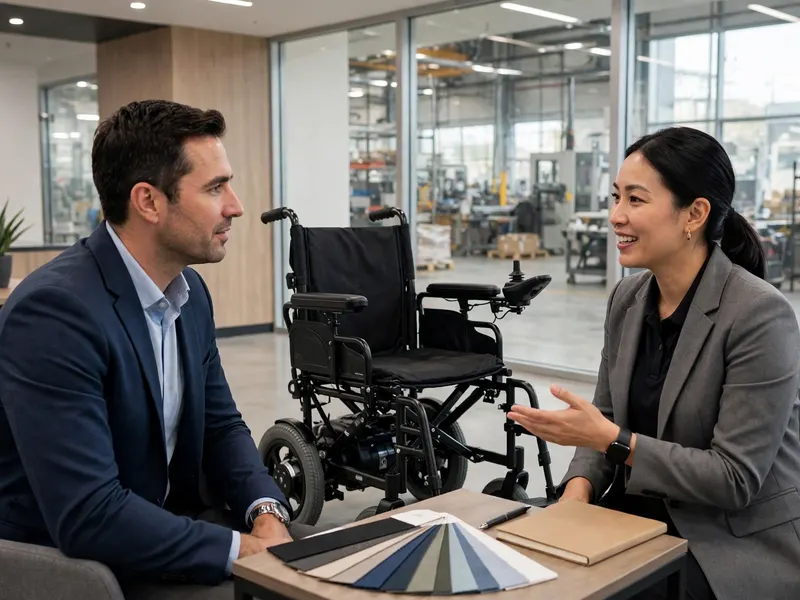
Your first message sets the tone for the whole order. A good inquiry names the model you want, the quantity, and the market you sell into. It also names the three things buyers most often forget: the color, the logo, and the packaging. Send those with the first message, not after the quote. The factory can then quote the chair you will actually sell, not a generic one.
Tell the factory how you plan to use the chairs. A chair for a rental fleet faces different wear than a chair for retail sale. A short note about your buyers helps the factory point you to the right model and flag a mismatch early.
Ask three plain questions in that first message. What is the minimum order? What is the lead time after payment? What does the warranty cover? At ZVCARE, the answers are simple. MOQ is 1 unit. Lead time is 7 days after payment. The warranty runs 36 months on the frame, 12 months each on the motor and the controller, and 6 months for lead-acid batteries and 12 months for lithium batteries. Get those answers in writing from any factory you talk to, and compare them side by side.
Key Takeaway: A good inquiry names the model, the quantity, the market, the color, the logo, and the packaging. Add your buyers, your climate, and three plain questions about order size, lead time, and warranty.
How do you turn an inquiry into a clear order?
The factory answers with a quote and a specification sheet. Your job now is to turn that sheet into a clear order. Read every line of it. Check the model name, the frame material, the battery type, and the folded size. A mistake caught here costs an email. The same mistake caught after production costs a shipment.
Write down every choice you make. Frame color, seat color, logo position, logo file, carton markings, and the number of chairs. Put each choice in one document and send it to the factory. Both sides then work from the same page. If a choice changes later, update the same document and send it again. Verbal changes get lost. Written changes do not.
Our guide to how to write an RFQ for electric wheelchairs shows the full list of details a good request carries. Use it as a checklist for this step. The stronger your written order, the fewer surprises the later steps hold.
Key Takeaway: Turn the quote into one written document that lists every choice: model, colors, logo, packaging, and quantity. Update that same document when anything changes.
What happens when the factory builds your sample?
The factory builds one chair to your written order. This is the sample, and it is the most important chair in the whole process. It is not a catalog chair with your logo stuck on it. It is your chair, built to your spec, so you can judge it before you commit to a full order.
The build follows the same line as a production order. Workers install the frame, the motor, the controller, and the battery, then the seat and the armrests in your chosen colors. They place your logo where your document says it goes. They pack it in the carton you approved. The sample then ships to you, and you test it the way your buyers will use it.
Do not judge the sample from photos alone. Photos show color and shape, not how the chair folds or how the joystick feels. Drive the sample. Fold it. Lift it. Charge it. Let a staff member who has never driven one try it too. That test tells you more than ten photos will.
Key Takeaway: The sample is built to your written order on the normal production line. Test it by driving it, folding it, and charging it, not by looking at photos.
How do you approve a sample without missing anything?
Sample approval is one step in this walkthrough, not a project of its own. You check the sample against your written order, line by line. Color against the swatch. Logo against the file you sent. Folded size against the spec sheet. Range, weight, and battery type against the quote. Anything that does not match goes back to the factory in writing, with a photo.
Test the chair the way your buyers will. Drive it forward, back, and in a turn. Test the brakes. Fold it and unfold it five times, not once. A hinge that sticks on the fifth fold will stick for your buyer too. Check the seat, the armrests, and the footrests for sharp edges and loose fittings. Charge the battery fully and note how the charger behaves.
If something is wrong, say so now. The factory fixes the sample and sends a revised one, or confirms the fix in writing with photos. Our guide to the electric wheelchair OEM sample approval process covers this step in full detail if you want a checklist for it.
Key Takeaway: Check the sample against your written order, line by line, and test it by driving and folding it several times. Production copies the approved sample, so approve nothing with a known fault.
What do you confirm before production starts?
Production starts only after a written confirmation from you. That confirmation lists the model, the quantity, the colors, the logo, the packaging, the price, and the delivery date. It also confirms the payment. Lead time runs from payment, not from the first inquiry. At ZVCARE, lead time is 7 days after payment, and MOQ is 1 unit, so a small first order is possible. Confirm the date in writing so both sides count from the same day.
Packaging gets its own confirmation at this step. The carton, the markings, the manual, and the spare parts list are all part of the order. A buyer who confirms the chair and forgets the carton gets a good chair in the wrong box. Our guide to how distributors approve electric wheelchair OEM packaging treats that approval as its own step, and it is worth reading before you sign off.
Confirm the spare parts at the same time. A first order should include the parts that wear first: a spare joystick, a spare charger, and spare tires. Spare parts ship with the order and cost little now. The same parts ordered alone later cost more in freight and time. Ask the factory which parts to hold, and put them on the same confirmation.
Key Takeaway: Production starts from a written confirmation of model, quantity, colors, logo, packaging, price, payment, and date. Confirm the carton and the spare parts in the same document.
What happens on the production line?
Production is the shortest step to describe and the easiest to misunderstand. The factory builds your chairs in batches on the line. Frames are fitted first, then motors, controllers, and batteries. Seats, armrests, and footrests follow. Each chair then gets your colors and your logo, exactly as the approved sample shows.
Your order size does not change the steps. One chair goes through the same stations as one hundred. That is why a 1-unit MOQ works: the line builds your chair the same way it builds a large order. The difference is only the count. The 7-day lead time after payment covers the build, the checks in the next step, and the packing. Our guide to how long electric wheelchair OEM takes breaks that time down further if you want the detail.
Know which model you ordered and what it weighs. The EW1000 is carbon fiber and weighs 15 kg with the battery. The EW100 is aluminum and weighs 23 kg. The EW8722 weighs 45 kg, the EW8703G 46 kg, and the EW8720 45 kg. Folded sizes run from 73×55.5×31 cm for the EW100 to 89×43×76 cm for the EW8703G.
Key Takeaway: Production builds your chairs on the same line and in the same order as the sample: frame, motor, controller, battery, seat, then your colors and logo. The steps do not change with order size.
How does the factory check quality before shipment?
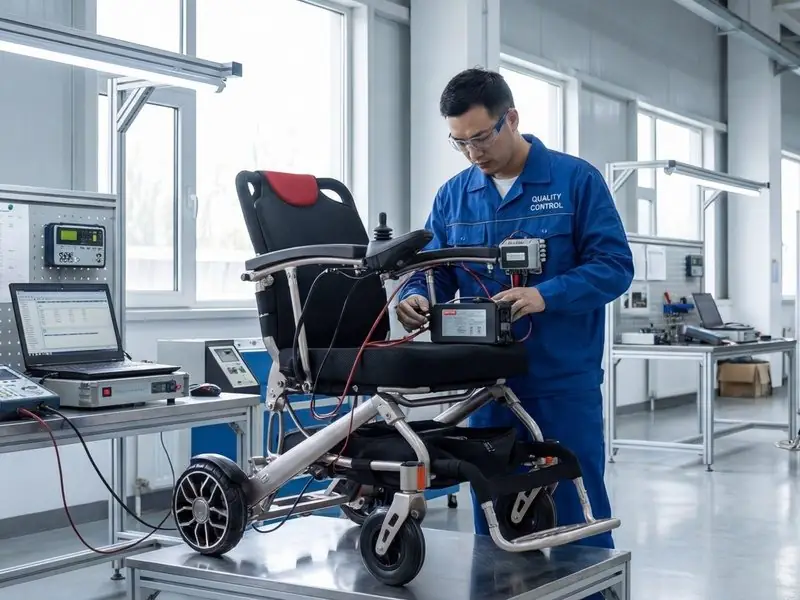
Every chair is checked before it ships. At ZVCARE, that means 100% visual inspection: every chair, not a sample of the batch. A worker looks over the frame, the welds, the seat, the paint, and the logo. Any scratch, loose fitting, or wrong color is caught here, while it is still cheap to fix.
Then comes the function check. The joystick is driven forward, back, and in a turn. The brakes are tested. The chair is folded and unfolded. The battery is charged and the charger is checked. The chair is driven a short distance to confirm the motor and the controller work together. A chair that fails any of these checks is fixed on the line or rebuilt. It does not ship with a known fault.
The check also compares each chair with the approved sample. Same color, same logo position, same carton markings. This is where a wrong logo or a swapped color gets caught. Ask the factory for the checklist they use and for photos of your chairs before loading.
Key Takeaway: Quality control means every chair gets a full visual check plus a function test of the joystick, brakes, folding, and battery. Chairs are compared with the approved sample, and failed chairs are fixed, not shipped.
How does your order get packed and shipped?
Packing starts with folding. Each chair folds down to its packed size and goes into its carton with padding around the frame and the joystick. The manual, the charger, and the spare parts go in with it. The carton is sealed, labeled with your markings, and stacked for loading. The label matters: it carries your brand, the model, and the count, so your warehouse can receive the order without opening every box.
Loading is counted, not guessed. The factory counts cartons onto the truck or into the container and sends you the count with photos. Check that count against your order the day it ships.
Keep your shipping papers in one place. The packing list, the invoice, and the delivery address travel with the order. Confirm the delivery address in writing before loading. A chair shipped to the wrong warehouse costs days to redirect. A chair shipped to the right one with the right papers clears fast and reaches your shelves on time.
Key Takeaway: Each chair is folded, padded, boxed with its manual and charger, labeled, and counted onto the truck. Check the count and the delivery address on shipping day, not on arrival day.
What happens after your chairs arrive?
Open the cartons and count first. Check the count against the packing list before you shelve anything. Then test one chair from the shipment: drive it, fold it, and charge it. If it matches the approved sample, the rest of the batch almost certainly does too. If it does not, stop and call the factory with photos before you sell any of them.
Learn the warranty before you need it. The frame carries 36 months, the motor and the controller carry 12 months each, and the battery carries 6 months for lead-acid and 12 months for lithium. When a buyer reports a fault, ask what failed and when. A motor that fails in normal use is a warranty matter. Damage from a fall is not.
Plan your next order while the first one sells. Note which model moved fastest, which color buyers asked for, and which spare parts you used. That note becomes the first message of your next order, and the whole process runs faster the second time. The factory already knows your colors, your logo, and your packaging. Your second order starts at the confirmation step, not at the beginning.
Key Takeaway: Count and test on arrival, learn the warranty lines before a fault appears, and keep notes on what sold. Your second order starts from the confirmation step, not from scratch.
Electric Wheelchair OEM Process: Step by Step — The Short Answer
The process is six steps: inquiry, written order, sample, approval, production, and shipment. You drive the first four with clear writing and honest testing. The factory drives production and quality control. The two sides meet at the sample, which is the one chair that decides what the rest will be.
Electric Wheelchair OEM Process: Step by Step comes down to this: write everything down, test the sample like a buyer, and approve nothing with a known fault. ZVCARE — Shenzhen Zhiwei Health Technology Co., Ltd., founded in 2015, with two facilities totaling 3,000+ sqm and 50+ global partners — builds the folding and big-wheel models in this guide, with a 1-unit MOQ, a 7-day lead time after payment, and spare parts support behind every order. If you are ready to start, talk to us with your model, your quantity, and your colors, and we will send you a quote.
Frequently Asked Questions
How long does the whole OEM process take?
The build itself runs 7 days after payment at ZVCARE. The full process takes longer because the sample step and the approval step sit before production. Send a clear written order and test the sample fast, and you shorten the process more than any other single move.
Can I order just one chair to start?
Yes. MOQ is 1 unit, so a single chair can be your first order or your sample order. Many distributors start with one chair, test it with their buyers, and then place a larger order with the same colors, logo, and packaging already confirmed.
What should I test on the sample?
Drive it forward, back, and in a turn, test the brakes, and fold it several times. Check the color against your swatch and the logo against your file. Charge the battery fully. Let someone who has never driven a chair try it too, because that is how your buyers will meet it.
Who checks quality before shipment?
The factory does, and every chair is checked, not a sample of the batch. At ZVCARE, that means 100% visual inspection plus a function test of the joystick, brakes, folding, and battery. Each chair is also compared with your approved sample for color, logo, and carton markings.
What if a chair arrives damaged or faulty?
Count and test on arrival, and call the factory with photos before you sell any chairs from that shipment. The warranty runs 36 months on the frame, 12 months each on the motor and controller, and 6 months for lead-acid and 12 months for lithium batteries. Damage from a fall is not a warranty claim, but a part that fails in normal use may be.
Founded in 2015, ZVCARE is an ISO 13485:2016 certified electric wheelchair manufacturer in China, providing OEM & ODM solutions for global distributors and medical stores.