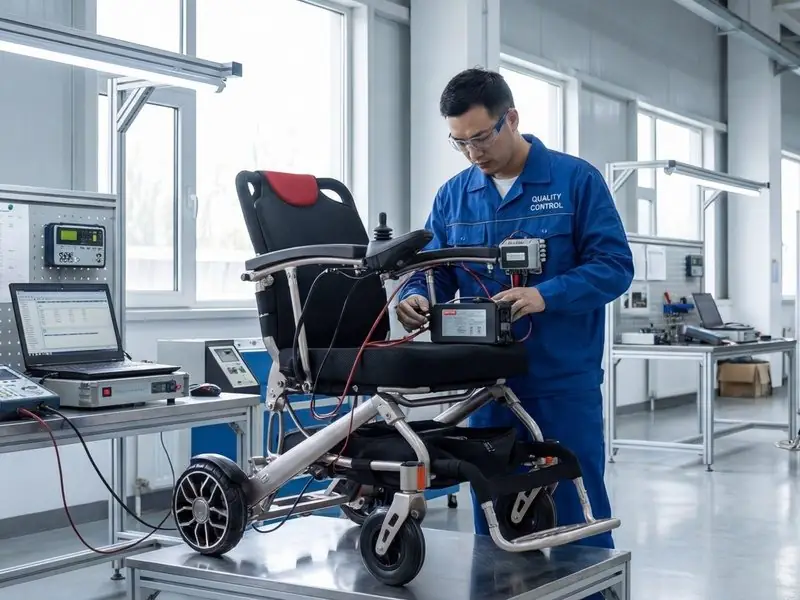
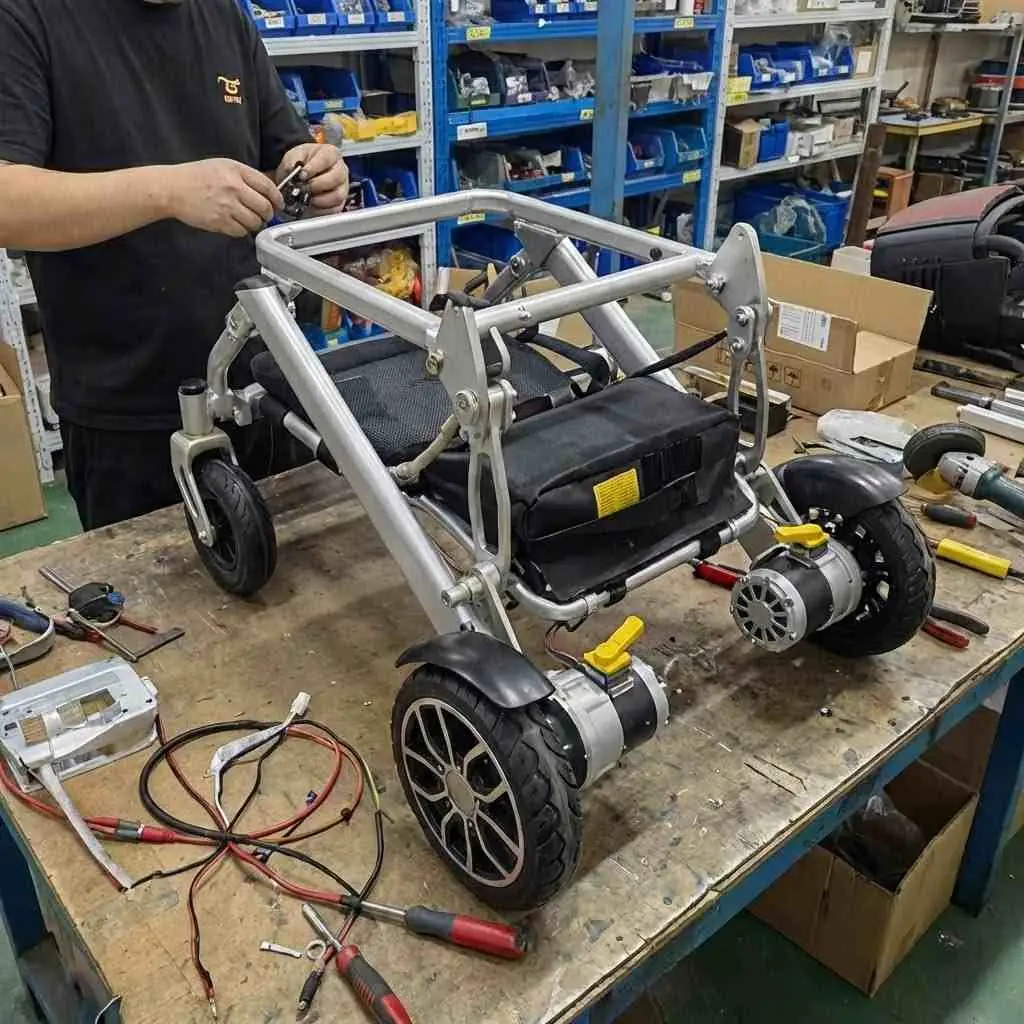
Ordering an own-brand wheelchair is not the same as approving one. The Electric Wheelchair OEM Sample Approval Process is the step between “the factory made a sample to your specification” and “you are willing to put your brand on it and sell it to your customers.” Get this step right, and bulk production starts from a sample both sides have actually agreed on; rush it, and every small difference you waved through becomes a bulk-order argument later.
What does the Electric Wheelchair OEM Sample Approval Process actually approve?
It approves one physical sample against one written specification, not a general impression that the chair is “good.” A sample can be well made and still be wrong for your order: the right chair in the wrong colour, the right frame with your logo in the wrong place, or the right features with packaging your market cannot use. Approval means you have checked the sample, recorded what matches and what does not, and signed off on a version the factory can repeat.
This guide is therefore different from a general guide to testing samples. Our guide to evaluating samples explains how to put a sample through its paces: how to evaluate electric wheelchair samples. This article covers the decision around that testing: pass, feedback, sign-off, and failure. If you have not yet placed the order, start with our OEM overview: how electric wheelchair OEM works in China.
Before the sample is made, agree the approval process itself in writing: who tests it, how feedback will be sent, who decides pass or fail, and what happens to cost and timing if a revision is needed. Do not promise a bulk delivery date that depends on a sample you have not yet approved. For where this step sits in the whole order, see our guide to OEM timelines: how long does electric wheelchair OEM take.
Key Takeaway: You are approving one sample against one written specification, so the specification has to exist before the sample does.
What should your acceptance criteria say before the sample is made?
Acceptance criteria are the list you will judge the sample against, and they need to be specific enough that two people looking at the same chair reach the same verdict. “Good quality” is not a criterion. “Frame colour matches the approved swatch, logo sits centred on the backrest, and the chair folds to the agreed folded size” is a criterion, because each point can be checked yes or no. Our RFQ guide helps you draft that brief in a form a factory can quote and build from: how to write an RFQ for electric wheelchairs.
Start with identity: model, frame colour, upholstery colour, logo artwork and placement, and packaging. OEM customization at ZVCARE covers colours, logo placement, and packaging, so name each exactly rather than assuming the factory will guess from an earlier email. For a heavy-duty model, confirm whether your sample carries the lead-acid or the lithium battery option, since both are offered, and record which one you approved.
Next, list the measurements you will actually check. Folded size affects transport and storage: the EW100, for example, is listed at 73×55.5×31cm folded, so a buyer of that model can check the sample with a tape measure rather than by eye. Weight needs the same care: always state whether a figure includes the battery. The EW1000, for example, is listed at 15 kg including battery, while the EW100 is listed at 23 kg, so ask the factory to confirm in writing whether your specification figure includes the battery before you weigh the sample.
Then list function, not just appearance: folding and unfolding, driving, braking, battery removal, and charger fit. Add the claims you will and will not make: if a chair is designed for air travel, your listing should still say it is designed for air travel (airline approval required), because the airline makes the final decision on the day of travel.
Finally, list the paperwork that must match the sample: specification sheet, packing list, and warranty terms. At ZVCARE the unified warranty is frame 36 months, and battery 6 months for lead-acid or 12 months for lithium, motor, and controller 12 months each. Check that the sample paperwork says the same thing.
Key Takeaway: If a point cannot be checked yes or no on the sample in front of you, it is not yet an acceptance criterion, it is a hope.
How should you test the sample when it arrives?
Test in the order a customer will meet the chair: unbox it, look at it, fold it, drive it, charge it, and pack it away again. That sequence catches problems a bench test alone can miss, such as packaging that hides the logo.
Start with the carton and the paperwork. Check the model name, colour, and quantity against your order, photograph any carton damage before you open it, and keep the packing list with the sample file. Then check appearance one point at a time: colour against the swatch, logo position and print quality, stitching and finish, and any accessories you specified. Photograph it from the angles you will use for feedback.
Next, run the functional checks from your criteria list. Run the functional checks from your criteria list — folding, driving, braking, battery removal, and charger fit — following the testing sequence in our sample-evaluation guide, and record each result against its criterion. You do not need a laboratory for this stage; you need consistency. Note anything that feels awkward, stiff, or unclear, even if it still technically works.
Keep the sample out of saleable stock while you test it, and do not lend it to a customer as a demonstration unit until you have decided whether it is the version you want to repeat.
Our incoming inspection checklist covers the same discipline at bulk-delivery scale: electric wheelchair QC checklist for incoming inspection. Any gap found at sample stage can still be fixed before bulk production.
Key Takeaway: Test the sample as a customer would meet it, in order, and write down every result while the chair is still in front of you.
How do you write feedback the factory can actually act on?
Good feedback lets the factory fix the problem without guessing what you meant. Vague feedback, such as “the colour looks off,” usually produces a second sample with a different guess, not a corrected one. Specific feedback, with a photo, a measurement, and a requested change, usually produces a corrected sample first time.
Use the same structure for every point. First, name the criterion from your specification, so the factory can see which agreed point was not met. Second, describe what the sample actually shows, with a photo that proves it: a logo close-up with a ruler beside it, the colour next to the approved swatch, or a short video of a folding action that sticks. Third, state the change you want in plain words: move the logo, e.g., 2 cm to the left, match the swatch, or adjust the latch so the chair folds in one smooth action. Mark any figure you suggest as an example to be confirmed, unless it comes from your agreed specification.
Separate facts from preferences, and say which is which. “The logo is printed on the left side, but the specification says centred” is a fact the factory must fix. “I would prefer a darker shade of blue” is a preference, and it may affect cost or timing.
Send all feedback in one consolidated, numbered list. Ask the factory to confirm each point back in writing: fixed, adjusted as described, or not possible, with a reason.
Key Takeaway: A photo, a measurement, and one plain sentence saying what to change will get you further than a page of general impressions.
What happens in a revision round, and how do you keep it from drifting?
A revision round is a loop, and loops drift when each round quietly adds new requests. Stop that by freezing the specification at the start of the round: the factory revises the points on your feedback list, and anything new goes onto a separate list for discussion, clearly marked as new. The revised sample is then judged against the same criteria as the first one, plus the agreed fixes, rather than against a moving target.
When the revised sample arrives, test what changed, plus a short re-check of the whole chair, because a fix in one area can affect another, such as a new logo position affecting how the backrest folds. The decision should rest mainly on whether the listed points are now met. If you raise fresh unrelated points on every round, the process never closes.
Agree the revision terms before the first sample is made, not after the first sample fails. That agreement should cover, in writing, how revision requests are sent, what counts as a factory correction versus a buyer-requested change, who bears the cost of each kind, and how timing is affected. Do not treat any of these as factory facts to assume; they differ from order to order.
Protect your design through this loop: share only the artwork and details the factory needs, keep a dated copy of everything you sent, and record any branding change in the same file. Our guide to design protection explains the practical steps: how to protect your design in electric wheelchair OEM.
Key Takeaway: Freeze the specification during a revision round, judge the revised sample against the feedback list, and keep new ideas on a separate list.
What does a proper sign-off look like?
Sign-off is a short written record, not a handshake or a single word in a chat message. Months later, either side should be able to open the file and see exactly which sample was approved.
A usable sign-off file contains the following points, each confirmed in writing:
– Sample identification: model, sample date or batch reference, and photos from the front, side, folded position, and logo close-up.
– Specification match: each acceptance criterion marked as met, with measurements recorded where a figure was checked, such as folded size or weight including or excluding the battery.
– Customization confirmed: frame and upholstery colours, logo artwork and placement, and packaging, each matched against the approved version.
– Battery and charger: battery type and charger pairing confirmed, and paperwork that must travel with the bulk order listed.
– Warranty and after-sales terms: the agreed warranty periods and claim process, recorded as they will be given to customers.
– Bulk reference: a statement that bulk production should match this sample, plus a separate list of any points deliberately deferred from this approval, each with a date for its decision and a note that bulk production must not proceed on those points until they are decided.
– Signatures or written confirmation from both sides, with the date of approval.
Keep one signed copy yourself and make sure the factory holds the same version. If the factory later queries a bulk detail, the answer should come from this file, not from memory, and your warehouse, sales, and service staff should all work from this approved version.
Key Takeaway: Sign-off is not approval of a chair in general; it is a dated record that this exact sample, with these colours, this logo, and this packaging, is the version to repeat.
What should you do if the sample fails?
A failed sample is not a failed relationship, but it does need a clear decision, made quickly and recorded honestly. The worst outcome is not a fail; it is a sample nobody will call a fail, so it drifts into bulk production with its problems still attached. Decide on the evidence from your criteria list, not on time already spent or eagerness to get stock moving.
The table below sets out the three outcomes most buyers face. Treat the next steps as a structure to agree with your factory, not as terms to assume: cost and timing for a replacement sample should already be covered by the agreement you made before the first sample was produced.
Outcome
What it means
Next step
Pass
Every acceptance criterion is met
Sign off in writing and release bulk production against that approved sample
Conditional pass
The chair is right except for minor points that do not affect safety, function, or first impression, e.g., a carton label wording change
List each condition in writing, agree how each will be fixed in bulk production, and sign off only with those conditions attached
Fail
A criterion affecting function, identity, or saleability is not met, e.g., the wrong battery type or logo
Stop, send consolidated feedback with photos and measurements, and agree in writing whether the factory revises the sample or starts again
If it fails, separate the sample from saleable stock, label it clearly, and do not use it for demonstrations until the factory confirms what should happen to it. Send feedback in the same structured form: criterion, evidence, requested change. Then ask the factory to confirm, point by point, what will change on the next sample, and what will stay the same.
Know when to walk away from a sample route, too. If revised samples still miss the same core criterion, or if the factory cannot explain why a point keeps failing, the specification, the model choice, or the factory fit may need to change. All three are better than approving a sample you do not believe in because rejecting it feels awkward.
For the commercial side of starting again, check the terms you agreed before sampling, including the minimum order position: what is the MOQ for custom electric wheelchairs.
Key Takeaway: Call the result what it is, pass, conditional pass, or fail, and let the written criteria, not politeness or sunk time, make the call.
FAQ
Does a passed sample guarantee the bulk order will be identical?
No, it guarantees what bulk production should match, not that every unit will match it automatically. Your sign-off file, with photos and measurements, gives your incoming inspection a fixed reference to check bulk units against. If a bulk unit differs, raise it with the same evidence structure, criterion, photo, and requested fix, that you used at sample stage.
How many revision rounds should I expect?
Do not treat any number as a factory promise. Agree the revision process in writing before the sample is made, including how feedback is sent, what counts as a factory correction versus a buyer-requested change, and how cost and timing are handled. A clear first feedback list usually reduces rounds far more than debating a round limit in advance.
Should I approve a sample I have only seen in photos?
Photos are useful for early feedback on colour and logo, but they cannot replace hands-on testing for folding, driving, braking, and charger fit. If you cannot test the physical sample yourself, ask a trusted person near the factory to test it against your criteria list and send photos, measurements, and a short video. Record who tested what in your approval file.
What if the factory says my requested change is not possible?
Ask for the reason in writing, and for the closest workable alternative, with a photo or sample where possible. Then judge it against your original criterion: does it still meet the need behind the request, or would customers notice the change? If they would, treat it as a specification change, record it, and re-check the affected points before you sign off.
Can I change the specification after I have signed off?
Yes, but treat it as a new decision, not as a small tweak. Record the change, its reason, and its effect on colour, logo, packaging, cost, and timing in writing, and confirm whether it needs a fresh sample or can be checked against the existing approved sample. An undocumented post-sign-off change is how bulk orders quietly drift away from the version you approved.
The Electric Wheelchair OEM Sample Approval Process rewards the buyer who is specific early and disciplined late: clear criteria before the sample, structured feedback with photos and measurements, a revision loop that does not drift, and a sign-off file both sides hold. Follow that sequence, and the sample stops being a hopeful prototype and becomes the agreed reference for everything that follows.
If you are starting an OEM order, talk to ZVCARE. We offer OEM customization in colours, logo placement, and packaging, with a 1pc MOQ and a 7-day lead time after payment once your sample is approved. Send us your specification and acceptance criteria, and we will work through the sample, feedback, and sign-off steps with you, point by point.
Founded in 2015, ZVCARE is an ISO 13485:2016 certified electric wheelchair manufacturer in China, providing OEM & ODM solutions for global distributors and medical stores.