How Distributors Market Electric Wheelchairs Locally
November 4, 2026
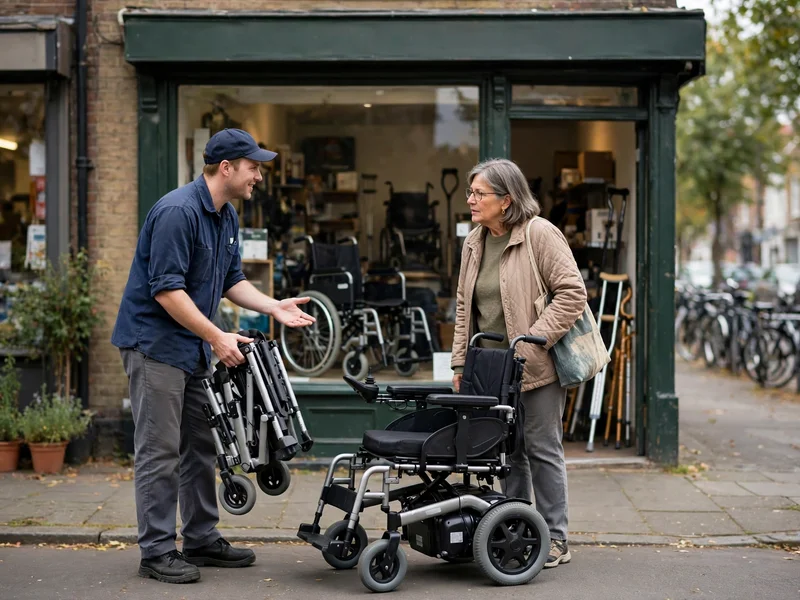
Most wheelchair buyers do not start with a nationwide search. They start close to home: a shop they can visit, a name a neighbour mentioned, a local listing with a local phone number. This guide explains How Distributors Market Electric Wheelchairs Locally: how to be found by buyers in your own area, how to earn their trust before they visit, and how to tell which local efforts actually brought each enquiry.
What does local marketing mean for a wheelchair distributor?
Local marketing is everything you do to win buyers in the area you can serve: one city, a county, or a region your delivery van can reach in a day. The test is simple: a buyer who found you this way should be able to visit you, try a chair, or get a visit from your team without a long journey.
That matters more for wheelchairs than for most products: a buyer usually wants to sit in the chair, see it fold, and ask questions face to face before spending this much money.
Local marketing is also different from having a shop. A shop with no listings, no local contacts, and no community presence will stay invisible to the buyers around it, however good the chairs inside are. Local marketing is the work that connects the shop to the people around it: listings they find, places they already trust, and neighbours who have already bought from you.
Key Takeaway: Local marketing means winning buyers in the area you can serve, where a visit, a trial, and after-sales help are within easy reach.
How Distributors Market Electric Wheelchairs Locally: Where do local buyers look first?
Start with the buyer, not your advertising. A local buyer, often buying for a family member, takes one of three routes. First, they search online with a local filter, such as a town name or “near me”, and check whether the seller is nearby. Second, they ask someone they trust: a care worker, a community group, a neighbour, or a local shop. Third, they notice a shop window or a local business at a community event.
Your job is to be present on all three routes, not to bet everything on one of them. A local listing with no shop behind it feels thin. A good shop with no local listings stays invisible. A recommendation from a trusted local contact beats both, but it only comes after visible, reliable work in the area.
Keep the three routes in balance: a single route can dry up, but three working routes together are far steadier.
Key Takeaway: Local buyers find you through local search, trusted local contacts, or seeing you in person, so build all three routes instead of betting on one.
What should a local listing say, and what should it never claim?
A local listing is often the first thing a buyer sees, and it does more work than a glossy brochure. Buyers judge a listing on three things: whether the chair is real, whether the seller is real, and whether the details can be checked.
Use real photos of the actual chairs you stock, taken in your own premises or at a local delivery, not catalogue renders or photos borrowed from another seller. A buyer who visits and finds a different chair from the photo will not trust the next thing you say. Show the chair folded as well as unfolded, so buyers can judge size and handling. If you show a folded size, use the figure for that model: the EW100 folds to 73 x 55.5 x 31 cm.
State the weight honestly, and say what the figure includes. The EW1000 weighs 15 kg including its battery, and the EW100 weighs 23 kg. If you quote a weight without the battery, weigh the chair that way first and label it as without battery, so buyers compare like with like. A figure that quietly switches between with-battery and without-battery is how a buyer ends up surprised on delivery day, and that surprise costs you the sale and the recommendation.
Say plainly what you offer locally: viewing by appointment, delivery in your area, and after-sales help from your own team. Do not promise things you cannot deliver, such as a medical outcome for the user, and leave health claims out entirely. If a buyer asks whether a chair suits a particular medical situation, suggest they check with their own clinician, and offer a trial so they can judge comfort and handling for themselves.
Keep the listing current: remove models you no longer stock, update prices when they change, and answer enquiries promptly. A listing with last year’s stock and no reply teaches local buyers to skip you next time. For the online side of this work, including how to write listings that buyers trust, see our guide to selling electric wheelchairs online.
Key Takeaway: A trustworthy local listing uses real photos, states weight with or without the battery plainly, and promises only what your local service can deliver.
How do you build local partnerships without paying for referrals?
Care settings, community groups, and local organisations shape how buyers in your area decide, but the relationship must be built on usefulness, not payment. Never offer a fee, commission, or reward to a care provider or community contact in return for sending buyers your way. It puts the buyer in the middle of an arrangement they know nothing about, a poor foundation for a sale that depends on trust.
What you can offer instead is genuinely useful: an information session, a demonstration day with no obligation, or printed material explaining in plain language how to compare models by weight, folded size, and battery type. A care home manager who has seen you answer questions honestly is far more likely to mention your name than one who has only received a leaflet.
Approach these contacts as a local business, not as a sales campaign. Visit in person, explain what you stock and where you are based, and ask what would help the people they support. Sometimes the answer is a short talk. Sometimes it is simply knowing a local distributor exists who will deliver, set up the chair, and come back if something goes wrong. Sometimes the answer is no, and accepting that gracefully keeps the door open. Keep the relationship long-term: send a short update when you add a new model, and invite contacts to an open day. Our guide to selling electric wheelchairs to nursing homes covers approaching care settings properly, and our guide to building an electric wheelchair range helps you decide which models to show them.
Key Takeaway: Earn local partnerships by being useful in person, with honest demonstrations and clear information, and never by paying for referrals.
How do you show up in your community without a big budget?
Community presence needs no large budget, only showing up regularly where local buyers already are.
A demonstration day is one of the most effective low-cost options: a morning at your premises, or at a community venue that invites you, where people try chairs, fold them, and ask questions. Staff it with people who can demonstrate the chairs well, not just hand out leaflets. If your team needs practice first, our guide to distributor staff training for electric wheelchair demos covers how to prepare them.
Local events and community noticeboards are also worth your time, provided you offer something useful there — for example, a short demonstration or a plain-language comparison sheet — rather than a leaflet.
Your premises matter too: a clean shop with chairs on display, clear hours, and a sign that says what you do brings walk-in enquiries no listing can replace. If your showroom needs work first, read our guide on how to set up an electric wheelchair showroom and fix the basics before spending on promotion.
Word of mouth is the slowest channel and the strongest one. Every on-time delivery and every after-sales problem handled quickly becomes a story a buyer tells a neighbour. That is why after-sales service belongs in your local marketing plan: our guide to building an after-sales service network explains how reliable local service becomes the reason buyers recommend you.
Key Takeaway: Show up regularly where local buyers already are, with real demonstrations and a welcoming premises, and let good service do the long-term talking.
How do you compare local channels before you spend money on them?
Not every local channel deserves the same effort. Before you commit time or money, compare channels on cost, upkeep, and the kind of enquiry they bring. A channel that brings many enquiries but few buyers is not better than a quieter one bringing buyers ready to visit.
Local channel
Cost
Effort to maintain
What it usually brings
Local online listings
Low
Medium: photos, stock, and replies kept current
Buyers comparing models who want to visit or call
Care-setting and community contacts
Low
High: visits and trust built over time
Buyers who already trust the person who mentioned you
Demonstration and open days
Medium
Medium: planning, staffing, and follow-up
Buyers who try a chair and decide faster
Community events and sponsorship
Low to medium
Low to medium: presence, not selling
Local name recognition that pays off over months
Your own shopfront and window
Low after setup
Low: display and hours kept current
Walk-in buyers from your immediate area
Word of mouth from past buyers
None
Ongoing: service quality every time
The most trusted enquiries, but the slowest to build
Use this comparison as a starting point, not a verdict. Your area will differ, so choose deliberately and stop spending on a channel that brings enquiries but never buyers.
Key Takeaway: Compare local channels on cost, upkeep, and the quality of enquiry they bring, and give each one enough time to prove itself before you judge it.
How do you know which local activity brought each enquiry?
This is the question most local marketing skips, and it is the reason distributors keep paying for things that do not work. The fix is simple, and it costs nothing: ask every new enquirer one question at first contact, and write the answer down.
The question is: “How did you hear about us?” Ask it on the phone, in the shop, and on your enquiry form, and record the answer in the same place every time, whether a notebook, a spreadsheet, or your customer system. Keep answers short and consistent: listing, care contact, community event, demonstration day, walk-in, recommendation, or other. If an enquirer names more than one route, record the first and note the second beside it.
Review the log once a month. Count enquiries by source, and more importantly, count buyers by source. A channel that brings, e.g., 20 enquiries and 2 buyers is less valuable than one that brings 8 enquiries and 5 buyers, even though the first looks busier. That comparison tells you where to spend next month’s effort, and where to stop spending.
Without the log, every channel feels like it is working, because you remember the one good enquiry from each and forget the weeks of silence. One more habit makes the log far more useful: follow up on enquiries that did not buy, and note the reason in one line. If several mention price, that is a pricing conversation; if several bought elsewhere because they could try a chair sooner, that is a demonstration problem. For the period after a sale, when a buyer becomes the source of your next recommendation, see our guide to after-delivery follow-up for electric wheelchair distributors.
Key Takeaway: Ask “How did you hear about us?” at first contact, log the answer the same way every time, and judge each channel by buyers, not by enquiries alone.
How do distributors keep a local plan honest as they grow?
If you are starting from scratch, keep the first plan small enough to finish: five actions, each with one named owner, not ten actions with no owner — write the owner’s name beside each action when you adopt the plan.
First, fix your listings: photograph the chairs you stock, write honest descriptions with weight and folded size stated plainly, and check your address, phone number, and opening hours everywhere they appear. Second, visit, e.g., three to five care settings or community groups in your area, introduce yourself in person, and offer a demonstration with no obligation. Third, plan one demonstration day in the next month, staff it properly, and invite past buyers as well as new contacts. Fourth, make your shopfront welcoming, with chairs visible and hours clear. Fifth, start the enquiry log on day one, and review it after a month.
After that first month, the review tells you what to repeat. If listings brought the buyers, improve them. If a demonstration day brought the buyers, run another one. If word of mouth brought the buyers, invest in after-sales follow-up, because that creates the next recommendation.
Keeping that plan honest as you grow matters just as much. Growth tempts you to stretch claims, reuse photos of chairs you no longer stock, or promise service you can no longer deliver in a wider area. Resist it: the trust behind local marketing is built slowly and lost quickly.
Keep three habits as you grow. First, update listings the day stock changes, not at the end of the month. Second, only claim a local service, such as same-week delivery or a home visit, where your team can provide it. Third, when you enter a new town, start as you started at home: visit in person, offer a demonstration, and earn the first recommendations before spending on promotion.
Local marketing done well is unglamorous work, and that is why it lasts.
Key Takeaway: Start with five finishable actions, listings, local visits, one demonstration day, a welcoming shopfront, and an enquiry log, and let the first month’s results decide what you repeat.
This guide has set out How Distributors Market Electric Wheelchairs Locally as a practical routine: be findable where local buyers look, list honestly with real photos and plain weight figures, build partnerships on usefulness rather than payment, show up in your community, compare channels before spending, and track every enquiry to the activity that brought it. Follow that routine, and local marketing stops being guesswork.
If you are building or refreshing the range you will market locally, talk to our factory team about models, colours, logo placement, and packaging under our OEM service. We supply from a 1-unit MOQ, with a 7-day lead time after payment, frame warranty 36 months, and battery warranty 6 months for lead-acid or 12 months for lithium, motor, and controller warranty 12 months each. Tell us which models suit your local buyers, and we will help you put together a range your local marketing can stand behind.
FAQ
How much should a small distributor spend on local marketing?
Start small and spend on what you can measure. Honest listings, local visits, and one demonstration day cost far less than a broad campaign, and the enquiry log will show which of them earns its keep before you spend more. Increase spending only on channels that have already brought buyers.
Should local listings mention prices?
Yes, where you can keep them current. A listing without a price still attracts enquiries, but many buyers will call a competitor whose price they already know. If prices change often, give a starting price or range, and say the exact price depends on model and configuration.
Is it worth listing on local platforms if I already have a website?
Yes, because local buyers often start on a platform they already use, not on a search for your business name. Your website is where buyers check you in detail; listings are where many find you first. Keep details consistent across both, so a buyer moving from a listing to your website sees the same models, prices, and contact details.
How long does local marketing take to show results?
Listings and demonstration days can bring enquiries within weeks, but trusted partnerships and word of mouth take months to build. Judge a new channel after a fair trial, e.g., a month of current listings or two demonstration days, and judge it on buyers rather than enquiries alone.
What is the most common local marketing mistake distributors make?
Promising more than the local service can deliver: listings showing chairs not in stock, weight figures mixing with-battery and without-battery numbers, or delivery promises that fail on the first order. Accurate listings and reliable follow-through turn a first-time enquirer into a buyer who recommends you.
Founded in 2015, ZVCARE is an ISO 13485:2016 certified electric wheelchair manufacturer in China, providing OEM & ODM solutions for global distributors and medical stores.