A distributor calls with one question before they place a first order for folding models. They want to know if the chairs will hold up. Are Folding Electric Wheelchairs Durable enough for daily use, or does the fold itself make them weak? It is the question that decides whether a folding model earns a place in your stock.
The short answer is yes, if you pick the right build. It is weak only when the hinge is cheap, the frame is thin, or the chair is used far harder than it was built for. This guide walks through the three things that decide durability: the folding hinge, the frame material, and the daily use the chair actually sees.
What wears out first on a folding electric wheelchair?
The hinge wears first on most folding chairs. It moves every time the chair folds. It carries load every time the chair is used. A hinge that is built well lasts for years. A hinge that is built cheap starts to feel loose within months.
The second thing to wear is the frame joint around the hinge. The joint takes the force that the hinge passes on. If the joint is thin, it flexes a little with every bump. That flex adds up over time. Small cracks can start where the metal bends most. A thick joint spreads the force and flexes less.
The third thing is the parts that move with the fold. Cables, the seat fabric, and the armrest pivots all move when the chair folds down. A cable that rubs at the fold point will fail before the frame does. Check how the cables run when the chair folds. They should have slack and a clear path.
Key Takeaway: The hinge wears first, the joint around it wears second, and the moving parts show wear early. Check all three when you judge a folding chair, not just the frame.
Are folding hinges the weak point of a folding chair?
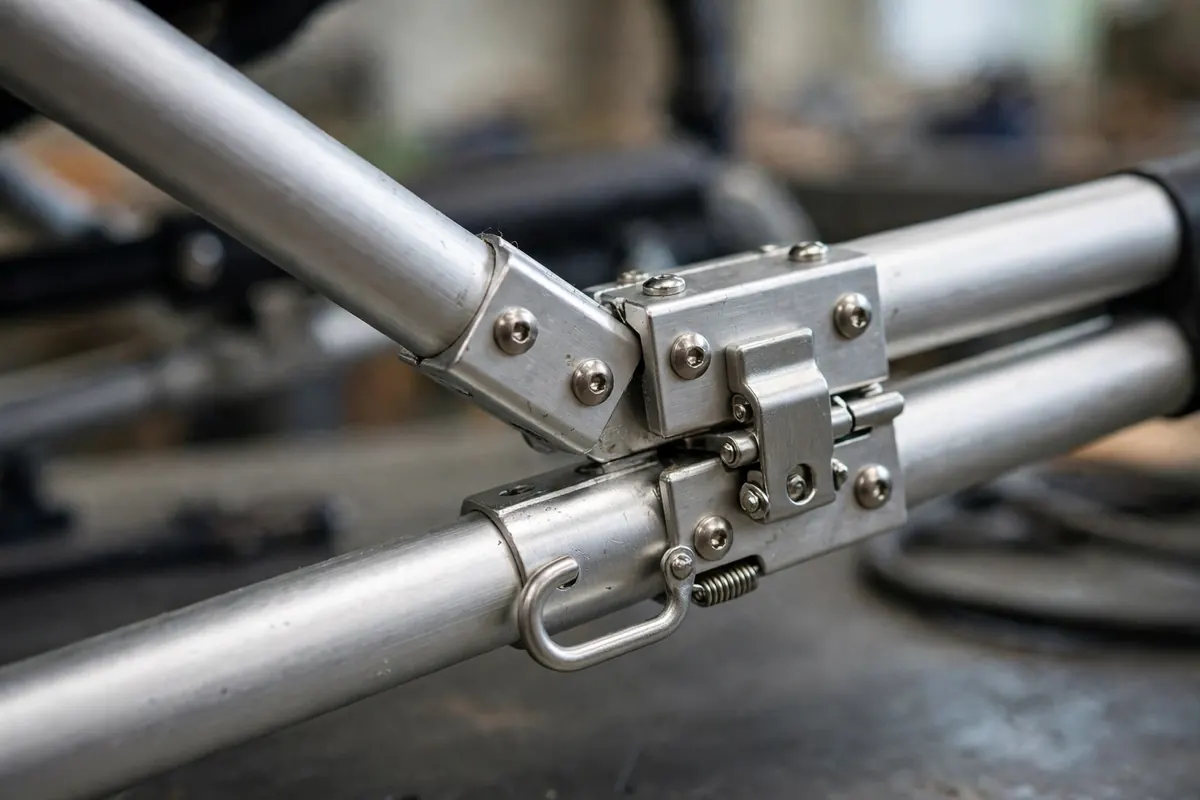
A hinge is only a weak point when it is underbuilt. A good hinge uses thick steel plates, a solid pivot pin, and a lock that clicks shut with no play. You can test it in a minute. Open the chair, lock it, and push the seat from side to side. A good hinge stays firm. A weak hinge lets the frame shift.
The lock matters as much as the hinge itself. The lock holds the chair open while it is used. If the lock is loose, the frame moves a little on every bump. That movement grinds the hinge pin and the joint. A lock that holds firm protects the hinge.
The number of folds matters too. A chair in a rental fleet may fold twice a day. A chair in a shop may fold ten times a day for demos. A chair that folds often needs a hinge rated for that work. Ask how many fold cycles the hinge is built for. A factory that tests its hinges can answer that question.
Key Takeaway: A hinge is a weak point only when it is underbuilt. Test for play, check the lock, and ask how many fold cycles the hinge is built for.
How does frame material change durability?
Frame material decides how the chair handles years of load. The two materials you will meet most are carbon fiber and aluminum. Carbon fiber is light and stiff. Aluminum is heavier but simple to work with. Both can last for years. The difference is in how they fail and how they are fixed.
Carbon fiber keeps its shape under load. It does not bend and stay bent. It holds its stiffness for a long time. That is why the lightest chairs use it. The trade-off is that a crack in carbon fiber is hard to fix in the field. It usually means a part swap, not a repair.
Aluminum bends before it breaks. A bent tube shows the damage, and a workshop can often straighten or replace it. Aluminum is heavier than carbon fiber, but it is forgiving. A chair with an aluminum frame is easier to keep in service for years.
The finish on the frame matters too. A good coating keeps water and salt off the metal. A thin coating wears through at the fold points first. Once the metal is bare, rust starts. Check the coating at the hinge and at the joints.
Key Takeaway: Carbon fiber stays stiff and light, while aluminum bends before it breaks and is easier to repair. Both last when the joints and the coating are built well.
Which frame is tougher: carbon fiber or aluminum?
Toughness depends on what you mean by tough. Carbon fiber wins on stiffness for its weight. It carries a load without flexing, and it does not tire the way metal does under repeated stress. That is why our lightest model uses it.
Aluminum wins on field repair. A dented aluminum tube is visible and often fixable. A damaged carbon fiber tube needs a trained hand and a new part.
The best way to compare them is to look at the models side by side. The EW1000 uses a carbon fiber frame. It weighs 15 kg with the battery. The EW100 uses an aluminum frame. It weighs 23 kg. Both fold small, both use a 24V system, and both carry the same frame warranty. The choice is not about which material is better in general. It is about which trade-off fits your buyers.
Model
Frame / type
Weight, with battery
Folded size
Range
EW1000
Carbon fiber
15 kg
73×39×71 cm
15±3 km
EW100
Aluminum
23 kg
73×55.5×31 cm
12±5 km
EW8722
Small-wheel
45 kg
80×39×74 cm
18–22 km
EW8703G
Big-wheel
46 kg
89×43×76 cm
18–22 km
EW8720
High-end
45 kg
80×34×74 cm
18–22 km
If your buyers lift the chair into a car every day, the carbon fiber model earns its place. The 8 kg gap between the EW1000 and the EW100 is felt on every lift. If your buyers value easy repair and a lower price point, the aluminum model is the safer stock choice. Our guide to EW100 vs EW1000 compares the two lightweight models in full, so you can match the frame to your market.
Key Takeaway: Carbon fiber wins on stiffness and weight, aluminum wins on field repair. Pick the frame that fits how your buyers use and fix their chairs.
Are Folding Electric Wheelchairs Durable enough for daily use?
Daily use is the real test. A folding chair in daily use folds, drives, charges, and folds again. It crosses door thresholds, bumps over curbs, and rides in car trunks. That is a hard life. A chair built for it holds up. A chair built for light use does not.
The load on the frame comes from the user and the ground. A smooth indoor floor is easy on a chair. A rough outdoor path is hard on it. Big wheels help on rough ground. The big-wheel EW8703G crosses grass and gravel with less shock to the frame than a small-wheel model. The small-wheel EW8722 turns tighter indoors.
The fold itself adds a daily task. A user who folds the chair twice a day puts about 700 folds a year on the hinge. A user who folds it six times a day puts over 2,000 folds a year on it. Both are normal. Both are fine for a hinge built for that work. What breaks a hinge is not the count. It is a hinge that was never built for daily folding in the first place.
Key Takeaway: Daily use is the real durability test. Match the wheels to the ground, count the folds per day, and judge the chair on the whole routine, not one part.
What should you check on a folding chair before you order?
Start with the hinge. Fold the chair and open it again. The lock should click shut with no play. Push the seat side to side. The frame should stay firm. If it shifts, the hinge is loose or the joint is thin. That is the first check, and it tells you the most.
Next, look at the frame joints. The welds or bolts around the hinge should be clean and even. A rough weld is a weak spot. Ask the factory what the frame is made of and how thick the tubes are.
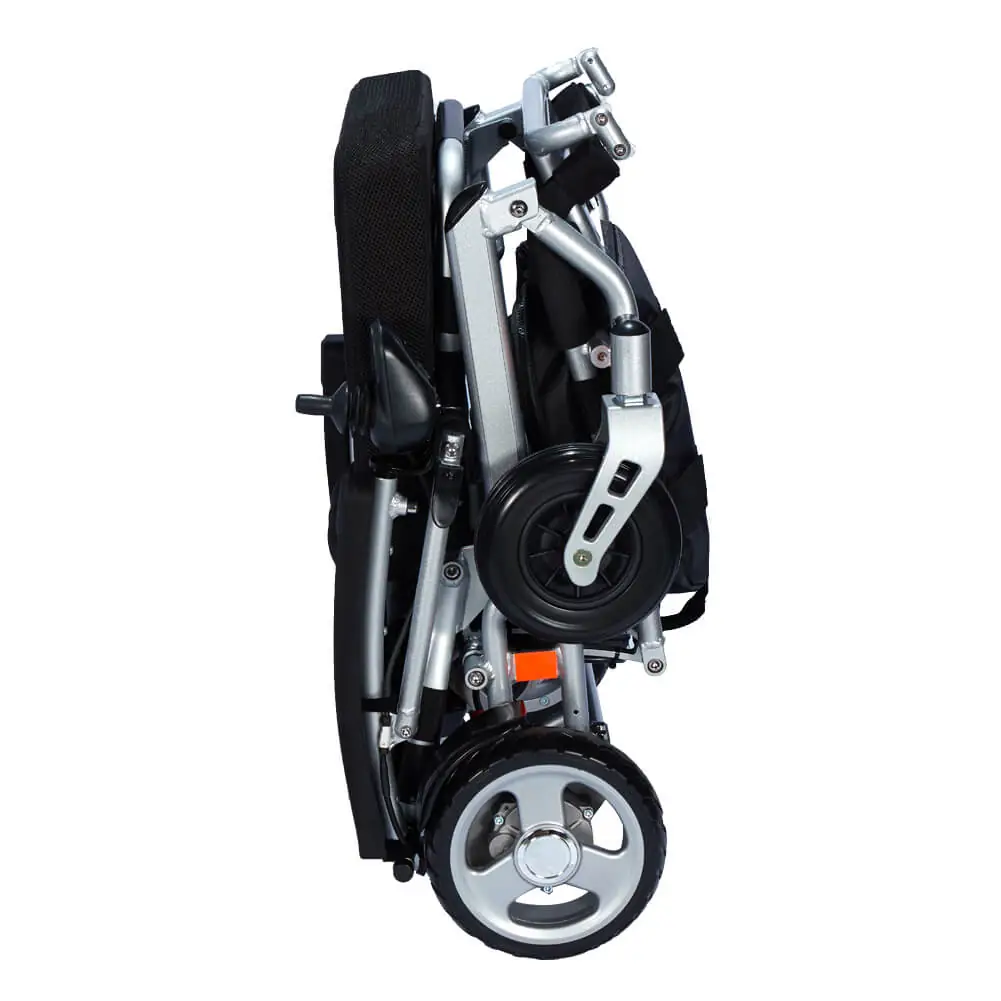
Then check the folded size against your storage. The EW1000 folds to 73×39×71 cm. The EW100 folds to 73×55.5×31 cm. The EW100 is heavier, but it folds thinner, so it stands slim against a wall. Measure your storage room before you order. A chair that does not fit your shelf is a chair that gets stored badly, and bad storage wears a chair out fast.
Finally, check the tires and the seat. Tire wear is normal, and it shows how hard a chair has worked. Worn tires do not mean a weak frame. They mean the chair has done miles. Check the seat fabric at the fold lines too. Good fabric holds up. Thin fabric splits at the crease.
Key Takeaway: Check the hinge lock, the frame joints, the folded size, and the wear points, in that order. A chair that passes all four checks is worth stocking.
How does the warranty back up durability claims?
A warranty is a factory putting its money behind its claims. It is the simplest durability proof a distributor can ask for. A short warranty says the factory is not sure. A long warranty says the factory has tested the chair and trusts it. Read the warranty before you read the brochure.
Our frame warranty runs 36 months. The motor and the controller each carry 12 months. The battery carries 6 months for lead-acid and 12 months for lithium. The frame gets the longest cover because the frame is the part that must last. A factory that covers its frame for three years has built a frame it expects to last three years.
The warranty also tells you what to stock. The motor and the controller carry 12 months each, so keep one spare of each on the shelf. A chair fixed in a day keeps its buyer. A chair that waits a month for a part does not.
Ask what the warranty does not cover. Damage from a crash is not a warranty claim. A part that fails in normal use is. Get that answer in writing before you order. See how much weight a folding electric wheelchair can hold to check the load rating too.
Key Takeaway: A 36-month frame warranty is the factory backing its durability claim. Stock the 12-month parts, and get the warranty terms in writing before you order.
Do folding chairs last as long as fixed-frame chairs?
A fixed-frame chair has no hinge, so it has one less part to wear. That is true. A fixed-frame chair is harder to store and harder to move. It gets dragged and lifted badly more often, and that rough handling wears it out in other ways. A folding chair is stored neatly and moved with care. The hinge is a wear point, but the fold protects the rest of the chair.
The fair comparison is years in service, not parts on the chair. A folding chair with a good hinge lasts as long as a fixed-frame chair in the same use. A folding chair with a cheap hinge does not. The hinge is the difference, not the fold itself. Our guide to folding vs non-folding electric wheelchairs compares the two types for stocking decisions, including which buyers suit each type.
Key Takeaway: A folding chair with a good hinge lasts as long as a fixed-frame chair in the same use. The hinge is the difference, not the fold itself.
What goes wrong first when a folding chair is used hard?
The first sign is play in the hinge. The chair feels loose when it is open. The seat shifts a little when the user turns. That play is the hinge pin wearing, or the lock wearing. Check for it when a chair comes back for any reason.
The second sign is noise. A hinge that clicks or creaks on every bump is telling you it has play. A frame that rattles over rough ground is telling you a joint is loose. Noise is not a small thing. It is wear you can hear. A chair that is quiet is a chair that is still tight.
The third sign is a fold that sticks. The chair used to fold in one smooth move. Now it catches halfway. That catch is often a bent pivot or a cable in the way. Do not force it. A forced fold bends the hinge further. If a chair will not fold at all, see what to check when an electric wheelchair will not fold.
Key Takeaway: Play in the hinge, noise on bumps, and a fold that sticks are the three early warnings. Catch them early and the chair stays in service.
Are Folding Electric Wheelchairs Durable — The Short Answer
Are Folding Electric Wheelchairs Durable enough to stock with confidence? Yes, when the hinge is solid, the frame fits the use, and the warranty backs the build. Check the hinge lock for play. Pick carbon fiber for light lifting or aluminum for easy repair. Match the wheels to the ground your buyers drive on. And read the warranty before you order.
ZVCARE — Shenzhen Zhiwei Health Technology Co., Ltd., founded in 2015 — builds folding models in two facilities totaling 3,000+ sqm, with 100% visual inspection before shipment and 50+ global partners. Every frame carries a 36-month warranty, the motor and controller 12 months each, and the battery 6 months for lead-acid and 12 months for lithium. MOQ is 1 unit and lead time is 7 days after payment, so you can order a single chair and test it on your own ground before you commit to stock. If you want to test one first, talk to us.
Frequently Asked Questions
Are folding electric wheelchairs less durable than fixed-frame models?
Not when the hinge is built well. A fixed-frame chair has no hinge to wear, but it is harder to store and move, so it takes more rough handling. A folding chair with a solid hinge and a firm lock lasts as long as a fixed-frame chair in the same daily use.
How long should a folding electric wheelchair last?
The frame is built to last years, and it carries a 36-month warranty. Motors and controllers carry 12 months each, and batteries carry 6 months for lead-acid and 12 months for lithium. How long a chair lasts in practice depends on the ground it drives on and how often it folds each day.
What is the first thing to check on a folding chair?
Check the hinge lock. Open the chair, lock it, and push the seat from side to side. The frame should stay firm with no play. Then look at the frame joints around the hinge and check that the cables have slack and a clear path when the chair folds.
Does folding a chair every day wear it out?
Daily folding is normal use, not abuse. A chair that folds twice a day sees about 700 folds a year. A hinge built for daily folding handles that easily. What wears a hinge out is a hinge that was never built for daily folding, or a loose lock that lets the frame shift on every bump.
Which folding model is best for a distributor to stock first?
Start with the model that fits your buyers. The EW1000 is the lightest at 15 kg, so it suits buyers who lift the chair into a car every day. The EW100 is aluminum at 23 kg and folds thinner at 73×55.5×31 cm, so it suits buyers who value easy repair. Order one unit first and test it before you stock more.
Founded in 2015, ZVCARE is an ISO 13485:2016 certified electric wheelchair manufacturer in China, providing OEM & ODM solutions for global distributors and medical stores.