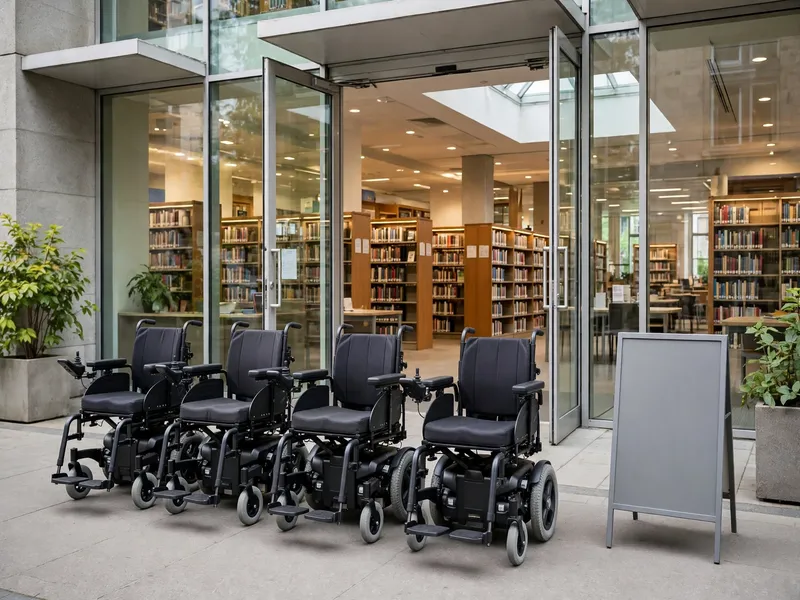
A visitor arrives at your library, cannot walk far, and needs a chair to reach the shelves. That is the whole problem this guide solves — not in theory, but desk by desk: how many chairs, which ones fit between the shelves, how the handover works, and how the fleet stays charged and clean. This Electric Wheelchairs for Libraries Buyers Guide follows that visitor from the entrance desk to the shelves and back.
How Many Electric Wheelchairs Does a Library Need?
Picture a busy Saturday. The doors open, and by mid-morning two visitors have already asked for a chair — one heading for the shelves, one for a reading room. A third visitor arrives while both chairs are out. That is the moment your fleet size is decided, not on a quiet Tuesday. Two or three chairs cover most libraries on most days. One is out on loan, one is charging, one is ready at the desk.
The loan book tells the story better than any guess. Write down the date, the time the chair went out, and the time it came back, and note whether anyone had to wait. Read it at the end of the week. If visitors wait on busy days, add one chair. If the fleet sits unused for weeks, the problem is usually visibility, not size. Put the chairs where visitors can see them, with a clear sign at the entrance.
Plan around your busiest hours, not your average ones. School holidays, weekend mornings, and community events bring several visitors at once. A fleet that copes on a quiet Tuesday can run out on a busy Saturday. A library with a busy events program — author talks, story time, community classes — can see three visitors ask at once. Keep the extra chair near the events room. A large central library with several floors may need a few more chairs, with one kept on each public floor.
Library
Starting fleet
Where the chairs live
Small branch library
Two chairs
One by the entrance, one charging
Medium library, one floor
Three chairs
Two at the desk, one on charge
Large library, several floors
Four to five chairs
One on each public floor, plus one charging
Library with a busy events program
One extra chair
Near the events room
Key Takeaway: Let the loan book decide — start with two or three chairs, and add one when visitors wait on a busy Saturday.
Electric Wheelchairs for Libraries Buyers Guide: Which Models Fit Between the Shelves?
The shelves decide the model. Library aisles are narrow, and the turning space at the end of a shelf row is tight. A compact folding chair works better than a wide daily chair. The EW1000 is the compact one: 73×39×71 cm folded, 15 kg with the battery, 15±3 km of range. Try it in a narrow aisle before you buy. A chair that turns easily there, and lifts easily into a store room, is the one you want. The EW100 is the aluminum alloy alternative at 23 kg. It folds to 73×55.5×31 cm with a range of 12±5 km, the light, practical loan chair.
A visitor who stays for a long visit may need something sturdier. The EW8722 adds comfort and durability at 45 kg, with a range of 18–22 km, for hours in a reading room. The EW8703G, our big-wheel model, suits libraries with outdoor paths and ramps. It weighs 46 kg with a range of 18–22 km. The EW8720 is a comfortable daily model at 45 kg with a range of 18–22 km. It is powered by dual 12V 22.3Ah lead-acid batteries in series, which gives 24V 22.3Ah. All models run on a 24V system.
Let your staff drive each model between the shelves before you buy. A chair that turns well on a showroom floor may still catch on a shelf end.
Model
Weight
Range
Battery
Best for
EW1000
15 kg incl. battery
15±3 km
24V 10Ah lithium
Narrow aisles and quiet rooms
EW100
23 kg
12±5 km
24V
Daily loans, light to carry
EW8722
45 kg
18–22 km
24V
All-day comfort in reading rooms
EW8703G
46 kg
18–22 km
24V
Outdoor paths and ramps
EW8720
45 kg
18–22 km
Dual 12V 22.3Ah lead-acid in series = 24V 22.3Ah
Long days in the reading room without recharging
Key Takeaway: Compact folding models first — and drive them through your own aisles before you buy.
How Quiet Does a Loan Wheelchair Need to Be?
A library is a quiet place, and a loan wheelchair has to respect that. Motor hum, wheel noise on a hard floor, and a beeping control panel all carry in a reading room. Choose a chair with a smooth, quiet motor and soft tyres that do not squeak on polished floors. Test the chair in a quiet room before you buy, not only in a noisy showroom.
Ask the supplier about the noise level in plain terms. A chair that sounds fine in a warehouse may sound loud in a silent reading room. Run it past the help desk and through the reading room during your test. If staff look up, the chair is too loud for that space.
Keep the fleet quiet over time. A loose wheel, a dry bearing, or a worn tyre gets louder with use. Add a monthly check to the cleaning routine. Listen for new noises, tighten what is loose, and replace a worn tyre before it starts to squeak. Museums face the same question, as our guide on electric wheelchairs for museums shows.
Key Takeaway: Test the chair in a quiet reading room, and keep the fleet quiet with a monthly noise check.
How Does the Handover Work at the Loan Desk?
Think of the handover as the first three minutes of the visit, not as paperwork. The visitor is already at your desk because walking is hard; the last thing they need is a form and a lecture. Take a name and a phone number, set the speed low, and show them the joystick and how to stop. Then walk with them past the first shelf row, so they feel steady before you leave them to browse. A small card in the chair’s basket — how to go, how to stop, and who to call — does the rest of the talking.
Settle the return before the visitor leaves the desk. Ask them to bring the chair back to the same desk by the latest return time. When it comes back, look it over at the desk. Wipe it down, check the battery, and plug it in if it needs a charge. A chair that is looked over at return is ready for the next visitor.
Key Takeaway: The handover is the first three minutes of the visit. Keep it short, keep it slow, and check the chair at return.
Where Do You Keep and Charge the Fleet?
Keep the fleet where the visitor’s day starts and ends: beside the loan desk. A chair kept beside the desk is easy to hand over and easy to check when it comes back. Chairs stored two floors away stay unused: nobody fetches one for every visitor who asks. On several floors, keep one chair on each public floor, spares near the main desk.
Charge where staff can see the chairs. A row plugged in along a back wall is easy to check at the end of the day. Keep chargers away from damp rooms and water sources, and keep the charging area dry, clear, and away from public walkways, so no cable crosses a path.
Run charging around your opening hours. A chair that comes back goes straight on charge, so another chair is free for the next visitor. A chair that is always charging is never the one you can hand over. Make the last job of the day a walk past the charging row: every chair plugged in, every cable off the walkway, one chair ready at the desk for the morning. Theme parks run the same rotation on a bigger scale, as our guide on electric wheelchairs for theme parks shows.
Key Takeaway: Beside the desk, in sight while charging, and plugged in the moment it comes back.
How Do You Clean the Chair Between Visitors?
Make cleaning part of the return, not a job for later. A loan chair is used by many people in a day. Wipe it down the moment it comes back: seat, armrests, joystick, and hand grips, with a cloth and a mild cleaner. That takes a minute and keeps the chair pleasant for the next visitor.
At the end of the day, go deeper. The end-of-day check looks at the wheels, the frame, and anything loose. Check for dirt and hair in the wheels, a frame that needs wiping, and a part that has worked loose. A check at closing catches small problems before they become repairs. A simple log at the desk records each clean.
Keep the supplies beside the desk, not in a locked cupboard: a cloth, a spray bottle, and a spare cloth. Supplies fetched from another floor mean cleaning that never happens, and visitors trust a chair that comes back clean.
Key Takeaway: Wipe it at return, check it deeper at closing, and keep the cloth beside the desk.
How Do You Train Library Staff to Help Wheelchair Users?
Train every staff member who works the desk, not only one person. A visitor may ask for a chair at any hour. The person on duty has to know what to do. Keep the training short. Cover how to hand over a chair, how to set the speed, how to charge it, and who to call when something breaks. A short session with a real chair covers it.
Practice the handover, not only the theory. Let each staff member drive the chair through the aisles, fold it, and plug it in. A person who has driven the chair will explain it better to a visitor. Repeat it when a new model arrives or a new staff member joins.
Teach staff how to talk with visitors who use a wheelchair. Speak to the visitor, not to their companion. Ask what help they need, and do not push the chair without asking. A little respect matters more than any checklist. Universities run the same kind of staff training for their campus fleets — our guide on electric wheelchairs for universities shows how.
Key Takeaway: Train everyone on the desk, practice with a real chair, and speak to the visitor, not their companion.
How Do You Set the Budget and Buy the Fleet?
Buying the fleet outright is the usual choice for a small library fleet. Two or three chairs are a one-off cost. After that, the costs are small: charging, cleaning supplies, and the odd spare part. The chairs are yours to keep, lend, and replace whenever you choose.
A service contract is the other option, and it suits a library with no maintenance staff of its own. With a contract, the supplier keeps the chairs and visits on a set schedule to check them. When one fails, they bring a working chair, for a regular fee. The contract earns its fee on a Saturday: the only chair breaks at mid-morning, and the supplier brings a working one instead of leaving the desk with nothing to lend. Ask what the fee covers before you sign. The chairs, the checks, the spares, and how fast a swap happens. A small fleet is usually bought outright. But a library with nobody to run the yearly check may find the contract cheaper in staff time than in money.
Before you order, get the quote in writing: chairs, delivery, a spare controller and charger, and the warranty terms. The frame is covered for 36 months. The motor and the controller are covered for 12 months each. The battery is covered for 6 months for lead-acid or 12 months for lithium. Find out what the warranty leaves out, and who covers delivery when a chair goes back for repair.
Plan the running cost in the same budget: cleaning supplies, a spare battery charger, and a yearly service check. A fleet that is bought well and kept well costs little to run. A fleet that is bought cheap and never serviced costs more in the end.
Key Takeaway: Buy outright, get a written quote with warranty terms, and budget for cleaning and a yearly check.
What Are the Common Mistakes Libraries Make With a Loan Fleet?
The first mistake is hiding the fleet where nobody sees it. Chairs kept in a far store room do not get borrowed, however good they are. Put them where visitors can see them, with a clear sign at the entrance.
The second mistake is treating cleaning as an extra. A loan chair is used by many people in a day. A chair that is not wiped down after each loan soon looks and feels dirty. Visitors notice, and they stop asking. Cleaning is part of the loan.
The third mistake is buying for comfort and forgetting the building. A wide chair that cannot turn at the end of a shelf row is no use in a library. However comfortable it is. Test-drive each model through your own aisles before you buy, and listen for noise in a quiet room.
The fourth mistake is training one person only. A visitor may ask for a chair at any hour. If only one staff member knows the handover, the fleet fails whenever that person is away. Train everyone on the desk.
Key Takeaway: Keep the fleet visible and clean it at every return. Test it in your own aisles, and train the whole desk team.
Conclusion
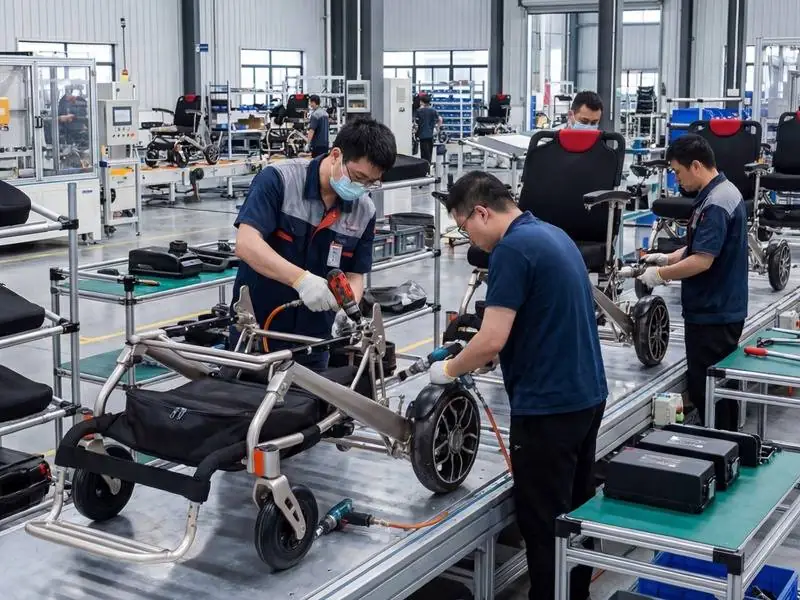
This Electric Wheelchairs for Libraries Buyers Guide follows one visitor. They arrive, borrow a chair at the desk, reach the shelves, and bring it back. Get those four moments right and the fleet works: enough chairs, models that fit, a three-minute handover, and a chair that is charged and clean. Start with two or three compact folding chairs. Test-drive them through your own aisles, and put them where visitors can see them. Train everyone on the desk and keep a simple loan book. Let the loan book tell you when to add the next chair. If you want a supplier who works the same way, ZVCARE — Shenzhen Zhiwei Health Technology Co., Ltd., founded in 2015, with two production facilities totaling 3000+ sqm and ISO 13485:2016 certification — offers a minimum order quantity of 1 unit, a lead time of 7 days after payment, and spare parts support. Contact us to discuss a loan fleet for your library.
FAQ
How many electric wheelchairs should a library buy first?
Two or three chairs cover most libraries: one out on loan, one charging, one ready at the desk. Keep a simple loan book and add one chair at a time when visitors have to wait. A large library with several floors may need one chair per public floor.
Which electric wheelchair is best for narrow library aisles?
A compact folding chair turns best between shelves. The EW1000 is the one to try first: 73×39×71 cm folded, 15 kg with the battery. The EW100 is the lighter everyday option: 73×55.5×31 cm folded, 23 kg. Drive each model through your own aisles before you buy, and listen for noise in a quiet reading room.
Do visitors need to book a library wheelchair in advance?
No. For most libraries a visitor simply asks at the desk, gives a name and phone number, and borrows the chair for the visit. Keep the handover to the first three minutes: show the joystick and how to stop, set the speed low, and walk with the visitor past the first shelf row.
How do you keep a library loan fleet charged?
Keep the fleet beside the loan desk and charge where staff can see it. A chair that comes back goes straight on charge. Keep the charging area dry and clear of public walkways, so no cable crosses a path.
Who cleans a library loan wheelchair, and how often?
Library staff wipe the chair down at every return: seat, armrests, joystick, and hand grips. They do a deeper check at the end of the day: wheels, frame, and anything loose or damaged. Keep the cloth and spray beside the desk.
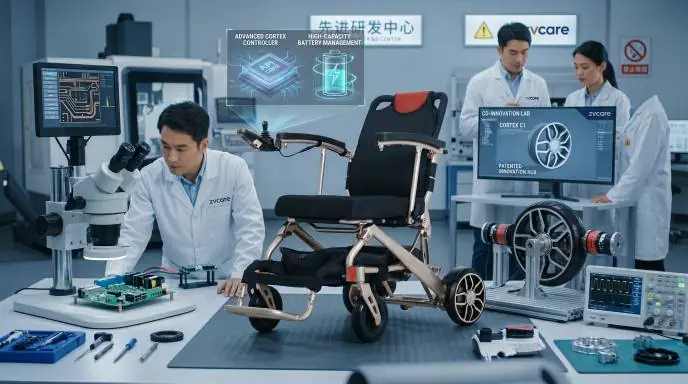
Founded in 2015, ZVCARE is an ISO 13485:2016 certified electric wheelchair manufacturer in China, providing OEM & ODM solutions for global distributors and medical stores.