Electric Wheelchairs for Office Buildings Buyers Guide
November 15, 2026
This Electric Wheelchairs for Office Buildings Buyers Guide is written for the facilities team that gets the call: a visitor arrives at reception, cannot walk far, and needs a chair to reach a meeting room, a lift, or a tenant’s office. A small loan fleet answers that call. It lets reception hand over a chair at the front desk, collect it when the visit ends, and keep it charged and ready for the next visitor. This guide walks through each step: how many chairs to buy, which models fit your lifts and corridors, how to hand them over, and how to keep them charged, clean, and ready.
How Many Electric Wheelchairs Does an Office Building Need?
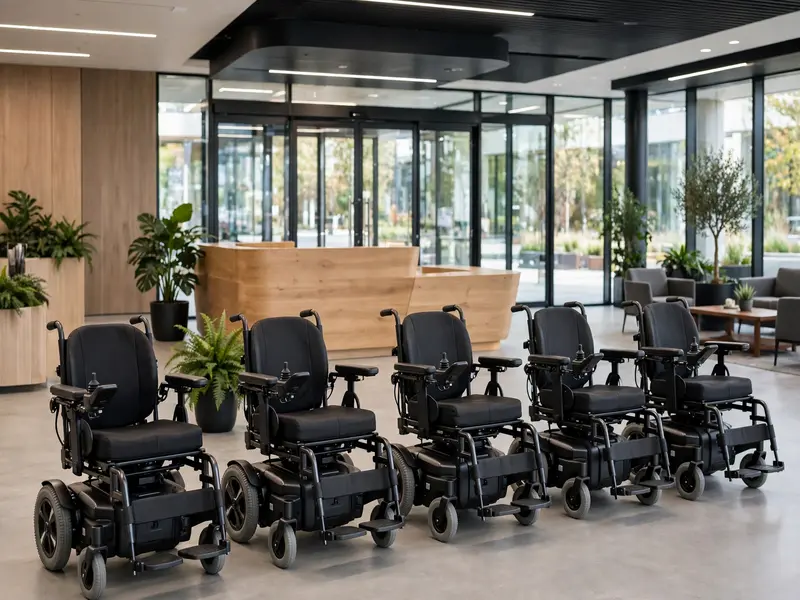
Order two or three chairs to start. That covers a normal day in most office buildings: one chair out on loan, one charging, and one ready at reception. A small fleet is simple to manage, simple to store, and simple to keep charged. Add chairs only when the loan book shows visitors waiting.
Read the loan book before you count the chairs. Keep a simple record at reception: date, time out, time back, and whether a visitor had to wait. If visitors wait on busy mornings, add one chair at a time. If the fleet sits unused for weeks, visibility is usually the problem, not size. Put the chairs where visitors can see them, and tell your tenants the fleet exists.
Plan for your busiest times, not your average day. Morning arrivals, lunch hours, and large meetings bring more visitors at once. A fleet that copes on a quiet afternoon can run out when a conference starts. Two or three chairs cover most ordinary days. A large multi-tenant tower with several lifts may need a few more: one chair at the main reception and one near the busiest lift lobby.
Building
Starting fleet
Where to keep them
Small office building, one lift
Two chairs
Both at the main reception
Medium building, several floors
Three chairs
Two at reception, one on charge
Large multi-tenant tower
Four to five chairs
One at main reception, one by the busiest lift lobby, rest on charge
Building with a busy events floor
One extra chair
Keep it near the events floor
Key Takeaway: Order two or three chairs, read the loan book, and add one chair at a time when visitors wait.
Electric Wheelchairs for Office Buildings Buyers Guide: Which Models Fit Your Lifts and Corridors?
Pick models that fit your lifts and corridors. Office lifts are smaller than you think. A chair that fits the lift with room to turn is worth more than a chair with a longer range. A compact folding chair turns more easily in a lift lobby and a narrow corridor. The EW1000 folds to 73×39×71 cm, weighs 15 kg including the battery, and has a range of 15±3 km. Try it in your own lift before you buy — a chair that turns easily there, and stores easily in a facilities room, is the one you want. The EW100 is the aluminum alloy alternative at 23 kg, folds to 73×55.5×31 cm, and has a range of 12±5 km. It fits a building that wants a light, practical loan chair.
Some visitors need a sturdier chair for a long meeting day. The EW8722 gives them comfort and durability at 45 kg, with a range of 18–22 km. It fits a visitor who will sit in the chair for hours between meetings. The EW8703G is our big-wheel model at 46 kg, with a range of 18–22 km, for buildings with outdoor paths and ramps between blocks. The EW8720 is a comfortable daily model at 45 kg with a range of 18–22 km. It runs on dual 12V 22.3Ah lead-acid batteries in series, which gives 24V 22.3Ah. Every model runs on a 24V system.
Have your facilities team try each model in your own lift before you buy. A chair that fits on a showroom floor can still catch on a lift door. A short run from reception to a meeting room tells you more than any spec sheet.
Model
Weight
Range
Battery
Good for
EW1000
15 kg incl. battery
15±3 km
24V 10Ah lithium
Lifts and corridors
EW100
23 kg
12±5 km
24V
Everyday loans
EW8722
45 kg
18–22 km
24V
Long meeting days
EW8703G
46 kg
18–22 km
24V
Outdoor paths between blocks
EW8720
45 kg
18–22 km
Dual 12V 22.3Ah lead-acid in series = 24V 22.3Ah
Long days on one charge
Key Takeaway: Pick compact folding models first, and test-drive them through your own lift before you buy.
How Should the Reception Desk Hand Over a Wheelchair?
Keep the handover short. A visitor who needs a chair does not want a form to fill in or a lecture to sit through. Take a name and a phone number, show the visitor the joystick and the speed control, and walk with them to the lift. That covers most loans. A card with three short instructions — how to go, how to stop, and who to call — covers the rest.
Set the speed low before you hand over the chair. An office building is full of people, corners, and glass doors. A chair on its slowest indoor speed is safer for the visitor and for everyone around them. Show the visitor how to change the speed, and ask them to keep it low indoors.
Agree the return before the visitor leaves. Ask the visitor to bring the chair back to the same reception desk, and give them the latest return time. When the chair comes back, check it at the desk: wipe it down, check the battery, and plug it in if the charge is low. A chair checked at return is ready for the next visitor.
Key Takeaway: Keep the handover to a name, a short demo, and a slow speed. Check every chair when it comes back.
How Do You Handle Wheelchair Requests From Tenants?
Tell your tenants the fleet exists. A tenant who does not know about the loan chairs will not ask for one. Send a short note to every tenant when the fleet arrives: where the chairs are kept, who to call, and how long a loan takes. Put the same note in the tenant handbook and on the building notice board.
Agree a simple booking rule with tenants. A tenant can call reception in the morning to reserve a chair for a visitor that afternoon. Keep one chair unbooked for walk-in visitors, so a booking never leaves reception with nothing to offer. A short call beats a long form, and a reserved chair beats a promise.
Ask tenants what they need after the first month. Some tenants host visitors every week. Others never ask. A short check-in with the busiest tenants tells you whether the fleet size is right and whether the handover works. A tenant who books chairs often is also the first to tell you when something breaks. Stadiums run the same kind of tenant-style booking for event days, as our guide on electric wheelchairs for stadiums shows.
Key Takeaway: Tell every tenant the fleet exists, keep one chair unbooked for walk-ins, and check in with busy tenants after a month.
Where Do You Charge and Store the Office Fleet?
Store the fleet near reception, not in a far basement. A chair beside the front desk is easy to hand over and easy to check. A chair kept two floors down will sit unused, because reception staff will not fetch it for every visitor. In a large tower, keep one chair at the main reception and one near the busiest lift lobby.
Charge the chairs where facilities staff can see them. A row of chairs plugged in along a back wall is simple to check at the end of the day. Never charge a chair in a damp room or next to a water source. Keep the charging area dry, clear, and away from public walkways, so a cable never crosses a path where people walk.
Build the charging routine around your opening hours. Plug a chair in the moment it comes back, so it charges while another chair serves the next visitor. A chair that is always on charge is never ready. With a small fleet and a simple routine, one chair is always ready at reception. Hotels run the same rotation for their guest fleets, as our guide on electric wheelchairs for hotels shows.
Key Takeaway: Store the fleet beside reception, charge where staff can see it, and plug each chair in as soon as it comes back.
How Do You Clean an Office Loan Wheelchair Between Users?
Wipe the chair down after each loan. A loan chair serves many people in a day, so cleaning belongs to the handover, not to an end-of-week job. Wipe the seat, armrests, joystick, and hand grips with a cloth and a mild cleaner. That takes a minute and keeps the chair pleasant for the next person to use it.
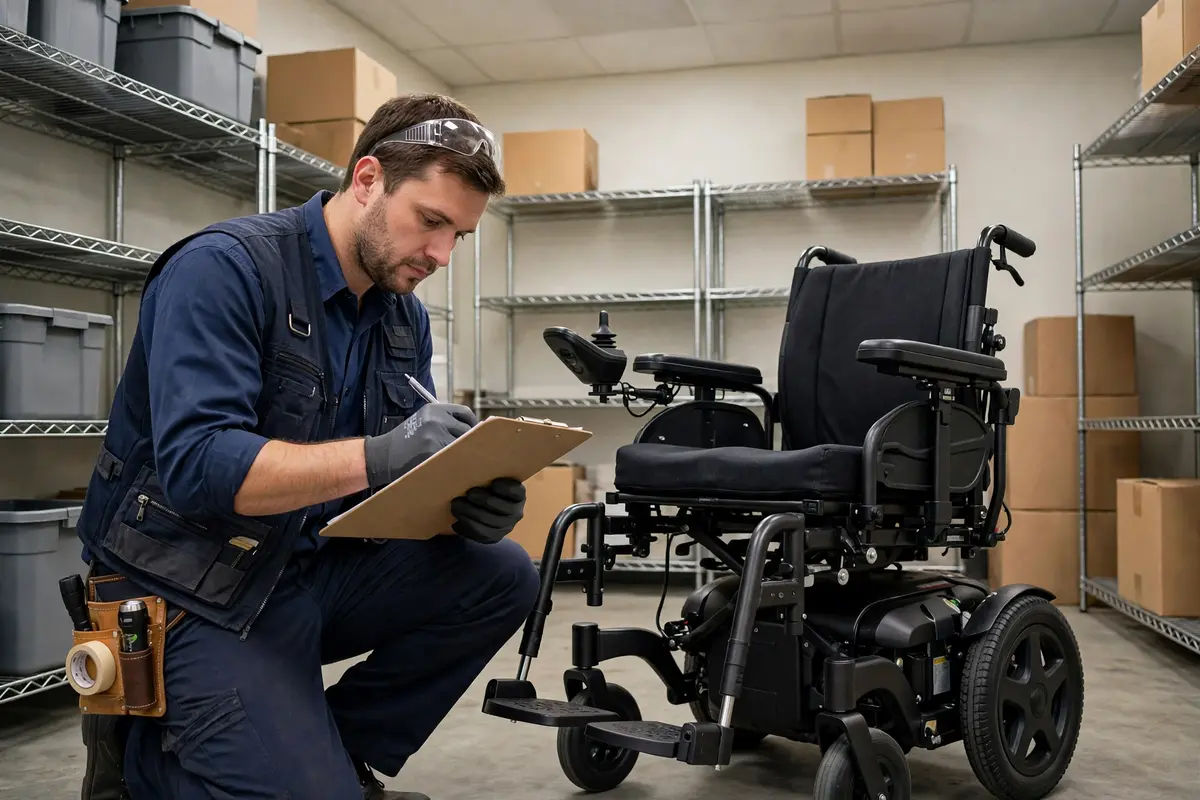
Do a deeper clean at the end of each day. Check the wheels for dirt and hair, wipe the frame, and look for anything loose or broken. A daily check catches small problems before they turn into repairs. Keep a simple cleaning log at reception, so staff can see when each chair was last cleaned and checked.
Keep cleaning supplies beside reception, not in a locked cupboard. A cloth, a spray bottle, and one spare cloth are enough. If staff must fetch supplies from another floor, the cleaning will not happen. A chair cleaned at return is a chair visitors trust.
Key Takeaway: Wipe the chair after every loan, check it deeper at the end of the day, and keep supplies beside reception.
Should You Buy the Fleet or Sign a Service Contract?
Buy the fleet outright when you can. A small fleet of two or three chairs is a one-time purchase, and the running cost stays small: charging, cleaning supplies, and the odd spare part. Buying also means the chairs are yours to keep, lend, and replace on your own schedule.
A service contract suits a building that wants no maintenance work at all. Under a contract, the supplier owns the chairs, checks them on a set schedule, and swaps a faulty chair for a working one. You pay a regular fee and make one phone call when something breaks. Ask what the fee covers: the chairs, the checks, the spares, and the swap time. A contract that covers only the chairs and not the checks is a purchase with a fee on top.
Ask the supplier for a clear quote before you order, either way. The quote should cover the chairs, delivery, a spare controller and charger, and the warranty in writing. The frame runs 36 months. The motor and the controller run 12 months each. The battery runs 6 months for lead-acid or 12 months for lithium. Ask what the warranty leaves out, and who pays for delivery on a warranty repair.
Key Takeaway: Buy outright for control, or sign a contract that covers checks and swaps — and get the warranty in writing either way.
How Do You Keep the Fleet Ready During Busy Hours?
Busy hours are the test of a loan fleet. Morning arrivals, lunch hours, and large meetings all bring visitors at once. Stage one chair, fully charged, at reception before the morning rush, instead of leaving it on charge in the back room. A chair that starts the day ready is a chair that serves the first visitor.
Stagger the charging through the day. When a chair comes back, plug it in at once and hand the next visitor a chair that is already charged. Do not wait until the end of the day to charge everything. A fleet that charges as it goes never runs out at the wrong hour.
Keep a simple status board at reception. A card on each chair — ready, charging, or out — tells reception staff what to offer without checking every chair. A visitor who waits while staff hunt for a chair will not come back. Schools run the same kind of status check for their loan fleets, as our guide on electric wheelchairs for schools shows.
Key Takeaway: Start the day with one chair ready, charge as chairs come back, and keep a simple status card on each chair.
What Are the Common Mistakes Office Buildings Make With a Loan Fleet?
The first mistake is keeping the fleet out of sight. Chairs kept in a far basement do not get borrowed. Put the chairs where visitors can see them, and tell every tenant the fleet exists. A fleet nobody sees is a fleet nobody borrows.
The second mistake is skipping the cleaning. A loan chair serves many people in a day. A chair that is not wiped down after each loan soon looks and feels dirty, and visitors stop asking. Cleaning belongs to the loan, not as an extra.
The third mistake is buying chairs that do not suit the building. A wide chair that cannot turn in a lift is no use in an office tower. Test each model through your own lift and corridors before you buy.
The fourth mistake is training only one person. A visitor can ask for a chair at any hour. If only one receptionist knows the handover, the fleet fails whenever that person is away. Train everyone on the desk, evening shift included.
Key Takeaway: Show the fleet, clean it after every loan, test it through your own lift, and train everyone on the desk.
Conclusion
This Electric Wheelchairs for Office Buildings Buyers Guide comes down to four things you can control: the right number of chairs, models that fit your lifts and corridors, a short and respectful handover, and a daily routine for charging and cleaning. Start with two or three compact folding chairs, test them from reception to a meeting room, and put them where visitors can see them. Tell every tenant the fleet exists, train everyone on the desk, and keep a simple loan book that tells you when to add the next chair. If you want a supplier who works the same way, ZVCARE — Shenzhen Zhiwei Health Technology Co., Ltd., founded in 2015, with two production facilities totaling 3000+ sqm and ISO 13485:2016 certification — offers a minimum order quantity of 1 unit, a lead time of 7 days after payment, and spare parts support. Contact us to discuss a loan fleet for your office building.
FAQ
How many electric wheelchairs should an office building buy first?
Order two or three chairs to start. That covers a normal day: one chair out on loan, one charging, and one ready at reception. Keep a simple loan book at reception and add one chair at a time when visitors have to wait. A large multi-tenant tower may need one chair at the main reception and one near the busiest lift lobby.
Which electric wheelchair is best for small office lifts?
A compact folding chair turns best in a lift and a narrow corridor. The EW1000 folds to 73×39×71 cm and weighs 15 kg including the battery, while the EW100 folds to 73×55.5×31 cm at 23 kg. Test each model from reception to a meeting room before you buy.
Do visitors need to book an office building wheelchair in advance?
No booking is needed for most buildings, but tenants can call reception in the morning to reserve a chair for a visitor that afternoon. Keep one chair unbooked for walk-in visitors, so a booking never leaves reception with nothing to offer. The handover itself takes only a few minutes.
How do you keep an office loan fleet charged?
Store the fleet beside reception and charge where facilities staff can see it. Plug a chair in the moment it comes back, so it charges while another chair serves the next visitor. Start the day with one chair fully charged and ready before the morning rush.
Who cleans an office loan wheelchair, and how often?
Reception or facilities staff wipe the chair down after every loan: seat, armrests, joystick, and hand grips. A deeper check happens at the end of the day: wheels, frame, and anything loose or broken. Keep cleaning supplies beside reception so the routine happens.
Founded in 2015, ZVCARE is an ISO 13485:2016 certified electric wheelchair manufacturer in China, providing OEM & ODM solutions for global distributors and medical stores.