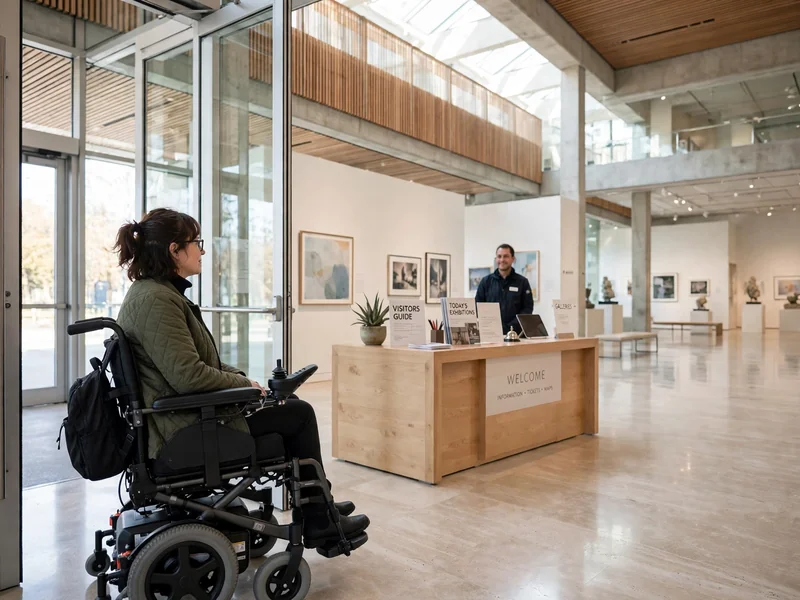
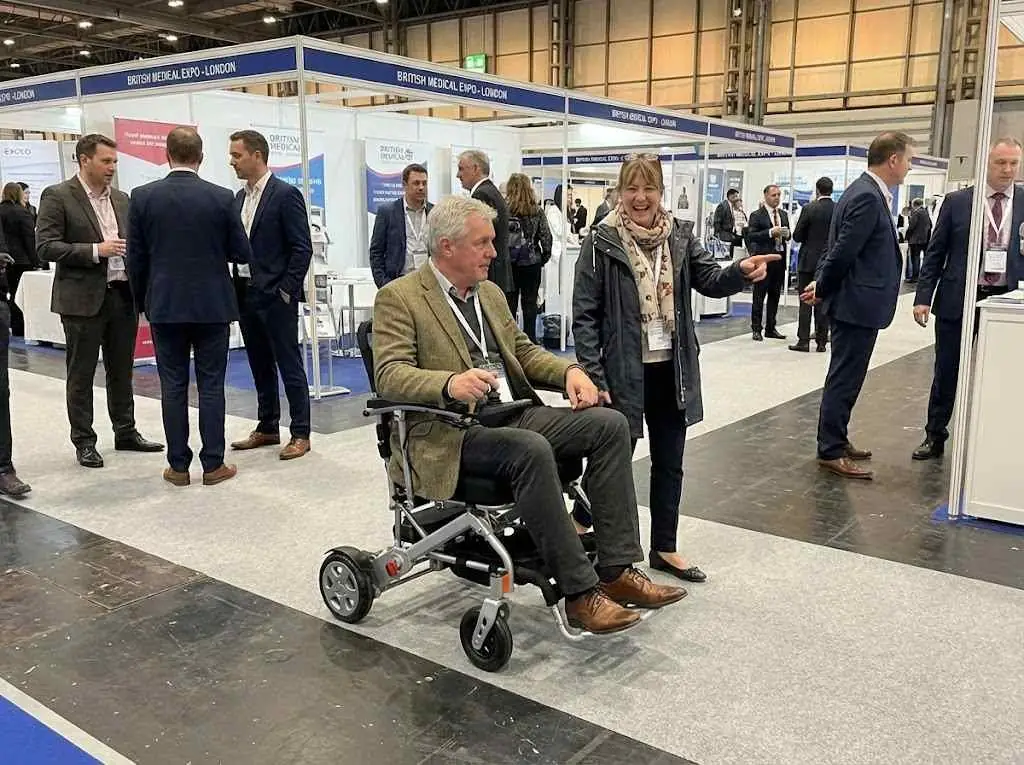
A visitor who cannot walk far should still be able to spend a whole morning in your galleries, and a loan fleet of electric wheelchairs is how many museums make that happen. This Electric Wheelchairs for Museums Buyers Guide is written for the person who has to choose those chairs: a visitor services manager or a front-of-house team buying its first fleet. It covers what makes a museum fleet different, which chairs suit indoor use, how many to keep, and how to run handover, charging, and daily checks.
Electric Wheelchairs for Museums Buyers Guide: Which Chairs Fit Quiet Gallery Use?
A museum chair has a different job from a chair bought for home use: driven slowly, indoors, for a few hours at a time, by a different person every day. It must turn in a gallery aisle, stop gently near a display case, and run quietly — so judge it on turning circle, low-speed control, quiet running, and non-marking wheels.
Start your selection there, not with top speed or outdoor range. Ask the supplier to let your team try each candidate chair in a real gallery space, turning between display cases and stopping beside a bench, before you commit.
Key Takeaway: Judge a museum chair at walking pace in a gallery — tight turns, gentle stops, quiet running — not by outdoor performance.
How Is a Museum Loan Fleet Different from a Mall, Stadium, or Theme Park Fleet?
It helps to see where a museum sits among other venue fleets, because the differences decide what you buy. A shopping mall lends chairs for short retail trips, turning them around quickly at a busy entrance. A stadium runs a large fleet on event days, across wide concourses and long distances between gates and seats. A theme park keeps a fleet in constant outdoor use all day, across long paths and in all weather.
A museum is quieter and more controlled than all three. Visits last a few hours, visitors move slowly from room to room, and the building sets the limits: narrow doorways between older galleries, polished floors, and display cases close to the path. Your fleet can be smaller than a stadium fleet and lighter than a theme park fleet, but your chairs must be gentler on floors and easier to turn than any of them.
Venue
Typical use
Fleet character
Main demand on the chair
Museum
Slow indoor visits, a few hours
Small, calm, indoor-only
Tight turns, quiet running, floor protection
Shopping mall
Short retail trips
Fast turnaround
Durability and quick cleaning
Stadium
Event days, large crowds
Large fleet, peak surges
Long distances, crowd handling
Theme park
All-day outdoor use
Hard-working outdoor fleet
Outdoor ground, all-day battery use
Key Takeaway: A museum fleet is smaller and calmer, but it asks more of a chair in tight spaces and on delicate floors.
What Makes a Chair Safe for Gallery Floors and Exhibits?
Some of your floors are expensive to repair, so floor protection deserves a proper check before you buy. Look at the tires first: solid, non-marking tires that leave no scuff on polished stone or wood are what you want, and your supplier should confirm this in writing for the exact model you order. If you can, run a test chair over each floor type in your building — stone, wood, and any carpeted galleries — and look for marks afterwards.
Turning matters as much as tires: test the turn in your narrowest doorway and tightest corner, not in an open hall. Also check the joystick — a chair that starts and stops gently, with no sudden lurch, is safer near exhibits and more comfortable for a first-time driver — and check for any sharp edge or footrest corner that could catch a case or a wall. Our guide to electric wheelchairs for hotels covers the same indoor problem.
Key Takeaway: Test the exact chair on your own floors, in your narrowest doorway, before you order — a supplier promise is no substitute for a mark-free test run.
Which Models Work Best for Indoor Museum Use?
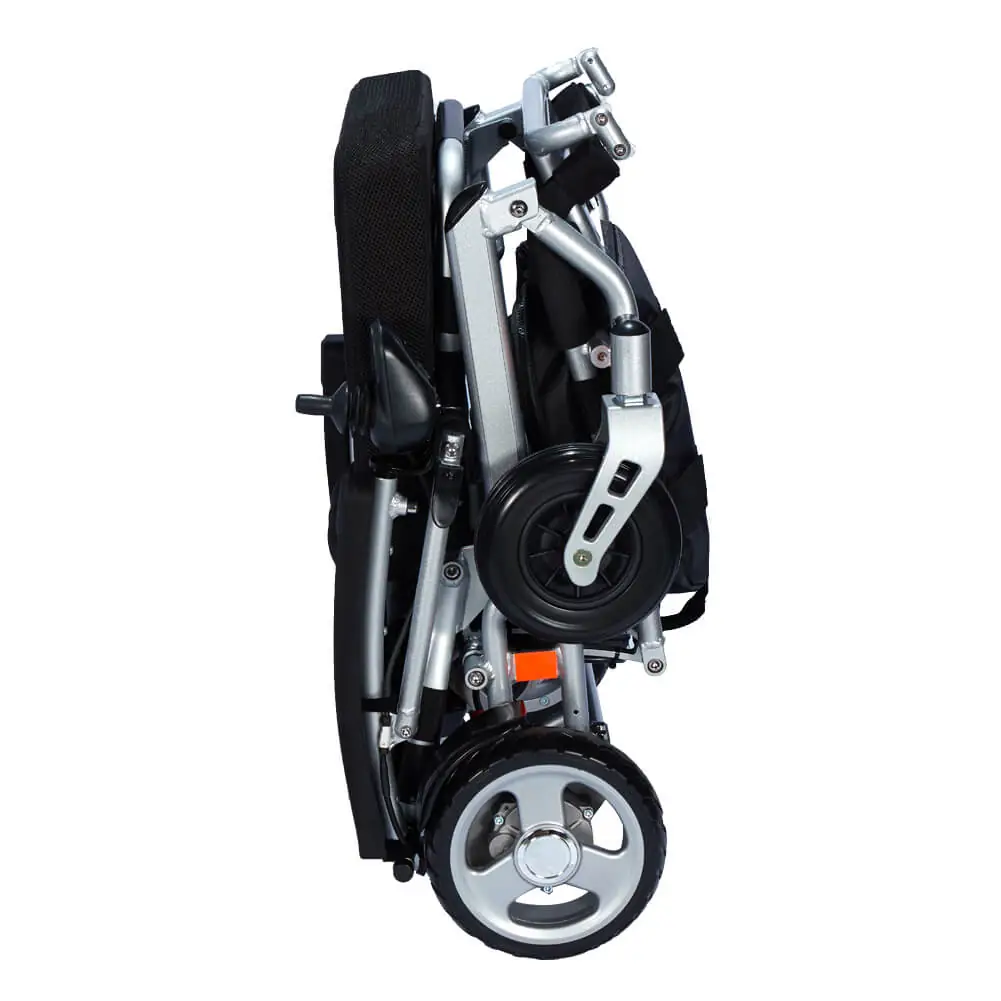
Lightweight folding chairs lead a museum fleet: easy for staff to move and store, and easy for a visitor to drive indoors. The EW1000 is a carbon fiber folding chair at 15 kg including the battery, folding to 73×39×71 cm with a range of 15±3 km — light enough for one staff member to lift and fold. The EW100 is the aluminum alloy alternative at 23 kg, folding to 73×55.5×31 cm with a range of 12±5 km.
For visitors who need a roomier seat, the EW8722 (45 kg, 18–22 km) suits long visits, the big-wheel EW8703G (46 kg, 18–22 km) suits uneven ground such as garden paths, and the EW8720 (45 kg, 18–22 km) runs on dual 12V 22.3Ah lead-acid batteries in series, giving 24V 22.3Ah. All models run on a 24V system, and the folding EW1000 and EW100 are designed for air travel (airline approval required).
A practical fleet mixes the two groups: folding chairs as the main loan stock, and one or two larger chairs for visitors who need more seat room. Keep the mix simple — two models at most — so staff only learn two sets of controls and your spares shelf stays small.
Model
Weight
Folded size
Range
Best museum use
EW1000
15 kg incl. battery
73×39×71 cm
15±3 km
Main loan chair
EW100
23 kg
73×55.5×31 cm
12±5 km
Everyday folding loan chair
EW8722
45 kg
80×39×74 cm folded
18–22 km
Roomier chair, long visits
EW8703G
46 kg
89×43×76 cm folded
18–22 km
Garden paths, uneven floors
EW8720
45 kg
80×34×74 cm folded
18–22 km
Comfortable chair, long visits
Key Takeaway: Build the fleet around light folding chairs, plus one or two larger chairs — two models at most keeps training and spares simple.
How Many Chairs Should a Museum Keep in Its Loan Fleet?
Start small and let loan records tell you when to add chairs. For most museums, a first fleet of a handful of chairs is enough to open the service, with one or two larger chairs included in that count. The number that matters is not your total visitor count but your peak overlap: how many chairs are out at the same time on your busiest morning. Keep a simple loan log — date, time out, time back — and the pattern will show itself, so you can add chairs before the next busy season instead of guessing now.
A museum with several floors and a lift will have chairs out longer than a single-floor gallery. If you run school visits or group tours, keep one chair in reserve for a group that arrives with a visitor who needs one unexpectedly. And remember that one chair will always be out of service — on charge, being cleaned, or waiting for a part — so a fleet that exactly matches peak demand is already one chair short.
Key Takeaway: Open with a small fleet, keep a loan log, and add chairs when the log shows peak overlap — not before.
How Should the Handover Desk Work for Visitors?
The handover is the moment your service is judged, so design it to be calm and unhurried. Keep the loan desk near the entrance, with enough open floor for a visitor to try the chair before setting off. A short routine works best: confirm the visitor can operate the joystick, show them how to stop, set the speed low, and walk with them for the first few meters until they feel steady.
Keep the paperwork light: a simple loan form — name, contact, time out — is enough, and it keeps the queue moving. Ask for ID or a deposit only if your museum already does this for other loan items; a new deposit rule just for wheelchairs can put visitors off a service that exists to welcome them. If a visitor arrives with a carer or companion, include them so they know how the chair works too. Our guide to electric wheelchairs for stadiums shows the same calm handover at event scale.
Key Takeaway: Keep the handover near the entrance, unhurried, with a short drive test and a one-page form.
Where Should Loan Chairs Be Charged and Stored?
Loan chairs need a home that is dry, out of public view, and close to the loan desk. A small store room near the entrance works well: chairs fold flat against a wall, chargers sit on a shelf above them, and the door stays shut during opening hours. A folded EW1000 or EW100 takes up little floor space, so a small room can hold a whole fleet.
Give each chair a labeled charging point so staff can see which chairs are ready, and make plugging in part of the return routine: chair comes back, staff checks it, chair goes on charge. Keep the room ventilated, keep chargers off the floor, and do not stack anything on top of a folded chair.
Key Takeaway: Store the fleet folded in a dry room near the desk, give every chair a labeled charging point, and make charging part of the return routine.
What Should Staff Check Before Each Loan?
A short check before each loan protects the visitor and the chairs. It takes a few minutes and should be done by the staff member handing the chair over, not left to the visitor.
Check
What to look for
If it fails
Battery
Charge level is enough for a full visit
Swap in a charged chair
Brakes and joystick
Chair starts and stops smoothly, joystick responds in all directions
Take out of service, log the fault
Tires and wheels
No damage, no debris in the wheels
Clean or replace before lending
Seat, armrests, footrests
Nothing loose, torn, or missing
Fix or take out of service
Cleanliness
Seat and joystick wiped
Wipe down before handover
Write the check on a small laminated card at the loan desk, so every staff member does the same check the same way. When a chair fails, tag it and move it to the store room — a chair out of service should never stand at the loan desk where a busy colleague might hand it out by mistake.
Key Takeaway: The same five-point check every time — battery, brakes, joystick, wheels, cleanliness — is what keeps a loan fleet safe.
How Do You Keep Loan Chairs Clean and Looking Presentable?
A loan chair is part of your front-of-house presentation, and visitors notice its condition. Wipe the seat, armrests, and joystick after every loan, and give each chair a deeper clean at the end of the week: frame, wheels, and footrests included. Keep a small cleaning kit at the loan desk so staff can clean a chair on the spot instead of carrying it away.
Pay attention to the wheels, because they carry dirt onto the next gallery. A quick wheel wipe at return stops marks building up on polished floors. Replace worn seat covers and scuffed armrest pads promptly; a tired-looking chair sends the wrong message.
Key Takeaway: Wipe down every chair after each loan and deep-clean weekly — clean wheels protect your floors.
What Should You Confirm Before Ordering Your First Fleet?
Before you place the order, confirm the practical details in writing with your supplier: exact models, quantities, battery type for each model, and confirmation that the tires are non-marking for your floor types. Then confirm the terms: a minimum order quantity of 1 unit means you can start small, and a lead time of 7 days after payment lets you plan around an opening date or a new season.
Confirm the warranty in the same exchange: frame 36 months, motor and controller 12 months each, and battery 6 months for lead-acid or 12 months for lithium. Ask what spare parts are available — controllers, motors, chargers, joysticks, and batteries — and order a small spares kit with the first fleet. Confirm the paperwork that travels with the shipment, and agree who your contact is for after-sales questions. A supplier with 50+ partners and ISO 13485:2016 certification, working from two facilities totaling 3000+ sqm, should answer all of this plainly — vague answers tell you something too. Our guide to electric wheelchairs for theme parks has a similar pre-order checklist for an outdoor fleet.
Key Takeaway: Confirm models, tires, warranty, and spares in writing before you order — a small fleet with a spares kit beats a large fleet with no backup.
How Do You Handle Repairs, Spares, and Warranty for a Loan Fleet?
Repairs on a loan fleet are usually simple, and the aim is to keep chairs in service, not to build a workshop. Keep the common parts on the shelf — controllers, motors, chargers, joysticks, and batteries — and train one or two staff members on the basic checks: a chair that will not charge, a joystick that feels loose, a wheel that drags. For anything beyond that, call your supplier with the model, serial number, and fault description.
Keep a written record for every chair: model, serial number, and every part you changed. The record is what makes a warranty claim quick, and it shows you which chairs cost the most to keep running, so your next order can favor the reliable ones. When repairs cost more than a chair’s remaining useful life, retire it and replace it; a tired chair that breaks down during a visit costs more in visitor trust than a new chair costs to buy. Our guide to electric wheelchairs for resorts makes the same point: a fleet lives or dies on spares and records, not on the purchase price alone.
Key Takeaway: Stock the common parts, train one or two staff on basic checks, and keep a record per chair — that record makes warranty claims fast and repeat orders smart.
Conclusion
This Electric Wheelchairs for Museums Buyers Guide comes down to a short list: choose chairs for quiet indoor use, test them on your own floors, start with a small fleet built around light folding models, and run a calm handover with a five-point check before each loan. Keep the fleet charged, stored near the desk, and clean, and keep a record for every chair. If you want a supplier who works the same way, ZVCARE — Shenzhen Zhiwei Health Technology Co., Ltd., founded in 2015 — offers a minimum order quantity of 1 unit, a lead time of 7 days after payment, spare parts support, and a range built around folding chairs for indoor use and sturdier models for longer visits. Contact us to discuss your first museum fleet.
FAQ
How many electric wheelchairs does a museum need to start a loan service?
Start with a small fleet of a handful of chairs, including one or two larger models for visitors who need more room. Keep a loan log and watch for peak overlap — how many chairs are out at the same time on your busiest morning — then add chairs before the next busy season.
Which electric wheelchair model is best for quiet gallery use?
Lightweight folding chairs suit galleries best, because they turn easily, run quietly, and are simple for staff to move and store. The EW1000, a carbon fiber folding chair at 15 kg including the battery, is a strong main loan chair, while the EW100 is the aluminum alloy alternative for everyday use. The EW8722 or EW8720 suits visitors who need a roomier seat for a long visit.
Will electric wheelchair tires damage museum floors?
They can if you choose the wrong tires, which is why this needs a test before you order. Ask your supplier to confirm in writing that the tires are non-marking, then run a test chair over each floor type — stone, wood, and carpet — and check for marks afterwards.
Do visitors need to pay a deposit to borrow a museum wheelchair?
Many museums lend chairs free of charge with a simple one-page loan form — name, contact, and time out. Ask for ID or a deposit only if your museum already does this for other loan items; a new deposit rule just for wheelchairs can put visitors off a service that exists to welcome them.
What warranty comes with a museum loan fleet?
The warranty terms are frame 36 months, motor and controller 12 months each, and battery 6 months for lead-acid or 12 months for lithium. Keep a written record for each chair so a claim starts with the facts.
Founded in 2015, ZVCARE is an ISO 13485:2016 certified electric wheelchair manufacturer in China, providing OEM & ODM solutions for global distributors and medical stores.