Electric Wheelchairs for Airports: A Buyer's Guide
October 28, 2026
If you run passenger assistance at an airport, you are not buying a chair for one person to take on holiday. You are buying a working fleet that will be driven, folded, charged, cleaned, and sent out again all day, every day. That difference changes almost every buying decision, from frame strength to charging layout to how much storage space you need behind the desk. This guide looks at electric wheelchairs for airports from the operator’s side of the counter: what holds up, what wears out, and what to settle with a factory before you order.
How Many Chairs Does a Terminal Fleet Actually Need?
Start with your busiest hour, not your daily average. A terminal can look quiet at midday and still have three flights landing within twenty minutes of each other, and that is when passengers wait. Count how many assistance requests arrive in that peak window, how long a typical job takes from meeting the passenger to handing the chair back, and how many chairs are out of service for charging or repair at the same time. The fleet that covers the average will fail at the peak, and the peak is what passengers remember.
Work in layers: enough chairs active to cover peak demand, plus cover for chairs on charge, and at least one spare waiting for a part. Place small groups of chairs near arrivals, departures, and transfer desks.
Fleet planning step
What to count
Example
Peak demand
Assistance requests in the busiest hour
e.g. 12 requests
Job length
Minutes from handover to return
e.g. 45 minutes
Charging cover
Chairs charging during peak hours
e.g. 2 chairs
Repair spare
Chairs held back for maintenance
e.g. 1 chair
A low minimum order helps here. With a MOQ of 1 unit, you can trial one or two chairs in live service first, then build to the number your peak actually needs, rather than guessing a large fleet on day one. The same forward planning applies to where chairs rest between jobs, as covered in storing an electric wheelchair in a warehouse.
What Wears Out First When a Chair Runs All Day?
A chair used by one owner at home might be folded once a day. A terminal chair might be folded many times before lunch, driven over different floor surfaces, loaded into a vehicle, and handed to a passenger with different weight and posture. The parts that move and take load wear first: folding joints, armrests, footrests, casters, and the joystick.
Durability here is less about how a chair looks on arrival and more about how it behaves after months of repeated use. Ask how the folding mechanism locks, whether it can be operated quickly while the other hand steadies a passenger, and whether the lock gives a clear, positive feel when it engages. A lock that feels vague on day one will worry staff by month six, and they will start to avoid using it properly.
Joystick durability deserves its own question. Many different hands use the same joystick, sometimes with a firm grip and in a hurry, so ask how it is protected and whether it can be replaced on its own without replacing the whole controller. A quick swap your team can do on site beats a neat joystick that takes a chair out of service for days.
Batteries wear differently under terminal use, too. Frequent short trips with partial recharging are harder on a battery than a single long trip with a full recharge, so ask what charging pattern the factory recommends for all-day use. For planning, note the warranty split: frame 36 months, with battery covered for 6 months for lead-acid or 12 months for lithium, and the motor and controller each covered for 12 months. That gives a clear line between what the factory stands behind and what you should budget as a running cost. A plain routine for daily care, such as how to maintain a folding electric wheelchair, helps your team catch a loose bolt or noisy caster before it becomes a chair out of service at peak time.
How Do You Keep Chairs Charged Without Taking the Fleet Offline?
Charging is a rotation problem, not a plug problem. If every chair comes back flat at the same time, you do not have a fleet, you have a queue at the charger. Rotate chairs through charging during natural gaps, such as between flight banks, rather than waiting until a battery is empty.
Give each chair a status any team member can read at a glance: in service, charging, or ready. A whiteboard, coloured tags, or marked parking spots all work. The system matters less than the habit. If staff cannot tell which chair is ready without testing it, they will grab the nearest one, and the nearest one is often the one that still needs charge.
Keep chargers where chairs rest between jobs, not in a distant room nobody visits until the end of a shift. Ideally, charging sits near the main assistance desk so a supervisor can see which chairs are plugged in and which are ready. Before ordering, confirm charging time, whether batteries charge on the chair or must be removed, and whether a spare battery makes sense for your busiest periods.
Charging rotation step
What happens
Example
Return
Chair comes back after a job
e.g. 10 minutes to check and plug in
Charge window
Chair charges during a quiet gap
e.g. 2 hours
Ready row
Charged chairs move to a marked ready area
e.g. 4 chairs
Swap
Next job takes a ready chair, not a charging one
e.g. 1 chair per job
A factory that understands terminal work should help you plan this rotation, not just quote a maximum range. Ask for the recommended charging pattern for repeated short use, and build your rotation around that answer.
What Does a Practical Maintenance and Spare Parts Plan Look Like?
Maintenance for a terminal fleet should be boring, regular, and written down. A weekly check taking a few minutes per chair catches most problems early: tyres and casters, folding joints, armrests, footrests, brakes, and joystick response. Add a monthly check for bolts, wiring, and battery condition, and keep a simple log of repeat faults.
Stock the fast-wearing parts your team can swap quickly, and do not tie up money in parts you will rarely need. Joysticks, casters, armrest pads, and footrest parts are the usual candidates for on-site stock, because a chair waiting for one of these cannot work. Larger parts, such as a motor or controller, can usually be ordered when needed, provided you know the lead time in advance. With a lead time of 7 days after payment, you can plan that wait into your spare cover instead of discovering it during a busy week.
When ordering spares, remember shipping cost is based on gross weight, or carton weight, rather than net weight. A small part in a protective carton can cost more to ship than its bare weight suggests, so combine spares with a chair order, or order a sensible batch of fast-wearing parts together, rather than paying separate freight for each small item as it fails. Also agree who does what: can your team swap a joystick or caster with basic tools, or does that need a technician?
How Do You Clean a Chair Between Users Without Damaging It?
In a terminal, one chair serves many passengers in a single day, so cleaning is part of every handover, not a weekly chore. Seat fabric, armrests, push handles, and the joystick are touched by every user, and passengers notice straight away whether a chair looks and feels clean. The challenge is to clean quickly without forcing water or cleaning fluid into motors, controllers, or connectors.
This is where the IP rating becomes a practical buying question. It describes how well a product resists dust and water, and for an operator it answers a simple question: can this chair be wiped down between users, and which parts must stay dry? Ask the factory for the IP rating of the chair as a whole and, more importantly, for the controller and joystick area, because those are the parts your team cleans most often. Do not accept a vague claim that a chair is waterproof. Ask for the rating, which parts it covers, and the recommended cleaning method.
Set a routine staff can follow between jobs: wipe the seat, armrests, and joystick with an approved cloth, check for damage while you clean, and let the chair dry before the next passenger sits down. Cleaning is also an inspection. A torn seat cover, cracked armrest pad, or sticky joystick found during cleaning can be logged and fixed before it becomes a complaint. If IP ratings are new to your team, a plain explanation such as what IP ratings mean for electric wheelchairs will help you ask sharper questions before you order.
How Much Space Does a Stored Fleet Really Take?
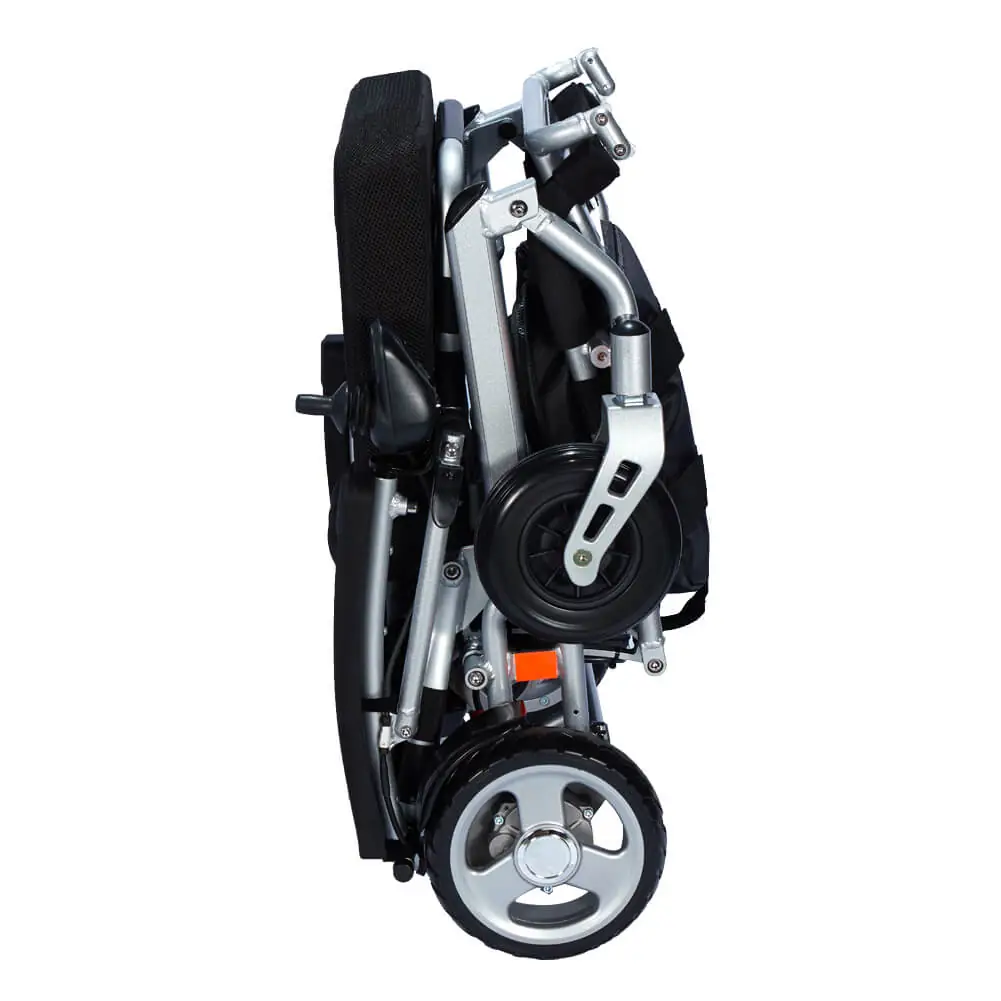
A folded chair looks small in a photograph. A fleet of folded chairs, plus chargers, plus room for staff to move around them, takes real space, and that space is often scarce in a terminal. Measure the folded footprint of the chair you are considering, then measure it again with footrests and armrests in their folded positions, because the shape your team actually stores may differ from the shape in a brochure.
Think about how chairs are stored, not just how small they fold. Upright storage needs different space from flat rack storage, and chairs that stay plugged in need power points, not just floor space. Leave room to pull one chair out without moving several others.
Storage question
What to measure
Example
Folded size
Length, width, and height when folded
e.g. 70 cm by 60 cm by 35 cm
Access space
Room to pull one chair out
e.g. 90 cm clear in front
Charging space
Power points near stored chairs
e.g. 6 sockets
Spare stock
Shelf space for fast-wearing parts
e.g. 1 shelf
Keep chairs dry, out of direct sun where possible, and in a space clear enough that a damaged chair is visible rather than hidden at the back. A tidy store is not just neat, it is how you spot problems early, and the same habits are set out in storing an electric wheelchair in a warehouse.
What Should You Ask a Factory Before You Order?
A factory conversation about a terminal fleet sounds different from one about a single chair. You are not asking which colour looks best, you are asking how the chair will survive a year of terminal work and how quickly you can get it back into service when something wears out. Take this list into the conversation and write down the answers, because those answers are what you will rely on later.
Ask about durability in terminal terms: folding cycles, joystick protection and replacement, and the recommended inspection routine. Ask about charging and batteries: the recommended pattern for repeated short trips, charging time, and whether a spare battery is available. Ask about cleaning: the IP rating, which parts it covers, and the recommended method. Ask about parts: which parts your team can swap, which wear fastest, and the lead time for the rest. Ask about storage: the true folded footprint, including armrests and footrests, and whether chairs can be stored upright.
Also ask about customisation that helps an operator. OEM options such as colours, logo placement, and packaging are practical in a terminal: a distinct colour or clear logo helps passengers and staff spot your chairs quickly, and packaging is worth specifying for transit. Judge the factory by its answers: concrete figures for folding cycles, charging, and lead times beat general promises.
If passengers ask about flying with a chair, keep the language precise. A chair used inside a terminal is not the same as a chair checked onto a flight, and no factory should promise airline approval for any chair. The correct wording is that a chair is designed for air travel (airline approval required), and staff should tell any passenger who asks about flying with a chair to check with their airline first. For the background your team may need when that question comes up, see can you take a folding electric wheelchair on an airplane.
Before committing to a large order, start small. Order one or two chairs, put them through real terminal shifts, and watch what your team reports: which parts loosen, how long charging takes in practice, how easy cleaning is between users, and how much space the chairs really need. That trial teaches more than any brochure.
What Do Airport Operators Ask Most Often?
How many chairs should we start with?
Start from your busiest hour, not your daily average, then add cover for charging and at least one spare for repair. A small trial fleet will quickly show whether your estimate was right, and it is easier to add chairs than to store chairs you do not need.
Can one chair really be used by many passengers in a day?
Yes, provided cleaning and checking are built into every handover. A quick wipe of the seat, armrests, and joystick, plus a glance at the folding lock and casters, keeps the chair presentable and catches small faults early.
What breaks first on a terminal fleet?
The moving and high-touch parts go first: folding joints, casters, armrest pads, footrests, and joysticks. Stock those parts on site, agree which swaps your team can do, and keep a simple log so repeat faults on one chair are easy to spot. A routine such as how to maintain a folding electric wheelchair gives that log a practical starting point.
Should we buy spare batteries?
It depends on your charging gaps. If your flight pattern leaves regular quiet periods, a good rotation may be enough. If your peak runs for hours with no gap, a spare battery, or a couple of extra chairs in rotation, will protect service far better than asking staff to rush a charge.
How do we keep chairs clean without damaging the electronics?
Ask for the IP rating and which parts it covers, then clean to that rating. Wipe high-touch parts between users, keep water and cleaning fluid away from the controller and connectors unless the rating supports it, and let chairs dry before the next passenger.
Is a cheaper chair good value for a terminal?
Not if it costs you chairs at peak time. A chair that is slightly cheaper to buy but slower to repair, harder to clean, or weaker at the folding joint can cost far more in lost service, spare cover, and staff time. Judge value over a year of terminal shifts, not just the purchase price.
How Should You Start?
A terminal fleet is a working system, not a shopping list. Size it from your peak hour, protect it with a charging rotation and a small stock of fast-wearing parts, clean it to its IP rating between users, and store it where staff can reach a ready chair quickly. Test your choice in real shifts before you scale. Done that way, electric wheelchairs for airports become a reliable part of passenger assistance: chairs ready when flights land, clean when passengers sit down, and back in service quickly when something wears out.
Key Takeaway: Start small, size from your peak hour, rotate charging, stock the parts that wear first, and only scale the fleet once a trial has proved itself in real terminal shifts. If you want to discuss a trial or fleet specification, contact the factory at alice@zvcare.com.
Founded in 2015, ZVCARE is an ISO 13485:2016 certified electric wheelchair manufacturer in China, providing OEM & ODM solutions for global distributors and medical stores.