Rain was not in the forecast. Halfway through a park visit, the sky opens up — and the rider’s first thought is not about getting wet, it is about the chair. The joystick, the battery box, the controller: how much water can they take? If you buy or sell electric wheelchairs, you have seen the answer on product pages a hundred times: “rainproof”, “waterproof”, “all-weather ready”. This guide explains what IP ratings mean for electric wheelchairs in plain terms — what the two digits promise, what they quietly do not, and how to tell a tested claim from a slogan.
What Do the Two Digits in an IP Rating Actually Mean?
IP stands for Ingress Protection: how well an enclosure keeps out solid objects and water. The code system is defined by the International Electrotechnical Commission in IEC 60529, the standard behind every “IP65” or “IPX4” label you see on electronics — from phones to factory control boxes.
The two digits each answer a different question. The first (0–6) rates protection against solid objects and dust; the second (0–9) rates protection against water. Higher is better, but the two scales are independent — a high water digit says nothing about dust, and vice versa.
First digit
What it means
0
No protection against solid objects
1
Blocks objects over 50 mm (e.g. the back of a hand)
2
Blocks objects over 12.5 mm (e.g. fingers)
3
Blocks objects over 2.5 mm (e.g. tools)
4
Blocks objects over 1 mm (e.g. wires)
5
Dust-protected — e.g. limited dust may enter, but not enough to interfere with operation
6
Dust-tight — e.g. no dust ingress at all
Second digit
What it means
0
No water protection
1
Vertically dripping water (e.g. condensation)
2
Dripping water with the enclosure tilted 15° (e.g. light angled drip)
3
Spraying water up to 60° from vertical (e.g. angled spray)
4
Splashing water from any direction (e.g. splashes from puddles)
5
Water jets from any direction (e.g. a garden hose at normal pressure)
6
Powerful water jets (e.g. heavy washdown)
7
Temporary immersion — the standard’s test is 1 m depth for 30 minutes
8
Continuous immersion under conditions the manufacturer specifies
9
High-pressure, high-temperature water jets (e.g. industrial hot washdown)
You will often see an X in place of a digit — IPX4, IP5X. The X means that side was not rated, not that it failed. IPX4 tells you about splashing water and nothing about dust; IP5X tells you about dust and nothing about water. Treat an X as a blank: not a zero, and not a promise either.
Key Takeaway: Read both digits separately. The first is about solids and dust, the second about water — and an X means that side was never tested, so do not assume anything about it.
Why Does “Waterproof” on a Product Page Mean Less Than You Think?
Here is the uncomfortable part: the word “waterproof” appears nowhere in IEC 60529. The standard only describes test results — how much water, from which direction, for how long. “Waterproof” is a marketing word laid over a test report, and the two are not the same thing.
Second, the tests run on new products in a laboratory. Seals are brand-new rubber, screws are torqued to spec, and nothing has vibrated loose yet. In real service, rubber gaskets harden with age and UV exposure, seals take a permanent set, and months of vibration loosen fasteners — each opening a path the lab test never saw.
Third, the test conditions are narrower than weather. The splash test behind IPX4 runs roughly ten minutes — a passing shower, not a monsoon afternoon. Real rain arrives with wind (which changes the angle of attack), road spray (which carries grit), and a duration the lab never attempted.
Fourth — and this surprises most buyers — a higher second digit does not always mean better rain protection. Under IEC 60529, an enclosure rated IPX7 (immersion) is not considered suitable for water jets (IPX5/IPX6) unless it carries both codes. Immersion and jets are different tests. For riding in rain, the jet digits (5 and 6) tell you more than the immersion digits (7 and 8).
Rain also changes what happens under the wheels, not just on the electronics — wet grass and mud behave nothing like dry pavement. Our guide to folding wheelchairs on grass, gravel and slopes covers the ground side of bad weather.
Key Takeaway: “Waterproof” is not a test result — it is a slogan. Ask which IP code was actually tested, on which parts, and remember the test ran for minutes on a brand-new unit in a lab.
What IP Ratings Mean for Electric Wheelchairs: Which Parts Need Protection Most?
An IP rating belongs to an enclosure, not to a vehicle. On a wheelchair, water lands unevenly, so some enclosures matter far more than others.
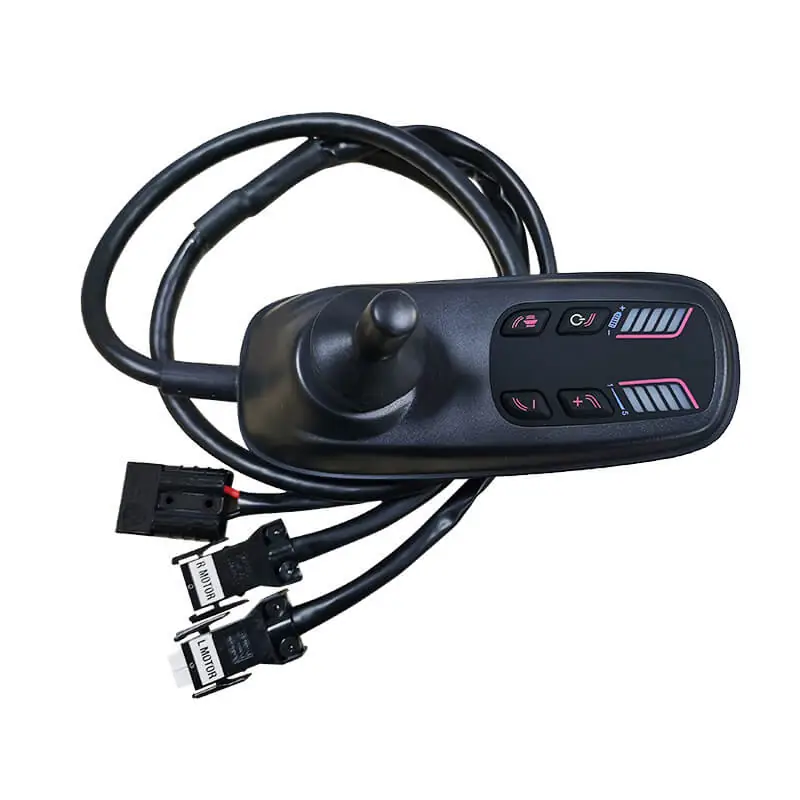
The joystick controller is the most exposed electronic part on the chair. It sits on the armrest at hand height, out in the open, and the rider’s own hands carry water straight to it. If any single part deserves a stated rating, it is this one.
Next come the battery box and its connectors. Water plus battery terminals means corrosion, and corroded contacts cause the intermittent faults that are hardest to diagnose — the chair that cuts out “sometimes”, only in damp weather. The charging port deserves the same attention: it should have a cover, and the cover should actually be closed during a ride, not merely present in the parts list.
Motors sit low, near road spray, which is why sealed hub construction matters — though “sealed” is another word worth interrogating with the five questions in the next section.
A word on how we state it ourselves: our chairs use electromagnetic brakes as standard and pair each motor with a matched iV1 (brushed) or iV2 (brushless) controller. Those are checkable component facts. Any water-protection claim — ours or anyone’s — should be backed the same way: with a test report, not adjectives.
Wet-weather braking is part of the wider safety picture. Our electric wheelchair safety features guide explains how electromagnetic brakes, anti-tip design and speed control work together to keep a rider safe.
Key Takeaway: Protection matters most where water actually lands: the joystick, the battery connections, and the charging port. A rating on the battery box says nothing about the joystick — ask part by part.
What Five Questions Should You Ask Before Trusting an IP Claim?
When a supplier quotes an IP code, these five questions separate a tested claim from a slogan. Ask them in writing — the answers belong in your supplier file.
1. Which parts carry the rating? A code on the controller housing does not cover the battery box, and neither covers the joystick. If the listing says “IPX5 wheelchair” without naming enclosures, the most important detail is missing.
2. What are the exact two digits? “Waterproof”, “rainproof” and “all-weather” are not digits. IPX4 and IPX6 describe very different afternoons. Get the code.
3. Who ran the test — and can I see the report? An independent lab report with a number you can verify beats an in-house test every time. No report, no claim.
4. What maintenance does the rating assume? Seals are wear parts. If the supplier cannot tell you how often gaskets should be inspected or replaced, the rating was a snapshot of a new product, not a maintenance plan.
5. What voids it? Pressure washing, submersion beyond the rated depth, opening the enclosure for repair, aftermarket modifications — know the exclusions before you promise anything to your own customers.
Treat the IP line the way you treat every other number on the page. Our guide to reading a specification sheet shows how to interrogate each figure instead of admiring it.
Key Takeaway: A real IP claim names the parts, the digits, the test report, the maintenance terms and the exclusions. Anything shorter is a slogan wearing a lab coat.
How Do You Keep Dust and Water Protection Working After Delivery?
Protection does not maintain itself. A few habits decide whether the rating on the test report still means anything a year later.
After rain, dry the chair — especially the joystick, the battery connectors and the charging-port area. Do not plug in the charger while anything is still wet; let the chair air-dry first. Water and charging current are a bad combination.
Never aim a pressure washer at the chair. Jets at close range can exceed even IPX5/IPX6 test conditions, and the standard itself warns that high-pressure cleaning may defeat protection the lab test confirmed. A damp cloth does the job.
Inspect the rubber gaskets and seals the way you inspect tires: look for cracks, hardening and gaps, and replace them before they fail. Check that the charging-port cover still closes firmly — a cover that hangs open protects nothing.
Store the chair under cover and out of standing water. A chair that sleeps in a dry place starts every rainy day with its seals in the best possible shape.
And remember that staying upright on wet pavement is about grip, not electronics. Our solid vs pneumatic tire comparison covers which tire suits wet conditions.
Key Takeaway: Seals are wear parts. Dry the chair after rain, never pressure-wash it, and check gaskets the way you check tires — before they fail, not after.
Once you can read the code, product pages get quieter — and more honest. Understanding what IP ratings mean for electric wheelchairs lets you compare suppliers on test results instead of adjectives, and lets your own customers ride in real weather with realistic expectations. If you want chairs built around verifiable components — electromagnetic brakes, matched iV1/iV2 controllers, a 36-month frame warranty with 6 months on the lead-acid battery, 12 months on the lithium battery, and 12 months on the motor and controller — contact the ZVCARE team. MOQ is 1 unit and lead time is 7 days after payment, so you can put a single chair through your own rain test before committing to more.
Frequently Asked Questions
Is an IPX4 wheelchair safe to ride in heavy rain?
IPX4 means the enclosure survived splashing water from all directions in a lab test lasting roughly ten minutes. Light rain and road splash sit inside that envelope; a sustained downpour does not. If your market gets heavy seasonal rain, treat IPX4 as “get home, then dry the chair” — not “ride all afternoon”.
Does the IP rating cover the whole wheelchair or just parts?
Usually just parts. A rating belongs to an enclosure — the controller housing, the battery box — not to the assembled vehicle. A listing that says “IPX5 wheelchair” without naming the tested enclosures skips the most important detail. Ask which parts were tested, in writing.
Can I clean my electric wheelchair with a hose?
Not with pressure. A hose at close range delivers water jets that can exceed IPX4 — and even IPX5 — test conditions, and the standard warns that high-pressure cleaning may defeat protection the lab confirmed. Wipe down with a damp cloth, dry the electrical contacts, and keep water away from the charging port.
If a chair is rated IPX7, does it handle rain better than one rated IPX5?
Not necessarily — this is the most misunderstood pair in the code. IPX7 covers temporary immersion, but the standard does not treat it as covering water jets, so an IPX7 enclosure is not automatically better in driving rain than an IPX5 one unless it carries both codes. For rain, the jet digits (5 and 6) matter more than the immersion digits (7 and 8).
Do IP ratings wear off over time?
The rating does not expire on paper, but the protection degrades in practice. Rubber seals harden, gaskets take a permanent set, and vibration loosens fasteners — each opening a path the lab test never saw. That is why the maintenance question matters: a rating is a snapshot of a new product, not a lifetime guarantee.
Founded in 2015, ZVCARE is an ISO 13485:2016 certified electric wheelchair manufacturer in China, providing OEM & ODM solutions for global distributors and medical stores.