How to Source Electric Wheelchairs at the Canton Fair
October 24, 2026
Every year, thousands of buyers fly to Guangzhou with the same plan: walk the halls, meet the factories, and come home with a supplier. If you want to source electric wheelchairs at the Canton Fair, the fair can be the most efficient week of your sourcing year — or the most expensive waste of a plane ticket. The difference is almost never luck. It is preparation.
This guide is the playbook we would hand a buyer friend: which phase to attend, what to prepare before you fly, the ten questions to ask at every wheelchair booth, how to spot a real factory, and the follow-up system that turns a stack of business cards into a signed supplier.
Which Phase of the Canton Fair Covers Electric Wheelchairs?
The Canton Fair runs in three phases, and each phase covers different product categories. Go in the wrong phase and you will find excellent luggage and toys — but no wheelchairs.
Electric wheelchairs are exhibited in Phase 3, under the medical devices and healthcare products categories. The fair’s own exhibitor directory lists “Health Care and Rehabilitation Equipment” — including rehabilitation equipment — as a Phase 3 category, and recent sessions have featured a dedicated Intelligent Healthcare zone with rehabilitation and mobility products. A wheelchair is rehabilitation equipment, so Phase 3 is where the wheelchair exhibitors are.
Do not rely on last year’s calendar. The fair holds two sessions a year (spring and autumn), and exact dates shift. Check the current session’s dates and phase product lists on the official website (cantonfair.org.cn) before you book anything — a wrong-phase trip is the single most expensive rookie mistake.
Key Takeaway: Electric wheelchairs are Phase 3 products (medical devices / rehabilitation equipment). Confirm the current session’s dates and phase lineup on the official website before booking flights.
What Should You Prepare Before You Fly to Guangzhou?
The buyers who get the most out of the fair do most of the work before they land. Here is the pre-show checklist:
Define your spec first. Write down, on one page: the models you want (folding, full-size, heavy-duty), target weight class, battery type (lithium vs lead-acid), must-have certifications for your market, and your target price band. If you cannot describe what you want on one page, no exhibitor can quote you accurately.
Turn the spec into an RFQ document. Bring a printed one-page RFQ — or better, have it ready to email from your phone. Booths are noisy and rushed; a written RFQ gets you a written answer. Our RFQ template for electric wheelchairs shows exactly what to put on that page.
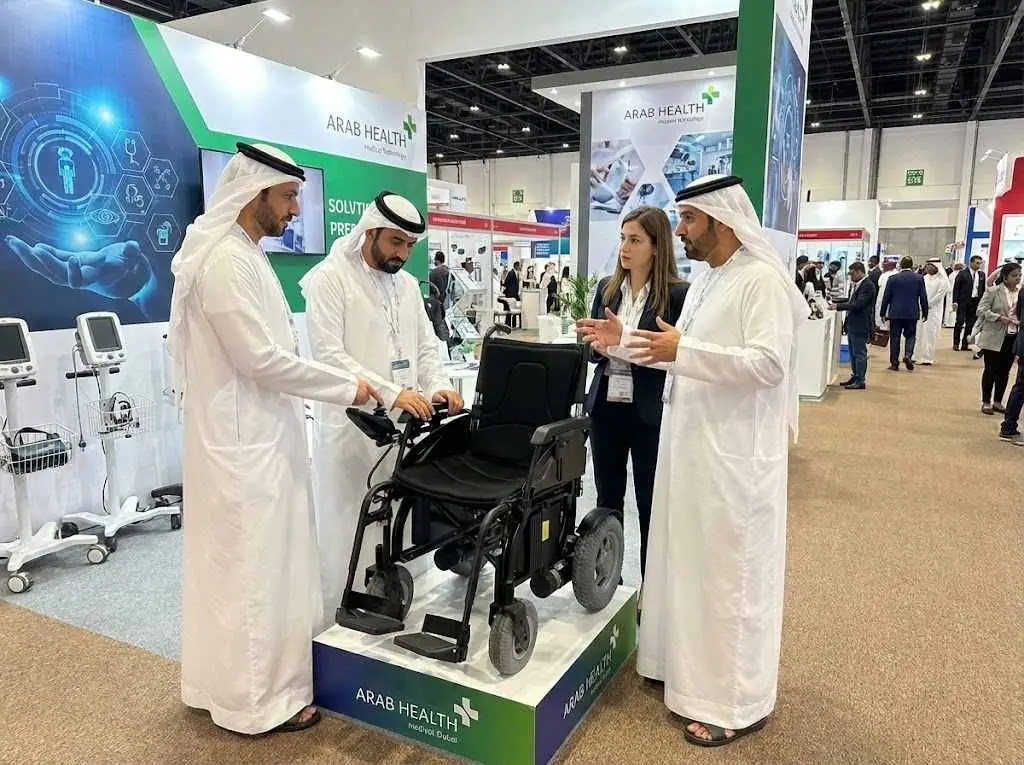
Shortlist exhibitors in advance. The official website publishes an exhibitor directory before each session. Search it for wheelchair and mobility exhibitors, note their booth locations, and email 5–10 of them to book appointments. The best conversations at the fair are the scheduled ones, not the walk-bys.
Prepare your questions. Print the ten booth questions from the next section and bring them. You will visit dozens of booths; without a fixed question list, every conversation blurs into the next.
Handle the logistics. You will need a valid passport, a business visa if your country requires one, and buyer pre-registration (available online before the fair — on-site registration means long queues). Bring comfortable shoes; the complex is enormous and you will walk all day. Bring more business cards than you think you need.
Key Takeaway: Arrive with a one-page spec, a ready-to-send RFQ, pre-booked appointments, and a printed question list. Preparation is what separates buyers who find suppliers from buyers who collect catalogs.
What Ten Questions Help You Source Electric Wheelchairs at the Canton Fair?
Ten questions. Ask all ten at every booth, and write down the answers before you walk away. The point is not just the answers — it is comparing answers across booths.
1. Are you the factory, or a trading company? Ask it directly, first. Then ask where the factory is and how many production workers it has. A real factory answers in specifics; a trading company answers in generalities.
2. Which of these models do you manufacture yourselves? Booths often display a wider range than the factory actually makes. Ask which models come off their own line and which are sourced from elsewhere. You want to know what you are actually buying.
3. What motor, controller, and battery go into this model? Ask for brands and model numbers, not just wattage. “250W motor” tells you almost nothing; the motor brand, controller model, and battery cell origin tell you everything about reliability and spare-parts availability.
4. What certifications ship with the goods — with certificate numbers? For the EU market, that means the CE Class I authorized-representative filing and ISO 13485 for the factory; for batteries, UN38.3 test reports. Ask to see the documents or at least the certificate numbers you can verify later. Vague answers here are the loudest warning sign in the hall.
5. What is your MOQ and lead time? Get both numbers in writing. For reference, our factory works at 1-unit MOQ with 7 days lead time after payment — use that as a benchmark for how a responsive factory answers, and be suspicious of anyone who cannot give you a straight number.
6. What are the warranty terms, exactly? “One-year warranty” is not an answer. Ask: frame for how long, battery for how long, motor and controller for how long — and what the claim process looks like. Our standard is 36 months on the frame and 6 months on the lead-acid battery, 12 months on the lithium battery, and 12 months each on the motor and controller, all in the contract.
7. What can you customize — and what can you not? If you are running an OEM project, this is the question that matters most. Colors, logo placement, packaging, and minor configuration changes are standard OEM work; structural redesigns are a different conversation. If you are unsure whether your project is OEM or ODM, our OEM vs ODM comparison draws the line.
8. Which markets do you already export to? A factory shipping regularly to your region understands your certification, voltage, and packaging requirements. A factory that has never shipped to your market is not disqualified — but you will be doing the market-education work.
9. What is the packaging data for this model? Carton dimensions, gross weight, units per carton. You need this for freight math, and a factory that cannot produce it on the spot is telling you something about its export maturity.
10. Can I visit your factory after the fair? The serious question. Real factories welcome it and will schedule it on the spot. Hesitation, deflection, or “we will arrange it later” is information — write it down.
Key Takeaway: Ten fixed questions, asked identically at every booth, turn a chaotic exhibition hall into comparable data. The factories worth pursuing are the ones whose answers stay specific under all ten.
How Do You Tell a Real Factory from a Trading Company at the Fair?
Beyond the direct question, watch for these tells:
Technical depth. Ask a follow-up that requires engineering knowledge — how the electromagnetic brake engages, what happens to the controller at low battery, why they chose a particular gear ratio. Factory engineers and experienced factory salespeople answer from knowledge. Trading-company staff answer from the brochure.
The spec sheet test. Ask for the full specification sheet with packaging data, not the glossy catalog. Factories produce detailed sheets; traders hand you marketing material. Compare what you receive against our factory evaluation guide, which lists exactly what a real factory’s documentation looks like.
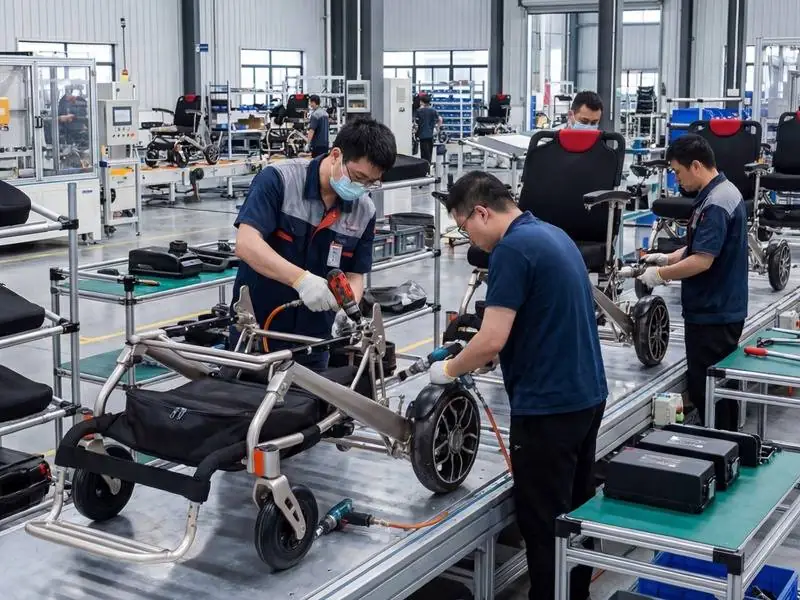
Evidence of production. Ask to see factory photos or a short video of the production floor — not the showroom, the floor. Two facilities totaling 3,000+ square meters looks very different from a rented office, and a real factory is proud to show it. We have operated our own two facilities since 2015, and we show them to every serious buyer.
The factory-visit test. As question 10 above: the willingness to schedule a visit, with a date, before you leave the booth. This single test filters out more pretenders than any other.
Key Takeaway: Do not trust the booth — trust the evidence. Technical depth, real documentation, production evidence, and a scheduled factory visit are four checks no trading company can fake at once.
What Should You Do After the Fair Ends?
The fair is the beginning, not the end. Most buyers waste the trip in the two weeks after it, when the business cards go cold. Here is the follow-up system:
Within 48 hours: organize. Photograph every business card next to your booth notes (you did take notes, right?). Score each supplier A/B/C while the conversations are fresh: A = visited-worthy, B = quote-worthy, C = archive. If you wait a week, every booth blurs together.
Week 1: send the RFQ. Email your one-page RFQ to every A and B supplier, referencing your booth conversation by name and date. Suppliers prioritize buyers who follow up fast and in writing — it signals you are real.
Weeks 2–3: compare quotations properly. Quotes will come back in different formats with different configurations. Do not compare headline prices — break each quote into its cost lines (frame, motor, battery, controller, certifications, packaging, commercial terms) and compare line by line. Our guide to why wheelchair quotes differ gives you the full breakdown framework.
Weeks 3–4: factory visits. Visit your shortlist in person. Nothing replaces standing on the production floor — and the fair gave you the appointment pipeline to do it efficiently. Ask your shortlisted suppliers where their factories are — many Guangdong-based manufacturers are within a few hours of Guangzhou, so a 2–3 day visit loop is often practical.
Month 2: trial order. Place a small trial order (this is where a 1-unit MOQ earns its keep) before committing to volume. Test the product, test the communication, test the documentation. Only then negotiate the container order.
Then: run the import process. Once the supplier is chosen and the trial passes, you move into shipping, customs, and delivery. Our complete import guide walks through that entire chain from RFQ to delivery.
Timing
Action
Purpose
48 hours after the fair
Organize cards + notes, score A/B/C
Strike while memory is fresh
Week 1
Send written RFQ to A/B suppliers
Get comparable, written quotes
Weeks 2–3
Break down and compare quotes line by line
Avoid headline-price traps
Weeks 3–4
Visit shortlisted factories
Verify with your own eyes
Month 2
Place a trial order
Test product and process at low risk
Key Takeaway: A fair without a follow-up system is an expensive holiday. Organize in 48 hours, RFQ in week 1, compare properly, visit, trial-order — then run the import process.
What Mistakes Do First-Time Buyers Make at the Fair?
Collecting catalogs instead of answers. A bag full of brochures and no written answers to the ten questions is worth nothing. The catalog goes in the bin; the answered question list becomes your supplier file.
Judging by booth size. Big booths are bought, not earned. Some of the best factories exhibit modestly; some of the flashiest booths belong to trading companies. Judge answers, not square meters.
Skipping the factory visit. The most common and most expensive mistake. A booth is marketing; a factory is reality. If you fly home without visiting at least your top two candidates, you have outsourced your most important verification step to hope.
Not checking certificates on the spot. Asking “do you have CE?” and accepting “yes” is not verification. Ask for the certificate number or the document, photograph it, verify it after the fair. Our supplier red-flags guide lists exactly which evasive answers to watch for — at the fair and after it.
Going dark after the fair. The suppliers you impressed at the booth will forget you in two weeks if you do not follow up. The follow-up cadence above exists because attention decays fast.
Key Takeaway: The fair rewards the systematic buyer: fixed questions, written answers, verified certificates, scheduled factory visits, and fast follow-up. Everything else is tourism.
Conclusion
The Canton Fair compresses months of supplier discovery into a few days — but only for buyers who treat it as a process, not a trip. Pick the right phase, arrive with a spec and an RFQ, ask the same ten questions everywhere, verify factories with your own eyes, and run the follow-up system without delay. Do that, and you will know how to source electric wheelchairs at the Canton Fair with a system most buyers walking those halls do not have.
If you would rather start the conversation before the fair — or skip the trip entirely — talk to us directly. ZVCARE is a Shenzhen electric wheelchair manufacturer operating two facilities totaling 3,000+ sqm since 2015: 1-unit MOQ, 7-day lead time after payment, and warranty terms (36 months frame; 6 months for lead-acid or 12 months for lithium battery; 12 months motor/controller) written into every contract. Contact the ZVCARE team with your spec, and we will quote it the way we would at the fair — in writing, line by line.
FAQ
Do I need to attend the Canton Fair in person, or can I source wheelchairs online?
You can do a great deal online — the official website runs an online platform year-round, and video calls handle most technical discussions. But the fair gives you two things the internet cannot: side-by-side comparison of dozens of suppliers in one day, and the factory-visit pipeline right after. If you are choosing a long-term supplier rather than placing a one-off order, the trip pays for itself.
How many days should I plan for the wheelchair section?
Wheelchair and rehabilitation exhibitors are a focused group within Phase 3, not the whole fair. Plan one to two full days for the wheelchair halls — one day for first-pass booth visits with the ten questions, a second day for returning to the shortlist and scheduling factory visits. Do not try to “see everything”; see your category deeply.
Can I place an order directly at the fair?
You can agree on terms at the fair, but treat any fair-floor agreement as a starting point, not a contract. Get the quotation in writing after the fair, confirm the exact configuration and certifications in the proforma invoice, and consider a trial order first. The suppliers worth working with will prefer it this way too — it protects both sides.
What documents should I bring to the fair?
Your passport, business visa (if required), buyer badge (pre-register online to skip the queues), business cards, and your one-page spec/RFQ — printed and on your phone. If you plan factory visits afterward, bring your company’s business license details; some factories ask for them before confirming a visit.
Is it worth visiting factories after the fair?
Yes — it is the highest-value part of the trip. The fair shows you who can talk; the factory shows you who can build. Plan 2–3 days after the fair for visits, prioritize your A-list suppliers, and use the same evaluation checklist at every site so the visits are comparable.
Founded in 2015, ZVCARE is an ISO 13485:2016 certified electric wheelchair manufacturer in China, providing OEM & ODM solutions for global distributors and medical stores.