Electric Wheelchairs for Convention Centers Buyers Guide
November 14, 2026
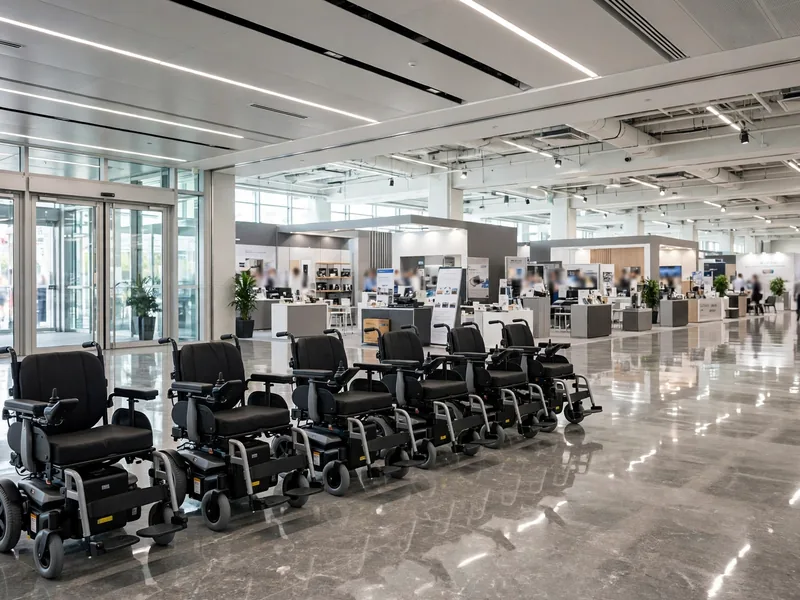
A convention center hosts thousands of visitors in a single day. Some of them cannot walk a big exhibition hall. A loan fleet at the entrance lets those visitors attend the event instead of leaving early. This electric wheelchairs for convention centers buyers guide helps convention center operations teams choose that fleet. It covers how many chairs you need, what works on a flat hall floor, and how to run turnaround, handover, and cleaning between sessions.
What Should You Check First in an Electric Wheelchairs for Convention Centers Buyers Guide?
Start with the building itself. Walk your largest hall the way a visitor does, from the entrance to the farthest booth and back. Note the distances, the turns, the doorways, and the lifts. A chair that works in a small meeting room may run short on a full day across a big hall. Your fleet has to match your floor, not a brochure.
Next, count who will use the chairs. Older attendees, visitors with a temporary injury, and exhibitors who spend all day on their feet all borrow chairs for different reasons. Some need a chair for an hour between sessions. Others need it for the whole day. That mix decides how many chairs you need and how long each battery has to last.
Finally, name the person who will run the fleet. In a convention center that means one owner on your operations team, with the loan desk staff covering breaks. That owner handles handover, charging, cleaning, and the morning check. Without an owner, chairs sit flat, dirty, or broken between sessions. With one, the fleet is ready every time the doors open.
Key Takeaway: Walk your largest hall first, count your borrowers, and give the fleet one owner on your team.
How Many Loan Chairs Does a Convention Center Actually Need?
Start with your biggest event, not your average day. A trade show with thousands of visitors needs far more chairs than a small conference. Ask your events team for the attendance of your largest show, then size the fleet for that day. A queue at the loan desk on your biggest day tells you the number faster than any plan.
Think in sessions, not just in chairs. A chair that runs all morning needs charging by the afternoon. If you have no spare to swap in, the next visitor waits. A small pool of spare chairs costs less than turning visitors away at the door. Keep the spares in the same room as the fleet, so a swap takes minutes.
Count your peak hours separately. The morning rush and the lunch break bring far more borrowers than a quiet afternoon session. Your fleet should cover the busiest hour, not the average hour. If the budget only covers part of the fleet now, buy the chairs for peak hours first and add the rest later.
Event size
Hall layout
Starting fleet
What to watch
Small conference
One hall, short distances
A few chairs at the entrance
Session breaks tell you when to add more
Medium trade show
Several halls, full-day visits
A full row plus one or two spares
Swap in a spare while a chair charges
Large expo
Many halls, thousands of visitors
A bigger fleet with spares at more than one point
Cover the busiest hour, not the average hour
Key Takeaway: Size the fleet for your biggest event, watch the busy hours, and keep spares ready so no visitor waits.
What Makes a Wheelchair Work in a Big Exhibition Hall?
Exhibition halls are flat, wide, and crowded. A chair for a convention center needs tight turning in aisles, steady speed in crowds, and a comfortable seat for a full day. Big halls mean long distances, so battery range decides how far a visitor can go. A chair with a range of 18–22 km covers a full event day for most visitors. Shorter-range folding chairs suit a small conference or a short visit.
The chair should also be easy to drive in a crowd. A simple joystick, a clear speed control, and a reliable brake matter more here than off-road ability. Your team should test-drive the chairs in a hall with booths and people in it, not only on an empty floor. A chair that is hard to steer in a crowd will cause more problems than it solves.
The chair should run quietly too. A loud motor disturbs sessions and other visitors. Ask the supplier how the chair sounds at walking speed, and test it yourself in a quiet corner of the hall. A quiet chair fits a convention center far better than a noisy one. The same thinking applies to stadiums, as our guide to electric wheelchairs for stadiums shows — a stadium runs match-day crowds outdoors, while a convention center runs all-day crowds indoors, so the floor decides the chair.
Key Takeaway: Test-drive in a crowded hall, match range to a full event day, and pick a quiet chair.
How Should a Convention Center Run Turnaround Between Sessions?
Turnaround is the work between sessions. When a chair comes back, staff should check the battery, wipe the seat, and plug it in before the next loan. That three-step check takes a minute. It keeps the next visitor from getting a flat or dirty chair. Build the check into the break, so it happens every time.
Give the fleet one storage room near the main entrance, with a charging point for every chair. Plug each chair in when it comes back, so the next session starts with a full fleet. A chair that is not plugged in is a chair that will fail mid-session. Keep the chargers labeled by chair number, so staff can see at a glance which chair is charging and which is ready.
Plan for the busiest break of the day. The lunch break brings the most returns and the most new loans at once. Put an extra staff member on the loan desk for that break. A short queue is fine. A long one is not, and one extra person prevents it.
Turnaround step
When
Who does it
What to check
Battery check
On every return
Loan desk staff
Battery level, plug in if low
Wipe-down
On every return
Loan desk staff
Seat, armrests, controls
Swap in a spare
When a chair is flat or faulty
Fleet owner
Spare chair ready at the desk
Full check
Start of each event day
Fleet owner
Drive, brake, battery, wheels
Key Takeaway: Check, wipe, and plug in on every return — and staff the busiest break.
What Should the Handover Look Like at the Registration Desk?
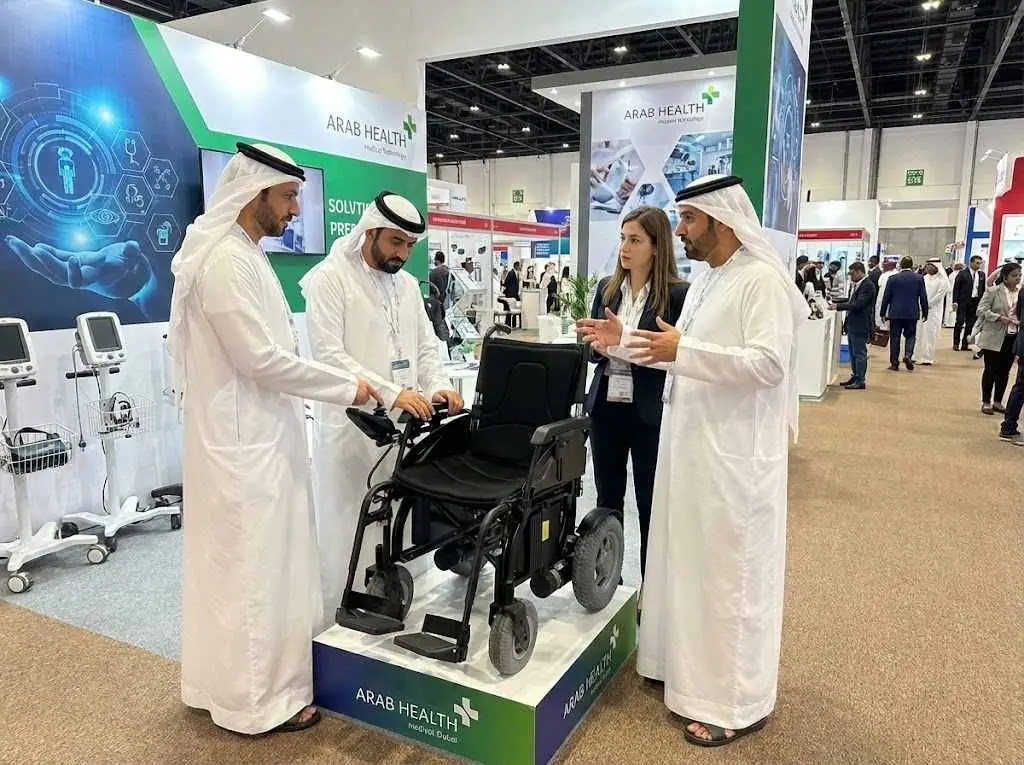
Handover at a registration desk should take minutes, not a form. Keep a short sign-out sheet: name, time out, chair number, and time back. Walk the attendee through the controls, the speed setting, and the brake before they leave the desk. A two-minute demo prevents most problems once the halls fill up.
Set a simple rule for the deposit or ID. Most venues hold an ID card and return it when the chair comes back. Keep the rule the same for every visitor, and write it on a small sign at the desk. A clear rule avoids arguments at the end of a long day.
Place the loan desk where visitors can find it. The main entrance is best, with a clear sign and a few chairs visible. If your center has more than one entrance, put the fleet at the busiest one and keep spares at the other. Our guide to electric wheelchairs for airports shows the same handover habit in a busy transport setting — the steps are the same, only the crowd differs.
Key Takeaway: A two-minute demo, one short sign-out sheet, and a desk visitors can find.
How Do You Keep a Convention Center Loan Fleet Clean and Working?
Clean the chairs between sessions, not just at the end of the day. Exhibition dust and spilled drinks get onto seats, armrests, and controls during a long event day. Wipe each chair when it comes back, and wash the seat covers between events. A clean chair is part of the event, not a chore to skip.
Check each chair every morning before the doors open. Test the drive, the brake, and the battery level. Listen for a new noise and feel for a wobble in the wheels. A five-minute check catches small faults before they become a breakdown in the middle of a hall.
Keep a simple log for each chair. Note the date, the event, the check, and any part you replaced. The log shows which chairs need more attention and when a battery is getting old. It also helps you plan the next order, because you can see which models held up best across your events.
Key Takeaway: Clean on return, check every morning, and keep a log per chair.
Which Electric Wheelchair Models Fit a Convention Center Loan Fleet Best?
A convention center fleet needs chairs that are easy to drive, easy to store, and comfortable for a full day indoors. The EW8722 is a comfortable and durable small-wheel chair at 45 kg, with a range of 18–22 km. It suits all-day event use. The EW8720 is a comfortable daily model at 45 kg with a range of 18–22 km, powered by dual 12V 22.3Ah lead-acid batteries in series, which gives 24V 22.3Ah. Both are good main fleet chairs.
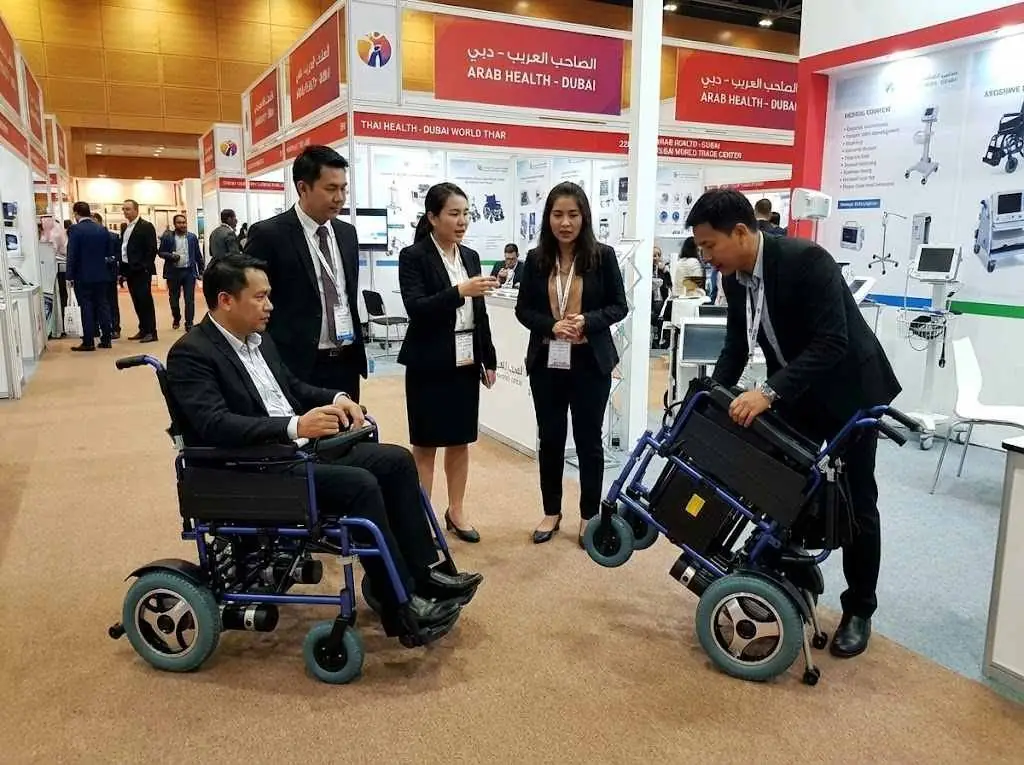
For smaller conferences or short visits, folding models also work. The EW1000 is a carbon fiber folding chair at 15 kg including the battery, with a folded size of 73×39×71 cm and a range of 15±3 km. The EW100 is the aluminum alloy alternative at 23 kg, folding to 73×55.5×31 cm with a range of 12±5 km. Folding chairs store in less space, which helps when your storage room is small. The EW8703G big-wheel model at 46 kg suits outdoor areas between halls, with a range of 18–22 km. All models run on a 24V system. Pick one main model for the fleet and keep the rest as spares, so staff learn one chair properly.
Model
Weight
Range
Battery
Best for
EW8722
45 kg
18–22 km
24V
Comfortable all-day event use
EW8720
45 kg
18–22 km
Dual 12V 22.3Ah lead-acid in series = 24V 22.3Ah
Daily use, long battery life
EW1000
15 kg incl. battery
15±3 km
24V 10Ah lithium
Small conference, easy storage
EW100
23 kg
12±5 km
24V
Short visits, easy storage
EW8703G
46 kg
18–22 km
24V
Outdoor areas between halls
Key Takeaway: Pick one main model for the fleet, match it to your halls, and keep the rest as spares.
What Are the Common Mistakes Convention Centers Make When They Buy a Loan Fleet?
The first mistake is buying on price alone. The cheapest chair often has the shortest range and the least comfortable seat for a full day. A chair that runs out mid-event costs more in unhappy visitors than the saving was worth. Buy for your floor, not for the lowest price.
The second mistake is skipping the test drive. A chair that looks right in a catalog may feel wrong in a crowded aisle or at the far end of a big hall. Test every model in a hall with booths and people in it before you order. Bring the supplier to the center and walk the route together.
The third mistake is buying the fleet without a storage and charging plan. Chairs with no charger each end up flat by midday, and chairs stored in a corridor get damaged. Sort the room and the chargers before the chairs arrive.
The fourth mistake is leaving the fleet to whoever is free. A loan fleet with no named owner slowly falls apart. Chairs go out dirty, come back flat, and sit broken for weeks. Name one owner, give them the morning check and the log, and the fleet stays working through the whole event. And remember the other side of events: choosing which trade show to attend is a different job, as our guide on how distributors choose electric wheelchair trade shows explains — that guide is for dealers picking a show, while this one is for the venue buying the fleet.
Key Takeaway: Buy for your floor, test-drive in a crowd, sort storage first, and name one owner.
Conclusion
This electric wheelchairs for convention centers buyers guide comes down to four things: match the chair to your halls, size the fleet for your biggest event, run turnaround as a routine between sessions, and give the fleet one owner. Walk your largest hall first, test-drive the models in a crowd, and start with a fleet that covers the busiest hour. If you want a supplier who works the same way, ZVCARE — Shenzhen Zhiwei Health Technology Co., Ltd., founded in 2015, with two production facilities totaling 3000+ sqm and ISO 13485:2016 certification — offers a minimum order quantity of 1 unit, a lead time of 7 days after payment, and spare parts support. Contact us to discuss a loan fleet for your convention center.
FAQ
How many electric wheelchairs should a convention center buy for a loan fleet?
Start with your biggest event, not your average day. A trade show with thousands of visitors needs far more chairs than a small conference. Watch the busiest hour of your largest show before you order more — a queue at the loan desk tells you the number faster than any plan.
Which electric wheelchair works best in a convention center?
A chair with tight turning in aisles, a simple joystick, a reliable brake, and a range that covers a full event day. The EW8722 suits all-day event use at 45 kg with a range of 18–22 km. The EW8720 is a comfortable daily model at 45 kg with a range of 18–22 km.
How do convention centers charge a loan fleet of electric wheelchairs?
Give the fleet one storage room near the main entrance, with a charging point for every chair. Plug each chair in when it comes back, so the next session starts with a full fleet. Keep the chargers labeled by chair number, so staff can see at a glance which chair is ready.
Do visitors need to pay to borrow a wheelchair at a convention center?
That is your venue’s own policy. A common approach is to lend chairs free with an ID held as a deposit. Keep the rule the same for every visitor and write it on a small sign at the desk, so there is no argument at the end of a long day.
How do convention centers keep loan wheelchairs clean?
Wipe each chair when it comes back, and wash the seat covers between events. Check every chair each morning before the doors open: drive, brake, battery, and wheels. Keep a simple log for each chair, so you can see which models held up best across your events.
Founded in 2015, ZVCARE is an ISO 13485:2016 certified electric wheelchair manufacturer in China, providing OEM & ODM solutions for global distributors and medical stores.