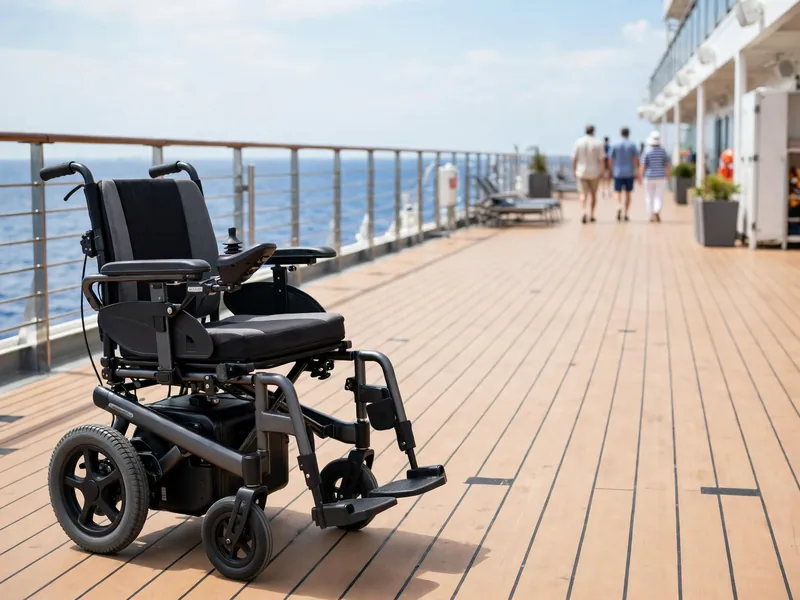
Electric Wheelchairs for Cruise Ships Buyers Guide
November 9, 2026
A cruise ship is a floating hotel, a restaurant, a theatre and a small town packed into one hull, and every guest who needs a wheelchair expects to move through all of it without a fuss. This Electric Wheelchairs for Cruise Ships Buyers Guide is written for the cruise-line fleet buyer who has to make that happen, not for a traveller packing for one holiday. It covers how a fleet of loaner chairs is stored, charged, moved and maintained on board, and what to ask a supplier before ordering.
Buying loaner chairs for a ship is a different job from buying chairs for a shop or a clinic. The chairs will be used by a new guest almost every sailing, folded and unfolded by crew who are in a hurry, charged from ship power, and rolled through salt air day after day. A chair that is perfect in a showroom can still be the wrong choice on board if it is awkward to fold, hard to charge, or tiring for crew to lift into a cabin.
What does a cruise line actually need from a fleet of loaner wheelchairs?
A cruise line needs chairs any guest can use with little instruction, and any crew member can fold, carry and charge without special training. Guests who borrow a chair may never have used a powered chair before, so the controls should be simple and the seating should feel steady and secure from the first minute. The same chairs will serve different guests all week, so they need to be easy to wipe down and quick to check between loans.
The fleet also has to fit the way a ship is run. Chairs are loaned out at embarkation, collected at the end of a sailing, and stored out of the way in between. So the buying decision covers storage space, charging points, spare parts and who on board is responsible for each chair, not only the chair itself. A buyer who plans those four things before ordering will have far fewer problems than one who only compares chairs.
Key Takeaway: Buy for the service, not the specification sheet — simple controls, easy folding, and a clear plan for storage, charging and care matter more than any single feature.
How much cabin space does a folded wheelchair really take?
Cabins on a cruise ship are compact, and a loaner chair has to fit the space a guest actually has. Compare the folded size of each model with the cabin storage the cruise line can offer. A chair that folds flat can slide beside a wardrobe, while a chair that stays bulky when folded will end up blocking the cabin door.
The lightest models here fold down small enough to store in a standard cabin without taking over the room. The EW1000 folds to 73×39×71 cm, and the EW100 folds to 73×55.5×31 cm, so both can be tucked away when not in use. The EW8722 is a heavier chair that folds to 80×39×74 cm, suiting guests who need a sturdier chair and cabins with a little more storage room.
Before ordering, ask the cruise line for the storage space in the cabin types where loaner chairs will be used, and check the folded dimensions against that space rather than against a guess. If chairs will live in a crew storage room between sailings, check how many folded chairs it can hold. A fleet with nowhere to live ends up in corridors, and corridors on a ship are working space, not storage.
Key Takeaway: Match the folded size to real cabin and storage space on the ship, and confirm that space before ordering rather than assuming a chair will fit.
How does charging work on board a ship?
Charging on board is straightforward as long as it is planned, and a headache if left to chance. Each chair runs on a 24V battery system, and its charger plugs into a standard power outlet, so the real question is where the outlets are and who manages the routine. A ship that charges chairs in a crew service area, on a set routine at the end of each day, will always have charged chairs ready in the morning.
The routine matters more than the hardware: assign charging to one role on board, keep a simple log of which chairs were charged, and check the battery before a chair goes out on loan. Lithium batteries carry a 12 month warranty and lead-acid batteries a 6 month warranty, so noting battery age and condition helps the cruise line plan replacements before a battery starts to fade.
Ask the supplier what charger comes with each chair and whether spare chargers can be ordered with the fleet. A chair without a working charger cannot be loaned, so keep spares with the chairs, clearly labelled, instead of hunting through stores when a sailing is about to start.
Key Takeaway: Charging works when one crew role owns it, with a set place, a set routine, and a spare charger on hand — plan the routine before the fleet arrives.
How do wheelchairs move through corridors, lifts and gangways?
Movement on board is about practice, not speed. Corridors, lifts and gangways are shared spaces, and a guest in a loaner chair will be moving through them alongside other guests, crew with trolleys, and luggage. The crew member who delivers a chair should walk the route with the guest the first time, showing where to wait for a lift and how to approach the gangway, rather than leaving the guest to work it out alone.
Gangway boarding deserves special attention because it is the first and last experience a guest has of the ship. Crew should be present at the gangway whenever a loaner chair is boarding, and the guest should never be rushed. If a chair is easier to board folded, crew should be ready to fold it, carry it on board, and unfold it on the other side. A light chair makes that job far easier, which is one reason weight matters as much as folded size.
A buyer who has read our guide to electric wheelchairs for airports will recognise the pattern: boarding flow, waiting areas and crew handover matter more than the chair itself. Our guide to electric wheelchairs for shopping malls makes the same point about busy shared spaces. The safety framework for passenger ships is set by the International Maritime Organization, and its passenger ship safety pages are a useful reference on the rules a ship operates under.
Key Takeaway: Walk the route with the guest, staff the gangway at boarding, and treat movement on board as a practised crew routine rather than something guests work out alone.
Which models work best for ship use?
There is no single best chair for every ship, because ships differ in cabin size, guest profile and how the fleet will be used. The table below compares the likely models on confirmed specifications only. Weight matters because crew lift and fold these chairs constantly, folded size matters because cabin space is limited, and range matters because guests use the chair all day, including ashore.
Model
Weight including battery
Folded size
Range
EW1000 carbon fiber
15 kg
73×39×71 cm
15±3 km
EW100 aluminum alloy
23 kg
73×55.5×31 cm
12±5 km
EW8722 durable folding
45 kg
80×39×74 cm
18–22 km
The EW1000 is the easiest chair for crew to handle at 15 kg including the battery, and its carbon fiber frame keeps it light without giving up strength, suiting ships where crew fold and carry chairs often and cabin storage is tight. The EW100 is the practical middle ground at 23 kg, with a slim folded shape that stores neatly in a cabin and an aluminum alloy frame built for daily use. The EW8722, at 45 kg, is the sturdier choice for guests who need a more durable chair, with the longest range of the three for long days ashore.
A sensible fleet is often a mix rather than a single model: mostly light chairs for general loan, with a smaller number of sturdier chairs for guests who need them. The mix stays simple to store and charge, since all three models run on the same 24V system. Talk through the mix with the supplier before ordering, and make sure the spare parts list covers every model in the fleet.
Key Takeaway: Choose on weight, folded size and range together, and consider a mixed fleet of mostly light chairs plus a smaller number of sturdier ones.
How does salt air and heavy daily use affect a wheelchair fleet?
Salt air and constant use wear a shipboard fleet out faster than the same chairs would wear out on land. Salt settles on metal parts and electrical contacts, and a chair used by a different guest every sailing never gets a rest. Powered chairs can still work on a cruise ship, but the fleet needs a cleaning and inspection routine a land-based fleet could skip.
The routine is simple: wipe the chair down after each loan, paying attention to the frame, the joystick and the charging port, and keep chairs dry in storage. Check moving parts for stiffness or noise, and battery contacts for corrosion. A chair cleaned and checked between loans lasts far longer than one only looked at when something breaks.
Heavy daily use wears parts out, and that is normal rather than a sign of a bad chair. Casters, armrest pads and batteries work hardest, so the fleet order should include spares of each from the start. Our electric wheelchair spare parts page lists the consumables to plan for, and ordering spares with the chairs beats ordering them one at a time after a chair has gone out of service. Schools face the same pattern of shared chairs and heavy daily use, and our guide to electric wheelchairs for schools covers how a shared fleet is kept in service.
Key Takeaway: Salt air and constant use wear a fleet out faster, so wipe chairs down between loans, inspect moving parts and battery contacts, and hold spares of the parts that work hardest.
What should a cruise line ask a supplier before placing a fleet order?
A fleet order is a relationship, not a single purchase, so the questions a buyer asks before ordering matter as much as the chairs themselves. The table below lists the questions that separate a supplier who understands fleet buyers from one who only sells single chairs.
Question to ask
Why it matters on a ship
What a good answer sounds like
What is the minimum order quantity?
A line may want a small trial fleet first
A low minimum, starting from 1 unit
How long is the lead time?
Ships work to sailing schedules
A clear lead time, such as 7 days after payment
What does the warranty cover?
Hard use needs a clear fault route
Frame 36 months, motor and controller 12 months each, battery lead-acid 6 months and lithium 12 months
How is quality checked before shipping?
A fault found on board is hard to fix
100 percent visual inspection before dispatch
Can you supply spare parts and chargers?
No parts means a chair out of service
Spares and chargers available with the fleet order
Do you work with other fleet buyers?
Fleet experience shows in the advice
A track record, such as 50 plus global partners
Beyond the table, ask how the supplier handles a fault found after delivery, and who the cruise line contacts when a chair needs attention mid-season. Ask whether the same model will stay available for repeat orders, because a fleet that grows with one model stays simple to maintain, while mixed generations become a parts headache. Hotels ask many of the same questions when they set up a loaner fleet, and our guide to electric wheelchairs for hotels is a useful comparison for a buyer who wants to see how another hospitality fleet is planned.
Key Takeaway: Ask about minimum order, lead time, warranty, inspection, spares and fleet experience before ordering, and judge the supplier on how plainly those questions are answered.
How should a cruise line look after its wheelchair fleet day to day?
Day-to-day care is a short routine done well, every day, rather than a big job done occasionally. At the end of each sailing, every loaned chair should come back to storage, be wiped down, checked for damage, and put on charge if it needs it. A chair that comes back damaged should be tagged and set aside, not sent straight back out. That habit prevents most problems that turn into guest complaints.
Keep a simple record for each chair: when it was loaned, what was checked on return, and when parts were replaced. That record is the only way to spot a chair that keeps coming back with the same fault, or a battery fading faster than the rest. When a chair shows the same fault more than once, take it out of service and find the cause.
Crew training is the other half of fleet care. Everyone who handles the chairs should know how to fold and unfold each model, how to check the battery, and who to call when something is wrong. A short hands-on session when the fleet arrives, plus a refresher when new crew join, covers it.
Key Takeaway: Bring every chair back, wipe it down, check it, charge it, tag damage, keep a simple record per chair, and train every crew member who handles the fleet.
Conclusion
A cruise-line wheelchair fleet succeeds when the buying decision starts from life on board rather than from a catalogue. Light chairs crew can fold and carry, folded sizes that fit real cabins, a charging routine with a named owner, practised movement through corridors and gangways, and a spares shelf stocked before it is needed — those are the things guests actually feel. The models in this guide cover the range a cruise line needs, from the 15 kg EW1000 to the sturdier EW8722, and the supplier questions in this guide give a buyer the facts to order with confidence. Get those basics right, and the fleet becomes a quiet part of good service that guests remember for the right reasons.
FAQ
Can a cruise line start with a small trial fleet before ordering more?
Yes, and it is the sensible way to buy. The minimum order quantity starts from 1 unit, so a cruise line can trial chairs on one ship, learn how guests and crew use them, and then order the full fleet with real experience behind the decision.
Where should loaner wheelchairs be stored on board?
Folded chairs should be stored where crew can reach them quickly at embarkation, dry and out of the way of guests. Cabins work for chairs on loan, and a crew storage area works for the rest of the fleet between sailings. Check folded sizes against the storage available, and do not store chairs in corridors, which are working space on a ship.
How long do the batteries last on a day ashore?
Range depends on the model, the guest, and how the chair is used, so there is no single answer for every sailing. The EW1000 covers 15±3 km, the EW100 covers 12±5 km, and the EW8722 covers 18–22 km. Crew should check the battery before each loan, and send the chair out fully charged.
What happens if a loaner wheelchair breaks down during a sailing?
Take the chair out of service, give the guest a replacement if one is available, and tag the faulty chair for inspection. Keep spare parts and a spare charger on board so small faults can be fixed without waiting for shore. Warranty faults go to the supplier: frame 36 months, motor and controller 12 months each, batteries 6 months for lead-acid and 12 months for lithium.
Do cruise lines need a different wheelchair from hotels or airports?
The chairs are often the same models, but the fleet plan differs, because a ship combines cabin storage, onboard charging, gangway boarding and salt air in one place. Hotels plan around rooms and lobbies, airports around terminals and boarding, so the buying questions overlap but the answers depend on the venue.
Founded in 2015, ZVCARE is an ISO 13485:2016 certified electric wheelchair manufacturer in China, providing OEM & ODM solutions for global distributors and medical stores.