How Distributors Build an Electric Wheelchair Service Team
November 11, 2026
A distributor can stock the right chairs and keep spare parts on the shelf, and still lose customers if the people behind the service desk are not organized. A buyer who waits days for an answer, gets a different story from each technician, or watches a repair start over because the first technician left will not come back. Building a service team is not about hiring as many technicians as you can afford. It is about giving each person a clear role, a clear standard for the work they can do alone, and a way to pass work to the next person without losing information. This guide covers how distributors build an electric wheelchair service team: the roles, where to find technicians, how to judge skill, how to schedule the week, how to hand work over, how to bring a new hire up to speed, and how to keep the good ones.
How Distributors Build an Electric Wheelchair Service Team: The Roles You Actually Need
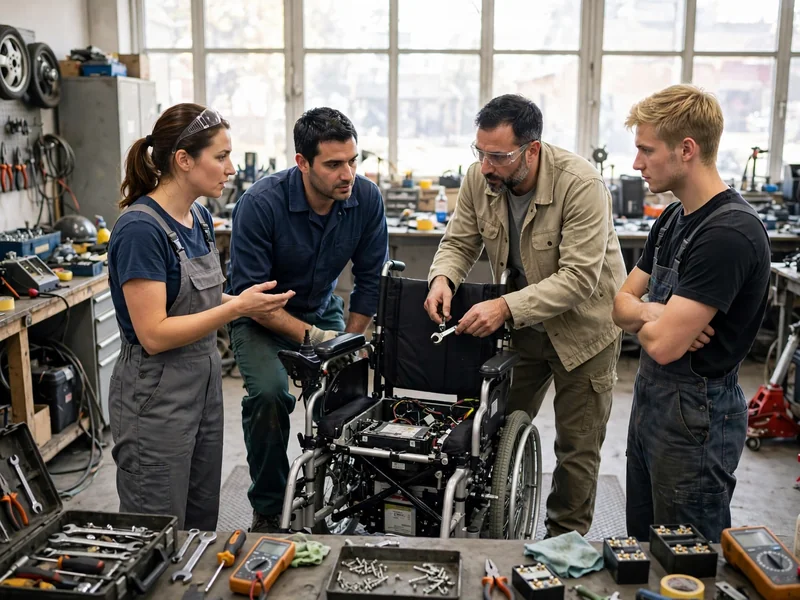
A small service team needs four roles, and in a very small business one person may cover more than one — but the roles should still be named, because unnamed work gets dropped. The lead technician decides what a repair needs, checks work before a chair goes back to a customer, and handles the jobs nobody else can solve. The bench technician does repair work at your premises: fitting a new controller, swapping a motor, testing a charger, and running a safety check after the repair. The field technician does the same kind of work at the customer’s home or a care facility, where the chair cannot easily be brought in. The service coordinator answers the customer, books the job, keeps the record, and tells the customer when the chair will be ready.
The coordinator role is the one distributors most often skip, and it is the one customers notice first. A technician who is also answering the phone, booking jobs, and chasing parts will do all of them badly. Even if the coordinator is part-time, give the job a name and a set of hours, so a customer always knows who to call and a technician always knows which job comes next.
Key Takeaway: Name four roles — lead technician, bench technician, field technician, and service coordinator — even if one person covers two of them at the start.
How Many Technicians Do You Need to Start?
Start with a lead technician and one bench technician, plus someone to coordinate bookings and customer calls. That team can handle the early volume of a new distributorship, because most early jobs are straightforward: a controller swap, a motor replacement, a charger test, or a safety check after a repair. What matters at this stage is not headcount but coverage — someone available to answer a customer, someone able to do the repair, and someone able to check the work before the chair is returned.
Add your next person when the signs are consistent, not when one busy week panics you: a waiting list that never clears, repairs sitting untouched because the technician is out on field visits, or customers waiting days for a first answer. When that happens, add a field technician first if most of the delay comes from travel, or a second bench technician if jobs are piling up at your premises. Each addition should solve a specific bottleneck you can name. As your service footprint grows, where each technician is based is a network question, covered in our guide to how distributors build an after-sales service network.
Where Do Distributors Find Good Service Technicians?
The best technicians for electric wheelchairs usually come from neighboring trades, not from a job board headline. Look for people who already repair mobility scooters, bicycles with electric assist, medical equipment, or small electric vehicles. They already understand batteries, wiring, and motors, and they know how to work safely around a customer. A general mechanic can also learn the work, but a candidate who has already handled a powered mobility product will reach useful speed faster.
Practical places to look include local mobility shops, medical equipment repair firms, vocational schools with electrical or mechatronics courses, and your own customer network. Ask your existing trade contacts who they would hire themselves — a recommendation from another repair business is worth more than a polished resume.
How Do You Hire a Technician Who Can Actually Do the Job?
A resume tells you where a technician has worked, not what they can fix. The interview should therefore include a practical test on a real chair. Give the candidate a chair with a known, common fault — a controller that needs swapping, a motor that needs replacing, a charger that needs testing — and watch how they work. Do they check the battery and the wiring before they replace a part? Do they test the chair after the repair, or hand it back untested? Do they write down what they did? The test does not need to be hard. It needs to show whether the person works in a careful, repeatable way.
Ask about the rest of the job as well. A field technician needs to be comfortable in a customer’s home, explaining a repair in plain language. A bench technician needs to be comfortable keeping records and following a checklist. Ask for an example of a repair that went wrong and what the candidate did next — the answer tells you more about judgment than any certificate does.
What Should a Junior Technician Be Able to Do — and What Marks a Senior?
Skill tiers only work if they are written down and tied to real tasks. If “senior” means whatever the longest-serving technician says it means, you cannot schedule jobs fairly, judge a new hire, or explain a promotion. Define three tiers and the jobs each tier may do alone, the jobs that need a second pair of eyes, and the jobs that belong to the lead technician only.
A junior technician should be able to do routine, repeatable work: safety checks, battery and charger tests, cleaning and adjustment, and replacing a part under supervision. An experienced technician should be able to diagnose a fault from the customer’s description, carry out a controller or motor swap alone, test the chair properly after the repair, and keep a clear written record. A senior technician — usually your lead technician — should be able to diagnose the faults nobody else can pin down, decide when a chair is safe to return, train other technicians, and talk a customer through a difficult decision, such as whether a repair is worth doing under warranty or outside it. A senior should know the warranty terms — frame 36 months, motor and controller 12 months each, battery 6 months for lead-acid or 12 months for lithium — well enough to give a straight answer; the process is covered in our guide on how distributors handle electric wheelchair warranty repairs.
Skill tier
Can do alone
Needs a check
Does not do alone
Junior technician
Safety checks, battery and charger tests, cleaning and adjustment
Part replacement, any first repair on a new model
Fault diagnosis, returning a chair to a customer
Experienced technician
Fault diagnosis, controller and motor swaps, testing after repair, written records
Unusual faults, borderline warranty decisions
Training sign-off, final say on a disputed repair
Senior or lead technician
Complex diagnosis, final safety sign-off, training others, difficult customer decisions
A second opinion on a safety doubt is still good practice
Nothing is off limits, but the lead still records every decision
Key Takeaway: Write down three skill tiers with the jobs each tier may do alone, and promote on demonstrated work, not on time served.
How Do You Schedule Technicians Without Leaving Customers Waiting?
Scheduling is where a good team either earns its reputation or loses it. The basic rule is simple: book field visits and bench work as separate blocks, and never let one fill the other’s time. A bench technician pulled out to a field visit leaves a row of half-finished chairs behind, and a field technician called back to the bench leaves a customer waiting at home. Give each technician a day plan they can see in the morning, with the jobs, addresses, parts, and customer contacts on it.
Leave room in every week for the jobs you cannot predict. Breakdowns do not book ahead, and a schedule with no slack means every urgent job pushes a booked job late. Keep one slot each day, or one morning each week, unbooked for urgent repairs, and protect it: it is not free time, it is the reason your booked customers stay on schedule. The coordinator owns the schedule, and the technicians own telling the coordinator early when a job will run long.
Regular maintenance visits deserve their own rhythm, separate from breakdown work. A standing maintenance plan gives customers a date they can expect and gives your team work you can plan weeks ahead — see our guide to electric wheelchair maintenance plans for distributors.
How Should Technicians Hand Over a Repair to Each Other?
Every repair that changes hands is a chance to lose information. A chair that comes back half-fixed because the second technician did not know what the first one already tried is not a parts problem — it is a handover problem. The fix is a short written handover note for every job that is not finished in one session. The note answers five questions: what is wrong with the chair, what has already been tried, which parts are on order, what the customer was told, and what the next step is.
Make the handover happen in person or by phone, not only on paper. The outgoing technician should walk the incoming technician through the note, and the incoming technician should repeat back the next step. That takes a few minutes and prevents hours of repeated diagnosis. Keep the notes with the job record for the chair, so the history is there if the same fault returns. The lead technician should check handover notes the same way they check repairs: a missing note is a gap in the service, not a minor admin slip.
A good handover also covers the customer side. If the first technician promised the customer a call on a certain day, the second technician needs to know the promise and keep it. One owner per job, one note per handover, and one promise kept — that is the whole system.
How Do You Onboard a New Technician in the First Month?
A new technician’s first month sets the standard for everything after it, so plan it rather than leaving the new hire to pick things up by watching. In the first week, the new hire should learn your models, your records, and your safety checks, working alongside the lead technician and not alone on customer jobs. Start with the lightweight folding models, such as the EW1000 at 15 kg including the battery and the EW100 at 23 kg, because those are the chairs a new technician will meet most often. Introduce the heavier daily models — the EW8722, EW8703G, and EW8720 at 45 to 46 kg — once the basics are solid, along with the difference that matters most in the workshop: the EW8720 runs on dual 12V 22.3Ah lead-acid batteries in series, giving a 24V 22.3Ah system, while the EW1000 uses a 24V 10Ah lithium battery.
In the second and third weeks, move the new hire from supervised work to the junior tier tasks in your skill table: safety checks, battery and charger tests, and part replacements with the lead technician checking the work. Give feedback at the end of each week, naming one thing that went well and one thing to fix. By the end of the first month, the new hire should be able to do junior work alone, keep a proper job record, and explain a repair to a customer in plain language. The benches, layout, and tools a new technician needs at their station are a workshop matter, covered in our electric wheelchair service workshop setup guide.
How Do You Keep Good Technicians From Leaving?
Good technicians leave for reasons a pay rise alone does not fix. The most common are being treated as interchangeable, never learning anything new, and carrying an unfair share of the difficult jobs. The fixes are practical. First, give each technician a visible path upward: the skill tiers in this guide are a promotion ladder, and a junior who can see what “experienced” requires will work toward it. Review progress against the tiers every few months, and promote when the work proves it, not when a vacancy appears.
Second, spread the hard work fairly. Field visits in bad weather, difficult customers, and the oldest, most worn chairs should rotate, not fall on the same person every week. Third, invest in learning: send technicians to supplier training and let the lead technician teach a short session on a new model. A technician who is learning is a technician who is staying. Finally, listen when technicians report a recurring fault. They are the first to know when a part keeps failing, and a distributor who acts on that information shows the team their judgment matters.
Conclusion
Building an electric wheelchair service team is people work, not paperwork. Name the four roles, start with a lead technician and a bench technician plus someone to coordinate, hire on a practical test rather than a resume, and write down what each skill tier may do alone. Schedule bench work and field visits separately, protect slack for urgent jobs, hand every unfinished repair over with a short written note and a spoken walk-through, onboard each new hire with a planned first month, and keep your good technicians by giving them a visible path upward and work that is shared fairly. A team run this way answers customers faster and fixes chairs once instead of twice. If you want a supplier who supports that kind of team, ZVCARE offers a minimum order quantity of 1 unit, a lead time of 7 days after payment, and spare parts support for controllers, motors, and chargers. Contact us to discuss how our range and parts support fit the team you are building.
FAQ
How many technicians does a new distributor need to start a service team?
A lead technician and one bench technician, plus someone to coordinate bookings and customer calls, is a practical starting team. That covers the common early jobs — controller swaps, motor replacements, charger tests, and safety checks — as long as one person is not expected to do all four roles at once. Add a field technician or a second bench technician when a waiting list or a pattern of delays shows a specific bottleneck.
How long does it take for a new technician to work alone?
A new technician with repair experience from a neighboring trade can usually handle junior tier work alone by the end of the first month: safety checks, battery and charger tests, and part replacements that have been checked. Full independence on diagnosis and on returning a chair to a customer takes longer and should follow your written skill tiers, not a fixed calendar date.
What is the difference between a junior and a senior service technician?
A junior technician does routine, repeatable work such as safety checks and battery tests, and replaces parts under supervision. An experienced technician diagnoses faults, carries out controller and motor swaps alone, and keeps clear records. A senior or lead technician handles complex diagnosis, gives the final safety sign-off, trains others, and makes difficult customer decisions, including borderline warranty calls.
How should a service team handle a repair that takes more than one day?
Use a short written handover note that records what is wrong, what has already been tried, which parts are on order, what the customer was told, and what the next step is. The outgoing technician should walk the incoming technician through the note in person or by phone, and the incoming technician should repeat back the next step. Keep the note with the job record so the history is there if the fault returns.
How can a small distributor keep good service technicians?
Give technicians a visible promotion path tied to written skill tiers, share difficult jobs fairly instead of loading them on one person, and invest in learning through supplier training and short sessions on new models. Listen when technicians report a recurring fault and act on it, because a team whose judgment is taken seriously is a team that stays.
Founded in 2015, ZVCARE is an ISO 13485:2016 certified electric wheelchair manufacturer in China, providing OEM & ODM solutions for global distributors and medical stores.