What Is the Turning Radius of a Folding Electric Wheelchair?
October 19, 2026
If you sell or buy folding electric wheelchairs, the turning radius of a folding electric wheelchair decides whether the chair works in real life — in a small bathroom, a narrow hallway, a crowded elevator. Range and weight get all the attention in marketing, but maneuverability is what the user feels every single day. A chair that turns tightly feels nimble and safe indoors; a chair that needs a wide arc becomes a daily frustration, no matter how good its battery is.
One honest note before we start: this guide explains what turning radius means, what the market typically offers, and how to measure it yourself — but it will not hand you a neat specification table for our models. We checked our own five product pages, and turning radius is not a figure we currently publish. Rather than invent numbers, we will show you the typical range found on third-party retailer listings, teach you the two-minute measurement, and tell you exactly what to ask any supplier — including us — before you buy.
What Does “Turning Radius” Actually Mean for a Wheelchair?
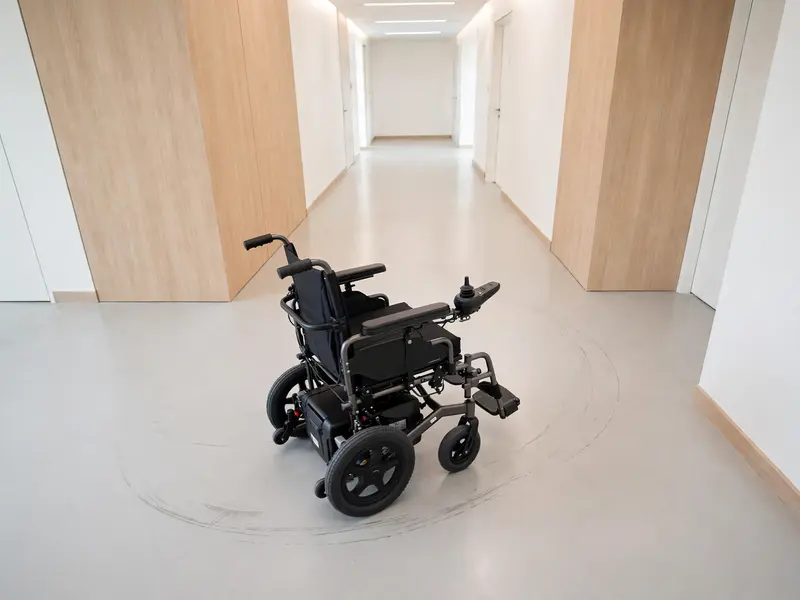
Turning radius is the radius of the smallest circle the wheelchair can turn within — or, as most listings state it, the diameter of that full circle. Picture the chair spinning a complete 360 degrees on the spot: the circle its outermost point draws is the turning circle, and half of that circle’s width is the turning radius. In practice, buyers and retailers use the two terms loosely, so always check whether a listed figure is a radius or a diameter before comparing. The turning radius concept is the same one used for cars, just applied at wheelchair scale.
Why does this single number matter so much? Because indoor life is a series of tight spaces. A smaller turning radius means the chair can reverse direction in a hallway, turn into a bathroom doorway, and navigate around furniture without a three-point shuffle. For elderly users and caregivers, that maneuverability translates directly into independence — fewer situations where the user gets stuck and needs help.
The circle your chair draws
Imagine looking down at the chair from above while it rotates fully. The drive wheels pivot the chair around a center point, and the front casters swing through the widest arc. The diameter of that arc is the number that decides whether the chair fits your hallway. Everything about turning radius follows from this simple picture: shorter chairs draw smaller circles.
Turning radius vs. overall length
Related, but not the same. Overall length tells you whether the chair fits in a car trunk — see our folding wheelchair dimensions guide for the folded numbers. Turning radius tells you whether the chair can maneuver once it is unfolded and in use. A buyer needs both numbers, for two different decisions.
Key Takeaway: Turning radius is the smallest circle the chair can turn within. Smaller means easier indoor maneuvering — and it is a different number from the chair’s length, answering a different buying question.
How Is the Turning Radius of a Folding Electric Wheelchair Measured?
The standard method is disarmingly simple: put the chair on a flat, open floor, rotate it a full 360 degrees, and measure the diameter of the circle drawn by its outermost point. That is the turning circle; halve it for the radius. Retailers and manufacturers who publish a figure almost always mean the full-circle diameter, even when they casually call it the “turning radius” — so when you see a number like 33 inches, read it as the width of the complete turning circle unless the listing says otherwise.
Two details affect the result. First, the measurement is taken with the chair at its normal driving setup — seat in the standard position, footrests in place — because moving parts change the outermost point. Second, the floor must be flat and the turn continuous; a jerky, stop-start rotation produces a ragged circle and an unreliable number. None of this requires special equipment: a tape measure, some masking tape, and an empty garage floor are enough.
The 360-degree turn test
Mark the starting position of the chair’s outermost edge with tape. Drive a slow, continuous full rotation — most testers use the joystick at low speed for consistency. Mark where the outermost point travels; the widest distance across your marks is the turning circle diameter. Repeat it twice; if the two measurements agree within an inch or two, you have a trustworthy number.
Why the number changes with setup
Move the footrests, recline the backrest, or hang a bag on the push handles, and the outermost point moves — so the measured circle changes. This is not a flaw in the method; it is the point. The published figure is a baseline under standard setup, and your real-world number depends on how the chair is actually configured. When comparing two models, compare their standard-setup figures, not one standard figure against one fully-loaded measurement.
Key Takeaway: One slow 360-degree turn on a flat floor, measured across the widest arc, gives you the turning circle. It is a two-minute test anyone can repeat — which is exactly why you should verify any listed figure yourself.
What Is a Typical Turning Radius for Folding Electric Wheelchairs?
Here is what the market actually lists. Searching current retailer product pages, folding electric wheelchairs typically show turning figures between about 17.7 inches and 33 inches (roughly 450–850 mm) of turning-circle diameter. At the tight end, the Robooter E40 is listed at 17.7 inches on its retailer page; at the wide end, the Porto Ranger series is listed at 31–33 inches; a JBH folding model is listed at 850 mm. Treat every one of these as a third-party retailer’s listed figure — useful for orientation, not a laboratory measurement, and not our data.
The honest context: there is no universal test standard behind these numbers, so two retailers can measure slightly differently and both print their result with a straight face. Use the range to calibrate your expectations — most folding models cluster in the low-to-mid 20s of inches — and treat any single figure as approximate until you have measured or confirmed it. If a listing gives no figure at all, that is common too, and the next section explains why.
What third-party listings show
The pattern across listings is consistent: compact folding models with short wheelbases list the tightest figures, while larger folding models with bigger wheels list wider ones. No surprise there — it follows directly from the geometry. What varies is not the physics but the marketing: some retailers list the figure prominently, others bury it, and many do not list it at all.
Why you should treat every number as “listed”, not gospel
Without a standard test, a listed figure is the manufacturer’s or retailer’s claim under their own conditions. It is still useful — it tells you the order of magnitude and lets you compare models within one retailer’s lineup. But the number becomes trustworthy only when you confirm the measurement method or test it yourself with the tape-measure method above. When in doubt, ask the supplier how the figure was measured; a straight answer is itself a quality signal.
Key Takeaway: Third-party listings cluster around 17.7–33 inches of turning-circle diameter, with compact folders at the tight end. Treat listed figures as orientation, verify by measurement, and ask how any figure was obtained.
Example (third-party retail listing)
Listed turning figure
Note
Robooter E40 (caremade.ca listing)
17.7 inches
Compact folder; tight end of the market range
Porto Ranger series (heavydutymobility listing)
31–33 inches
Larger folding models; wide end of the range
JBH folding model (made-in-china listing)
850 mm (≈33 inches)
Listed in metric; consistent with the wide end
Why Do Folding Models Usually Turn Tighter Than Full-Size Chairs?
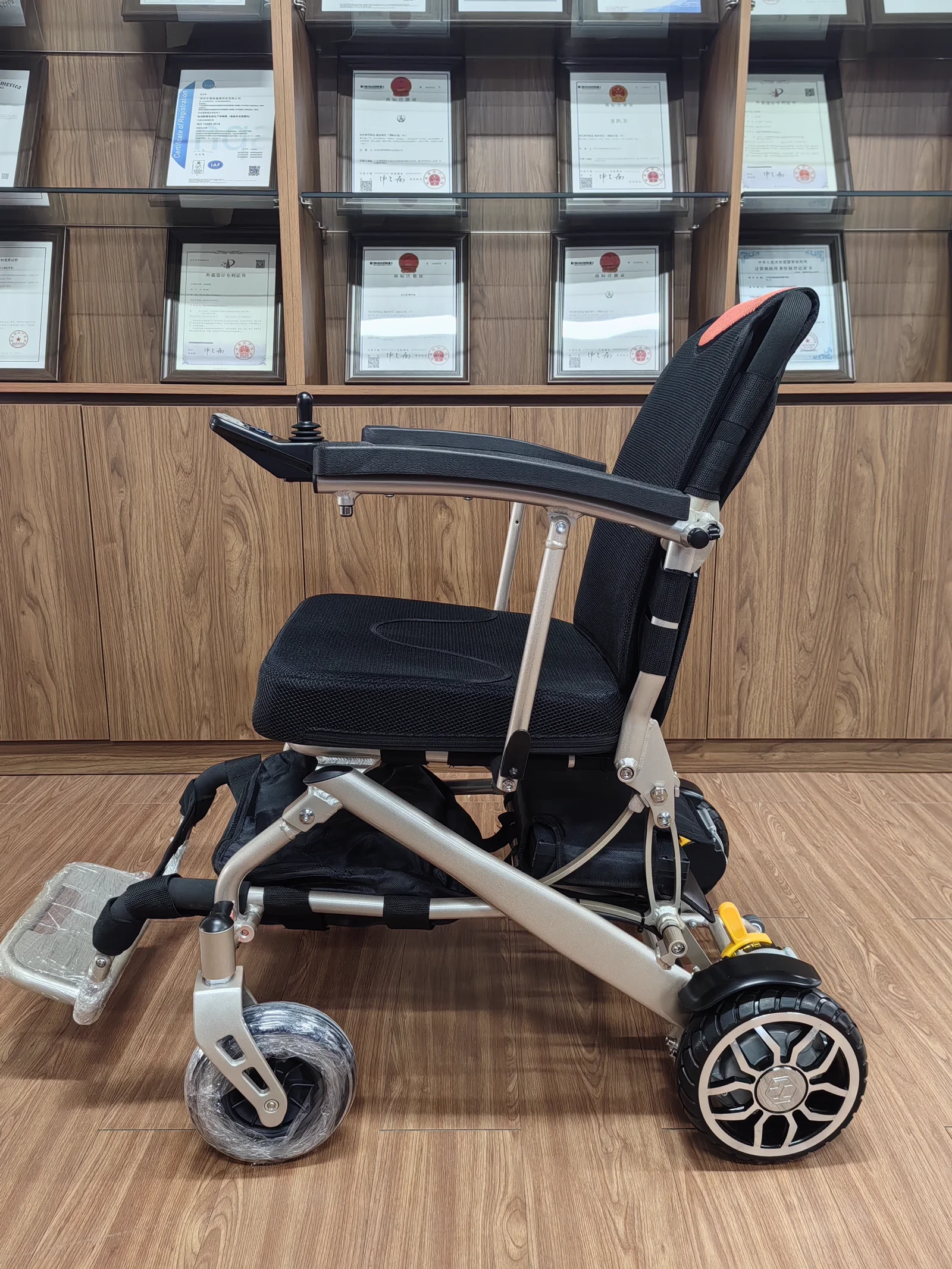
Geometry is the whole answer. Folding electric wheelchairs are built around a short wheelbase — the distance between the front casters and the drive wheels is compact, because the frame must collapse into a small package. A shorter wheelbase means the chair pivots around a tighter center, so the turning circle shrinks. Full-size power chairs, built for outdoor range and stability, carry a longer wheelbase and draw a wider circle. This is why folding models dominate indoor use: the same design choice that makes them portable also makes them nimble.
There is a trade-off, and honest sellers mention it. The short wheelbase that tightens the turning circle also means less fore-aft stability margin than a long-wheelbase chair — which is why folding models are tuned for indoor and paved-surface use rather than rough terrain. Neither design is “better” in the abstract; they are optimized for different lives. If your customer lives mostly indoors and travels, the folding geometry wins. If they need all-day outdoor range, the full-size geometry wins.
Short wheelbase, small footprint
Every centimeter removed from the wheelbase tightens the turning circle. Folding frames achieve this by placing the drive wheels close under the seat and using small front casters that swivel freely. The result is a chair that can often turn within its own length — the practical definition of “indoor-friendly.”
The trade-off nobody mentions
Tight turning comes from compact geometry, and compact geometry means a smaller stability footprint. Reputable manufacturers balance this with low seat height, battery placement low in the frame, and anti-tip design — but the physics does not disappear. This is worth understanding as a distributor: when a customer asks why a folding chair feels “tippier” than their old full-size chair, the answer is geometry, not a defect. Our range guide covers the other half of the equation — what folding models trade for their portability in distance terms.
Key Takeaway: Folding models turn tighter because their short wheelbase pivots in a smaller circle. The same compact geometry that makes them portable makes them nimble — and defines where they are best used.
What Makes One Chair Turn Tighter Than Another?
Four factors decide it, and all four are visible before you buy. First is wheelbase length: shorter pivots tighter, as above. Second is drive-wheel position: chairs with the drive wheels near the chair’s center (mid-wheel drive) rotate almost on the spot, while rear-wheel-drive chairs swing a wider arc. Third is overall length including footrests: the footrests are usually the outermost point, so a chair with long, fixed footrests turns wider than one with short, swing-away footrests. Fourth is caster size and swivel freedom: small casters that spin freely add less to the turning circle than large ones.
Notice what is not on the list: motor power, battery size, and frame material. A carbon-fiber chair and an aluminum chair of identical geometry turn identically — the carbon fiber EW1000 and the aluminum EW100 differ in weight and feel, not in turning physics. When customers ask which “type” turns tighter, steer them to dimensions and drive layout, not materials or branding.
Wheelbase and drive-wheel position
These two dominate. A mid-wheel-drive chair with a short wheelbase is the tightest-turning layout in the industry; a rear-wheel-drive chair with a long wheelbase is the widest. Most folding models are rear-wheel drive for simplicity and cost, which is why their turning figures sit in the middle of the market range rather than at the extreme tight end.
Caster size and overall width
Small front casters keep the turning circle compact and the chair light — part of why folding models stay portable. Overall width matters less for the turning circle itself but matters a lot for doorways: a chair can turn tightly and still not fit through a narrow bathroom door if it is too wide. Turning radius and width are two separate checks, and indoor buyers need both.
Key Takeaway: Wheelbase length and drive-wheel position decide the turning circle; footrest length and caster size fine-tune it. Compare geometry, not materials or brand names.
Factor
Tighter turn when…
Trade-off to know
Wheelbase
Shorter distance, caster to drive wheel
Less fore-aft stability margin
Drive-wheel position
Drive wheels near chair center
Mid-wheel designs cost more to build
Footrest length
Short or swing-away footrests
Less leg support for tall users
Caster size
Small, free-swiveling casters
Rougher ride on uneven ground
How Much Room Do You Need Indoors?
Translate the turning figure into the rooms your customer actually lives in. A standard interior doorway is about 32 inches (810 mm) wide in many markets — a chair with a 33-inch turning circle can pass through it going straight, but cannot turn around inside the doorway. A typical residential hallway is 36–42 inches wide: enough for most folding models to make a U-turn, but tight for the widest ones. Bathrooms are the real test — small, with fixtures on every wall — and this is where a tight turning circle pays for itself daily.
The practical rule: the chair’s turning-circle diameter should be comfortably less than the smallest space where the user must reverse direction. “Comfortably” means with margin — a 30-inch turning circle in a 32-inch hallway works on paper and frustrates in practice, because real hallways have door frames, radiators, and furniture. Advise customers to measure their own tightest spot and compare against the chair’s figure with at least a few inches to spare.
Doorways, hallways, and bathrooms
Doorways are about width, not turning — the chair goes straight through. Hallways and bathrooms are about turning, and they are where the figure matters. Ask the customer which room is tightest, measure it, and do the comparison on paper before anyone test-drives. This two-minute conversation prevents the most common post-purchase complaint in the folding category.
Elevators and tight corners
Elevators add a second dimension: the chair must turn to face the doors. Older residential elevators can be barely deeper than they are wide, and a wide-turning chair may need an awkward multi-point maneuver. The same applies to sharp hallway corners and small kitchens. When a customer mentions elevators, treat the turning figure as a must-check, not a nice-to-have. Keeping the chair’s moving parts in good order matters too — our maintenance guide covers caster and wheel care, and worn casters measurably widen the real-world turning circle.
Key Takeaway: Compare the turning-circle diameter against the customer’s tightest room with margin to spare. Doorways test width; hallways, bathrooms, and elevators test turning — measure the tightest spot first.
Scenario
What to check
Rule of thumb
Interior doorway
Chair width vs. doorway width
Straight pass needs width only, not turning
Hallway U-turn
Turning-circle diameter vs. hallway width
Keep several inches of margin, not exact fit
Bathroom
Full 360° turn among fixtures
Tightest-turning models earn their keep here
Elevator
Turn to face doors on entry/exit
Confirm against the smallest elevator the user rides
How Can You Test the Turning Radius Before You Buy?
Do not take any listed figure on faith — test it, in person, in ten minutes. The showroom test needs only masking tape and a tape measure. Mark the floor where the chair’s outermost point starts, drive one slow full rotation at low speed, and measure the widest distance across the marks. That is the turning circle under real conditions, with the footrests and seating exactly as the customer will use them. Do it twice; consistent results mean a trustworthy number.
Then run the hallway test, which answers the question the number alone cannot: does this chair work in my home? Find a hallway or a taped-off rectangle matching the customer’s tightest space, and ask the user — or the caregiver — to reverse direction inside it. Watch for the moments of hesitation, the extra shuffles, the places where the footrests come close to the wall. A chair can pass the tape-measure test and still feel wrong in a real hallway, and feeling is what the customer buys.
The tape-and-chalk test at the showroom
Bring the customer’s actual configuration to the test: footrests attached, seat at their height, any accessories mounted. A showroom chair in “display setup” can measure tighter than the chair the customer takes home. Honest dealers welcome this test — it takes ten minutes and it ends arguments about whose figure is right.
The hallway U-turn test
Mark out the customer’s hallway width with tape on the showroom floor if you cannot visit their home. Have the user turn around inside the marks at normal speed, not carefully. Normal speed reveals the real maneuvering; careful speed flatters every chair. If the user completes the turn comfortably with room to spare, the chair fits their life.
Key Takeaway: Tape, one full rotation, measure the widest arc — then replicate the customer’s tightest hallway. Ten minutes of testing beats any brochure figure.
Does Turning Radius Matter for Travel and Transport?
It matters more than most travelers expect. Airports, stations, and hotel lobbies are obstacle courses of queues, pillars, and crowds — a tightly-turning chair threads through them while a wide-turning one waits for gaps. Boarding gates and airplane aisles are the extreme case: no wheelchair turns inside an aircraft aisle, but the chair that maneuvers easily through the terminal arrives at the gate with less stress and less delay. For the full travel picture, our travel guide covers batteries, airline approval, and what to check before flying — including the standing rule that our chairs are designed for air travel (airline approval required).
The car is the other half of the story. Getting the chair to the destination means folding it, lifting it into the trunk, and unfolding it at arrival — and the maneuvering space around the car is often tight: a narrow garage, a crowded parking lot. A chair that turns tightly is easier to position at the trunk and easier to drive away from the car at the destination. Our car transport guide walks through the loading process step by step.
Airports, stations, and crowded spaces
In crowds, maneuverability is safety: the chair that can turn sharply can avoid the suitcase, the child, the sudden stop ahead. This is where folding models earn their reputation — their compact geometry is not just about fitting in trunks, it is about moving through the real world without constant three-point turns.
From car trunk to hotel room
Think of the journey as a chain: trunk, parking lot, lobby, elevator, room. The turning figure matters at every link after the trunk. When advising a traveling customer, walk the chain with them mentally and check the tightest link — it is usually the hotel bathroom or the smallest elevator, not the airport.
Key Takeaway: Travel is a chain of tight spaces, and the turning circle matters at every link. Check the smallest space on the customer’s itinerary, not the largest.
Why Don’t All Suppliers List a Turning Radius?
Because there is no single standard test, and without a standard, every published figure is measured a little differently. Some manufacturers measure with footrests removed; others with them attached. Some measure the radius, others the diameter, and a few do not say which. In that environment, a supplier who publishes nothing may simply be refusing to play a game with unclear rules — or may not have measured at all. Neither interpretation helps you as a buyer, which is why the right move is to ask.
Ask for the spec sheet, and ask how the figure was measured: footrests on or off, radius or diameter, under what setup. A supplier with a straight answer — “28 inches diameter, measured with standard footrests, flat floor” — has done the work. A supplier who cannot answer is telling you something too. This applies to us as well: our product pages currently do not list turning radius figures, and we would rather say so than print a number we cannot defend. When you request a quote — for the EW100, the EW1000, or any other model — ask for the full spec sheet including the turning figure and the measurement conditions. It is a reasonable question, and the quality of the answer tells you about the supplier.
No single standard test
The industry has detailed standards for many things — batteries, electromagnetic compatibility, structural strength — but turning-circle measurement has no universal protocol that every manufacturer follows. Until that changes, listed figures will remain approximate and occasionally inconsistent. Treat them as starting points for your own verification, not as engineering data.
What to ask the supplier instead
Three questions cut through the fog: what is the turning figure, was it measured as radius or diameter, and under what setup? Add a fourth for diligence: can you confirm it in writing on the spec sheet or quotation? Written confirmation turns a marketing number into a contractual one, and suppliers who stand behind their figures will not hesitate.
Key Takeaway: No standard test means listed figures vary in method and meaning. Ask every supplier — us included — for the figure, the method, and written confirmation on the spec sheet.
Conclusion
The turning radius of a folding electric wheelchair is a simple idea with daily consequences: it decides whether the chair turns around in a hallway, navigates a bathroom, and threads through a crowded station. The market typically lists turning-circle diameters between about 17.7 and 33 inches, compact folders at the tight end — but listed figures are only orientation until verified. Measure it yourself with one slow 360-degree turn, test it against the customer’s tightest room, and confirm the final number against the supplier’s spec sheet, in writing.
We have been deliberately honest in this guide about what we do and do not publish: our product pages do not currently list turning radius figures, and we will not invent them for an article. What we will do is answer the question directly when you ask — with the figure, the measurement method, and the setup — on the spec sheet that accompanies your quotation. That is how this number should be handled across the industry: measured, stated plainly, and confirmed in writing.
FAQ
What is a good turning radius for indoor use?
For typical homes, a turning-circle diameter in the low-to-mid 20s of inches handles hallways, bathrooms, and elevators comfortably. The real test is your own tightest space: measure it, subtract a few inches of margin, and compare. A figure that looks fine on paper can still frustrate in a hallway with furniture, so test in conditions close to real life.
Is a smaller turning radius always better?
Not always. Extremely tight-turning layouts can feel twitchy at higher outdoor speeds, and the compact geometry behind them trades some stability margin. For primarily indoor users, tighter is better. For users who spend long hours outdoors at speed, a slightly wider, more planted feel may be preferable. Match the geometry to the user’s life, not to the smallest number on a spec sheet.
How do I measure turning radius at home?
Clear a flat area, mark the chair’s outermost starting point with tape, drive one slow full rotation, and measure the widest distance across the marks — that is the turning-circle diameter. Halve it for the radius. Keep the chair in its normal setup, footrests and all, and repeat once to confirm. The whole test takes about ten minutes.
Does the turning radius change when the chair is folded?
The published turning figure always refers to the unfolded, in-use chair — a folded chair is not driven, so it has no turning radius in the meaningful sense. What matters when folded is the folded footprint for storage and transport, which is a different measurement entirely. Do not compare one model’s folded dimensions against another model’s turning figure; they answer different questions.
Where can I find the official turning radius of a model?
On the supplier’s spec sheet or quotation, confirmed in writing — that is the only figure that counts. Retailer listings are useful for orientation but are not contractual. If a supplier cannot provide the figure or explain how it was measured, treat that as information about the supplier. And always confirm whether the number is a radius or a diameter before comparing two models.
About Our Company
Since 2015, our company has focused on electric wheelchairs, building practical mobility solutions for distributors and medical stores worldwide.
Our specialized focus has led to collaborations with industry leaders and experts to develop products that truly understand and meet the needs of our discerning clients.