Electric Wheelchairs for Places of Worship Buyers Guide
November 25, 2026
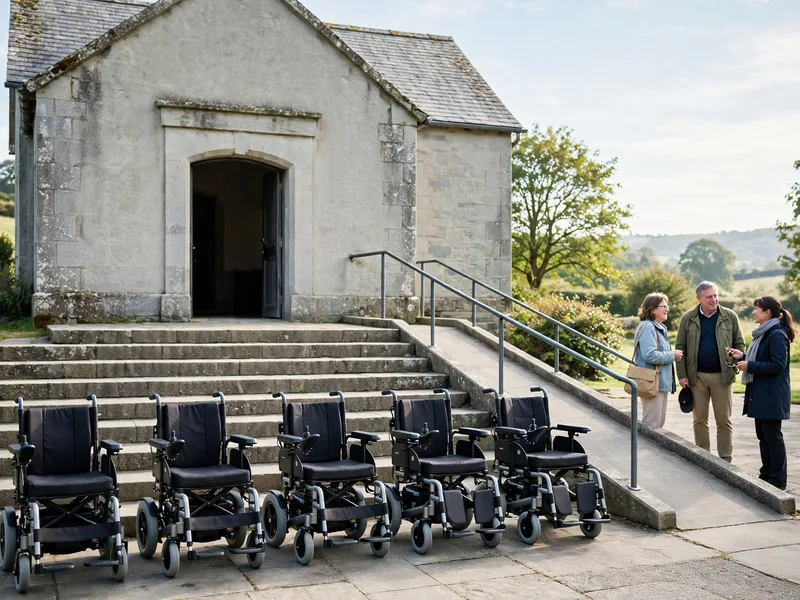
The doors open an hour before the gathering, and the car park fills within minutes. Among them is usually someone who can only walk a short distance, and needs a chair to reach a seat, sit through the gathering, and get back to the car. Whether they manage it often comes down to the small fleet the venue keeps by the door.
Electric Wheelchairs for Places of Worship Buyers Guide: this guide is for the person who looks after a church, mosque, temple, or similar building. It shows how to put together a shared fleet, covering the entrance ramp, the aisles, quiet running, handovers at the door, and storage and charging between services.
What does a place of worship fleet actually have to do?
A gathering runs to a timetable. Everyone arrives in the same short window, sits in one place for a set time, and leaves together when it ends. The chairs have to match that rhythm. They go out in a rush, stand silent through the gathering, and come back in a rush.
Silence is the point here. During the gathering, the whole hall can hear a humming motor, a clicking wheel, or a loose panel. Before you order, run each model in a silent hall and listen from the back row. A sports hall can absorb a humming motor. A worship hall cannot. Our guide to electric wheelchairs for leisure centers shows the other end of the scale.
Borrowers are not one type of driver. Some are tall, some are slight, some have strong hands, and some have very little grip. Many have never driven a powered chair at all. Pick chairs with simple controls, a seat and armrests that adjust without tools, and a gentle response when a first-time driver pushes too far.
A chair can stand untouched for days, then work hard for two or three hours on a service day. Batteries lose charge slowly while the chair waits, and motors cool right down between gatherings. Judge a chair on that stop-start pattern, not on steady daily use.
Key Takeaway: The fleet serves short, busy, silent gatherings. Choose soft-running motors, controls a stranger can learn at the door, and chairs that begin each service day fully charged.
What should you check at the entrance before you order?
Start at the gate, not at the door, and walk the route a visitor takes from the car park to a seat. Note the path surface, the slope, and any step or lip at the threshold. Old buildings often hide a single steep step that blocks the whole route, and a chair that fits the hall but cannot climb the entrance step strands its driver outside.
Check the ramp: its slope, its width, and its surface when wet. A ramp that works in dry weather can turn slick after rain. Run a demo chair up and down it, turning at the top and bottom. Measure the narrowest doorway on the route, and work from that number, not from the widest door.
Then look at the porch and the lobby, where chairs wait before the gathering and pile up after it, and leave room for chairs to queue without blocking the door.
Key Takeaway: Walk the route from the car park to a seat before you order. Ramp, slope, and lobby space shape the fleet, not the catalog.
How do chairs move through the worship hall?
The hall is one big room, and the aisles are its roads. Walk each aisle in a chair before you order. Note the width, the turn at the end of each row, and the parking space beside a seat. A chair that fits the aisle but cannot turn at the end of the row will need help every time, and a member who parks in the aisle blocks the people behind them.
Stone, tile, and wood carry sound further than carpet, and hard floors show every mark a tire leaves.
Keep the speed low inside the hall, and show each driver where the speed control sits.
Key Takeaway: Walk every aisle in a chair before you order. Aisle width, parking space, floor surface, and low speed keep the hall quiet and safe.
Which chairs fit a place of worship: folding or fixed?
A worship fleet has to vanish between gatherings. Folding chairs suit that pattern best, packing away into a side room until the next service day. The mix depends on the building: a wide lobby can hold bigger models, while a tight store room points toward the lightest folders.
Volunteers carry folded chairs up the entrance steps, so weight matters. The EW1000 is the lightest option: 15 kg with its battery fitted, folding to 73×39×71 cm. The EW100 is heavier at 23 kg, but its fold is slimmer at 73×55.5×31 cm, so it slides flat behind a door. Both are designed for air travel (airline approval required), which shows how portable they are.
Bigger models suit members who want a steadier ride over a long gathering. The EW8722 is the small-wheel choice for the hall: 45 kg, folds to 80×39×74 cm, and a full battery covers 18–22 km. The EW8703G runs on big wheels for the ground outside: 46 kg, folds to 89×43×76 cm, and a full battery gives it the same 18–22 km. The EW8720 is the high-end model: it weighs 45 kg, folds to 80×34×74 cm, covers 18–22 km on one charge, and suits members who sit through long gatherings.
Range is rarely the limit on a service day. A member covers only a short distance: from the car park to a seat, and back again. On one charge, the EW1000 covers around 15±3 km. The EW100 covers around 12±5 km. The bigger models each cover 18–22 km. What matters is the charge a chair holds when the doors open, not the number on the label. Our guide to how much a folding electric wheelchair weighs puts the lifting question in plain words for volunteers.
Model
Weight, with battery
Folded size
Range
How this model helps on a service day
EW1000
15 kg
73×39×71 cm
15±3 km
Lightest carry up the entrance steps
EW100
23 kg
73×55.5×31 cm
12±5 km
Slim fold that slides flat behind a door
EW8722
45 kg
80×39×74 cm
18–22 km
Steady on stone and tile hall floors
EW8703G
46 kg
89×43×76 cm
18–22 km
Big wheels for the car park and the path
EW8720
45 kg
80×34×74 cm
18–22 km
High-end model for a long gathering
Key Takeaway: Let the building set the mix: light folders suit a tight store room and a stepped entrance, while bigger models suit the car park and members who sit through long gatherings. A full charge before the doors open matters more than range.
How does a member borrow a chair for a gathering?
Booking stays simple. Members ask at the welcome desk when they arrive, or they phone the day before to have a chair held for them. Keep a plain notebook on the welcome table. Each line records who took which numbered chair, when it went out, and when it came back. Skip booking software: after a month of gatherings, the notebook tells you how many chairs the venue truly needs.
Show every first-time driver how the chair works. Walk them through the joystick, the speed dial, and the brake. Then let them try a short loop near the entrance while a volunteer watches.
When the gathering ends, look the chair over with the member still standing beside it, checking the wheels, the seat, and the joystick. Note any mark that was there before they took it out. Write down anything new on the spot. The same notebook habit works in schools. Our guide to electric wheelchairs for schools walks through a sign-out sheet that keeps track of who has which chair.
Key Takeaway: Use a notebook on the welcome table, run a two-minute practice loop at the door, and look over the chair with the member before they leave. That is the whole routine, and it prevents most trouble.
Where do chairs live between gatherings?
Gatherings come and go, and the chairs spend most of their life in storage. Pick a dry side room or store room close to the main entrance. It needs wall sockets for charging and enough floor space to fold the chairs flat. Start by counting sockets, then count chairs: every chair needs a socket of its own while it waits between service days. Six chairs sharing two sockets means four of them start the next gathering uncharged.
Line folded chairs against one wall, with the spare at the front where anyone can reach it, and label each chair and its charger with the same number.
Wipe each chair down before the next gathering, and check the charge light as you do it. Retirement villages run shared fleets on the same pattern. Our guide to electric wheelchairs for retirement villages shows how a written routine keeps the fleet going. The same routine works as volunteers change.
Key Takeaway: Keep the fleet in a dry store room near the entrance, giving each chair a socket of its own and a numbered spot for its charger. Wipe the chairs down and check the charge before each gathering.
How do chairs charge between service days, and who checks them?
While the building stands empty between service days, every chair stays plugged in where it is stored, one chair to one socket. The volunteer who brings a chair back plugs it in on the spot, and the check before the next gathering looks at the charge light before that chair goes out again. That is the whole charging routine, and one named volunteer owns it for the week.
The check before the gathering is short, and it pays for itself every time. Roll each chair across the store-room floor, push the joystick forward and then back, and listen for rattles. A chair that fails stays where it is, and the spare goes out in its place. Do the check early, not five minutes before the doors open.
Always keep one spare chair charged and waiting by the door. It covers a chair that fails the check, or a member who arrives without booking.
Key Takeaway: Give each chair a socket of its own, charge while the building stands empty between service days, and let a named volunteer run a short check before the doors open. Hold one spare ready, and add chairs only when the notebook shows the need.
What should a place of worship ask the factory before ordering?
Describe your building first — the entrance ramp, the aisles between the seats, and the roughest stretch of car park outside — then ask which model the factory would place on that route. A factory that has supplied places of worship will talk about ramps, hard floors, and quiet motors. One that has not will talk only about the catalog.
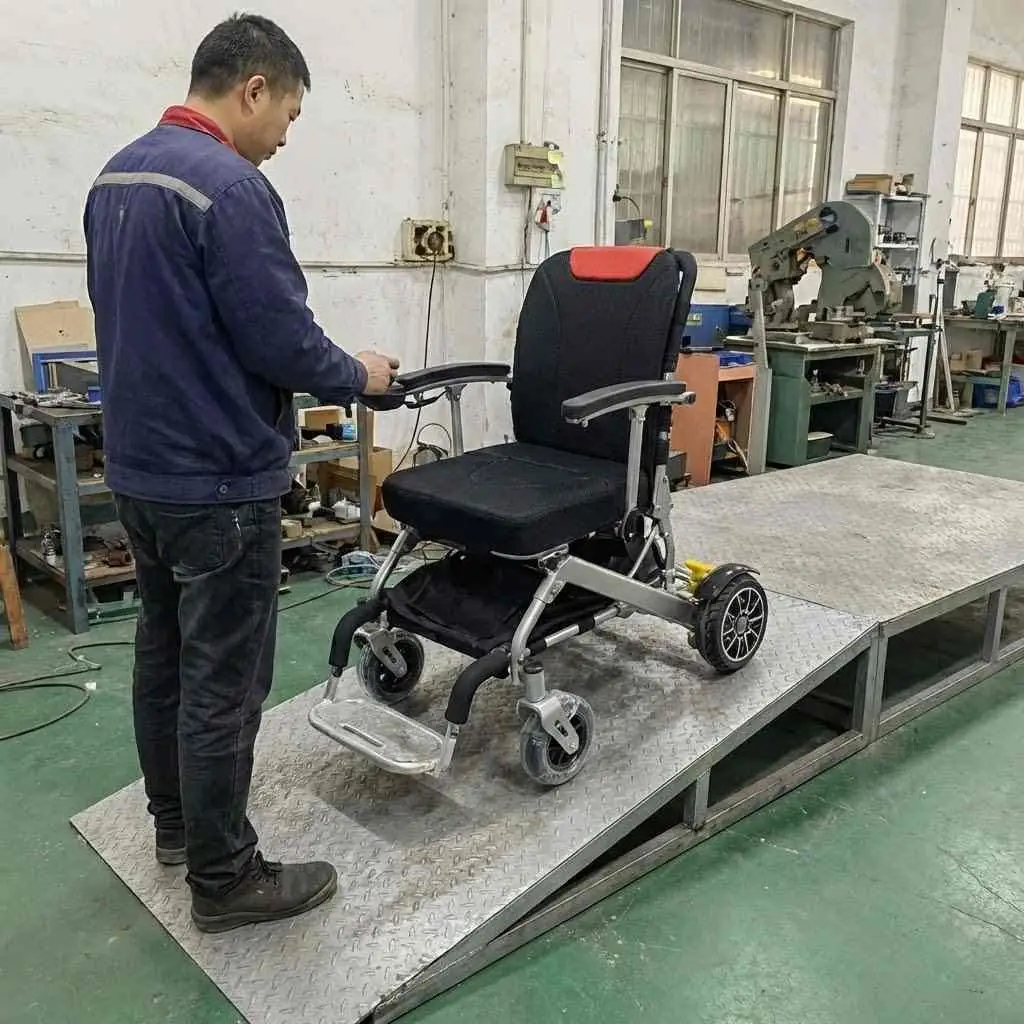
Ask what checks run before a chair leaves the factory floor. The answer you want is a full visual check of every chair, not a sample batch. Next, ask what the factory does if a chair turns up faulty. A maker running two facilities and serving 50+ partners around the world owes you a straight answer to that before you place an order.
Then turn to the chairs themselves. Could you borrow a demo chair for a week and let your own volunteers try it in your hall? Seven days with a demo chair in your own building costs little, and it settles the choice better than any brochure.
Key Takeaway: Put the building first, then the checks before shipping, then a demo week in your own hall. Straight answers to all three mark a factory worth ordering from.
How do you handle a chair that comes back damaged?
Damage is part of sharing chairs. Members catch a wheel on a step, clip a door frame, or scrape an armrest on a seat leg, so plan for it rather than hoping it never happens. The look-over at the welcome desk catches most damage while the member is still there. For the rest, keep a small shelf of spares: a spare joystick and a spare set of tires. With those spares on the shelf, a chair is back in service in a day. Without them, the same repair can take a month.
Read the warranty while the chairs are still new, not after the first one breaks. The frame carries 36 months of cover, the motor and the controller 12 months each, and the battery 6 months if lead-acid or 12 months if lithium. A scrape a member makes is not a warranty claim. A motor that fails in normal use is. Get the warranty in writing from your supplier before you order.
Key Takeaway: Plan for damage, keep a few spares on the shelf, and know the warranty by heart. The wipe-down between gatherings doubles as the inspection.
Electric Wheelchairs for Places of Worship Buyers Guide — The Short Answer
It comes down to three things: the building, the gathering, and the routine. Fit the chairs to the venue: folding chairs suit the hall and the store room, while bigger models suit the car park and long gatherings. Keep the sign-out simple, show each driver the controls, and check each chair before the doors open.
Electric Wheelchairs for Places of Worship Buyers Guide comes back to a single point: the fleet is a service for members, not a display of products. ZVCARE is the brand of Shenzhen Zhiwei Health Technology Co., Ltd., a maker founded in 2015 and certified to ISO 13485:2016. It builds the folding and bigger models a venue fleet needs, with spare parts behind them. Orders start at 1 unit, with a 7-day lead time after payment. The warranty runs 36 months on the frame. The motor and controller carry 12 months each. Lead-acid batteries carry 6 months, and lithium batteries 12 months. Before you place an order, talk to us about the fleet your venue needs.
Frequently Asked Questions
Can members use the chairs on the car park and garden path?
Yes, with the right model. Outside, the ground is rougher than the hall floor, so wheel size matters. The EW8703G, with its bigger wheels, copes with the car park surface and the garden path where a small-wheel chair would struggle.
How small do the folding chairs pack down?
The two folding models pack down small: the EW1000 folds to 73×39×71 cm, and the EW100 to 73×55.5×31 cm. Either one tucks into a narrow store room.
What happens if a member damages a chair?
Note the damage in the notebook while the member is still at the desk, and keep a spare joystick and spare tires on the shelf. With those in hand, a damaged chair is back in service in a day instead of a month. Damage a member causes is not a warranty claim.
How far does one charge take a member?
Far enough for a full service day at the venue. A full battery carries the EW1000 about 15±3 km and the EW100 about 12±5 km, while the EW8722, EW8703G, and EW8720 each cover 18–22 km.
What is the best way to start a first fleet?
Start small. Begin with a few chairs for one season. Let the ticks in the notebook show you the demand. The MOQ is 1 unit. Add more one at a time, since the lead time is only 7 days after payment.
Founded in 2015, ZVCARE is an ISO 13485:2016 certified electric wheelchair manufacturer in China, providing OEM & ODM solutions for global distributors and medical stores.