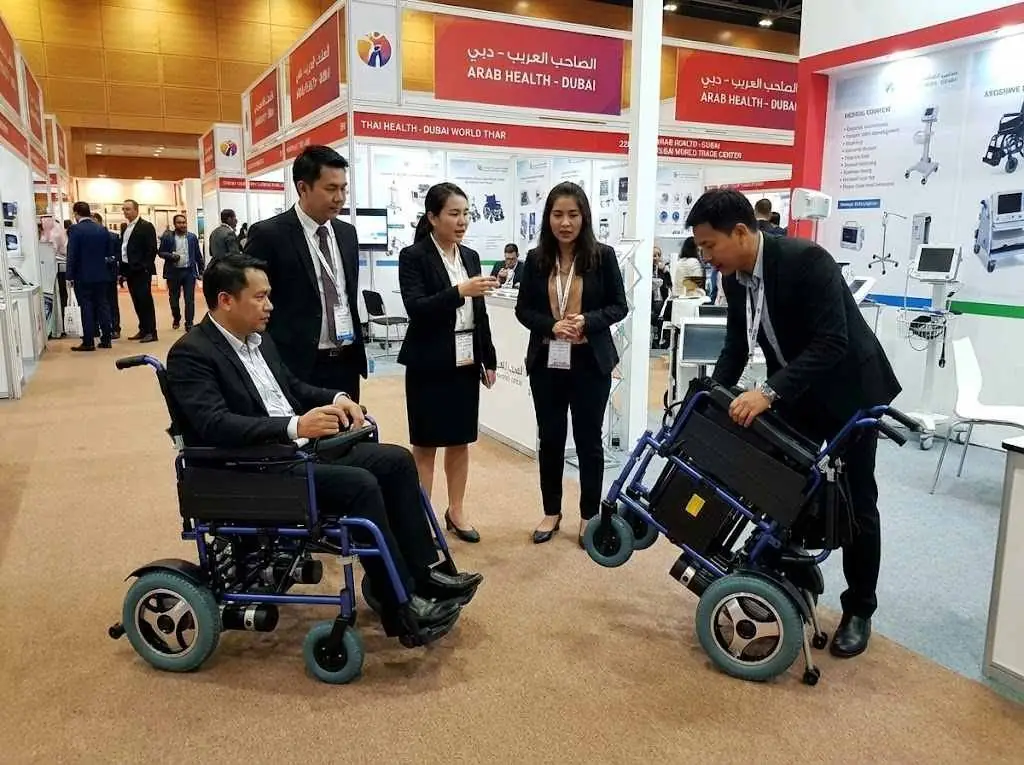
How to Exhibit Electric Wheelchairs at a Trade Show
October 30, 2026
A trade show stand is not a smaller showroom, and it is not a shop window. It is a few days of face-to-face work in a noisy hall, where a distributor, a retailer, or a hospital buyer decides in minutes whether your company is worth a longer conversation. This guide to how to exhibit electric wheelchairs at a trade show is written for the exhibitor side of that exchange: the manufacturer or supplier who brings the chairs, staffs the stand, and has to turn brief stand visits into real business after the show.
What should you decide before you book a stand?
Start with one sentence the whole team can repeat: who are we trying to meet, and what should they do next? A stand built for distributors needs a meeting table, supply information, and chairs that show range and build quality. A stand built mainly for end users and carers needs more test-drive space and simpler explanations; this guide focuses on the distributor-facing stand, where supply and follow-up questions decide the outcome. A stand that tries to serve everyone at once usually serves no one well, because the layout, the staffing, and the handouts all pull in different directions.
Decide the next step before you design anything else. For most exhibitors, the honest next step is not an order on the stand. It is a sample request, a factory visit, a video call, or a quotation for a defined quantity. When that step is clear, the stand has a job: let the visitor try the right chair, answer the questions that block that next step, and record enough detail for a useful follow-up. Everything else, from banners to giveaways, is secondary.
It also helps to be clear about which side of the show you are on. Visiting a large sourcing show to compare suppliers is a buying job, with its own preparation, and this guide to sourcing electric wheelchairs at the Canton Fair covers that side. Exhibiting is the opposite job: you are the one being compared, often against the stand next door, and visitors will judge your chairs, your staff, and your follow-through together.
Set the team before the stand design is finished. A good trade show team is small and practised: one person to greet and qualify visitors, one or two people to run test drives and answer product questions, and one person to handle conversations that turn serious, including pricing, supply, and next steps. Everyone should be able to fold and unfold the demo chairs, adjust the seat and footrest, check the battery, and explain the warranty in plain words. If only one person on the team can do those things, the stand stalls every time that person is busy. If you only have two people, combine the greeting and test-drive roles, and keep the serious conversations for the quieter moments.
How many demo chairs should you bring, and which ones?
Bring fewer chairs than you think, and make every one of them work hard. A crowded stand where visitors cannot move, sit down, or turn a chair is worse than a smaller stand with clear space. A useful way to choose is by the job each chair must do: one chair that shows light weight and easy folding, one that shows durable daily use, and one that shows comfort and finish for longer days. If a fourth chair only repeats one of those jobs, leave it at home and use the floor space for test driving instead.
The table below is a fuller example for a larger stand, not a rule; a small first stand can start with one chair per job plus one backup, four in total. Adjust the mix to the visitors you expect, and treat every figure as an example for planning, since the right number depends on stand size and team size.
Demo role
Example number
What the chair must prove on the stand
Lightweight folding
e.g. 2 chairs
Folds quickly, lifts easily, fits a car boot
Durable daily use
e.g. 2 chairs
Steady driving, comfortable seat, simple controls
Premium comfort
e.g. 1 chair
Finish, seating comfort, and smooth driving
Spare or backup
e.g. 1 chair
Ready to swap in when a demo chair needs charging or attention
Choose models visitors can compare by feel, not just by reading a card. A lightweight folding chair such as the EW1000, at 15 kg including battery and folding to 73 by 39 by 71 cm, gives visitors something concrete to lift and fold. The EW100, an aluminium model at 23 kg with a folded size of 73 by 55.5 by 31 cm, offers a different balance of weight and folded size. Let visitors fold both, lift the folded chair with staff help, and sit in both. The comparison lands better when the visitor has done it with their own hands.
For visitors weighing a folding chair against a non-folding one, keep the explanation practical. Folding chairs prioritise transport and storage, while non-folding chairs often prioritise ride comfort and stability, and this comparison of folding versus non-folding electric wheelchairs frames that choice around daily life. On a small stand, do not mix the two types in one row and hope visitors work out the difference. Label each chair by its job, and let staff point visitors to the chair that matches how they will actually use it.
Prepare every demo chair the way you would prepare a chair for a customer, not a display piece. Check the tyres, brakes, folding mechanism, joystick, seat, footrest, and battery before the show, and again each morning. A demo chair that will not fold smoothly, or that runs flat halfway through a test drive, tells a visitor more about your quality control than any brochure. This guide to maintaining a folding electric wheelchair covers the routine checks that keep a folding chair working smoothly, and the same checks belong on the pre-show list.
Pack spares and tools as carefully as you pack chairs. Bring chargers matched to each chair, a tyre pump, basic tools, cleaning cloths, and a small stock of common consumables and fast-moving parts. For deciding what to hold and what to order on demand, this electric wheelchair spare parts stocking guide is a practical starting point. Label chargers clearly, since ZVCARE chargers come in 2A and 5A versions and in lead-acid and lithium versions, and a charger picked up in a hurry at a busy show is easy to mix up. Keep lead-acid and lithium chargers on separate, marked shelves or in separate bags.
How should you lay out the stand so visitors can actually test-drive?
A trade show stand has three zones, and the test-drive lane is the one visitors remember. The first zone is the front edge, where a visitor decides in seconds whether to stop. Keep it open, with one or two chairs visible and a staff member who greets people rather than blocking the entrance with a table. The second zone is the display area, where chairs are grouped by job. The third zone is the meeting corner at the back, with a table, chairs, and space to talk without shouting over the aisle.
The test-drive lane should run through the stand, not around it. Visitors need room to drive forward, turn around, reverse, and stop again without hitting a display or a neighbouring stand. The simple test is this: can a first-time driver turn around without hitting anything, and can a companion walk alongside? If the answer is no, the lane is too tight, however good the stand looks in a photograph. Keep the lane free all day. Cartons, bags, and spare chairs creep into walkways at every show, and a lane that fills up during the day is a sign that storage needs attention.
The layout should reflect the stand’s short, first-meeting job. A showroom is built for repeat visits and after-sales service; this guide to setting up an electric wheelchair showroom covers that longer-term job. A trade show stand, by contrast, is built for first meetings in a few days. It needs less storage, less decoration, and more open floor, because its job is to start conversations that continue after the show, not to close every detail on the spot.
How do you capture leads without slowing the stand down?
Lead capture fails when it becomes a queue. A visitor who has just enjoyed a test drive should not have to wait while staff hunt for a form, and a visitor who only wants a brochure should not be forced through a long questionnaire. The fix is a short, standard capture that any team member can run in under a minute: name, company or organisation, country or city, what they are looking for, which chair they tried, and the next step they agreed to. Everything else can be added after the show, when the conversation is written up properly.
Use one capture method for the whole team, whether that is a paper form, a tablet, or the show organiser’s badge scanner. Mixed methods produce mixed records, and mixed records produce missed follow-ups. If you use a scanner, still note the next step and the chair the visitor tried, because a scanned badge alone does not say whether the visitor wants a sample, a quotation, or a factory visit. Agree the note format before the show opens, and keep it short enough that staff actually use it during a busy afternoon.
How do you run a test drive that visitors remember?
A good test drive is short, calm, and led by the visitor. Staff should check the battery, adjust the seat and footrest with the visitor, and explain the joystick slowly before the chair moves. Then step back and let the visitor drive. Talk about what the visitor is feeling, the steering, the speed control, the seat comfort, rather than reciting a list of features. If a visitor struggles with the joystick, slow down and adjust the settings together rather than taking over. A visitor who has driven the chair, folded it, and asked their own questions leaves with a decision they own.
End each test drive with a plain summary, not a sales push. Name the chair the visitor tried, say what it is best for, say what it is not best for, and ask what the visitor would like next. If the honest answer is a different chair, say so and point them to it. Visitors remember that honesty, and distributors remember it even more, because they will have to answer the same questions from their own customers later. Record the chair tried and the next step on the lead record before the next visitor starts.
How do you turn a stand conversation into a next step?
The most valuable sentence at a trade show is a specific next step with a date. “We will send you a quotation” is vague. “We will send you a quotation for the two folding models you tried, by the Thursday after the show, and include the carton sizes and gross weights” is a next step a visitor can check. Agree that step before the visitor leaves the stand, write it on the lead record, and give the visitor a card or a short note with the same wording. When both sides leave with the same words, follow-up is much harder to lose.
Answer supply questions in the terms a distributor actually needs. A minimum order of 1 unit and a lead time of 7 days after payment are straightforward facts, and they matter at a show because they let a visitor test a sample without a large commitment. State the warranty in the same plain way: the frame is covered for 36 months, and the battery is covered for 6 months for lead-acid or 12 months for lithium, and the motor and controller are each covered for 12 months. Do not add promises the factory has not made, and do not dress up a standard term as something special. A buyer who checks the details later will trust the stand more for having heard them plainly at the show.
What should you do after the show ends?
Follow-up is where most trade show work is won or lost, and it starts the evening the show ends, not a week later. Sort the lead records and check each one against the next step agreed on the stand, then send the first message while the visitor still remembers the stand. That first message should repeat the agreed next step, name the chair, and offer only what was promised. A long general brochure sent to everyone, with no reference to the actual conversation, is easy to ignore.
Work the sorted groups in order. Contact the visitors with a concrete next step first, with the quotation, sample arrangement, or meeting they agreed to. Then contact the interested but undefined group with a short, specific question that helps define the next step, such as which chair they would like to try as a sample. The general enquiry group gets a brief thank-you and general information, and no false urgency. Chasing every lead with the same hard message wastes the goodwill the stand built.
What should a good trade show stand leave behind?
A good trade show stand does not need the most chairs, the largest space, or the loudest display. It needs a clear purpose, a small fleet of well-prepared demo chairs, a lane visitors can actually drive, a lead record that captures the next step, and a follow-up that keeps the promises made on the stand. Do those five things well, and the show becomes the start of real distributor and customer relationships, not just a few busy days in a hall. That, in short, is how to exhibit electric wheelchairs at a trade show: plan it as carefully as any other part of selling.
For exhibitors starting from the factory side, the same discipline applies after the show as before it. Shenzhen Zhiwei Health Technology Co., Ltd., based in Longgang District, Shenzhen, operates two production facilities totalling more than 3,000 square metres, and trade show enquiries can be directed to alice@zvcare.com. A visitor who tried a chair, received a clear next step, and then heard back promptly will judge the company on that whole experience. Plan the stand so that experience is easy to deliver, and the show will repay the effort long after the hall empties.
Key Takeaway: A trade show stand earns its keep when visitors can drive a well-prepared chair in open space, leave with one agreed next step, and hear back promptly after the show.
What do exhibitors ask most about trade shows?
How many demo chairs should a small exhibitor bring to a first trade show?
Bring a small fleet that covers the main jobs visitors will ask about, rather than trying to show everything. One lightweight folding chair, one durable daily-use chair, and one comfort-focused chair, plus a backup, give visitors real choices without crowding the stand. Test every chair before the show, and keep a backup ready so a flat battery or a small fault does not close the test-drive lane.
Should a trade show stand focus on test drives or on meetings?
It should do both, in separate space. Test drives belong in an open lane where visitors can drive, turn, and fold a chair without blocking the aisle. Meetings belong at a table at the back, where a serious conversation can happen without shouting. When the two are mixed, test drives interrupt meetings and meetings block the lane, and both suffer.
What information should staff record for each trade show lead?
Record the visitor’s name and organisation, where they are based, what they are looking for, which chair they tried, and the next step they agreed to, with a date where possible. That short record is enough for a useful follow-up. A badge scan alone does not record the chair tried or the next step, so add those notes at the time, while the conversation is fresh.
How quickly should an exhibitor follow up after a trade show ends?
Start the evening the show ends by sorting the lead records and checking that every record has a next step. Send the first message while the visitor still remembers the stand, repeating the agreed step and naming the chair tried. Work the visitors with a concrete next step first, then the interested group, and keep a tracker until every promise is closed or honestly renegotiated.
Founded in 2015, ZVCARE is an ISO 13485:2016 certified electric wheelchair manufacturer in China, providing OEM & ODM solutions for global distributors and medical stores.