Selling Electric Wheelchairs in Japan is a distributor’s job, not a shipping job: the chair has to reach the right buyer, in the right language, with service waiting when it is needed. This guide covers the three parts that decide whether a Japan launch works — the channels that actually reach buyers, the localisation a Japanese buyer expects, and the after-sales setup that keeps the business going after the first order.
Selling Electric Wheelchairs in Japan: Which Channels Actually Reach Buyers?
Japan is not one market with one route to the buyer. Start by separating the channels into three groups, and judge each one by how much buyer contact it gives you, not by how easy it is to open.
The first group is specialist mobility dealers and care-equipment shops. These buyers already talk to end users every day, they can demonstrate a chair in person, and they can answer the practical questions — folded size, weight, charging routine — that decide a sale. The trade-off is that dealers expect demonstration stock and a clear margin structure.
The second group is online sales: your own product pages and established online marketplaces. Online reaches buyers who already know what they want and are comparing models, but it puts the whole burden of trust on your listing — real photos, honest weights, and a clear statement of what happens if something goes wrong. Our guide to selling online sets out the honest-listing rules that apply here: selling electric wheelchairs online.
The third group is institutional buyers: care homes, rehabilitation centres, and facilities that buy chairs for shared use. These orders are fewer but larger, and they come with longer decision cycles, formal quotations, and expectations about service coverage.
Channel
What it gives you
What it demands from you
Best first step
Specialist dealers and care-equipment shops
In-person demonstrations and trusted advice
Demonstration stock, margins, and service backup
Visit, e.g., two or three shops and watch how they sell
Online listings and your own site
Wide reach and comparison buyers
Real photos, honest weights, and clear returns and warranty terms
List one or two models done properly, not the whole range at once
Care homes and facilities
Larger orders per decision
Formal quotations and a service plan in writing
Offer a trial chair and a written service commitment
No channel replaces the others. A sensible Japan start is one or two dealer partners for demonstrations, one well-built online listing, and a trial offer for facilities — then expand the channel that brings repeat orders.
Who Buys Electric Wheelchairs in Japan, and What Do They Ask First?
The buyer is rarely just the person who sits in the chair. In Japan, as in other markets, the decision often involves family members, care staff, or a facility manager, and each of them asks a different question. The user asks whether the chair is comfortable and easy to drive. The family member asks whether it folds small enough to store, whether it is light enough to lift into a car, and what happens when the battery needs replacing. The facility manager asks about service, spare parts, and what a breakdown costs in downtime.
Space is the question that comes up first and most often. Homes, lifts, car boots, and storage rooms in Japan are often compact, so folded size and weight are not minor details — they are the sale. This is where confirmed figures matter and guesses hurt. The EW100, for example, folds to 73×55.5×31cm and weighs 23kg — confirm with the factory whether that weight includes the battery, then state both figures in the listing. The EW1000 weighs 15kg including its battery, which is a genuine selling point for a buyer who lifts the chair every day. State net weight with and without the battery wherever the two differ, and never round a weight down to make it sound better.
The second question is always about the battery: how it charges, how it comes out of the chair, and what a replacement costs. Answer it before the buyer asks, in plain language, on the listing and in the manual. The third question is about service: who fixes the chair, how fast, and what it costs.
Key Takeaway: Sell to the whole decision group — user, family, and facility manager — and answer folded size, weight, battery, and service before they have to ask.
How Should You Localise Your Range for Japanese Buyers?
Localisation is not a translation job pasted onto a chair built for another market. It is a short list of decisions about language, documentation, and range, made before the first shipment, and each one should be confirmed with a local partner rather than assumed.
Start with language. Every document the buyer touches should be in Japanese: the user manual, the charging instructions, the warranty card, and the safety warnings. A manual in English, or a machine translation nobody has read through, tells the buyer the product was not really made for them. Ask a local partner or a professional translator to review the manual, and check that model names, warning symbols, and contact details are consistent across every document.
Next, confirm the practical details of the Japanese market with your local partner and your forwarder, in writing, before you order. These include the charger and plug requirements your customers expect, the labelling and documentation that must travel with the shipment, and any local rules that apply to the model you plan to sell. Do not guess at these, and do not copy an answer from another country’s guide. Our Europe guide shows the same discipline applied to a different market, where local confirmation came before shipment rather than after: selling electric wheelchairs in Europe. The UK guide is worth reading for the same reason — it separates what is confirmed from what still needs checking: selling electric wheelchairs in the United Kingdom.
Then choose the range, not the catalogue. A Japan launch does not need every model you carry. It needs a small range that covers the real buying reasons: one genuinely lightweight folding model for buyers who lift and store the chair daily, one comfortable everyday model for longer daily use, and, only if your dealer partners ask for it, a further model for buyers whose needs the first two do not cover. Keep the launch range small enough that you can stock spare parts for every model in it — a model you cannot service is a model you should not sell yet.
Key Takeaway: Localise in Japanese, confirm charger, labelling, and local requirements with a local partner before ordering, and launch with a small range you can fully support.
What Should You Confirm Before Your First Shipment to Japan?
The first shipment is where most Japan launches lose money, and the losses are almost always avoidable. They come from details that were never confirmed in writing: a document missing, a carton labelled the wrong way, or a charger assumption that nobody checked.
First, confirm the order in writing with your factory: exact models, colours, logo placement, and packaging, plus the documents that will travel with the goods. Order the first spare-parts batch with the first chair shipment, so service does not wait for a second freight booking.
Second, work through the import side with your forwarder and your local partner before the goods leave the factory. Ask them to confirm, in writing, which documents the shipment needs, how the goods should be labelled, and what happens at each step from port to warehouse. Our import guide walks through this kind of preparation for a first order from China, and the discipline is the same even though the destination differs: how to import electric wheelchairs from China. For the transport leg itself, compare sea, air, and courier on cost, time, and risk for your actual order size, as our shipping guide explains: how electric wheelchairs are shipped from China. Freight is charged on gross and carton weight, not on net chair weight, so get those figures from the factory before you book transport.
Third, inspect on arrival. Count cartons against the packing list, check labels against the order, and test at least one chair of each model before any stock goes on sale. A problem found in your warehouse is a supplier conversation; a problem found by a customer is a reputation problem.
Key Takeaway: Confirm the order, the import documents, and the freight figures in writing before shipment, and inspect and test on arrival before anything goes on sale.
How Do You Price and Present a Wheelchair for the Japanese Market?
Japanese buyers compare carefully, and a price that cannot be explained will lose to a price that can. Build the price from the ground up — factory price, freight on gross weight, import costs your forwarder confirms, dealer margin, and your service reserve — and keep a written record of each element. When a dealer or a facility asks why your chair costs what it does, that record is your answer. Do not cut the service reserve to win a first order: it pays for the warranty visit six months later.
Presentation matters as much as price. Use real photos of the actual chair, not catalogue renders and not another model’s photos. Show the chair folded and unfolded, show it going into a car boot or through a doorway, and show the battery coming out. State the folded dimensions, the weight with and without the battery, and the warranty terms on the same page as the price, so the buyer never has to hunt for the catch. If a model is described as designed for air travel (airline approval required), say exactly that — the airline’s own approval is still required, and a buyer who learns that at the airport will not buy from you again.
For the heavy-duty end of a range, be precise about batteries. A heavy-duty model that offers both lead-acid and lithium batteries should say so plainly, with the trade-offs explained in plain terms, rather than implying one battery type covers every buyer.
Key Takeaway: Price from a written cost breakdown that includes a service reserve, present with real photos and full dimensions and weights, and never promise what the airline or the warranty has not promised.
How Should You Set Up After-Sales Service in Japan?
After-sales service is the part of a Japan launch that decides whether the second order ever comes. Set service up before the first sale, not after the first complaint.
Start with spare parts. Stock the parts that fail or wear first — batteries, chargers, controllers, tyres, and armrest and footrest components — for every model in your launch range, and set a reorder point for each one so a part never runs out unnoticed. Our spare-parts stocking guide gives a practical structure for deciding what to hold and how much: electric wheelchair spare parts stocking guide. Order parts by model and by part name, and keep the factory’s part list on file so a dealer can order without guessing.
Next, set up a local repair route. This can be your own workshop, a dealer partner’s workshop, or an independent repair partner — what matters is that the buyer knows who to call, how long a repair takes, e.g., a stated turnaround you can actually meet, and what it costs outside warranty. Put that in writing on the warranty card and on your website. Be exact about warranty terms: the frame is covered for 36 months and the battery for 6 months for lead-acid or 12 months for lithium, and the motor and controller for 12 months each, and the buyer should see those terms before purchase, not after a claim.
Then build the service network the way our after-sales guide describes — one trained contact per area, a shared record of every repair, and a regular review of which faults repeat: how distributors build an after-sales service network. A repeated fault is information: it tells you which part to stock deeper and which dealer needs more training. Dealers who get fast parts and straight answers will keep selling your chairs; dealers who wait weeks for a battery will quietly switch supplier.
Key Takeaway: Stock wear parts before the first sale, give buyers one written repair route with real turnaround times, and treat every repeat fault as stocking and training information.
What Should Your First 90 Days in Japan Look Like?
A 90-day plan keeps a Japan launch honest. Without one, the first months drift into reacting — answering whoever shouts loudest — and the range, the pricing, and the service setup never get the review they need.
In the first 30 days, sell through your launch partners only, and visit them. Watch demonstrations, listen to the questions buyers ask, and note which questions your materials do not answer. Fix the listing pages and manual notes from what you hear, not from what you assumed before launch.
In days 31 to 60, review the numbers you actually have: which model sold, which channel brought the sale, which spare part was requested, and how long each repair took. If one model is selling and another is not, ask why before ordering more — the answer is usually in the demonstration, the price presentation, or the folded size, not in the chair itself.
In days 61 to 90, decide what expands and what stops. Expand the channel that brought repeat orders and the model that dealers can demonstrate confidently. Stop, or at least pause, anything that sells only with heavy discounting or that you cannot service properly.
Key Takeaway: Spend the first 90 days listening to dealer demonstrations and buyer questions, reviewing real sales and repair data, then expanding only what you can service properly.
Selling Electric Wheelchairs in Japan rewards the distributor who does the unglamorous work first: Japanese manuals, confirmed import paperwork, a small range with full spare-parts cover, and a repair route a buyer can actually use.
If you are planning your Japan range, start by listing the models and the service setup you need, then raise that list with your factory contact — not just the price list. Our factory works to a 1pc MOQ with a 7-day lead time after payment, and OEM customization covering colours, logo placement, and packaging, so you can test the market with a small first order and build from what your dealers and buyers actually tell you.
FAQ
Do I need a local partner to sell electric wheelchairs in Japan?
In practice, yes — or at least a local contact who can confirm the details you cannot confirm from abroad. A local partner reviews your Japanese manuals, confirms labelling and documentation requirements with your forwarder, and gives buyers a service contact in their own language and time zone.
Which model should I launch with in Japan?
Launch with a genuinely lightweight folding model first, because folded size and lifting weight are the questions Japanese buyers ask earliest. The EW1000 at 15kg including its battery and the EW100 at 23kg, folding to 73×55.5×31cm, are the kind of confirmed figures you can build a listing around — with the battery position stated for each figure.
How do I handle import documents for a first shipment to Japan?
Ask your forwarder and your local partner to confirm, in writing, which documents the shipment needs and how the goods should be labelled, before the goods leave the factory. Do not rely on another country’s import checklist: confirm the Japan shipment’s own requirements, and inspect the delivery against your order file on arrival.
What spare parts should I stock first for the Japanese market?
Stock batteries, chargers, controllers, tyres, and armrest and footrest components for every model in your launch range, and set a reorder point for each part. These are the parts buyers and dealers ask for first, and having them on the shelf turns a service problem into a quick fix.
How long should I allow before judging whether Japan is working?
Give it at least the first 90 days, judged on real evidence: sales by model and channel, spare-parts requests, and repair turnaround times — not on enquiry counts alone. If dealers can demonstrate the chairs confidently, buyers can get repairs quickly, and one channel is bringing repeat orders, the market is working and worth expanding.
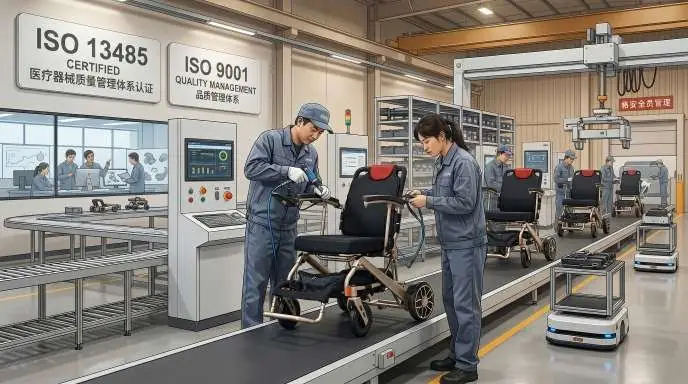
Founded in 2015, ZVCARE is an ISO 13485:2016 certified electric wheelchair manufacturer in China, providing OEM & ODM solutions for global distributors and medical stores.